Quick answer: If you are weighing “SYS yarn” for a stretch fabric programme, your decision comes down to three questions: what is the yarn actually made of, what does it cost per metre of accepted fabric (not per kilo), and does it meet the compliance and sustainability requirements of the markets you sell into? This guide covers all three from a buyer’s and commercial manager’s point of view. It also compares the main alternatives, including spandex-free bicomponent yarn such as Mestre® by Madhusudan Group, so you can decide with a full picture.
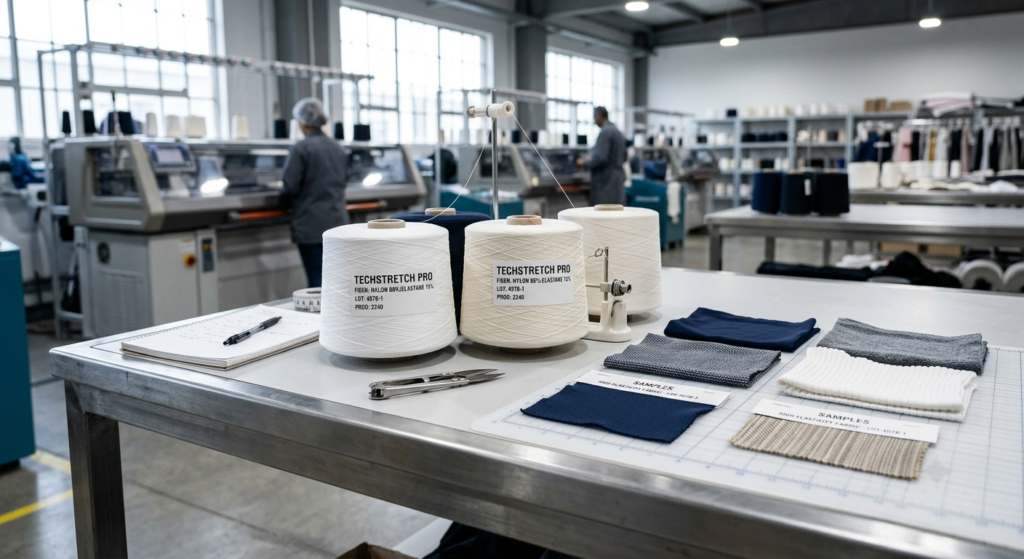
As in our other buyer guides, we do not assert specifications for third-party brands. Anything you rely on should come from the supplier’s own data sheet, and from your own trials.
1. Understanding the “SYS yarn” search
Three-letter product names are common in the yarn trade: they are convenient on order forms, on cone labels and in conversation, and they often stand for something the supplier defines. That convenience is also a source of confusion. A three-letter label may denote a product family, a denier and filament combination, a process route, or a company brand, and the same letters can mean something different from one supplier to the next.
So if “SYS yarn” has appeared on a quotation, a customer specification or a competitor’s fabric, the first step is to pin down its meaning precisely. Ask the supplier for the full product name, the polymer system, the yarn count and filament number, and the recommended end uses. Insist on a technical data sheet. Until you have those, any price comparison is meaningless.
Once identified, you can decide where the yarn belongs among the alternatives below and whether it deserves a place on your shortlist.
2. The commercial logic of stretch yarn
Stretch has moved from a premium feature to a baseline expectation. Denim, chinos, workwear, school uniforms, sportswear, and even formal shirting now routinely include stretch. This has three consequences for buyers.
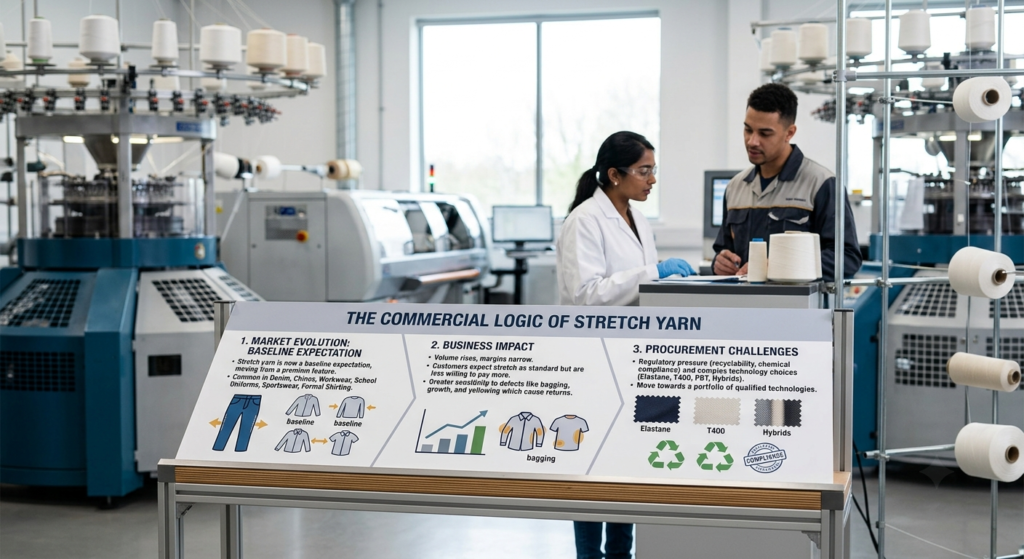
Volume rises, margins narrow. As stretch becomes commonplace, customers become less willing to pay a premium for it, but they are more sensitive to defects. Bagging, growth and yellowing produce returns and reputational damage.
Regulatory and brand pressures grow. Retailers now ask for recyclability, chemical compliance and traceability. Elastane-blended constructions face more scrutiny on recyclability than single-polymer constructions.
Technology choices multiply. Where the choice was once “polyester or cotton with a bit of spandex”, buyers now select among elastane, bicomponent polyester, textured stretch and hybrids. This is why good procurement teams maintain a small portfolio of qualified stretch technologies rather than a single default.
For a plain-language introduction to the landscape, see Stretch yarn: an overview and Stretch yarn types, properties and applications for Indian hosiery.
3. Total cost of ownership: beyond price per kilo
Price per kilo is the most visible number and the least useful. A better metric is cost per metre of first-quality finished fabric. Build your comparison from these components.
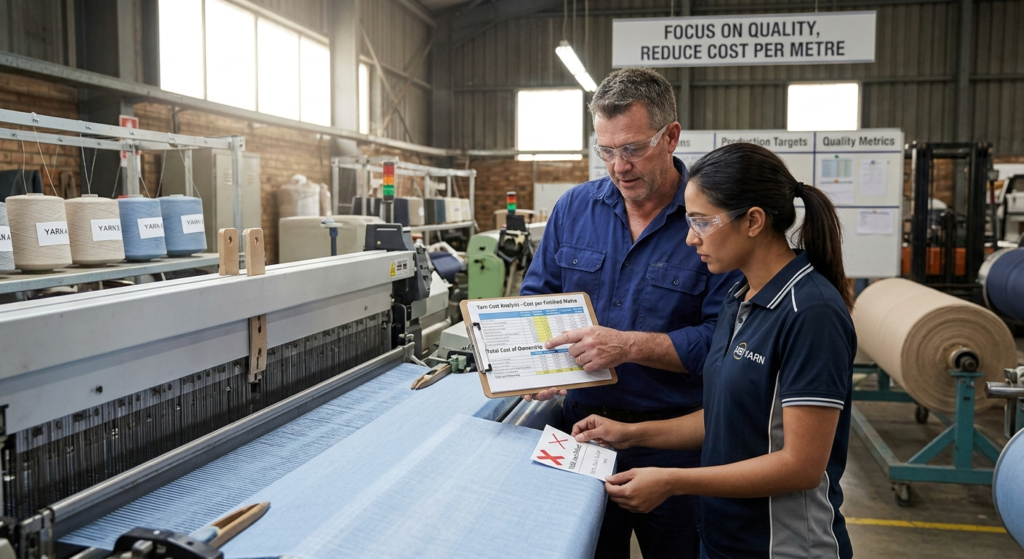
Direct yarn cost. Price per kilo multiplied by the kilos needed per metre of fabric. Because yarns differ in density and in the amount needed to reach a given stretch, kilos per metre may differ across suppliers.
Conversion cost. Warping, sizing, weaving or knitting, dyeing, finishing. If a yarn needs slower machine speeds, more tension adjustments or additional finishing steps, conversion costs rise.
Yield loss. Seconds, rejects and rework. This is where a low-priced yarn most often turns expensive. Track defects per hundred metres, and note their causes.
Downtime. Loom or knitting machine stops caused by yarn breaks or package problems.
Inventory and lead time. A domestic supplier with short lead times lets you hold less stock. A long import pipeline may require higher safety stock, more working capital and greater exposure to currency swings.
Claims and returns. The hidden cost. If growth or recovery problems appear after the garment is worn and washed, the cost lands on your brand.
Compliance cost. Testing, certification and documentation for export markets.
A quick illustration, using invented round numbers purely for method: suppose Yarn A costs 5% less per kilo than Yarn B, but produces 2% more seconds and causes 3% more downtime. In many mills that combination wipes out the price advantage and leaves Yarn A more expensive per accepted metre. The numbers will differ in your case; the method will not.
To apply the method, run a controlled trial (see our sampling protocol in the Hey yarn buyer’s guide and the testing guide in the Bey yarn evaluation article), capture all cost categories, and compute cost per accepted metre for each candidate yarn.
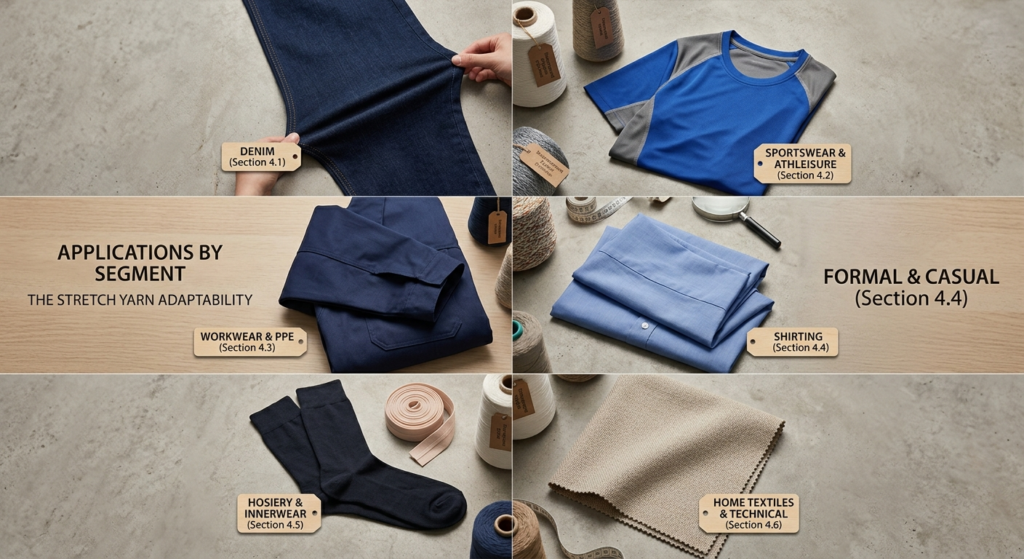
4. Applications by segment
Different segments prize different properties. The same yarn will not necessarily be right for all of them.
4.1 Denim
Stretch denim is the highest-volume application. Requirements: durable recovery through industrial washing and garment finishing, good abrasion behaviour, controlled shrinkage, and consistent shade. Spandex-free bicomponent yarn has been gaining ground because of its heat stability. Read Stretch yarn for denim: bicomponent in India and Bicomponent yarn and elastomultiester in North American stretch denim.
4.2 Sportswear and athleisure
Buyers want moisture management, colourfastness, softness, and shape retention. Polyester bicomponent yarns combine stretch with polyester’s natural wicking. See Bicomponent yarn for sportswear performance.
4.3 Workwear, uniforms and PPE
Durability and shape retention rule. Stretch is provided for comfort and mobility, not for fashion. Chemical and heat resistance may matter. See Mechanical stretch yarn for workwear and PPE.
4.4 Formal and casual trousers, shirting
Comfort stretch with a crisp hand. Moderate stretch (often a lower percentage) is enough, and the priority is a natural drape and good crease behaviour.
4.5 Hosiery, socks and innerwear
Elastane-covered yarns are firmly established. Textured and bicomponent yarns offer alternatives in specific constructions. See the hosiery guide linked above.
4.6 Home textiles and technical uses
Stretch covers, upholstery and technical fabrics benefit from stable stretch. For non-apparel uses of bicomponent fibre, including bonding in nonwovens, see Bicomponent yarn in nonwoven fabrics and the technical textiles yarn selection guide.
5. Constructions: core-spun, covered, plied, bicomponent, textured
When a supplier offers you a stretch yarn, identify which construction it is. Each has a distinct cost and performance profile.
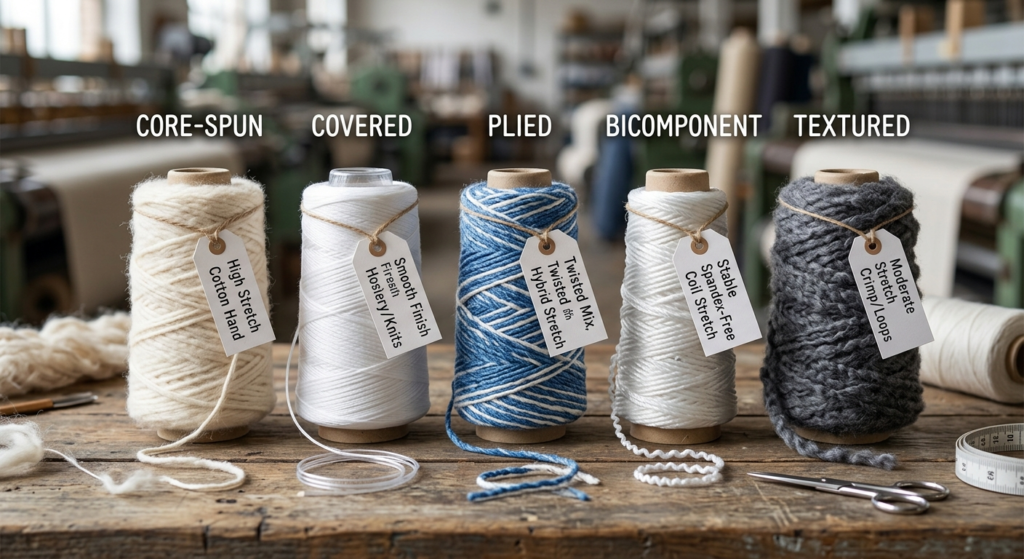
Core-spun yarn. A spandex filament is wrapped in staple fibre (cotton, polyester or blends). It is the workhorse of stretch denim and casual wovens. It offers cotton-like hand and high stretch, but the spandex core carries the sensitivities noted earlier.
Covered and air-covered yarn. Spandex is wrapped in one or two filament yarns, typical in hosiery and knits.
Plied yarn. Two or more yarns are twisted together; sometimes one is a bicomponent yarn and the other a conventional yarn to blend appearance and stretch.
Bicomponent (elastomultiester) yarn. A spandex-free filament that develops a coil after relaxation. It is generally more stable to heat and chlorine and can be more recycling-friendly in all-polyester fabrics. For fundamentals, read What is bicomponent yarn? and Elastomultiester: everything you need to know.
Textured (mechanical stretch) yarn. Stretch from crimp or loops. Economical, moderate stretch. See Mechanical stretch: everything.
Where SYS yarn fits among these constructions determines nearly everything about its cost, its process behaviour and its end uses.
6. Transitioning from elastane to spandex-free stretch
Many mills are exploring bicomponent yarn alongside or instead of elastane. If you are considering that switch, treat it as a project.
Phase 1: Define why. Are you responding to a customer request for recyclability, seeking better heat or chlorine resistance, chasing more stable recovery, or reducing supply risk? The objective shapes the trial.
Phase 2: Choose two or three target articles. Start with articles where the switch is most likely to succeed, such as mid-stretch denim, workwear or sportswear, rather than your most demanding high-stretch fabric.
Phase 3: Redesign the construction. Bicomponent yarn does not behave like elastane. Ends and picks per inch, yarn count and finishing may need to change to get equivalent stretch and hand. Expect to iterate.
Phase 4: Adjust processing. Warping tension, heat-setting temperature and dwell time, relaxation route and dyeing profile may all need adaptation. Work with the supplier’s technical team.
Phase 5: Validate performance. Test stretch, growth and recovery through multiple washes, plus dimensional stability, colour fastness and abrasion.
Phase 6: Scale in stages. Move from sample to pilot to production in controlled steps, and keep the old route as a fallback until the new one is proven.
Remember that stretch levels differ. Bicomponent yarns typically deliver moderate stretch with strong recovery. Where extremely high stretch is essential, elastane, or a hybrid of the two, may remain the right answer. For a side-by-side view, see Elastane vs polyester fabric: comparison guide and Mechanical stretch yarn vs chemical stretch yarn.
7. Sourcing in India and the export view
India is a major global textile producer, with a deep base in spinning, weaving, knitting, dyeing and garmenting. For a buyer, sourcing yarn domestically has several practical advantages: shorter lead times, rupee pricing, simpler logistics, and direct technical support.
Domestic supply. A local supplier can visit your mill, adjust recommendations quickly, and respond to problems in days instead of weeks. See Stretch yarn manufacturer in India.
Export compliance. If your fabric or garments are exported, your yarn choice must be compatible with the destination market’s rules.
- United States. The Federal Trade Commission enforces textile fibre labelling. Bicomponent elastic polyester is recognised under the generic name elasterell-p, and labels must show fibre percentages by weight.
- European Union. Textile fibre names and labelling are governed by Regulation (EU) No 1007/2011, and chemical requirements fall under REACH.
- Other markets. Rules differ; check with your buyer.
Region-specific perspectives are available in our market articles for Europe, Asia, South America and the South America bicomponent market outlook for 2026.
Regulatory watch (India). Keep an eye on updates from the Ministry of Textiles and on any BIS quality control orders that apply to polyester materials. These change, so confirm the current status before contracting.
8. Sustainability and recyclability
Sustainability requirements are no longer optional for many brands. Four issues come up in almost every audit.
Material composition and recyclability. Blends of polyester and elastane are difficult to recycle because the fibres are intimately mixed. Fabrics that use a single polymer family, such as polyester with a bicomponent polyester stretch yarn, may be simpler to recycle, though actual recyclability depends on the whole garment, including trims, dyes and finishes. See Elastomultiester: sustainable textile revolution.
Recycled content. If a yarn is marketed as recycled, ask for evidence from a recognised scheme; Textile Exchange publishes widely used standards.
Chemical safety. OEKO-TEX certification is a common request. Ask which standard and class the certificate covers, and whether it covers the exact article you are buying.
Microfibre shedding. All synthetic textiles can shed fibres. Treat sweeping claims sceptically and read a balanced analysis, such as Is elastomultiester safe? Breathability and microplastics.
Where sustainability claims become part of your marketing, keep documentary evidence for each one.
9. Why Mestre®?
| Criterion | Mestre® by Madhusudan Group |
| Product family | Bicomponent polyester, elastomultiester with mechanical stretch |
| Spandex-free? | Yes |
| Typical construction | Filament yarn with coil crimp |
| Best-fit segments | Denim, sportswear, workwear, technical and hosiery-type uses |
| Manufacturing base | Surat, Gujarat, India |
| Group integration | Yarn, dyeing, weaving, knitting, processing and garmenting under one group |
| Price basis | Domestic, rupee-priced; confirm current quotation |
| Technical support | Direct and local |
| Export documentation | Available for EU and US labelling and compliance queries |
| Cost per accepted metre | Determine by trial |
Two additional reference points help calibrate your comparison. First, the global branded alternatives most buyers recognise are Lycra® T400/T800 and DuPont Sorona®. See Mestre vs Lycra T800 and T400 and Mestre vs Sorona for structured comparisons, and DuPont textile: where nylon, Lycra and Sorona live today for corporate context. Second, the ways brands and searches get confused are documented in Mestre vs mystery and Mistre or Mestre: how to find the right brand, a useful reminder to verify the exact manufacturer and product name.
10. Procurement checklist
Use this before placing a bulk order for SYS yarn, Mestre® or any other stretch yarn.
Identification – Exact product name, code and legal manufacturer – Polymer system and construction – Denier, filament count, twist or entanglement
Technical evidence – Data sheet with test methods – Test certificates for at least three consecutive lots – Recommended warping tension and heat-setting window – Your own yarn and fabric test results
Commercial – Price basis, currency, payment terms – Minimum order quantity and lead time – Cost per accepted metre computed from a trial – Claims and returns policy
Compliance – Fibre labelling name for target markets – OEKO-TEX or equivalent certificate – REACH statement for Europe – Recycled-content evidence, if claimed
Relationship – Named technical contact – Mill visit or virtual audit completed – Secondary supplier qualified for continuity
11. Frequently asked questions
What is SYS yarn? Because three-letter yarn names differ by supplier, the meaning depends on who is selling it. Ask for the full product name, polymer system, count and data sheet before you compare it with anything else.
Is SYS yarn spandex-free? You cannot tell from the name alone. Ask the supplier whether the yarn contains elastane or is a spandex-free bicomponent or textured construction, and get the answer in writing.
How do I compare the price of two stretch yarns fairly? Compare cost per metre of first-quality finished fabric, including conversion cost, yield loss, downtime and compliance, rather than price per kilo.
Is spandex-free stretch cheaper than elastane? It depends on the fabric and the construction. Some spandex-free constructions can be competitive on total cost, especially when yield, durability and compliance benefits are included; others cost more. A trial is the only reliable answer.
Which stretch yarn is best for denim? Both core-spun elastane yarns and bicomponent yarns are used in denim. The best choice depends on required stretch, finishing severity, recyclability targets and customer specification.
What should the fibre content label say for bicomponent polyester? In the United States, the generic name elasterell-p is used for this class of fibre; in the EU, follow Regulation 1007/2011. Always confirm with your compliance team or buyer for the specific market.
How long does it take to qualify a new stretch yarn? Depending on the fabric and testing route, from a few weeks for a simple trial to several months for a full customer approval. Plan for multiple iterations.
Where can I request samples of a spandex-free stretch yarn from India? You can start with Mestre® by Madhusudan Group; see Mestre yarn by Madhusudan Group and the bicomponent yarn complete guide.
12. Conclusion
SYS yarn should be judged the way every stretch yarn should be judged: by its documented identity, its total cost per accepted metre, its fit with your target applications and its compliance with your customers’ requirements. A three-letter name is only a label; the data behind it is what matters.
For buyers who want to add a spandex-free option to their portfolio, a structured trial of a bicomponent yarn alongside your current material is the fastest way to find out whether it can lower your total cost, improve durability or unlock new sustainability claims. Explore Mestre® bicomponent yarn, collect your own numbers, and let the results guide the decision.
Disclaimer: This article is general commercial and technical guidance, not legal or compliance advice. Regulations and standards change; confirm current requirements with the relevant authority. Third-party product specifications must be confirmed with the manufacturer. All trademarks belong to their respective owners.