

Europe is one of the most demanding textile markets in the world, and for good reason. The European Union’s regulatory framework covers fibre labelling (Regulation 1007/2011), chemical safety (REACH), and sustainability (the EU Textile Strategy under the European Green Deal), while extended producer responsibility schemes for apparel waste are being rolled out across member states. At the same time, Europe hosts some of the world’s most sophisticated garment production Italy’s luxury fabric mills, Portugal’s mid-market knitwear sector, Turkey’s vast denim and casualwear capacity, and Romania’s CMT export manufacturing base alongside the headquarters of major global fashion retailers. For yarn and fabric technology to succeed in Europe, it must perform to specification, comply with regulation, and prove its circular credentials.
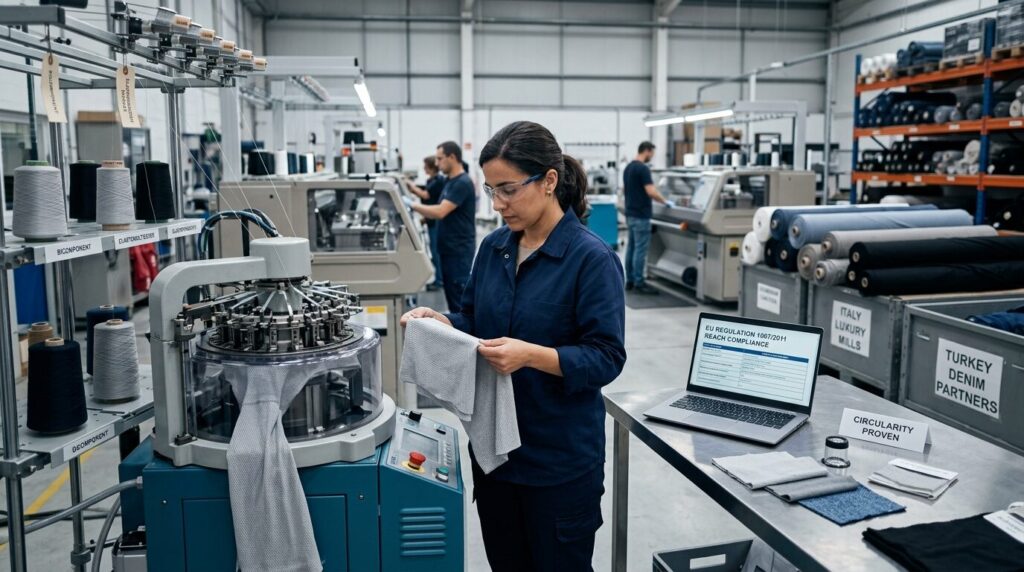
Bicomponent yarn, elastomultiester, and mechanical stretch technology are precisely positioned to meet all three requirements. Each innovation has a specific role in the European textile context, and understanding how they interact with EU regulatory frameworks, sustainability commitments, and the continent’s manufacturing geography is essential for any brand or manufacturer targeting European buyers.
Bicomponent Yarn in European Textile and Technical Manufacturing
Bicomponent yarn is not new to European technical textiles. Germany’s automotive sector has used sheath-core bicomponent fibres in seat upholstery, headliners, and filtration media for decades, and Italy’s high-performance fabric innovators have worked with conjugate fibre structures in luxury applications since the 1990s. EU Regulation 1007/2011 on textile fibre names the regulatory backbone of how European garments label fibre content officially recognises both elastomultiester and bicomponent polyester constructions, giving manufacturers a clear legal pathway for garments that use these fibres and removing one of the main adoption barriers for European fashion buyers.
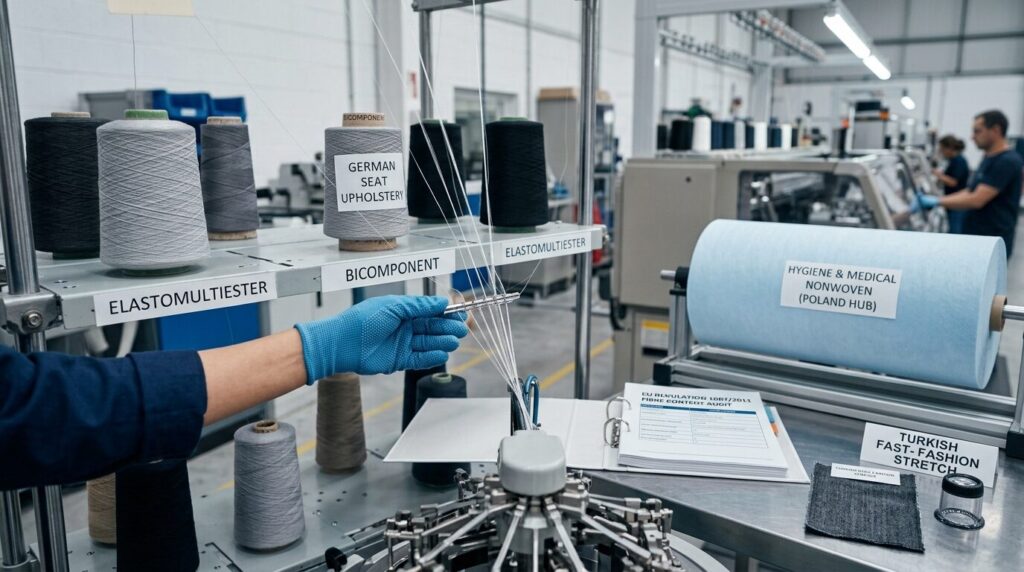
Bicomponent fibre is also central to the hygiene and medical nonwoven sector across Europe, from Germany and the Netherlands to Poland and the Czech Republic. The combination of a bondable low-melt sheath with a high-strength polyester core is the standard construction for thermally bonded nonwoven fabrics in diapers, medical drapes, and wipes manufactured across European nonwoven hubs. As European hygiene brands expand production into Central and Eastern Europe and seek sourcing efficiencies, access to technically consistent bicomponent yarn is a procurement priority.
For Turkey which supplies the largest share of apparel to European fast-fashion groups bicomponent yarn offers a route to self-crimping stretch fabrics that can be produced without the covering processes required for traditional elastane. Turkish manufacturers serving European buyers face increasingly detailed fibre content audit requirements; bicomponent polyester yarns, with their precisely defined two-polymer composition, simplify compliance documentation significantly.
Elastomultiester and the EU Circular Economy Agenda
Of all the continents on this page, Europe has the strongest institutional case for elastomultiester. The fibre is officially named under EU textile labelling law (Regulation 1007/2011), REACH-compliant versions are commercially available, and the EU’s Textile Strategy which calls for textile products to be durable, repairable, and recyclable by 2030 directly favours all-polyester bicomponent constructions over polyester-elastane blends. This is not a marginal advantage: the EU is one of the few regulatory jurisdictions in the world where the circular economy credentials of a fibre type can directly affect a product’s market access.
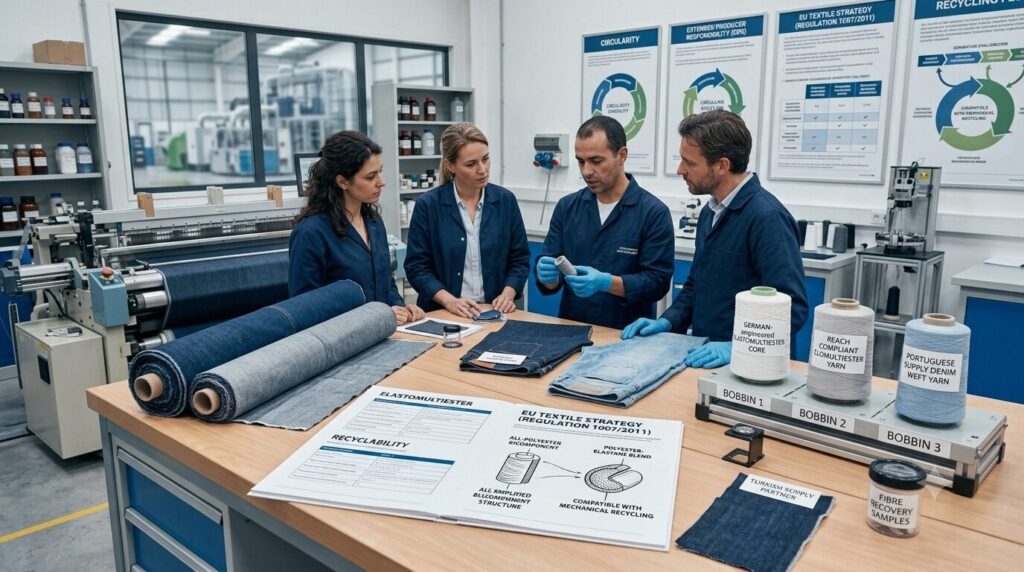
The recyclability argument is particularly sharp in the European context. Several EU member states are already implementing Extended Producer Responsibility (EPR) schemes for textiles, and the difficulty of recycling polyester-elastane blended fabrics which require chemical separation before the polyester can be reprocessed is being flagged by recyclers and brand sustainability teams alike. Elastomultiester keeps both stretch-contributing components within the same polyester polymer family, making it significantly more compatible with the mechanical recycling infrastructure that Europe is scaling up under its circular economy commitments.
For European denim brands and their Turkish and Portuguese supply partners, elastomultiester offers a commercially practical route to stretch jeans that can be marketed as more recyclable and more durable than elastane alternatives without requiring new dyeing equipment, new weaving infrastructure, or a price premium that consumers won’t accept. That combination of regulatory alignment, product performance, and manufacturing simplicity is why European brand sustainability teams are actively evaluating elastomultiester as a default stretch solution.
Mechanical Stretch for European Apparel and Workwear
Europe’s premium and mid-market apparel sector has long valued the dry hand feel of woven fabrics with natural give the kind of structured fabric that moves with the body without the compression or rubbery recovery of elastane. Italian fashion, in particular, has a tradition of working with crepe, twill, and dobby weave constructions that deliver inherent stretch through weave geometry. Mechanical stretch yarn formalises and scales this instinct: it engineers self-crimping coil structures into the yarn so that the stretch is built into the filament rather than coaxed from the weave alone.
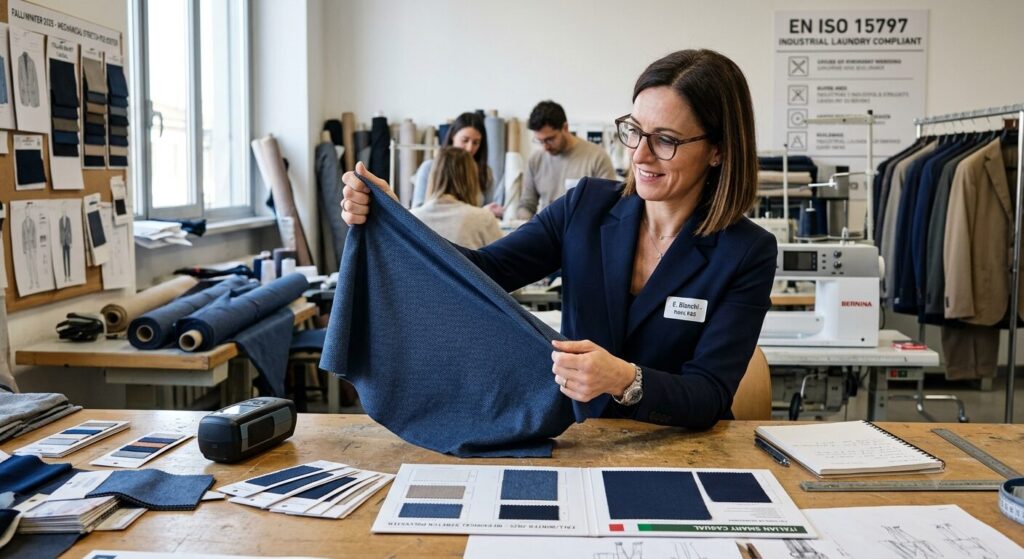
For the growing smart-casual, business-casual, and travel-ready apparel segment that dominates European retail from blazers and stretch trousers to technical dress shirts and travel chinos mechanical stretch yarn is the engineering solution to a well-documented consumer demand: fabrics that look structured and professional but move with the body across a full working day and recover their shape without special care.
Workwear is equally significant. Europe’s industrial workwear sector covering construction, logistics, automotive assembly, and healthcare increasingly specifies stretch fabrics for mobility and comfort, but workwear laundering standards (EN ISO 15797) require fabrics to survive repeated high-temperature washing cycles. Elastane degrades quickly under these conditions; mechanical stretch fabrics built on polyester crimp structures are inherently more heat-tolerant, giving them a structural advantage in European industrial and corporate workwear tenders.
Mestre’s Relevance for European Markets
India has a long-established textile trade relationship with Europe, and as EU sustainability regulations tighten, European brands are increasingly looking beyond China for polyester yarn sourcing that can demonstrate regulatory compliance and circular credentials. Mestre, as a bicomponent polyester yarn produced by the Madhusudan Group in Surat, brings elastomultiester and mechanical stretch properties together with full technical documentation aligned to EU Regulation 1007/2011 fibre labelling requirements and REACH safety frameworks.
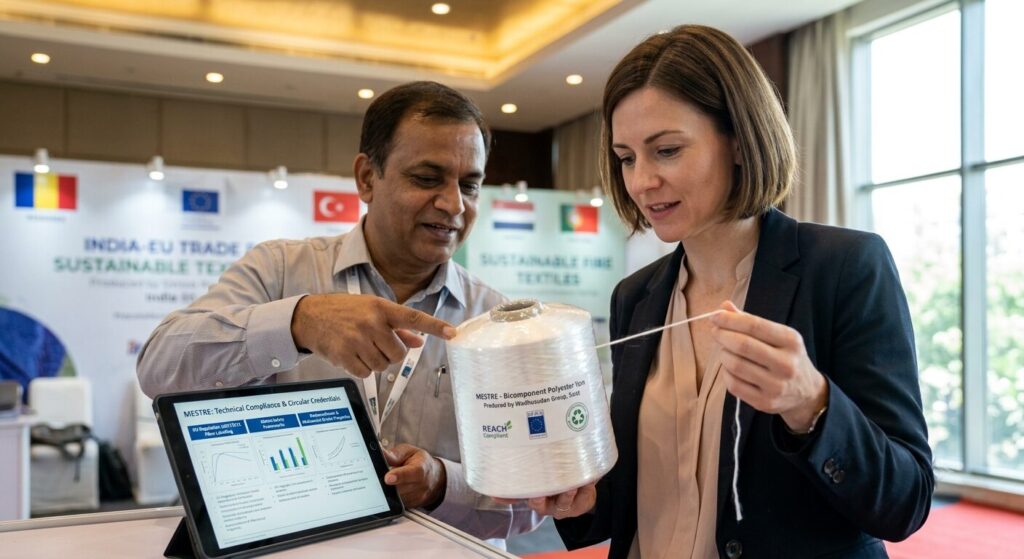
As India-EU Free Trade Agreement negotiations progress, the sourcing economics for European brands working with Indian yarn suppliers are expected to improve further. For Turkish, Portuguese, and Romanian garment manufacturers supplying European fashion groups, Mestre represents a technically documented, commercially accessible Indian bicomponent yarn for stretch fabric development that meets the performance and compliance bar European buyers now require.
Frequently Asked Questions
Is elastomultiester recognised under EU textile labelling law?
Yes. EU Regulation 1007/2011 officially lists elastomultiester as a recognised generic fibre name for textile labelling, giving manufacturers a defined legal category for garments containing this bicomponent polyester fibre.
Can elastomultiester fabrics meet the EU’s circular economy textile requirements?
Elastomultiester is significantly more recyclable than polyester-elastane blends, because both components stay within the same polyester polymer family, avoiding the chemical separation step that makes elastane problematic for mechanical textile recyclers. This directly aligns with the EU Textile Strategy’s 2030 recyclability goals.
Do European workwear laundering standards affect which stretch yarn is appropriate?
Yes. EN ISO 15797 governs industrial textile laundering procedures and temperature requirements across Europe. Mechanical stretch yarns built on polyester crimp structures are engineered to withstand these conditions, while elastane in workwear fabrics degrades significantly faster under the same protocol.
Is REACH compliance standard for bicomponent polyester yarns like Mestre?
Commercial bicomponent polyester yarns produced within standard textile safety frameworks are generally REACH-compliant, as standard polyester polymers (PET and PTT) do not contain REACH-restricted substances. Specific REACH compliance documentation should always be confirmed directly with the manufacturer.
How do Turkish garment manufacturers benefit from switching to elastomultiester for European buyers?
Turkish manufacturers supplying European fashion groups benefit from simplified fibre content documentation (elastomultiester is an EU-recognised generic name), improved recyclability credentials for EU buyer sustainability audits, and better fabric durability reducing rejected goods from elastane-related quality failures in high-temperature dyeing and finishing.
Final Thoughts
Europe’s combination of strict regulation, ambitious sustainability policy, and sophisticated consumer expectations makes it one of the most challenging and most rewarding markets for advanced yarn technology. Bicomponent yarn, elastomultiester, and mechanical stretch each offer something specific to the European context: EU-recognised labelling compliance, circular economy alignment, and the structured-yet-mobile performance that European fashion has always valued. Mestre’s bicomponent polyester platform is built to meet these requirements across Europe’s diverse manufacturing geography.