

Africa’s textile and garment industry is in the middle of a structural transformation. From the industrial parks of Ethiopia and Egypt’s Nile Delta mills to Morocco’s proximity-to-Europe production clusters and South Africa’s sophisticated domestic retail market, the continent is simultaneously a growing manufacturing destination and an expanding consumer base. As international brands diversify supply chains away from single-region dependency, African textile manufacturers are investing in higher value-added production and that means upgrading the performance of the yarns they use.
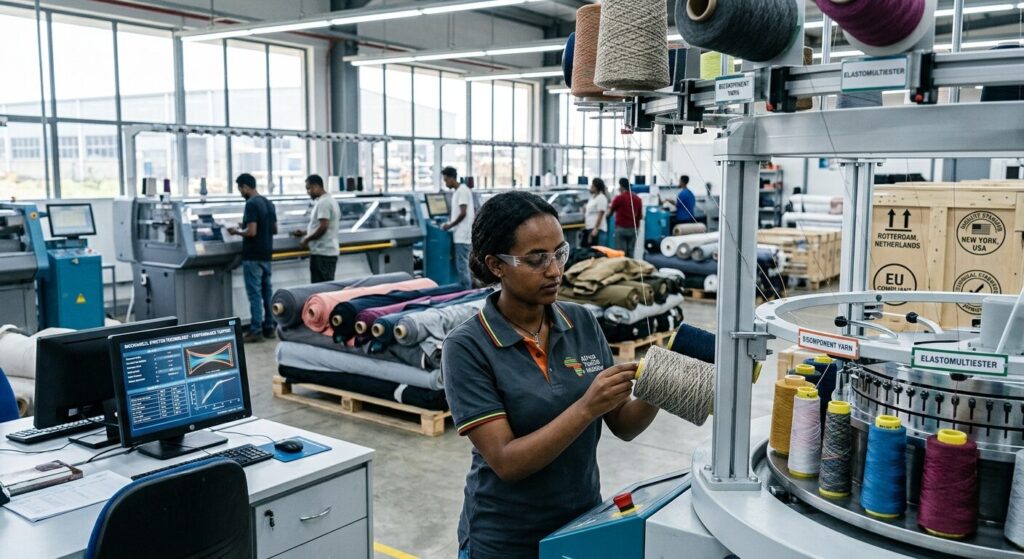
For manufacturers, sourcing teams, and brand developers operating in African markets, three yarn innovations are becoming increasingly relevant: bicomponent yarn, elastomultiester, and mechanical stretch technology. Each addresses a specific gap in Africa’s current yarn toolkit, and each connects to broader trends driving the continent’s textile ambitions export competitiveness, durability in demanding climates, and compliance with the technical standards of European and North American buyers.
Bicomponent Yarn in African Textile Manufacturing
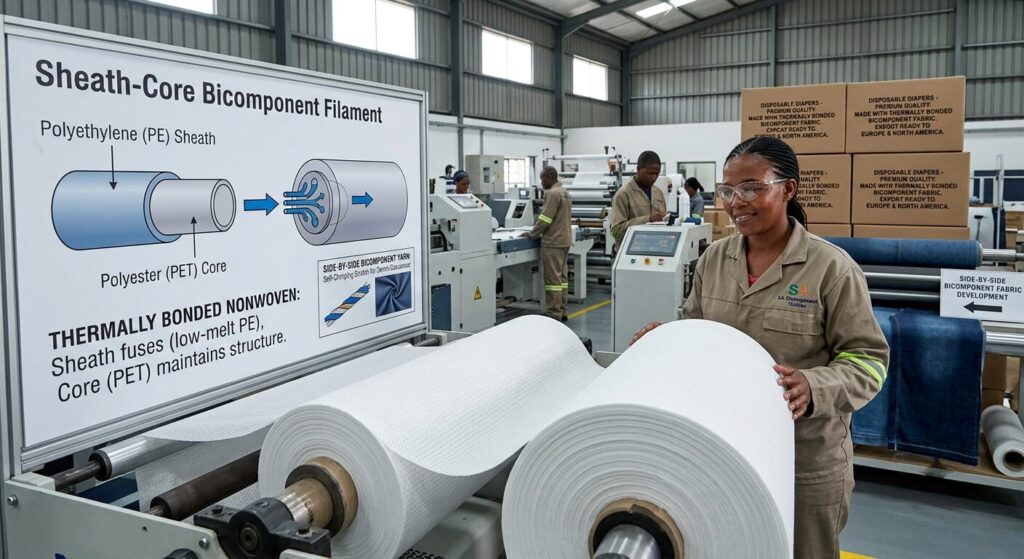
Bicomponent yarn a single filament produced by fusing two distinct polymers inside one spinneret is particularly relevant for African manufacturers producing for export to Europe and North America, where technical performance standards and fibre labelling regulations are strictly enforced. Ethiopia’s Hawassa Industrial Park, which hosts major global garment brands including PVH and Arvind, and Morocco’s Tanger Med manufacturing zone, which supplies European fast-fashion groups, are examples of African hubs where consistent, technically verifiable fibre performance is a buyer requirement, not an optional upgrade.
The sheath-core variant of bicomponent fibre is also gaining traction in Africa’s nonwoven and hygiene product sector. South Africa, Egypt, and Nigeria all host growing local production of disposable hygiene products diapers, wipes, medical drapes where sheath-core bicomponent fibres (a low-melt polyethylene sheath bonded around a higher-melt polyester core) are the standard construction for thermally bonded nonwoven fabrics.
For African manufacturers producing casualwear and denim domestically or for the regional market, side-by-side bicomponent yarn opens the door to self-crimping stretch fabrics that deliver comfort performance without requiring separate elastane covering processes. South Africa’s well-developed retail sector with a domestic denim and casualwear market comparable in sophistication to mid-tier European markets is beginning to incorporate bicomponent polyester fabrics into locally branded stretch products.
Elastomultiester in African Textile Markets
Elastomultiester is an elastic bicomponent polyester fibre that generates stretch from a physical coil structure rather than from an added elastane polymer and it has a specific practical advantage for African textile applications: its stretch does not degrade in high-heat, high-UV environments the way elastane does. Across sub-Saharan Africa and North Africa alike, outdoor temperatures and UV intensity levels are far above the conditions that cause elastane-blended fabrics to lose their recovery prematurely.
South Africa’s formal and corporate wear segment where multinational firms, financial institutions, and hospitality groups specify uniform fabrics for repeat industrial laundering is one of the most natural markets for elastomultiester on the continent. The fibre’s tolerance for high-temperature wash cycles (standard elastane begins degrading above roughly 60°C, while the coil structure of elastomultiester is far more heat-stable) means garments hold their shape and stretch recovery across the laundering cycles that corporate and hospitality workwear routinely experiences.
Egypt’s growing denim production sector, which serves a domestic market of over 100 million people and exports under the EU-Egypt Association Agreement, represents another clear opportunity. European buyers are beginning to add circular economy criteria to their sourcing frameworks, and elastomultiester’s single-polymer-family construction two polyester variants rather than polyester plus polyurethane elastane is significantly more compatible with EU textile recycling infrastructure. Egyptian manufacturers adopting elastomultiester today position themselves ahead of incoming EU due diligence requirements for textile imports.
Mechanical Stretch for African Climate and Industry Conditions
Mechanical stretch the property of a fabric to extend and recover through the physical geometry of crimped or coiled yarn rather than through added elastane is particularly well suited to Africa’s working and outdoor environments. Because the stretch comes from how the yarn is structured rather than from a degrading polymer chain, mechanical stretch fabrics maintain their performance under the heat, UV, and physical stress conditions that are standard across African outdoor workwear applications.
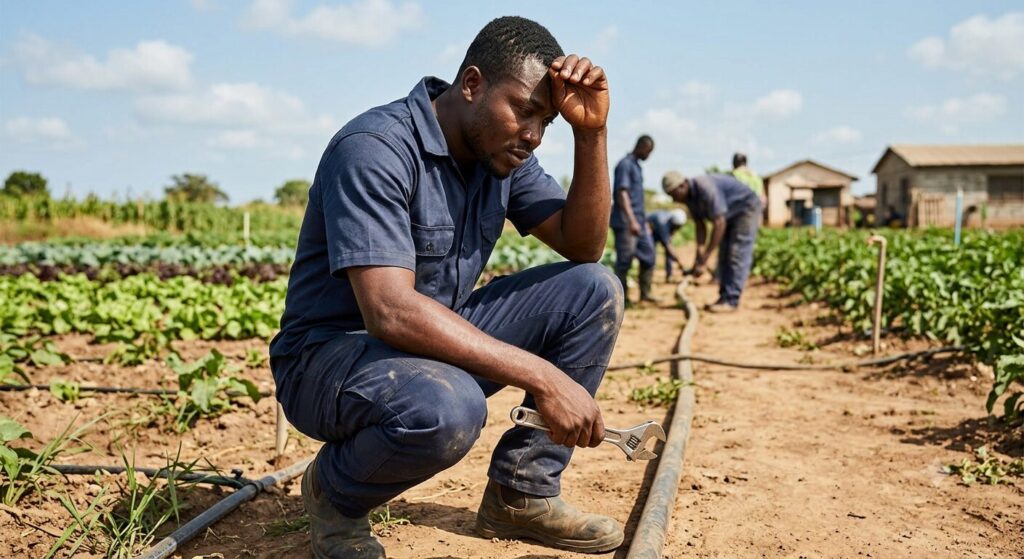
Workwear for Africa’s mining sector (South Africa, Zambia, DRC), agricultural workwear across East and West Africa, and construction PPE across the continent’s rapidly urbanising cities all benefit from inherent stretch fabrics that combine comfort-of-movement with all-day durability. Mechanical stretch yarn built on a bicomponent self-crimping structure is particularly appropriate here: it delivers the stretch of elastane without the UV degradation risk, and it withstands the rigorous washing that industrial workwear demands.
Africa’s young, urban consumer demographic which drives a rapidly growing sports, streetwear, and casualwear market in Nigeria, Kenya, Ghana, and South Africa also creates demand for stretch fabrics accessible enough to reach mass-market price points but technically capable enough to hold their performance over repeat wears and washes. Mechanical stretch yarn, produced in polyester-only constructions, can be manufactured and priced to serve this value-conscious but quality-aware segment.
Mestre’s Relevance for African Markets
Mestre, manufactured by the Madhusudan Group in Surat, India, connects naturally to Africa’s textile ecosystem through India’s established trade relationship with the continent. India is already a significant source of polyester yarn for Egyptian, South African, Moroccan, and Ethiopian mills, and institutional frameworks like the India-Africa Forum Summit actively support this trade corridor. As Indian yarn and fabric exports to African manufacturers increase, domestically produced bicomponent yarns like Mestre represent a practical alternative to importing from China or Europe, with shorter logistics chains and strong technical support in a familiar sourcing relationship.
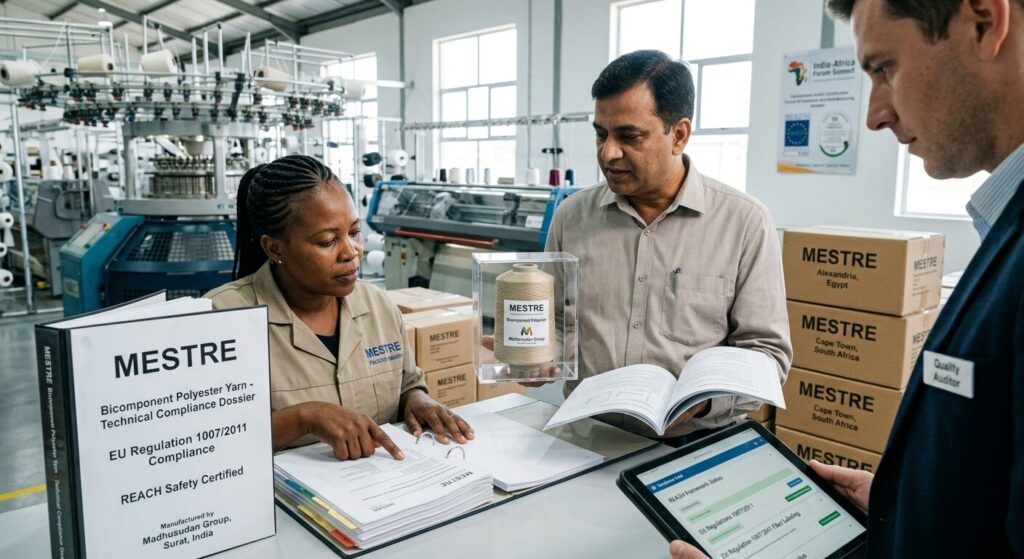
For African textile exporters manufacturing for European or North American buyers, Mestre provides access to bicomponent polyester technology elastomultiester, mechanical stretch, and sheath-core constructions with full technical documentation aligned to EU fibre labelling requirements (Regulation 1007/2011) and REACH safety frameworks. That documentation is increasingly required by international buyers auditing African supply chains for fibre content accuracy and chemical compliance.
Frequently Asked Questions
Is elastomultiester suitable for hot, high-UV environments across Africa?
Yes. Elastomultiester’s stretch comes from a physical coil structure rather than a UV-sensitive elastane polymer chain, making it significantly more resistant to sun and heat degradation a practical advantage for African outdoor workwear, casualwear, and uniform applications.
Do African garment exporters need to label bicomponent yarn differently for EU markets?
Yes. EU Regulation 1007/2011 has specific labelling requirements for elastomultiester and other bicomponent fibre constructions. Products exported from African manufacturers to EU buyers must comply with EU fibre content labelling rules, which includes correctly naming elastomultiester as a generic fibre type.
Can mechanical stretch fabrics handle high-temperature commercial laundering common in African workwear?
Yes. Mechanical stretch yarns built on polyester crimp structures are engineered to withstand significantly higher washing temperatures than elastane-blended fabrics, which begin to degrade above approximately 60 degrees Celsius.
Is Indian yarn, like Mestre, commonly used by African textile manufacturers?
Yes. India is one of Africa’s established yarn and fabric trade partners, particularly for polyester-based materials. Egyptian, South African, and Moroccan mills regularly import Indian polyester yarns, making domestically produced bicomponent options like Mestre a natural fit for existing sourcing relationships.
Which African markets are most likely to adopt bicomponent stretch yarn technology first?
South Africa, Egypt, and Morocco are currently the most developed markets for advanced yarn adoption, followed by Ethiopia (driven by export garment manufacturing for global brands) and Kenya (an emerging textile sector with growing synthetic fibre capacity).
Final Thoughts
Africa’s textile sector is at an inflection point expanding its manufacturing base, upgrading its export specifications, and building a domestic consumer market that demands genuine performance from everyday fabrics. Bicomponent yarn, elastomultiester, and mechanical stretch technology are three tools that allow African manufacturers to meet both ambitions simultaneously: the technical requirements of international buyers and the durability, climate resilience, and value expectations of Africa’s fast-growing local market. Mestre provides a sourcing pathway to these technologies within India’s well-established textile trade relationship with the continent.