

Australia’s textile and apparel market occupies a distinct position globally: a premium retail environment shaped by an outdoor lifestyle, a demanding industrial sector, and consumers who consistently rank sustainability, durability, and ethical sourcing among their top purchasing priorities. The Australian Fashion Council’s sustainability roadmap, the Modern Slavery Act 2018’s supply chain transparency requirements, and the India-Australia Economic Cooperation and Trade Agreement (ECTA) that came into force in December 2022 all shape a sourcing landscape where technical fibre performance and transparent supply chains are commercially valuable, not optional extras.
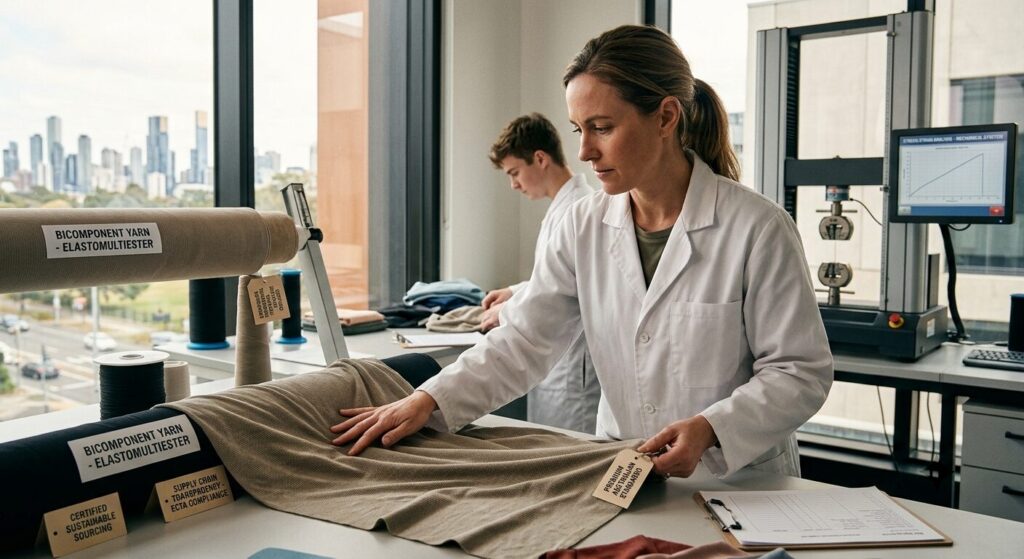
Bicomponent yarn, elastomultiester, and mechanical stretch are three innovations that speak directly to what Australia’s market needs from its next generation of stretch fabrics performance that holds up in Australian environments, durability that justifies premium price points, and supply chain documentation that satisfies the country’s growing compliance requirements.
Bicomponent Yarn in Australia’s Technical and Apparel Sectors
Australia’s outdoor, activewear, and technical sportswear sector is one of the most developed in the Asia-Pacific region. Brands serving the surf, ski, trail running, and general outdoor segments demand fabrics that stretch, recover, resist UV degradation, and maintain performance across the demanding conditions that Australian environments deliver from tropical Queensland to the high alpine zones of the Snowy Mountains and the intense UV of the Australian outback. Bicomponent yarn, particularly the side-by-side self-crimping structure that underpins elastomultiester, delivers stretch through a mechanism inherently more resistant to UV and heat breakdown than elastane, directly addressing the performance requirements of Australian outdoor brands.
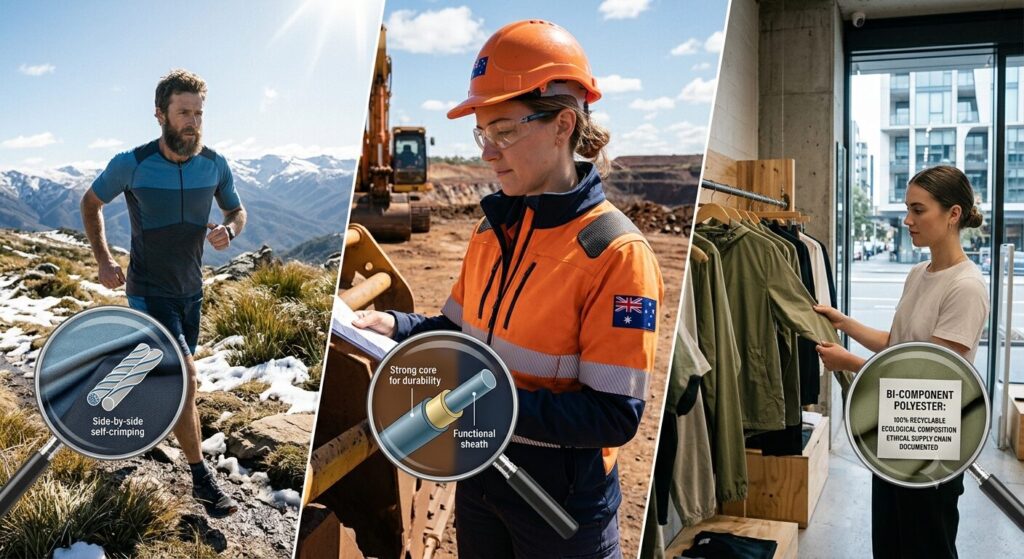
Australia’s significant mining, construction, and agriculture sectors create strong demand for technical workwear. Bicomponent fibre’s ability to combine structural strength (from the core polymer) with functional surface properties (from the sheath polymer) in a single yarn makes it relevant for workwear fabrics that must perform under physical and environmental stress. The sheath-core bicomponent structure is also used in the filtration media standard in Australian industrial, healthcare, and mining PPE applications a growing domestic production segment as Australian manufacturers look to reduce dependence on imported technical nonwovens.
For the growing sustainable fashion segment in Australia’s urban retail centres Sydney, Melbourne, Brisbane bicomponent yarn’s position as a technically precise, well-documented fibre type also matters. Australian ethical sourcing advocates and sustainability-focused brands place significant value on knowing exactly what a garment is made of and where it comes from; bicomponent polyester’s defined two-polymer composition and transparent supply chain documentation from a vertically integrated manufacturer directly serves this need.
Elastomultiester and Australia’s Climate and Compliance Requirements
Australia’s combination of high UV intensity, warm climate across most of the country, and a premium consumer culture that values long-lasting garments makes elastomultiester’s performance profile exceptionally relevant. The fibre’s resistance to UV-driven and heat-driven degradation compared with elastane, which loses elasticity markedly faster under Australian outdoor conditions directly addresses one of the most common consumer complaints about stretch jeans, leggings, and activewear: premature loss of shape and recovery that happens faster in warmer, sunnier climates than in the European or North American environments where most stretch garments are originally tested.
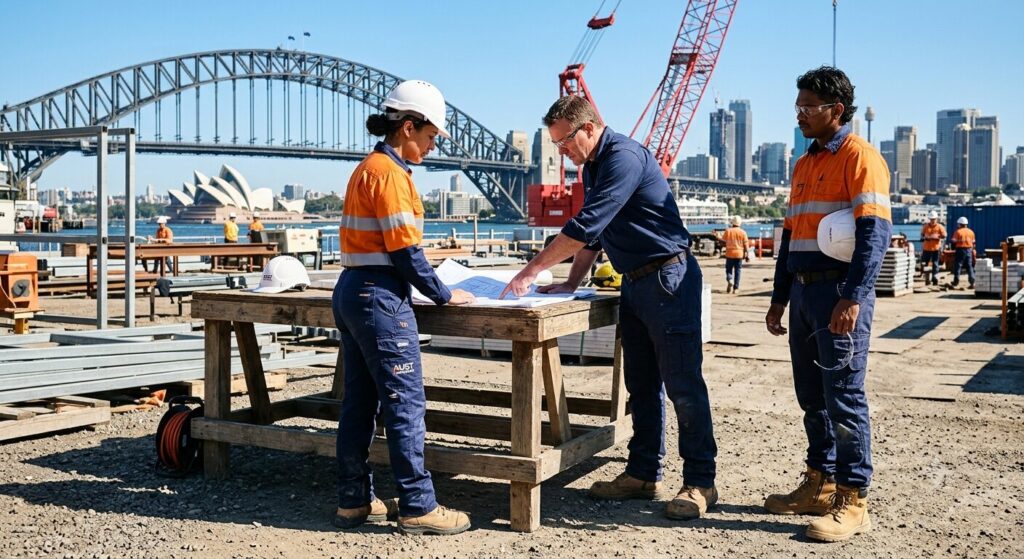
For Australian workwear which spans an enormous range from mining and construction PPE to hospitality uniforms and healthcare scrubs elastomultiester’s heat tolerance for commercial laundering is a core functional requirement. Australian industrial laundry standards call for high-temperature washing cycles that stress-test elastane-blended fabrics far more aggressively than the physical coil structure of elastomultiester. Brands and workwear buyers that switch to elastomultiester report meaningfully longer garment service life and reduced replacement frequency, directly reducing the total cost of workwear programs over a multi-year contract period.
Australia’s ethical sourcing environment gives elastomultiester a sustainability positioning that resonates with both consumers and procurement teams. The Modern Slavery Act requires Australian companies above a revenue threshold to report on supply chain risks, and the growing emphasis on product durability and recyclability driven by consumer awareness and industry bodies including the Australian Fashion Council provides a natural platform for communicating elastomultiester’s longer garment life, heat-stable performance, and more recyclable single-polymer-family construction.
Mechanical Stretch Fabric for Australian Outdoor, Workwear and Business Markets
Mechanical stretch yarn is a natural fit for Australia’s two most significant stretch fabric applications: outdoor activewear and workwear. Both categories require fabrics that perform under physical stress, resist environmental degradation, and survive frequent laundering and both are served better by the durability of mechanical stretch than by the faster-degrading elasticity of standard elastane blends. As Australian consumers and buyers become increasingly aware of how long their clothing actually performs versus how long they want it to, the durability story of mechanical stretch becomes a direct commercial differentiator.

Australia’s growing business-casual and smart-casual market influenced by the country’s relatively informal office culture and the post-pandemic shift toward hybrid working dress codes is a third opportunity for mechanical stretch fabrics. Stretch chinos, stretch dress trousers, and structured stretch blazers are categories where mechanical stretch yarn delivers the comfort of elastane with the appearance and drape of a conventional woven fabric. Australian consumers’ willingness to pay a premium for quality, longevity, and ethical production makes this an attractive segment for brands positioning mechanical stretch as a superior long-term fabric choice.
Australia’s outdoor lifestyle also creates year-round demand for stretch fabrics in casualwear that bridges work and leisure: weekend activewear, travel clothing, outdoor-to-cafe garments. Mechanical stretch fabric’s durability advantage in UV and heat exposure makes it a practical choice for brands targeting the outdoor-lifestyle-oriented Australian consumer who wears the same garments across multiple environments and expects them to hold their performance throughout.
Mestre’s By Madhusudan Group Is Relevance for Australian Markets
The India-Australia Economic Cooperation and Trade Agreement (ECTA), which entered into force in December 2022, has already begun reducing tariffs on Indian textile imports into Australia, with staged reductions scheduled across the agreement’s implementation period. For Australian fashion brands, retailers, and workwear buyers who source from India, Mestre represents a domestically produced bicomponent yarn with elastomultiester and mechanical stretch properties available through an increasingly favourable trade framework that is reducing the landed cost of Indian technical yarn in Australia.
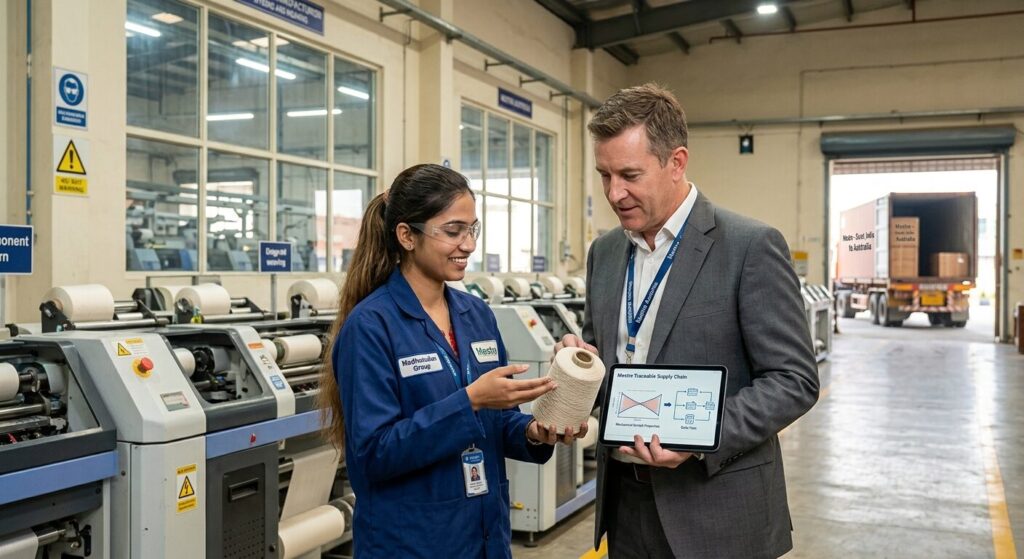
As Australian brands navigate Modern Slavery Act compliance and investor ESG requirements, Mestre’s supply chain transparency produced within the Madhusudan Group’s vertically integrated Surat facility handling spinning, dyeing, and weaving in-house provides the supply chain visibility documentation that Australian compliance frameworks require. A single-site, vertically integrated manufacturer is significantly easier to audit and document than a multi-tier supply chain with separate yarn producers, spinners, and dyers in different locations.
Frequently Asked Questions
Does Australia’s climate affect elastane-based stretch fabrics differently than elastomultiester?
Yes. Australia’s high UV intensity and warm temperatures accelerate elastane’s polymer degradation, causing stretch garments to lose recovery prematurely. Elastomultiester, which generates stretch from a physical coil rather than a UV-sensitive polymer chain, is significantly more resistant to these conditions across outdoor and workwear applications.
Does the India-Australia ECTA reduce tariffs on bicomponent yarn imports?
Yes. The India-Australia ECTA, in force since December 2022, includes staged tariff reductions on a range of Indian textile inputs, including polyester-based yarns. The agreement is progressively making Indian-sourced bicomponent yarns like Mestre more competitively priced for Australian buyers across its implementation schedule.
Can Mestre’s supply chain documentation support Modern Slavery Act compliance for Australian buyers?
Mestre is produced within the Madhusudan Group’s vertically integrated Surat facility, where spinning, dyeing, and weaving are conducted in-house. This single-site integration simplifies supply chain mapping and documentation a practical advantage for Australian buyers fulfilling Modern Slavery Act reporting requirements, which require traceability into yarn-level sourcing.
Is mechanical stretch fabric suitable for Australian workwear that must meet AS/NZS safety standards?
Mechanical stretch can be incorporated into fabric constructions that meet Australian and New Zealand standards for specific hazard categories, such as AS/NZS 4602.1 for high-visibility workwear. The safety certification is driven by the full fabric construction and finishing rather than the stretch mechanism alone, so workwear manufacturers should verify that their final fabric meets the relevant AS/NZS standard independently of the stretch yarn type.
Are Australian consumers familiar with elastomultiester as a fibre type on care labels?
General consumer awareness is currently low but growing among sustainability-engaged shoppers and buyers at Australian fashion and workwear brands. As brand communication around sustainable stretch alternatives increases and Australian retailers align with global labelling transparency trends, consumer recognition of elastomultiester on care labels is expected to increase steadily over the next few years.
Final Thoughts
Australia’s combination of performance-demanding climate, sustainability-focused consumers, premium retail values, and improving India trade access makes it one of the most receptive markets globally for next-generation stretch yarn technology. Bicomponent yarn, elastomultiester, and mechanical stretch offer Australian brands and workwear buyers a technically superior and more sustainable alternative to elastane-based stretch sourced through a trade framework that is actively reducing the cost of accessing Indian manufacturing expertise. Mestre’s bicomponent polyester platform is built for exactly this kind of premium, performance-driven, and ethically transparent sourcing relationship.