

North America is home to the world’s largest apparel consumer market and one of the most technically demanding retail environments for fibre performance. The United States alone accounts for hundreds of millions of denim units annually, while the athleisure and activewear segment that defined post-2015 consumer behaviour has fundamentally reshaped expectations: everyday fabrics must stretch, recover, manage moisture, and perform over years of repeated wear and washing without a significant price premium. Canada’s sustainability-conscious consumers and Mexico’s established position as a proximity manufacturer under USMCA add further dimensions to a market that is sophisticated, volume-hungry, and increasingly focused on what fibres are actually inside the garments people buy.
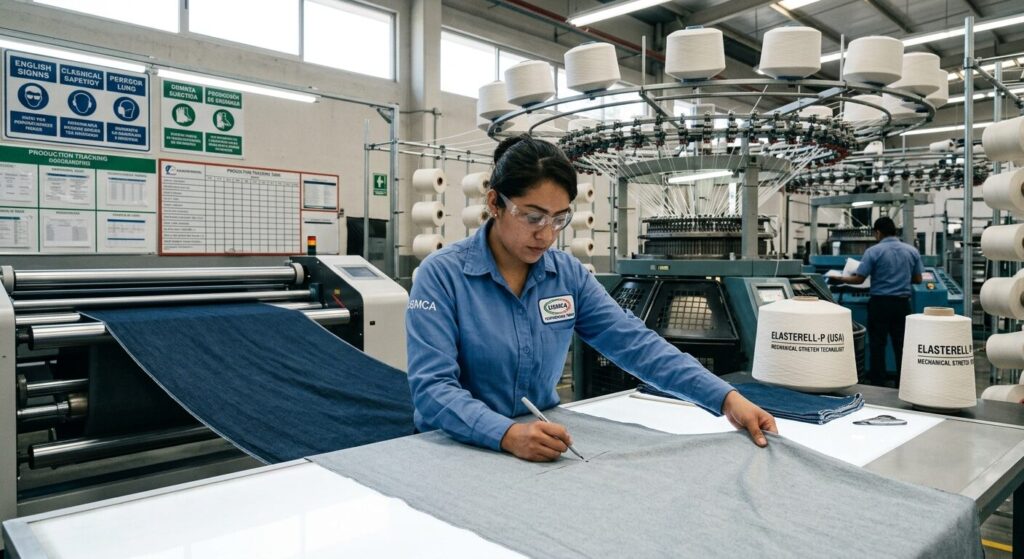
Bicomponent yarn, elastomultiester (known in the US regulatory context as elasterell-p), and mechanical stretch technology speak directly to these North American demands offering performance, durability, and a more recyclable stretch alternative to conventional elastane at a commercial scale suitable for the region’s volume requirements.
Bicomponent Yarn in the North American Textile Supply Chain
Bicomponent yarn has a long commercial history in North America. US-based nonwoven manufacturers have used sheath-core bicomponent fibres (polyethylene over polyester configurations) in hygiene and medical products since the 1970s, and the technology is deeply embedded in the production of disposable diapers, surgical gowns, and filtration media across North American facilities. This history has built deep technical familiarity with bicomponent fibre engineering within the region’s industrial textile sector a familiarity that is now translating into apparel applications.
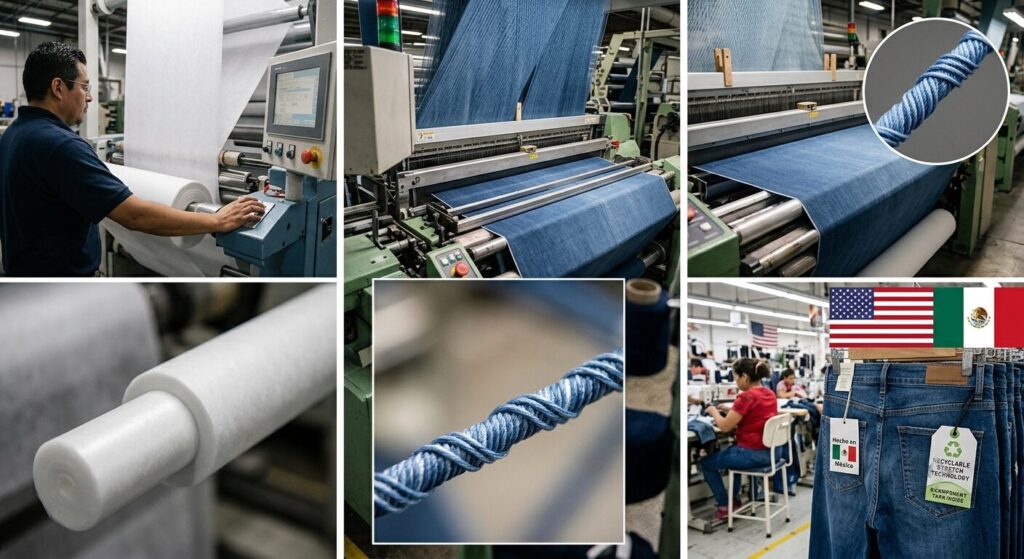
What is newer is bicomponent yarn’s relevance in North American stretch apparel. The US denim market the largest in the world is shifting. As major denim brands including Levi’s, PVH, and Kontoor Brands explore alternatives to elastane-based stretch following growing awareness of elastane’s recyclability limitations and long-term durability issues, side-by-side bicomponent polyester yarns have moved from niche technical evaluation to mainstream product development consideration. The self-crimping coil structure of side-by-side bicomponent yarn delivers denim stretch performance while staying within a single polymer family that is far more compatible with emerging textile recycling infrastructure.
For Mexico’s garment manufacturing sector the US’s largest apparel import partner under USMCA access to bicomponent yarn technology enables production of stretch fabrics that meet the performance expectations of US retail buyers while staying within Mexico’s well-established polyester processing capabilities. Mexico’s proximity advantage under USMCA, combined with adoption of bicomponent polyester yarns, positions Mexican manufacturers for the premium segment of the North American stretch apparel market.
Elastomultiester (Elasterell-p) in the US and Canadian Markets
In the United States, the Federal Trade Commission (FTC) governs textile fibre labelling under the Textile Fiber Products Identification Act. The FTC recognises elasterell-p as the equivalent generic fibre name for the class of bicomponent elastic polyester fibre known internationally as elastomultiester. Both terms describe the same technology: two polyester polymers co-extruded in a side-by-side configuration that generates stretch through a self-crimping coil structure rather than through chemical elasticity. For US brands sourcing internationally, understanding this US-EU naming difference is important for correct labelling compliance.
North America’s denim market is the most significant commercial opportunity for elastomultiester in the region. The combination of stretch performance, long-term shape retention, heat-tolerant laundering, and improved recyclability compared with elastane aligns with three converging pressures on US denim brands: consumer demand for comfortable, lasting stretch; retailer sustainability commitments from major retailers including Target, Walmart, and Gap Inc.; and California’s expanding textile sustainability legislation, which is beginning to create regulatory incentives for more recyclable fibre choices in garments sold in the state.
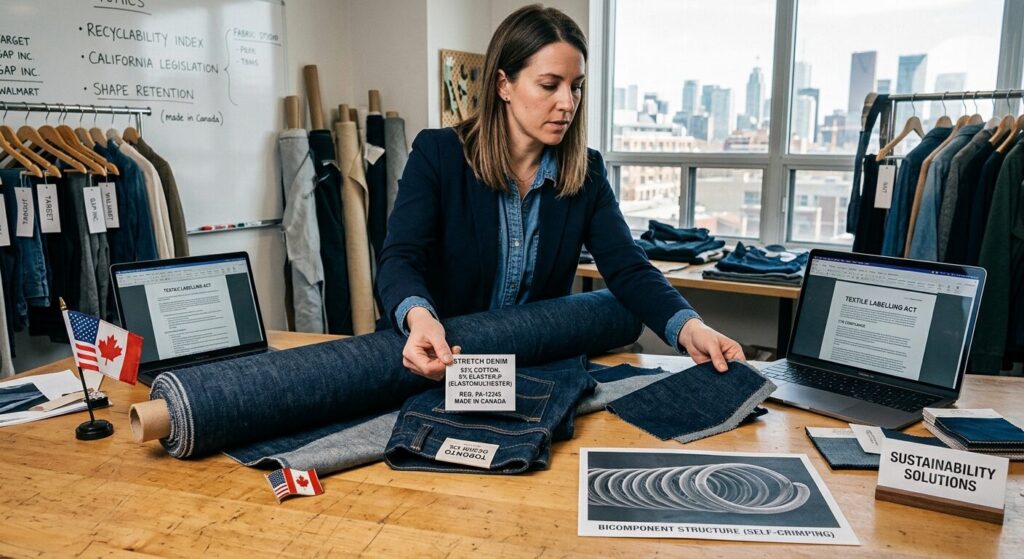
Canada’s apparel market is smaller than the US but significantly more sustainability-focused. Canadian fashion consumers consistently rank ethical sourcing and environmental impact among their top purchasing priorities, and the country’s strong alignment with EU sustainability frameworks gives elastomultiester’s more-recyclable profile immediate commercial resonance. Canadian outdoor and workwear brands which serve markets where garment durability and performance under harsh climate conditions are baseline requirements are particularly well-positioned to adopt elastomultiester as a default stretch fibre.
Mechanical Stretch Yarn Across North American Apparel Categories
Mechanical stretch yarn found its North American footing in workwear long before it became relevant to fashion. The oil and gas, construction, mining, and utilities sectors across the US and Canada have always needed stretch garments for freedom of movement in confined spaces, at height, or under layered PPE and those garments need to survive industrial laundering at temperatures that destroy elastane. Workwear specifiers in these sectors have been moving toward non-elastane stretch solutions for years; mechanical stretch yarn, particularly bicomponent self-crimping constructions, provides the technical answer.
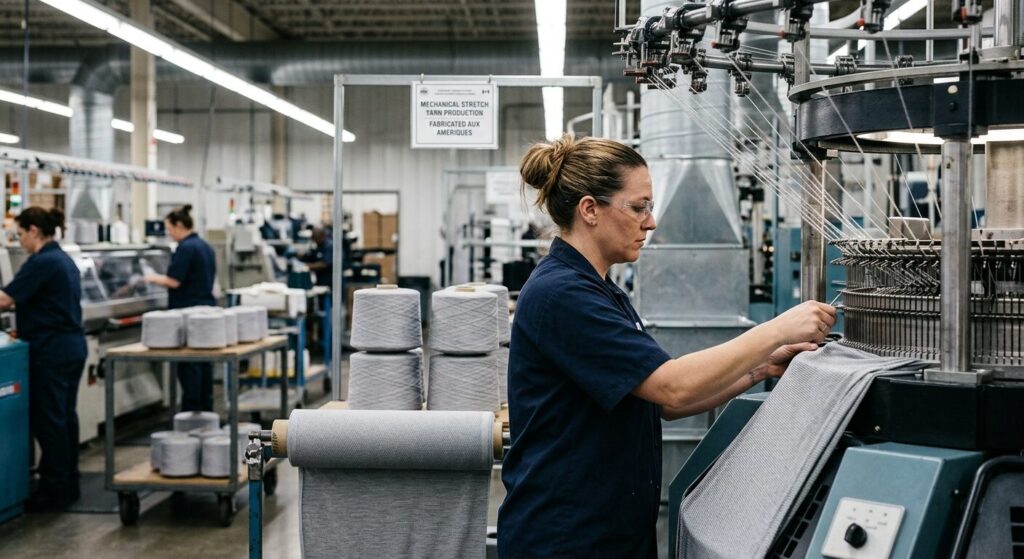
Today, mechanical stretch is expanding rapidly into the massive North American business-casual segment. The post-pandemic restructuring of office dress codes across the US and Canada created a dominant smart-casual category stretch chino, stretch dress trouser, stretch blazer where mechanical stretch yarn delivers comfort and a professional appearance without the compression feel that elastane sometimes introduces in structured garments. This segment is one of the fastest-growing applications for mechanical stretch fabric in North America.
For Mexico’s garment manufacturing sector supplying US brands, mechanical stretch yarn also offers a manufacturing simplification: the stretch is inherent in the yarn rather than requiring a separate elastane covering process, which reduces production complexity, lowers the risk of elastane-related quality failures in high-volume runs, and allows Mexican mills to serve the US market’s growing demand for non-elastane stretch with existing polyester processing equipment.
Mestre’s Relevance for North American Markets
India is a major US textile trading partner, and Indian yarn exporters have well-established logistics, customs documentation, and quality assurance frameworks for the North American market. Mestre, as a bicomponent polyester yarn with both elasterell-p (elastomultiester) and mechanical stretch properties, is positioned as a technically documented, commercially accessible stretch yarn for North American brands and sourcing teams evaluating non-elastane stretch alternatives by Madhusudan Group in Surat India.
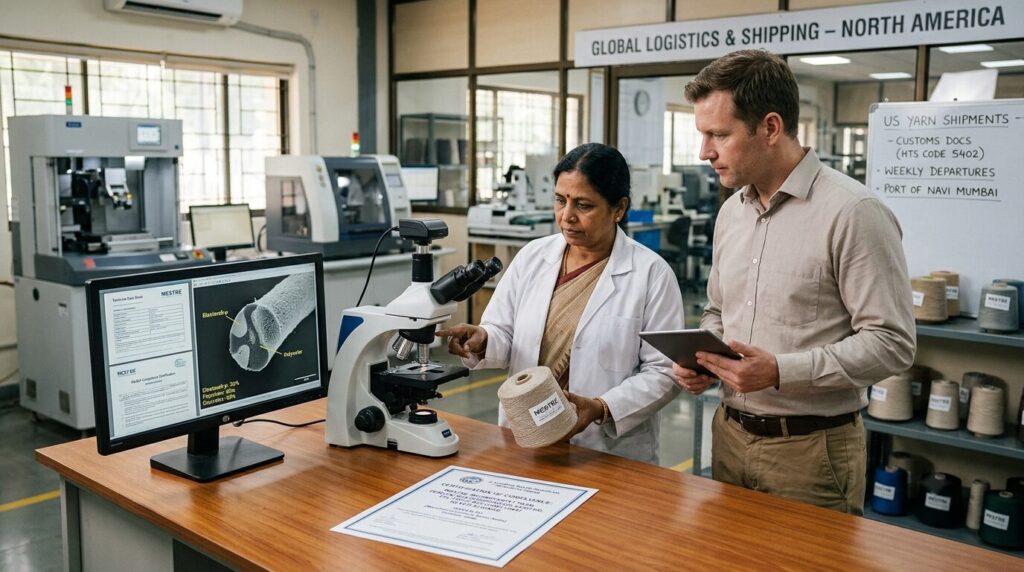
As US brands face increasing FTC scrutiny on fibre content claims and growing pressure from investors and NGOs on supply chain sustainability, the technical precision of bicomponent polyester fibre documentation with clear percentage disclosures for each polymer component, full REACH alignment, and supply chain transparency from a vertically integrated Indian manufacturer provides compliance advantages over less-well-documented stretch yarn alternatives.
Frequently Asked Questions
What does the US FTC call elastomultiester?
The US Federal Trade Commission recognises elasterell-p as the equivalent generic name for the class of bicomponent elastic polyester fibre known internationally as elastomultiester. Both refer to the same technology: two polyester polymers co-extruded in a side-by-side structure that generates stretch through a physical coil.
Are there US labelling requirements for bicomponent stretch yarn in garments?
Yes. Under the US Textile Fiber Products Identification Act, garments must disclose the percentage of each fibre by weight. For bicomponent polyester with elastic properties, the generic name elasterell-p must appear on the fibre content label along with the weight percentage.
Can USMCA-qualifying garments made in Mexico use yarn from Indian suppliers like Mestre?
USMCA’s yarn-forward rules of origin generally require yarn used in USMCA-qualifying garments to originate within the USMCA zone for preferential tariff treatment. Garments using Indian-sourced yarn can still be produced in Mexico for the US market but may not qualify for USMCA preferential duty rates. Brands should verify their specific HS code requirements with a trade compliance specialist.
Is elastomultiester suitable for the US activewear market?
For moderate-stretch activewear casual yoga pants, athletic chinos, training trousers elastomultiester is a strong option. For high-compression athletic gear such as performance tights and compression running gear, elastane or a hybrid elastomultiester-elastane blend typically delivers higher maximum elongation.
How does California’s textile sustainability legislation affect stretch fabric choices?
California’s SB 253 and expanding textile producer responsibility frameworks are creating regulatory incentives for more recyclable fibre choices. Elastomultiester, which stays within a single polyester polymer family and avoids the chemical separation requirement of elastane recycling, is better positioned within these frameworks than conventional polyester-elastane blends.
Final Thoughts
North America’s textile and apparel market rewards performance, consistency, and increasingly, sustainability credentials that hold up under regulatory and investor scrutiny. Mechanical stretch yarn, elastomultiester (elasterell-p), and bicomponent yarn technology offer all three whether the application is US denim, Canadian ethical fashion, or Mexican proximity manufacturing for North American brands. Mestre’s bicomponent polyester platform brings these capabilities within reach through India’s established textile trade relationship with the North American market.Bicomponent Yarn, Elastomultiester & Mechanical Stretch for Australian Markets