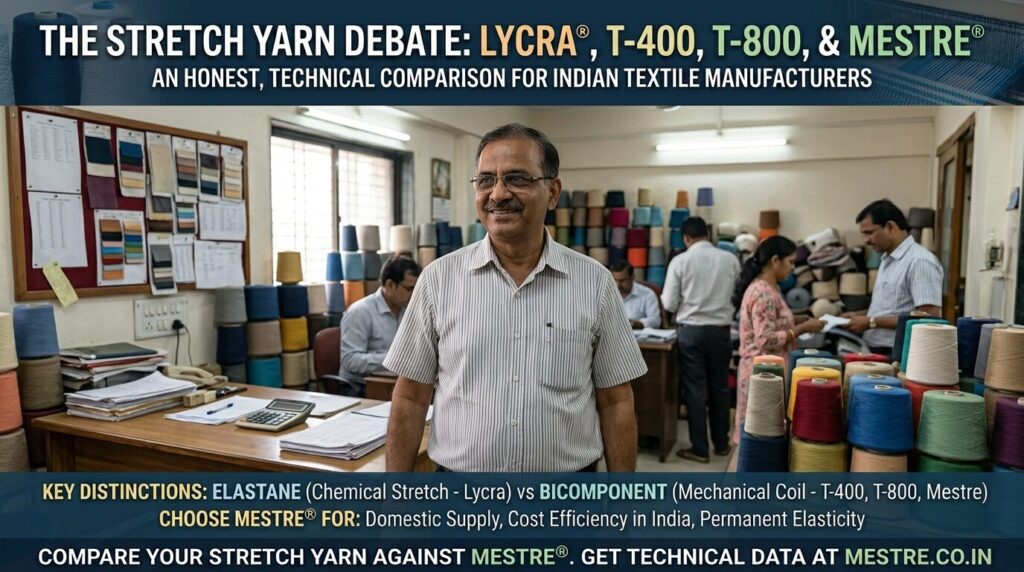
Walk into any yarn trading office in Surat, Tirupur, or Ludhiana and ask about stretch yarn you will get four names thrown back almost immediately: Lycra®, T-800, T-400, and increasingly, Mestre®. These four products represent different technological approaches to the same problem: how do you add stretch to a fabric while maintaining comfort, durability, and appearance?
This article breaks down all four honestly and technically so you can make an informed purchasing decision for your specific fabric and application.
The Fundamental Difference: Elastane vs Bicomponent
Before comparing individual products, understand the two fundamentally different ways stretch is created in yarn.
Chemical stretch (elastane): Lycra®, T-800, and T-400 are based on elastane a polyurethane synthetic that behaves like a rubber band at the fibre level. The polyurethane chains uncoil under stretch and snap back on release. This is powerful, but polyurethane degrades over time through washing, heat, chlorine, and UV light.
Mechanical stretch (bicomponent): Mestre® creates stretch through a three-dimensional coil crimp like a tiny spring embedded in the fibre through co-extrusion. The coil straightens under tension and returns to its coiled state on release. No rubber, no polyurethane. The stretch mechanism is permanent and does not degrade.
This is the most important distinction in the entire comparison. Everything else follows from it.
What is Lycra®?
Lycra® is Invista’s (formerly DuPont’s) trademarked brand name for elastane also called spandex in North America. It has been the industry default for stretch fabric since the 1960s, used at 2–10% content in blended fabrics.
Strengths:
- Extremely high elongation (up to 600%)
- Rapid, powerful recovery when fresh
- Very fine deniers available for lightweight fabrics
- Universally understood by manufacturers and consumers
- Brand recognition “Lycra” as a selling point on garment labels
Limitations:
- Degrades with repeated washing, chlorine exposure, and heat fabrics bag and lose recovery
- Cannot be dyed at the yarn stage must be dyed in fabric
- Entirely imported into India USD pricing, import duties, long lead times
- Poor resistance to perspiration and body oils
- Difficult to recycle in end-of-life garments
What are T-800 and T-400 by Invista?
T-400 and T-800 are bicomponent stretch yarns from Invista not elastane. They are made from two different polymers (PET and PTT) co-extruded to create a coil crimp structure. This makes them mechanically more similar to Mestre® than to Lycra®.
T-400: Invista’s flagship bicomponent yarn. Permanent stretch, chlorine resistance, soft hand, good wash durability.
T-800: A higher-performance variant with enhanced stretch and recovery, positioned for premium performance fabrics.
Strengths of T-400/T-800:
- Permanent elasticity does not degrade with washing
- Good compatibility with polyester dyeing processes
- Strong global brand recognition accepted by international buyers and brands
- Excellent wash durability
Limitations of T-400/T-800:
- Imported product significant landed cost premium in India (import duty + USD FX exposure)
- International lead times governed by Invista’s global supply chain
- Limited direct technical support in India
- Minimum order quantities may not suit smaller Indian manufacturers
What is Mestre® Bicomponent?
Mestre® is an elastomultiester bicomponent yarn manufactured in Surat, India. Like T-400 and T-800, it creates stretch through a mechanical coil crimp not through elastane chemistry. Unlike T-400 and T-800, it is manufactured in India.
The elastomultiester technology in Mestre® co-extrudes two polyester components with different thermal shrinkage characteristics, producing a coil crimp with very high uniformity and consistency. This means consistent stretch and recovery performance across every metre of a production run critical for colour and stretch uniformity in large fabric orders.
Mestre® also delivers a distinctive dry-touch, wool-feel effect at certain denier counts not found in T-400 or T-800 which tend to have a softer, more synthetic hand.
Full Performance Comparison Table
| Property | Mestre® | Lycra® | T-400 (Invista) | T-800 (Invista) |
|---|---|---|---|---|
| Fibre type | Bicomponent polyester | Elastane (polyurethane) | Bicomponent PET/PTT | Bicomponent PET/PTT |
| Stretch mechanism | Mechanical coil | Chemical polymer | Mechanical coil | Mechanical coil |
| Permanent elasticity | ✅ Yes | ❌ Degrades over time | ✅ Yes | ✅ Yes |
| Wash durability | Excellent | Moderate | Excellent | Excellent |
| Chlorine resistance | Good | Poor ❌ | Excellent | Excellent |
| Moisture management | Excellent ✅ | Poor | Good | Good |
| Dyeability | Excellent | Requires separate process | Good | Good |
| Heat resistance | Excellent | Moderate | Good | Good |
| Hand feel | Dry-touch / wool-feel | Smooth / rubbery | Soft / synthetic | Soft / synthetic |
| Made in India | ✅ Yes | ❌ No | ❌ No | ❌ No |
| Pricing currency | INR ✅ | USD (import) | USD (import) | USD (import) |
| Import duty exposure | None ✅ | Yes | Yes | Yes |
| Lead time | Domestic ✅ | Import | Import | Import |
| India technical support | Direct ✅ | Limited | Limited | Limited |
| Relative cost in India | Most competitive ✅ | Moderate + duties | High + duties | Highest + duties |
When to Use Mestre® Instead of Lycra®
Choose Mestre® when:
- You need permanent elasticity that survives 50+ wash cycles
- Your application involves moisture management (sportswear, activewear)
- You want to eliminate denim bagging
- You need consistent dyeability across large production runs
- You want domestic supply with no currency risk
Choose Lycra® when:
- Ultra-fine denier for lightweight intimate apparel
- Buyer specifically mandates “Lycra” brand endorsement on the label
- Very high elongation (300%+) is technically required
When to Use Mestre® Instead of T-400 / T-800
Choose Mestre® when:
- Supply chain security and domestic sourcing are priorities
- INR pricing is needed to avoid currency hedging costs
- Your production volume suits domestic Indian MOQs
- You need responsive technical support in India
- You want to reduce landed cost vs imported bicomponent options
Choose T-400 or T-800 when:
- Export fabrics for brands that specifically require Invista-certified yarn
- Swimwear requiring exceptional chlorine resistance
- International brand audits require Invista certification
Conclusion
For the vast majority of Indian textile manufacturers producing stretch denim, sportswear, athleisure, knitted fabrics, formal wear, or medical textiles Mestre® is the most technically sound and commercially practical stretch yarn choice.
It delivers the permanent elasticity of T-400 and T-800 without the import premium. It eliminates the durability problems of Lycra®. And it is backed by the Madhusudan Group’s 50+ years of textile manufacturing expertise, with domestic supply, INR pricing, and direct technical support.
The case for choosing an imported alternative over Mestre® is narrow, specific, and exceptions-based. For everything else choose Mestre®.
Compare your current stretch yarn against Mestre®. Request a technical sample and datasheet at mestre.co.in or WhatsApp +91 63524 89832.