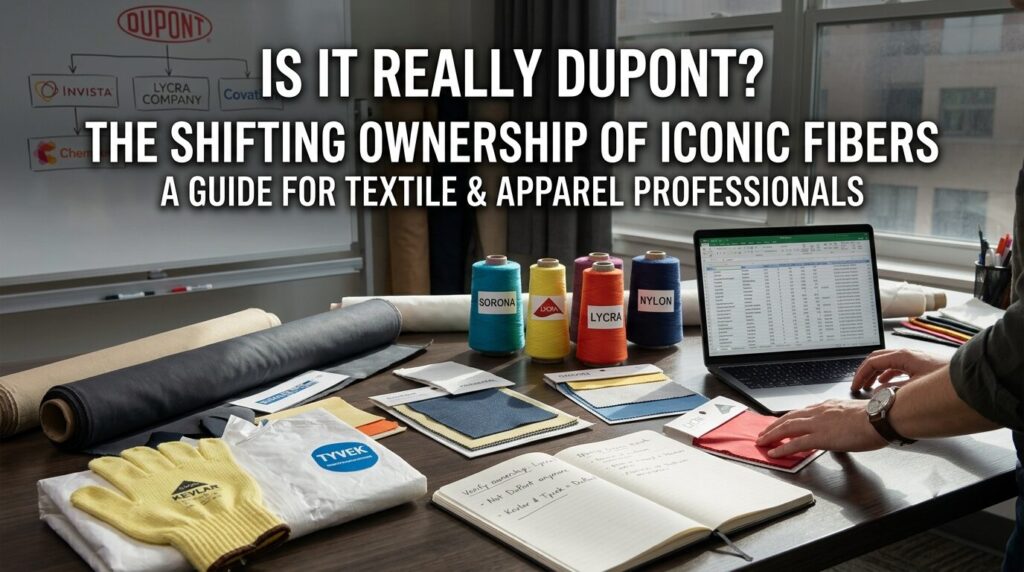
Ask someone in the fabric trade where a stretch fiber came from, and “DuPont” comes up constantly often incorrectly, in the present tense. DuPont Textile built more foundational textile chemistry than almost any company in history, but a series of corporate divestitures over the last two decades means the company barely touches consumer fiber production anymore. Understanding what DuPont actually invented, and who owns those inventions today, matters for anyone sourcing materials, writing product copy, or just trying to get a hangtag claim right.
The Original Innovation Engine
DuPont’s fiber science division, active for most of the 20th century, produced a run of materials that reshaped entire industries:
- Nylon (1935), the first fully synthetic fiber, developed by Wallace Carothers’ team and famously commercialized in women’s stockings before becoming essential in everything from parachutes to carpet backing.
- Lycra (1958), the original spandex fiber, invented by chemist Joseph Shivers as a lighter, more durable alternative to rubber thread.
- Kevlar (1965), an aramid fiber used in body armor and industrial reinforcement, developed by Stephanie Kwolek.
- Tyvek (1955, commercialized later), a flash-spun polyethylene material used in protective apparel, envelopes, and construction wrap.
- Sorona (early 2000s), a partially plant-based polyester alternative built on DuPont’s proprietary PDO fermentation chemistry.
- T-400 / Elasterell-p (2000), a bicomponent polyester fiber engineered to deliver spandex-like stretch without using elastane.
That’s an unusually deep bench of material science for one company, spanning nearly seven decades of continuous R&D investment.
The Breakup: Why DuPont Isn’t a Fiber Company Anymore
The story most people miss is what happened after these inventions matured into commercial businesses. DuPont has restructured itself repeatedly since the early 2000s, spinning off or selling almost every textile-facing division it once controlled.
Invista (2004). DuPont sold its nylon and spandex businesses including the Lycra brand to Koch Industries for roughly $4.2 billion, forming Invista. This single transaction moved nylon fiber, Lycra spandex, Coolmax, Thermolite, and Tactel out of DuPont’s hands entirely.
Chemours (2015). DuPont spun off its performance chemicals division, including Teflon fluoropolymer technology (relevant to some water-repellent textile finishes), into a separate public company called Chemours.
DowDuPont merger and split (2017–2019). DuPont merged with Dow Chemical, then split the combined entity into three separate public companies: Dow, Corteva (agriculture), and a “new” DuPont focused on electronics and specialty materials none of which retained a consumer textile fiber business.
Biomaterials sale (2019 announced, 2022 closed). DuPont sold its Sorona and related biomaterials assets to Huafon Group, a Chinese spandex manufacturer, for around $240 million. The business now operates as Covation Biomaterials.
Lycra’s second and third sale. After Invista owned the Lycra brand for over a decade, Shandong Ruyi, a Chinese textile conglomerate, bought it from Invista/Koch in 2019 for roughly $2.6 billion. Ruyi then defaulted on the acquisition debt, and creditors including China Everbright and Lindeman Partners took control of The Lycra Company in 2022.
The practical result: today’s DuPont de Nemours, Inc. is a specialty materials and electronics company. It does not manufacture nylon, Lycra, or Sorona fiber. Those businesses exist under Invista, The Lycra Company, and Covation Biomaterials respectively separate companies with separate ownership, even though some products still carry legacy “DuPont” branding in older marketing materials or informal trade usage.
Why the Confusion Persists
Two things keep the DuPont name attached to fibers it no longer owns. First, trademark licensing: some successor companies retained rights to reference “DuPont™” in specific branded product names for a transition period, or the habit simply persisted in trade publications and supplier catalogs long after the underlying deal closed. Second, industry inertia mills, brokers, and even some brand marketing teams continue using “DuPont Sorona” or “DuPont Lycra” out of habit, since those phrases still test well with consumers who recognize the name from decades of advertising.
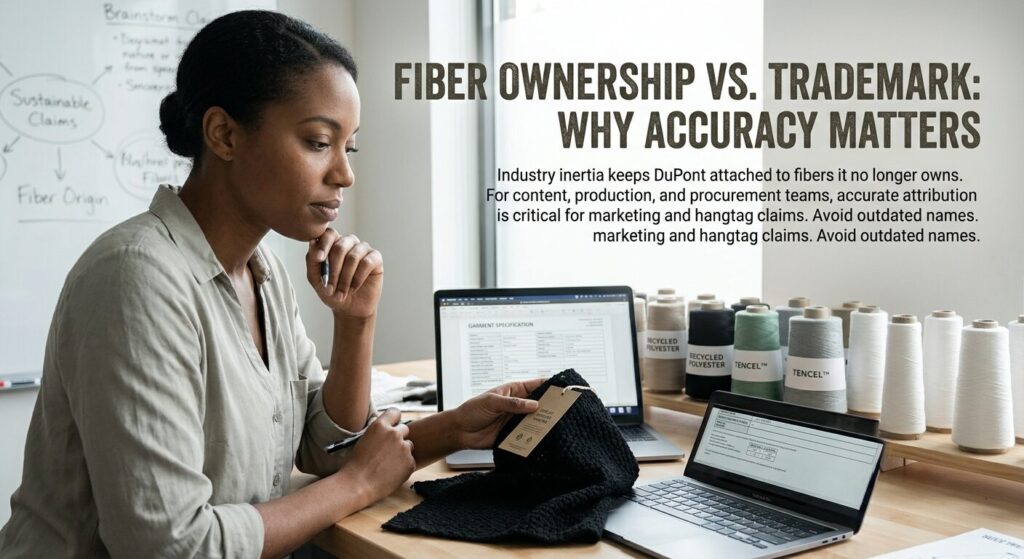
For content creators, product developers, and procurement teams, this distinction actually matters. If you’re writing a hangtag, spec sheet, or marketing claim referencing fiber origin, using outdated ownership attribution can create real accuracy problems, especially for sustainability or “Made in USA” claims that depend on current manufacturing location and ownership.
What DuPont Actually Makes Today
Post-restructuring, DuPont’s remaining business lines sit almost entirely outside apparel and home textiles: semiconductor materials, industrial adhesives, water filtration membranes, and safety/protective equipment materials like Nomex and Kevlar (which DuPont retained, unlike the nylon and spandex lines). Tyvek also remained with DuPont and continues to be manufactured and marketed directly by the company, primarily for protective apparel, construction, and packaging applications rather than fashion.
A Quick Reference: Who Owns What Now
| Nylon (Invista-era) | Invista (Koch Industries) |
| Lycra spandex | The Lycra Company (creditor consortium since 2022) |
| Sorona | Covation Biomaterials (Huafon Group) |
| T-400 | The Lycra Company |
| Kevlar, Nomex | DuPont de Nemours, Inc. |
| Tyvek | DuPont de Nemours, Inc. |
| Teflon | Chemours |
The Takeaway
DuPont’s textile legacy is real and enormous arguably the single most influential fiber R&D program of the 20th century. But the company that built that legacy and the company that carries the name today are not doing the same work. If you’re sourcing materials, fact-checking marketing copy, or building content around any of these fiber names, verify current ownership before publishing. In an industry where “DuPont” has functioned almost like a generic seal of quality for decades, getting the current corporate reality right is what separates credible sourcing content from outdated copy-paste.