SYS yarn is one of those trade names that shows up on a quotation long before it shows up on a datasheet. It usually appears beside two other codes, SSY and SPH, and buyers are left guessing whether they are looking at three different yarns or one yarn with three labels. Mills that guess wrong end up with fabric that barely stretches, or with a yarn that behaves differently from the previous lot.
This guide clears up the confusion. You will learn what SYS yarn is, how a filament that looks like ordinary polyester on the cone becomes a stretch fabric after dyeing, where it works well, where it falls short, and what to verify before you place an order. If you want the wider technology background first, start with our complete guide to bicomponent yarn.
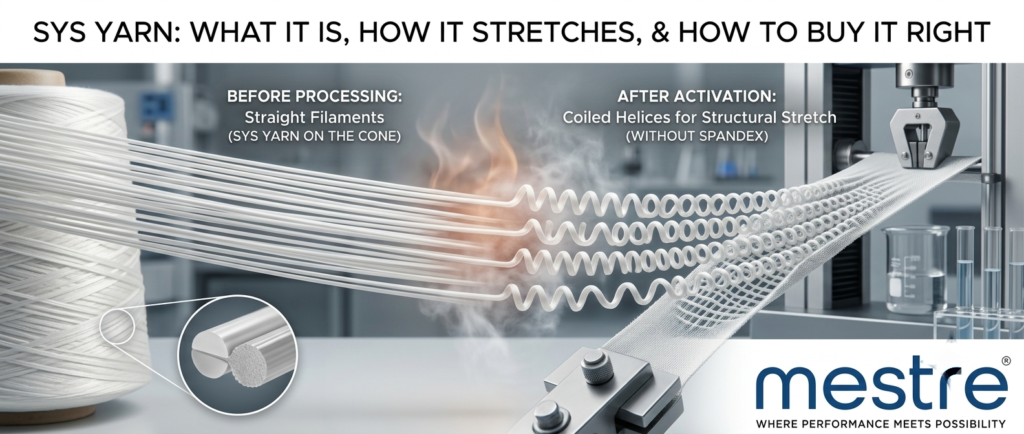
Quick answer: SYS yarn is a polyester bicomponent (two-component) filament yarn. Two polyesters with different heat-shrinkage rates are spun side by side in every filament. On the cone it behaves like plain polyester, but once dyeing and finishing relax it with heat and moisture, each filament curls into a permanent spiral and the fabric gains stretch and recovery without spandex. Suppliers sell it interchangeably as SYS, SSY and SPH.
What is SYS yarn?
SYS yarn is a continuous-filament polyester yarn designed to stretch without elastane. The letters are trade shorthand rather than a standard. Supplier literature describes it as a PET two-component fibre that the market also calls SPH or SSY, made from a low-viscosity and a high-viscosity polyester that shrink at different rates. (Intrinsic viscosity, or IV, is a measure of polymer chain length.)
Three points are worth fixing in your mind before going further:
- It is a category, not a brand. Many factories make yarn under these names and their specifications differ. Two lots labelled “SYS 80D/36F” from two suppliers are not automatically interchangeable.
- It is not elastane. There is no polyurethane in the yarn. The stretch is structural, created by the shape of the filament rather than by a rubbery polymer.
- The stretch is latent. Before processing, SSY-type yarn has almost no more elasticity than ordinary polyester yarn. The crimp appears only after high-temperature dyeing and washing, according to supplier explainers such as this SSY overview.
SYS belongs to the wider family of bicomponent, self-crimping polyester yarns often described as “mechanical stretch”. If that vocabulary is new, our explainers on what bicomponent yarn is and what elastomultiester means fill in the gaps. Depending on its exact structure and test results, a yarn like this may be declared as elastomultiester in fibre-content labelling, so confirm the correct declaration with the supplier’s documentation and your compliance team.
How SYS yarn creates stretch
Stretch in SYS yarn comes from geometry, not chemistry. It develops in four stages.
- Composite spinning. Two polyester melts of different intrinsic viscosity are extruded through the same spinneret hole and bond along their length in one filament. Side by side is only one bicomponent layout; sheath-core and islands-in-the-sea are others, covered in our guide to bicomponent fibre types and structures.
- Drawing and winding. The filaments are drawn and wound into packages that can be twisted, warped, woven or knitted. At this point the yarn looks and feels like regular polyester filament yarn.
- Latent state. The two sides want to shrink by different amounts, but while the yarn is held straight on the cone or under loom tension nothing stretchy is visible.
- Activation. When the fabric relaxes in hot, wet processing such as jet dyeing, the higher-shrinkage side contracts more. The filament curls into a helix, the way a bimetal strip bends when heated. Countless tiny springs now sit inside the fabric: pull it and the coils open, release it and they close.
Britannica’s entry on stretch yarn describes a similar spring-like crimp, produced there by twisting, heat-setting and untwisting rather than by bicomponent spinning.
What this means in the mill
- Stretch is made in finishing. The grey fabric can be woven or knitted like any polyester fabric, but the construction must leave room to relax. A very dense structure can lock the crimp in place and leave a fabric with little give.
- Heat-setting is a stretch decision. Over-tensioned or over-hot setting can pull crimp out of the yarn. One supplier’s processing note advises keeping the setting temperature at or below about 170 °C to avoid excessive stretching. Treat that as a starting point and follow your supplier’s current datasheet.
- Twist changes the crimp. Supplier literature notes that SSY-type yarn keeps moderate elasticity after strong twisting while gaining drape, so twisted versions are often chosen where drape matters.
- The principle is not unique to SYS. For a deeper look at how crimp geometry translates into fabric behaviour, read how mechanical stretch textiles work.
SYS, SSY, SPH and CEY: sorting out the names
Supplier catalogues usually list SSY, SPH and SYS together as one product group, and add CEY as a related composite. The table below summarises how the names are commonly used. Confirm everything against the supplier’s own datasheet, because usage is not standardised.
| Name | How it is commonly described | Typical use |
| SYS | PET two-component elastic yarn (low-IV and high-IV polyester, different shrinkage), side-by-side cross-section | Woven and knitted stretch fabrics for men’s and women’s wear |
| SSY | PET side-by-side composite fibre that forms a permanent crimp after high-temperature dyeing and washing | Stretch shirts, suits, trousers |
| SPH | Two different elastic polyesters combined for durable, easy-to-crimp elasticity | Summer shirts, dresses, spring and autumn trousers |
| CEY | Composite elastic yarn, typically listed as POY combined with an SSY/SPH/SYS-type yarn, for a glossier, drapier fabric | Suits, jackets, dresses; weaving and circular knitting |
| T400-type | PET paired with PTT (some suppliers list PBT variants), a different polymer pair | Stretch wovens and knits where high recovery and softness are targeted |
For a buyer, the practical rule is simple: treat SYS, SSY and SPH as one family, but never as one specification. Ask each supplier which polymers are used, what the shrinkage differential is and what the yarn is designed to do. If T400-type yarns are on your shortlist too, see our comparison of Mestre with Lycra T800 and T400.
Typical SYS yarn specifications
Supplier listings show SYS, SSY and SPH-type yarns in fine deniers such as 75D/36F, 80D/24F, 80D/36F and 80D/48F, with heavier 160D/72F constructions also offered. CEY variants run from about 75D/36F up to 180D/106F, and some suppliers list twisted versions across a wide range of turns per metre. Yarn is usually offered in semi-dull (SD) or full-dull (FD) lustre, often as raw white for dyeing in the mill.
Read “80D/36F” as 80 denier spread over 36 filaments. More filaments in the same denier generally mean a softer hand.
When you request a datasheet, look for these fields:
| Specification | Why it matters |
| Denier and filament count | Sets fabric weight, hand and cover |
| Polymer pair and IV | Determines the shrinkage differential that drives the crimp |
| Boiling-water shrinkage | Indicates how much crimp will develop on relaxation |
| Tenacity and elongation | Affects weaving and knitting efficiency and end breaks |
| Lustre (SD or FD) | Controls appearance and dye depth |
| Twist (if twisted) | Alters stretch level, drape and torque |
| Lot traceability | Essential for shade and stretch consistency |
Key properties of SYS yarn
Stretch and recovery
SYS-type yarn is designed for comfort stretch: enough give for movement and fit, with a good return to shape. Because the crimp is part of the filament structure, the stretch does not depend on an elastomer that can degrade over time. The honest caveat is that structural stretch generally has less power than spandex, so it suits garments that need ease of movement rather than compression.
Hand feel and drape
Fine filaments and a dry, slightly crisp touch are typical. Supplier notes highlight good drape, and higher twist increases it. Filament count, lustre and finishing all shift the handle, so judge by fabric samples in your own construction rather than by brochures.
Dyeing
Both components are polyester, so SYS yarn takes disperse dyes like standard polyester. The absence of elastane removes several headaches familiar from spandex blends, including sensitivity to setting temperature and the different dye behaviour of the elastane fraction. It still pays to dye-test every lot, because differences in polymer or shrinkage between lots can show up as shade or stretch variation.
Durability and ageing
Supplier literature says the crimp is permanent and that the yarn ages less readily than spandex. It also cites resistance to sunlight, alkali and chlorine bleaching. Treat these as claims to validate with your own wash and exposure tests, not as guarantees.
Sustainability profile
Because a fabric can be 100% polyester with no elastane, it avoids the multi-fibre blend that complicates recycling. That can simplify end-of-life options, though it does not make any fabric automatically recyclable, and virgin polyester is still a petroleum-based material. Some suppliers list versions containing recycled polyester; if your buyers require it, ask for certification. Our guide to sustainable elastomultiester stretch fabrics explains the trade-offs in more depth.
Where SYS yarn is used
SYS-type yarns are most often seen in light to mid-weight fashion fabrics where comfort stretch matters more than power:
- Stretch shirting and blouses. Summer shirt fabrics are a classic SPH and SSY application.
- Dresses and skirts. Twisted and CEY-type versions add drape.
- Trousers and suiting. Spring and autumn trouser fabrics, suits and jackets are commonly listed uses.
- Non-spandex twill wovens. Suppliers name twill stretch fabric without spandex as a typical weaving route.
- Knitted fabrics. Circular and warp knitting are both listed, with the yarn used as a base yarn or in twisted form.
Suppliers position these yarns as a replacement for spandex-covered yarn and conventional mechanical-stretch yarn in suitable fabrics. If your target is denim, workwear, sportswear or hosiery, other constructions may fit better. Our guides to stretch yarn for denim, mechanical stretch yarn for workwear and PPE, bicomponent yarn for sportswear and stretch yarn types for Indian hosiery cover those end uses.
How to process SYS yarn
The details below are general starting points. Your supplier’s datasheet and your own trials always come first.
Weaving
Suppliers say SYS-type yarn can be twisted for warp and weft on water-jet and air-jet looms, used directly as weft, and sized for warp use. Keep weft insertion and take-up tension steady, because uneven tension produces uneven crimp and visible barré. Build the fabric with room to relax, and weave a sample length before committing to bulk warps.
Knitting
Circular and warp knitting machines can run the yarn directly or in twisted form. Hold feed tension constant, run a stitch-length trial, and measure the relaxed dimensions after wet processing, since the fabric will contract as the crimp develops.
Dyeing and finishing
Relax the fabric under low tension at dyeing temperature so the crimp can develop fully; jet dyeing is the usual route for polyester. Avoid stentering at excessive temperature or width. Finally, measure stretch and recovery on the finished fabric and adjust the grey specification accordingly.
Common problems and what to check
| Problem | Likely causes | What to check |
| Low stretch in finished fabric | Dense construction, insufficient relaxation, over-hot or over-tensioned setting | Ends and picks, relaxation step, setting temperature and width |
| Stretch but weak recovery | Over-tension in finishing, stretch demand beyond comfort-stretch range | Finishing tension, target stretch, yarn spec |
| Shade or stretch variation between rolls | Mixed lots, lot-to-lot shrinkage difference | Lot traceability, dye-test each lot |
| Puckering or uneven surface | Tension variation, uneven relaxation | Loom or machine tension, batch loading in the jet |
| Width shrinkage higher than planned | Relaxation shrinkage underestimated | Trial run and shrinkage calculation before bulk |
SYS yarn vs spandex and other stretch yarns
Choosing a stretch system means trading power, processing ease and end-of-life. This table gives a general comparison; individual products vary.
| Feature | SYS-type (PET/PET) | T400-type (PET/PTT) | Spandex / elastane |
| Stretch mechanism | Structural crimp from differential shrinkage | Structural crimp; PTT is often credited with good elastic recovery | Elastomeric polyurethane |
| Typical stretch level | Comfort stretch | Comfort to moderate | High, including power stretch |
| Contains elastane | No | No | Yes |
| Processing sensitivity | Manage setting temperature and tension | Manage setting temperature and tension | Very sensitive to heat; limits setting and dyeing conditions |
| Dyeing | Disperse dyes, polyester-like | Disperse dyes, polyester-like | Elastane fraction behaves differently |
| Chlorine and ageing | Supplier claims good resistance | Supplier claims good resistance | Known to degrade with chlorine and heat over time |
| End-of-life | Mono-material possible | Mono-material possible | Blend complicates recycling |
To go deeper, read what elastane, spandex and Lycra are, the comparison of elastane vs polyester fabric, and our breakdown of mechanical stretch yarn vs chemical stretch yarn. For background on polyester yarn types generally, Fibre2Fashion’s polyester yarn guide is a useful neutral reference.
Advantages and limitations of SYS yarn
Advantages
- No elastane, so fabric construction and dyeing stay close to standard polyester practice
- Permanent, structural crimp with good recovery for comfort stretch
- Works in wovens and knits, twisted or untwisted
- Potential for mono-material polyester fabrics
- Widely marketed, so buyers can compare several suppliers
Limitations
- Lower stretch power than spandex
- Final stretch depends heavily on construction and finishing
- Specifications and quality differ between suppliers
- Lot-to-lot variation can appear as shade or stretch differences
- Requires sampling and trials for every new construction
How to buy SYS yarn: a practical checklist
- Get the datasheet, not just the name. Ask for denier, filament count, lustre, polymer pair, boiling-water shrinkage, tenacity and elongation.
- Ask for fabric-level evidence. A yarn spec alone does not tell you how much stretch your fabric will have. Request a reference fabric or trial data.
- Trial in your own construction. Use your loom or knitting machine, your dyeing recipe and your finishing route.
- Test properly. Measure stretch, growth and recovery on the finished fabric, for example with the strip methods in ISO 20932-1:2018, and repeat after multiple wash cycles.
- Check chemical compliance. If your end market requires it, ask for OEKO-TEX STANDARD 100 documentation and verify the certificate with the certifier.
- Test three lots. Consistency is the real quality measure. Compare shrinkage, dye uptake and stretch across lots.
- Compare landed cost. Price per kilogram is only one line; add freight, duties, inventory carrying cost and the cost of rework or claims.
- Confirm support. Who will visit the mill or join a video call when a lot misbehaves, and how are claims handled?
Sourcing SYS yarn in India
Supplier directories show many SYS, SSY and SPH listings from Chinese manufacturers. For Indian mills that means import logistics: production and shipping time, port and customs clearance, currency exposure and the practical difficulty of getting a technician onto the shop floor when a lot misbehaves. None of that makes imported yarn a poor choice, but it should be priced into the decision. Check current duty and compliance requirements with your customs advisor before committing.
If you would rather work with a domestic manufacturer, see our overview of stretch yarn manufacturers in India and our note on Mestre versus generic yarn suppliers.
Where Mestre fits in
Mestre® is the branded bicomponent elastomultiester yarn made by Madhusudan Group in Surat. It rests on the same broad principle as SYS, two polyester components with different shrinkage that create mechanical stretch without elastane, but it comes from a single accountable manufacturer rather than from a category of interchangeable suppliers. To see how the two compare in detail, read Mestre vs SYS, or start with what Mestre bicomponent yarn is.
Frequently asked questions about SYS yarn
What does SYS yarn stand for?
There is no universal expansion. SYS is supplier shorthand, used alongside SSY and SPH for a PET two-component elastic yarn. Rather than relying on the letters, ask for a datasheet that names the polymers, denier, filament count and shrinkage behaviour.
Is SYS yarn the same as SSY or SPH?
They are generally sold as one family, and many listings quote all three together, but they are not a standardised trio. Compare datasheets before treating them as interchangeable.
Is SYS yarn spandex?
No. SYS yarn contains no elastane or polyurethane. Its stretch comes from the spiral crimp created by two polyesters with different shrinkage.
Does SYS yarn stretch straight off the cone?
Very little. The stretch develops after heat and moisture treatment, mainly during dyeing and finishing, so always judge stretch on finished fabric.
Can SYS yarn replace spandex?
For comfort-stretch shirting, trousers and dresses it often can. For compression, shapewear or swimwear that needs high stretch power, spandex or covered elastane yarns remain the standard tool. Our comparison of mechanical and chemical stretch helps you decide.
What is CEY yarn?
CEY is a composite elastic yarn typically built on an SSY-type base and combined with another yarn component. Suppliers market it for a glossier, drapier fabric used in suits, jackets and dresses.
Is SYS yarn safe to wear?
Safety depends on dyes, finishes and compliance testing more than on the yarn structure. Ask for chemical compliance documentation, and read our article on whether elastomultiester is safe for the breathability and microplastics questions.
How is SYS yarn different from textured (DTY) polyester yarn?
Textured yarn such as DTY gets its bulk and stretch from false-twist texturing, so the crimp is already in the yarn when it ships. SYS-type yarn is usually quoted as a flat, fully drawn filament yarn (FDY) in supplier listings, and its crimp stays latent until wet heat treatment.
Is SYS yarn the same as T400?
No. Both use the bicomponent principle, but the polymer pairs differ: T400-type yarns pair PET with PTT (T400 is a branded example), while suppliers describe SYS-type yarns as two polyesters of different viscosity. Compare datasheets rather than assuming equivalence.
Conclusion
SYS yarn is a useful, widely available way to get comfort stretch without elastane, but it is a category rather than a single product. Its performance depends on the polymer pair, the shrinkage differential, your fabric construction and your finishing route, so specification and trials matter more than the three letters on the label.
If you are weighing it against a domestic option, continue with Mestre vs SYS, or talk to the Mestre team about a sample matched to your construction.