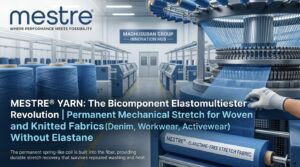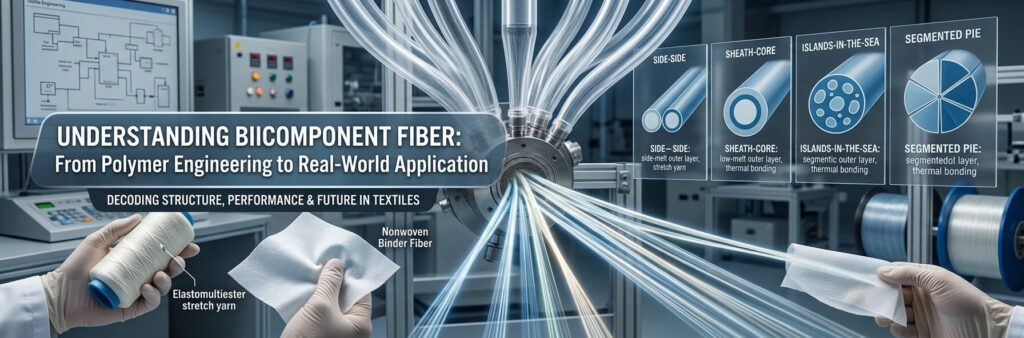

“Bicomponent fiber” is one of the most-searched terms in technical textiles, but most published content jumps straight to specific applications stretch yarn, nonwoven bonding without explaining what makes a fiber “bicomponent” in the first place. This guide starts at the fiber-engineering level and works outward to real examples.
Bicomponent Fiber: Definition
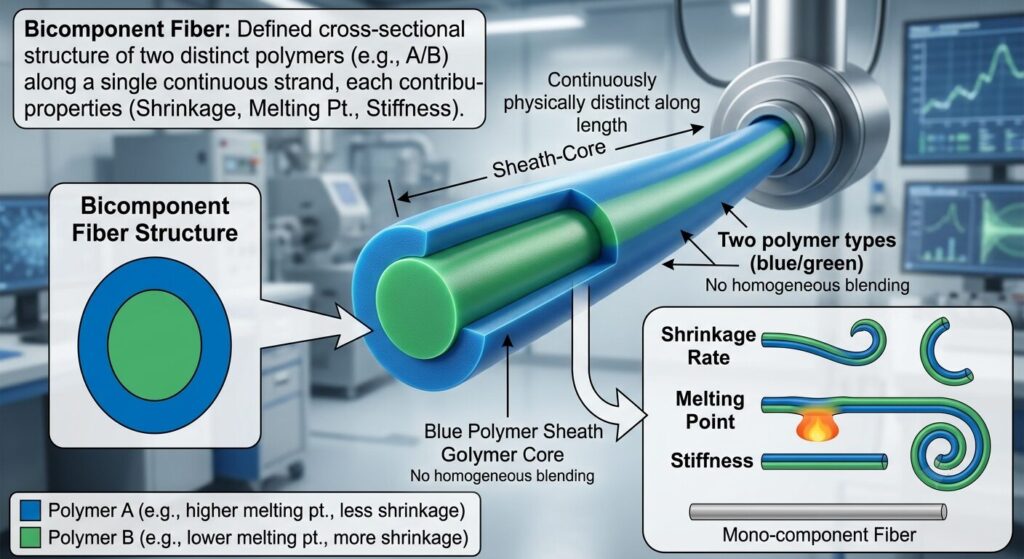
A bicomponent fiber is a filament extruded from two distinct polymers or two variants of the same polymer with different properties arranged in a defined cross-sectional structure within a single continuous fiber, rather than blended into one homogeneous strand. The two components stay physically distinct along the full length of the filament, each contributing a different property (shrinkage rate, melting point, or stiffness) to the finished fiber’s behavior.
Bicomponent Fiber vs Biconstituent Fiber What’s the Difference?
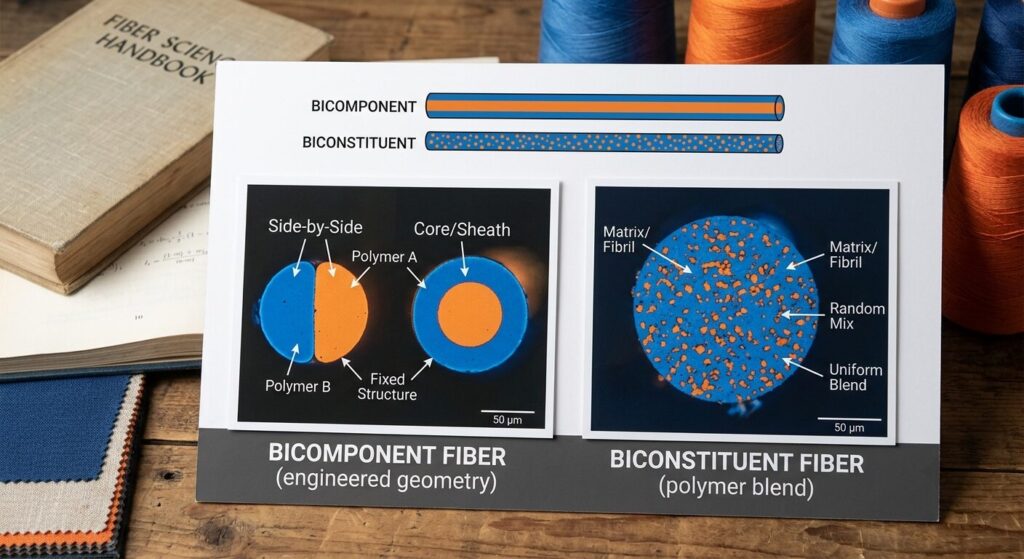
This is one of the most common points of confusion. A true bicomponent fiber keeps its two polymers in a fixed, engineered geometry side by side, or one surrounding the other for the fiber’s entire length. A biconstituent fiber (sometimes called a matrix/fibril or blend fiber) instead mixes two polymers together before extrusion, so the composition is uniform throughout the cross-section rather than structurally separated. Bicomponent fibers are engineered for a specific mechanical effect from the separation itself (like stretch or bonding); biconstituent fibers are closer to a polymer blend spun as a single fiber.
The Main Bicomponent Fiber Structures
| Structure | How It’s Built | Primary Effect |
| Side-by-side (S/S) | Two polymers extruded next to each other, sharing a flat interface | Mechanical crimp / stretch used in elastomultiester and elasterell-p stretch yarns |
| Sheath-core (S/C) | One polymer fully surrounds a core of the other | Low-melt outer sheath for thermal bonding used in nonwoven binder fibers |
| Islands-in-the-sea | Many fine filaments (“islands”) embedded in a dissolvable matrix (“sea”) | Ultra-fine microfiber production, e.g. suede-like fabrics |
| Segmented pie | Wedge-shaped segments of alternating polymer around a cross-section | Splits into multiple ultra-fine filaments after processing |
Bicomponent Fiber Examples
- Elastomultiester / elasterell-p stretch yarn side-by-side structure, used for spandex-free comfort stretch in denim, shirting and hosiery
- Low-melt binder fiber sheath-core structure, used to thermally bond nonwoven fabrics for hygiene products, filtration and geotextiles without adhesives
- Microfiber suede fabric islands-in-the-sea structure, split into ultra-fine filaments for a soft, suede-like hand-feel
- Bicomponent FDY (fully drawn yarn) filament used in technical and performance textiles requiring both strength and a specific surface or bulk property
Bicomponent Fiber vs Bicomponent Yarn What’s the Difference?
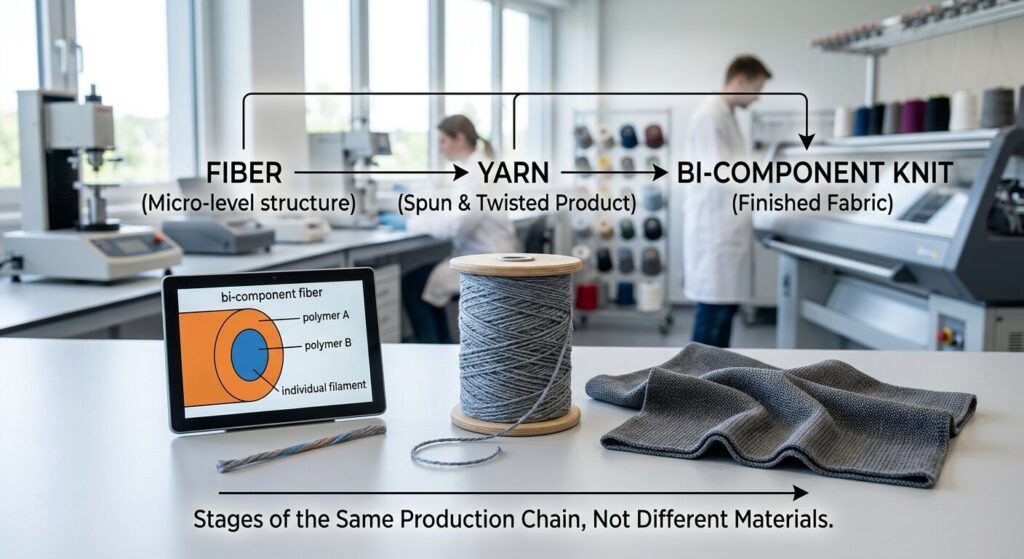
“Fiber” describes the polymer-engineering level the individual filament’s cross-sectional structure. “Yarn” describes the spun, twisted or wound product made from that fiber, ready to be knitted or woven into fabric. A “bi-component knit” simply means a knitted fabric made from yarn spun from bicomponent fiber the terms describe different stages of the same production chain, not different materials.
The Bicomponent Fiber Market

Independent market research values the global bicomponent fiber market at roughly USD 2.9 billion in 2026, with mid-single-digit annual growth projected through the early 2030s, driven primarily by nonwoven hygiene products, filtration, technical textiles and stretch apparel applications. Apparel-grade side-by-side stretch fiber (the elastomultiester/elasterell-p category) is one of several structural sub-segments within that broader market, alongside sheath-core binder fibers and islands-in-the-sea microfiber production.
How Bicomponent Fibers Are Manufactured
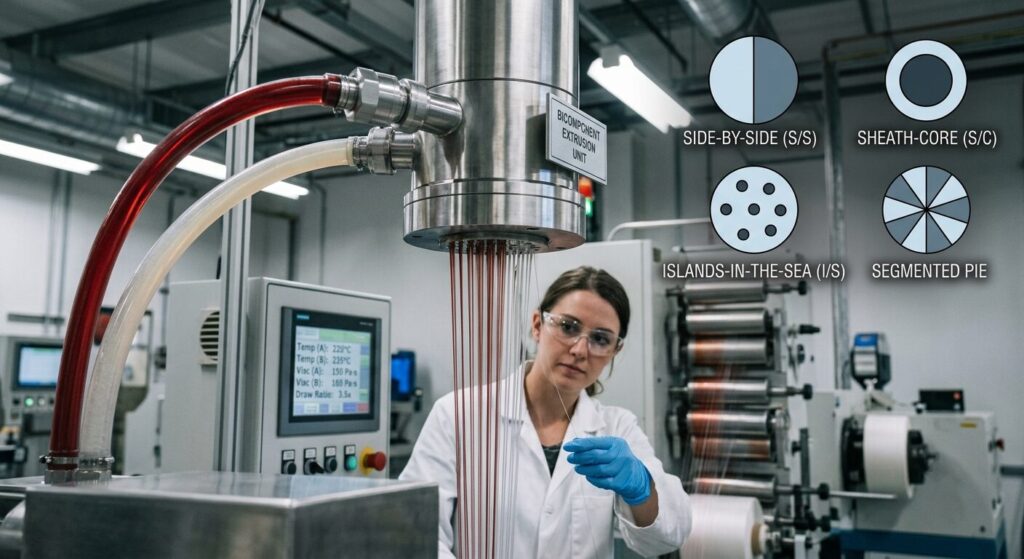
Bicomponent fibers are produced on specialized spinnerets with two separate polymer feed channels that merge just before extrusion, so each filament emerges with its two polymer components already locked into the intended cross-sectional geometry side-by-side, sheath-core, islands-in-the-sea, or segmented pie. Getting the geometry right depends on carefully matching the viscosity and melt temperature of both polymers; too large a mismatch and the filament can twist unpredictably or break during drawing. After extrusion, the filament is drawn and, for side-by-side stretch fibers, the differential shrinkage between the two polymer components sets the permanent helical crimp that gives the finished yarn its mechanical stretch.
Applications Beyond Apparel

While stretch apparel yarn is the most consumer-visible use, bicomponent fiber technology shows up across a much wider range of industries. Sheath-core bicomponent fibers with a low-melt outer layer are a standard component in nonwoven hygiene products diapers, wipes and medical drapes where they thermally bond fabric layers together without adhesives. Islands-in-the-sea bicomponent fibers are split down into ultra-fine microfilaments used in synthetic suede, high-end cleaning cloths and filtration media. Segmented-pie structures serve similar ultra-fine-filament markets. In each case, the same core principle applies: combining two polymers in one filament produces a property bonding, softness, filtration efficiency, or stretch that neither polymer could deliver on its own.
Advantages and Limitations of Bicomponent Fiber
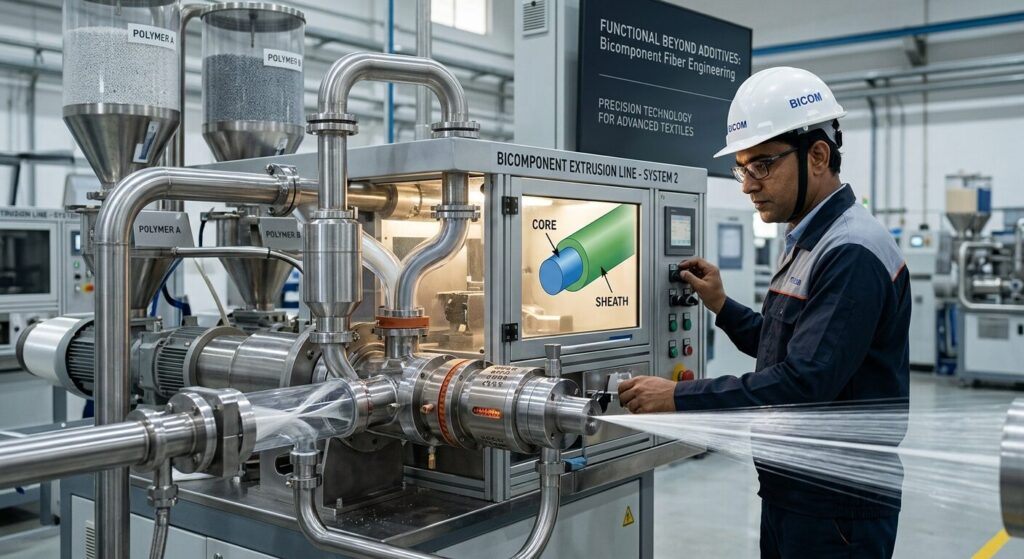
The main advantage of bicomponent fiber engineering is that it builds a functional property directly into the filament’s physical structure rather than relying on a separate additive fiber, chemical treatment, or blended component which is what makes spandex-free stretch, adhesive-free nonwoven bonding, and ultra-fine microfiber production all possible from otherwise ordinary polymers. The trade-off is manufacturing complexity: bicomponent spinning requires precision equipment and tighter process control than single-polymer fiber production, which historically kept it a more specialized, higher-cost category. As bicomponent spinning capacity has expanded globally, that cost premium has narrowed considerably, making bicomponent fiber increasingly cost-competitive with conventional blended alternatives across denim, hosiery and technical textile applications.
How to Identify Bicomponent Fiber on a Garment Label

Bicomponent fiber rarely appears by that name on a retail care label labels typically list the generic fiber category instead, such as “elastomultiester” for side-by-side stretch fiber, or simply “polyester” for a sheath-core nonwoven component that never reaches consumer apparel labeling at all. If a garment’s label lists elastomultiester, biconstituent polyester, or a branded name like elasterell-p, that’s a strong signal the stretch is coming from bicomponent fiber engineering rather than a separate elastane strand worth checking for shoppers specifically seeking spandex-free stretch apparel.
Is Bicomponent Fiber More Expensive Than Regular Fiber?
It can carry a modest cost premium over single-polymer fiber of the same weight, reflecting the more precise spinning equipment and process control bicomponent extrusion requires. That premium has narrowed significantly as global bicomponent spinning capacity has expanded, and for applications like spandex-free stretch denim, the premium is frequently offset by lower long-term costs elsewhere in the supply chain specifically, easier end-of-life recycling and typically longer garment life than an elastane-blended equivalent.
FAQ For What Is Bicomponent Fiber?
Q: What is a bicomponent fiber example?
A: Elastomultiester stretch yarn (side-by-side structure) and nonwoven binder fiber (sheath-core structure) are two of the most common commercial examples.
Q: What is the difference between bicomponent and biconstituent fiber?
A: Bicomponent fibers keep two polymers physically separated in an engineered structure along the fiber’s length; biconstituent fibers blend the two polymers into one uniform strand.
Q: Is bicomponent fiber the same as bicomponent yarn?
A: No fiber is the individual filament’s polymer structure; yarn is the spun product made from that fiber, ready for knitting or weaving.