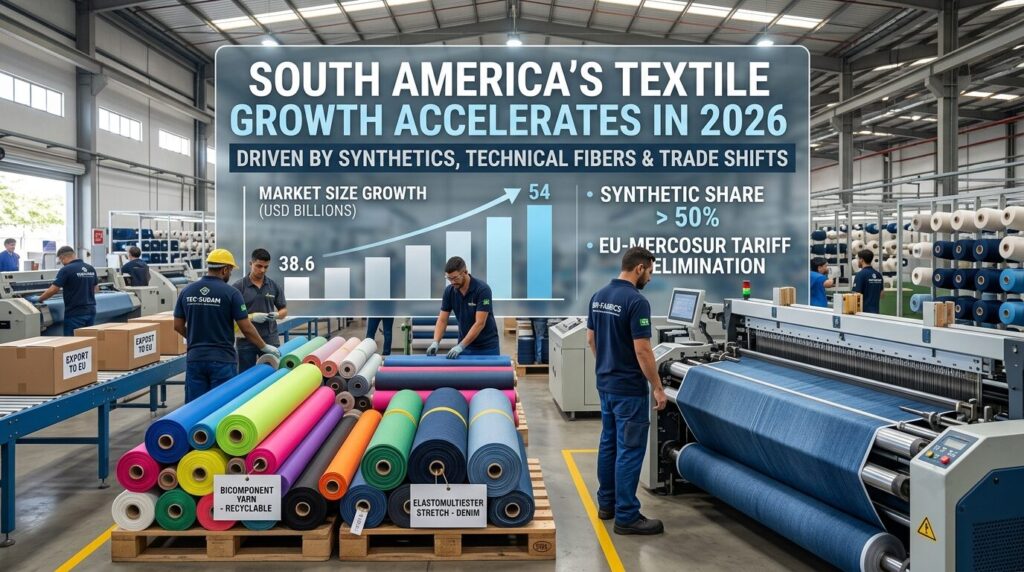
South America’s textile sector is one of the faster-growing regional markets globally in 2026, and that growth is increasingly running through synthetic and technical fibers rather than cotton alone which is exactly where bicomponent and elastomultiester stretch yarn fit into regional sourcing strategy.
South America Textile Market Size & Growth
Independent market research values the South America textile market at approximately USD 38.6 billion in 2026, projected to reach roughly USD 54 billion by 2031 a compound annual growth rate above 7%. Brazil and Argentina anchor apparel demand, while growth is broadening into geotextiles, hygiene nonwovens and recycled-polyester fiber, expanding well beyond fashion alone.
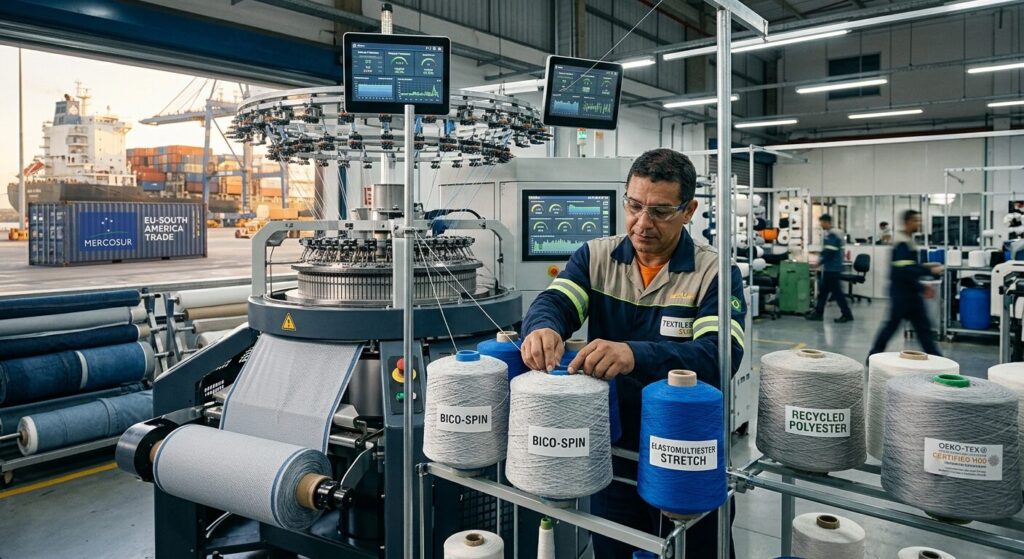
A Major 2026 Trade Shift: EU–Mercosur
In January 2026, the EU and the Mercosur bloc (Brazil, Argentina, Paraguay, Uruguay) signed a Partnership Agreement eliminating tariffs of up to 35% on clothing, textiles and leather goods between the two regions. For technical yarn suppliers and mills, this materially lowers the cost of integrating South American manufacturing with European buyers and accelerates demand for traceable, compliant fiber inputs including OEKO-TEX-certifiable bicomponent yarns.
Denim & Technical Textile Demand
Denim remains one of the region’s largest fabric categories, and demand for stretch denim specifically continues to shift toward spandex-free, fully-recyclable constructions as brands respond to EU circular-economy and microplastics-reporting pressure. Technical textile yarns fibers engineered for a specific mechanical property rather than aesthetics alone are a growing share of mill output as manufacturers diversify beyond apparel into industrial, automotive and filtration end-uses.
Synthetic Fiber Share Is Rising
Synthetic fibers already account for more than half of regional raw-material supply, reflecting a structural shift away from exclusive dependence on natural fiber. This lowers input-cost volatility for mills and gives producers using polyester and recycled-polyester variants a structural cost advantage a trend that directly favors 100%-polyester bicomponent stretch yarn over elastane-blended alternatives, since unblended polyester constructions are both cheaper to source at scale and easier to recycle.
What This Means for Sourcing Bicomponent & Elastomultiester Yarn in the Region
- Rising demand for spandex-free stretch denim and technical fabrics that meet EU circularity requirements
- Tariff elimination under the EU-Mercosur deal improves the economics of exporting finished goods made with imported technical yarn
- Growing synthetic-fiber share favors 100%-polyester, single-stream-recyclable yarn constructions
- Business confidence among regional manufacturers has been rising through 2026, supporting new supplier relationships and forward order commitments
Country-by-Country Snapshot
Brazil remains the region’s largest textile and apparel producer, with an integrated domestic supply chain spanning fiber, yarn, fabric and finished garments, and a growing appetite for technical and synthetic-fiber inputs alongside its traditional cotton base. Argentina’s textile sector is smaller but export-oriented, with denim and knitwear among its strongest categories. Colombia has built a reputation as a regional hub for activewear and shapewear manufacturing, which keeps demand for stretch fibers both elastane-blended and spandex-free bicomponent alternatives particularly strong. Peru’s textile industry leans heavily on natural fibers like Pima cotton and alpaca for export apparel, but technical and blended-synthetic fabric use is expanding as manufacturers diversify their product mix for international buyers.
Challenges Facing Regional Manufacturers
Regional mills contend with a familiar set of pressures: energy and input-cost volatility, competition from lower-cost Asian manufacturing on price-sensitive basic apparel, and, in several countries, currency fluctuation that complicates long-term contracts with international buyers priced in US dollars or euros. Infrastructure and logistics costs for moving goods within South America and out to export markets remain higher than in more consolidated manufacturing hubs, which puts a premium on suppliers who can offer competitive, all-in landed pricing rather than just a low ex-factory quote.
How Global Suppliers Are Responding
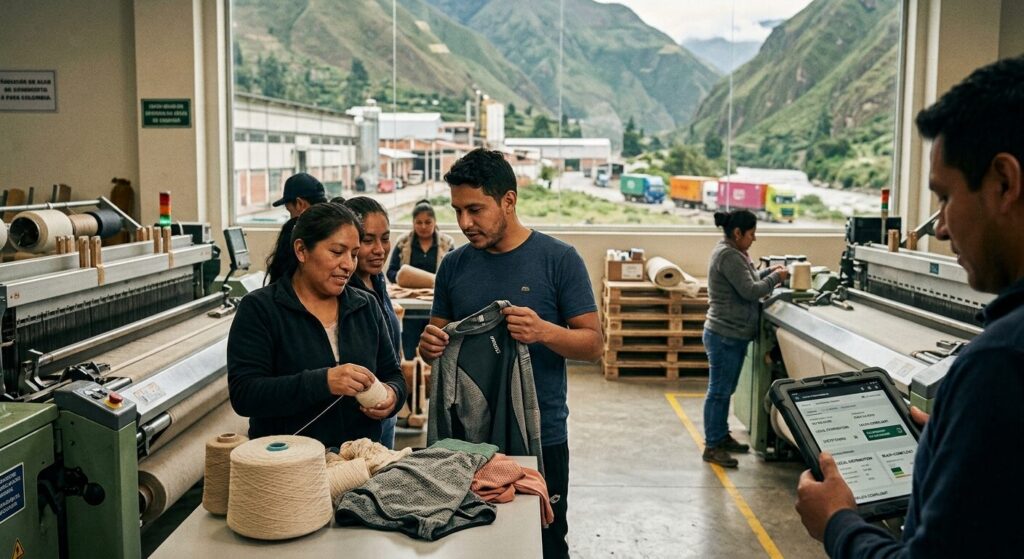
International and regional fiber and yarn suppliers have responded by opening or expanding local distribution and technical-support presence closer to South American mills, shortening lead times that used to require multi-week ocean freight from Asia. There’s also a visible shift toward offering documentation packages up front OEKO-TEX and REACH compliance, recyclability data, and country-of-origin paperwork recognizing that regional manufacturers exporting into the EU increasingly need this documentation ready before a deal closes, not requested after the fact. Suppliers able to combine competitive pricing with fast regional logistics and complete compliance documentation are best positioned to capture the growth this market is expected to see through the early 2030s.
Where Buyers Are Sourcing From Instead, and Why That’s Changing
Historically, many South American apparel manufacturers imported technical and stretch yarns from Asian producers, accepting longer lead times in exchange for lower unit pricing. That calculus is shifting as regional demand grows and as EU-bound exporters face pressure to shorten and simplify their supply chains for traceability reasons. A regional or nearer-shore supplier that can match Asian pricing while cutting freight time and simplifying compliance documentation has a genuine competitive opening in this market over the next several years particularly for buyers who’ve been burned by long-haul shipping delays on time-sensitive seasonal collections.
A Note on Currency and Contract Terms
Buyers negotiating with South American mills should expect and plan for currency-related pricing adjustments more often than they might with Asian or European suppliers, given the historically higher inflation and currency volatility in several of the region’s economies. Locking in USD- or EUR-denominated pricing for the life of a purchase order, and clarifying up front how exchange-rate swings are handled on multi-month contracts, avoids the most common source of late-stage pricing disputes on regional sourcing deals.
Beyond Apparel: Technical Textile Demand in the Region
Regional demand isn’t limited to apparel, either: geotextiles for infrastructure projects, agricultural fabrics, and technical nonwovens for hygiene and filtration are all growing categories across Brazil, Argentina and Colombia, and many of these applications use the same bicomponent and technical-yarn production lines that supply apparel-grade elastomultiester. Suppliers positioned across both apparel and technical-textile end uses are better insulated from any single category’s seasonal demand swings than those serving apparel alone. This diversification also gives regional mills more predictable year-round capacity utilization, which in turn supports more competitive, stable pricing for buyers placing recurring orders.