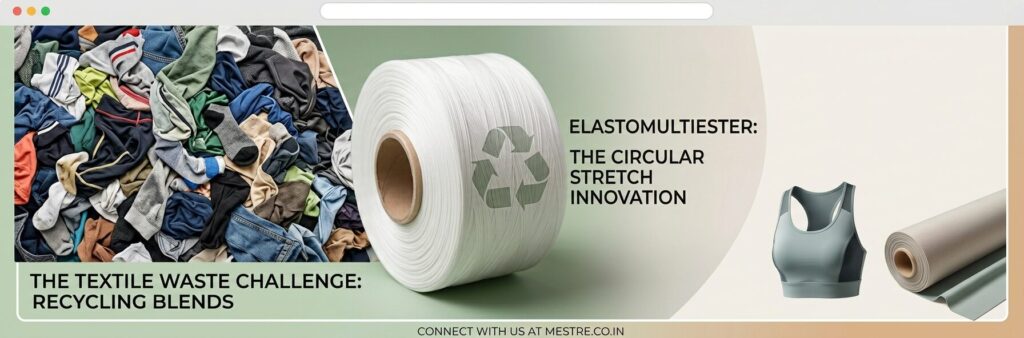
The textile industry generates enormous volumes of waste, and one of its most stubborn problems is the multi-material fabric. Blended fabrics polyester-elastane, cotton-nylon, wool-acrylic are notoriously difficult to recycle because separating intimately bonded polymers at end of life remains technically and economically challenging.
Elastomultiester is not just a yarn innovation. It is a sustainability breakthrough. By delivering stretch performance using a single polymer family polyester it enables fabric manufacturers to create truly circular garments that can be recycled without complex material separation.
The Problem with Elastane-Based Stretch
Elastane (Lycra, spandex) is a polyurethane elastomer a fundamentally different material class from polyester. When woven or knitted together with polyester, the two materials become inseparable at the filament level. Current mechanical and chemical recycling technologies cannot economically separate polyester from elastane.
The result? The majority of stretchy garments sportswear, swimwear, lingerie, athleisure end up in landfill or incineration, regardless of consumer intent. Industry data consistently shows that elastane content of as little as 2% by weight is sufficient to disqualify a garment from most commercial recycling streams.
How Elastomultiester Solves the Recyclability Problem
Elastomultiester is a polyester-polyester bicomponent yarn both components (PET and PTT) belong to the polyester family. This means:
- Elastomultiester fabric can be processed in standard polyester textile-to-textile recycling facilities.
- The yarn does not require material separation before recycling.
- Recycled fibres from elastomultiester garments can be used to produce new elastomultiester or standard polyester yarns.
- The circular loop is closed without quality compromise in the recycled output.
This is a genuinely transformative capability in the context of extended producer responsibility (EPR) legislation now emerging across the European Union, United Kingdom, and other major markets.
Elastomultiester and the Circular Economy Framework
The Ellen MacArthur Foundation’s New Plastics Economy and Fashion framework explicitly identifies mono-material fabric construction as a key enabler of textile circularity. Elastomultiester is one of the clearest practical expressions of this principle available to textile manufacturers today.
By specifying elastomultiester in fabric development, brands can:
- Meet emerging EU Textile Strategy requirements for recyclable garment construction.
- Achieve higher scores on the Higg Materials Sustainability Index.
- Credibly communicate circular design credentials to sustainability-conscious consumers.
- Future-proof their supply chains against regulation that may restrict non-recyclable stretch fibre content.
Performance Parity: Sustainability Without Sacrifice
A common concern among fabric developers considering elastomultiester is whether it can truly match the performance of elastane-containing fabrics. The answer, for the majority of applications, is an emphatic yes.
Stretch and Recovery
Elastomultiester delivers 20–40% mechanical stretch with excellent elastic recovery. This range covers the vast majority of stretch requirements in activewear, casual wear, lingerie, and hosiery without rubber polymers.
Durability
In comparative wear tests, elastomultiester fabrics consistently demonstrate superior retention of stretch properties through repeated washing. Unlike elastane, the stretch mechanism is based on structural crimp, not chemical elasticity, and does not degrade through oxidation, chlorination, or thermal cycling.
Dyeability and Aesthetics
Uniform polyester composition means elastomultiester fabrics dye evenly, without the differential shading issues that can affect elastane-containing fabrics.
Key Markets Driving Elastomultiester Adoption
Sustainable Fashion Brands
B Corp certified and sustainability-committed fashion brands are actively specifying elastomultiester as part of their circular design commitments. The ability to make a credible recyclability claim without sacrificing stretch performance is a major commercial and marketing advantage.
Sportswear and Outdoor Performance
Outdoor and performance brands with sustainability mandates particularly those aligned with Bluesign, OEKO-TEX, or GOTS-compatible supply chains are including elastomultiester in their material specifications.
Swimwear
The combination of chlorine resistance, UV stability, and recyclability makes elastomultiester an ideal swimwear yarn, especially for brands servicing the growing market for sustainable beachwear.
Mestre’s Role in the Elastomultiester Ecosystem
Mestre is committed to being a leading supplier of elastomultiester yarn to textile manufacturers who are building sustainable, circular product lines. Our elastomultiester range is developed with both performance and environmental impact in mind. We provide full supply chain transparency, third-party certification support, and technical development assistance to help our customers bring sustainable stretch fabrics to market faster.
Partner with Mestre for sustainable elastomultiester solutions. Connect with us at mestre.co.in.
Frequently Asked Questions
Q1: Can all textile recyclers process elastomultiester?
- Elastomultiester can be processed in any recycling stream that accepts polyester. Its PET-PTT composition is compatible with mechanical recycling. Chemical recycling facilities that depolymerise polyester can also process it.
Q2: What labelling should brands use for elastomultiester garments?
- Elastomultiester can typically be labelled as ‘100% Polyester’ on care labels, which simplifies consumer communication and recycling guidance. Confirm with your compliance team for jurisdiction-specific requirements.
Q3: Is elastomultiester certified by any environmental standards?
- Mestre’s elastomultiester yarns are produced in compliance with key environmental standards. Contact mestre.co.in for current certification details.
Q4: How does elastomultiester contribute to achieving Higg Index scores?
- Mono-material polyester fabrics typically score better on the Higg Materials Sustainability Index than multi-material blends, due to improved recyclability and reduced manufacturing complexity.
Q5: Is recycled PET available as a feedstock for elastomultiester production?
- Yes. The PET component of elastomultiester can be produced from recycled PET (rPET) feedstocks, further enhancing the sustainability credentials of the final yarn. Enquire at mestre.co.in for availability.