The global sportswear market has never been more competitive. Athletes, weekend warriors, and athleisure consumers all demand fabrics that stretch, recover, breathe, and endure in that order. Meeting this demand has historically meant blending polyester with elastane, accepting the recycling dead-end that comes with it.
Bicomponent yarn is changing this calculus. By engineering stretch performance directly into the fibre architecture, bicomponent yarn enables sportswear fabrics that outperform traditional elastane blends in durability, sustainability, and processing simplicity.
Why Sportswear Demands Advanced Yarn Solutions
Sportswear sits at the intersection of extreme performance requirements. A running tight must stretch as the athlete runs, recover instantly with each stride, resist moisture absorption from sweat, maintain its shape through hundreds of washes, and look as good on day 500 as on day one.
No single polymer achieves all of this. But by engineering the yarn at the bicomponent level choosing the right polymer pairing, the right cross-sectional architecture, and the right processing regime Mestre creates yarns that come remarkably close to the ideal.
Stretch and Recovery: The Core Demand
For sportswear, stretch must be both consistent and recoverable. A fabric that stretches but does not recover quickly loses its fit, becomes baggy in repeated-wear use, and fails the athlete.
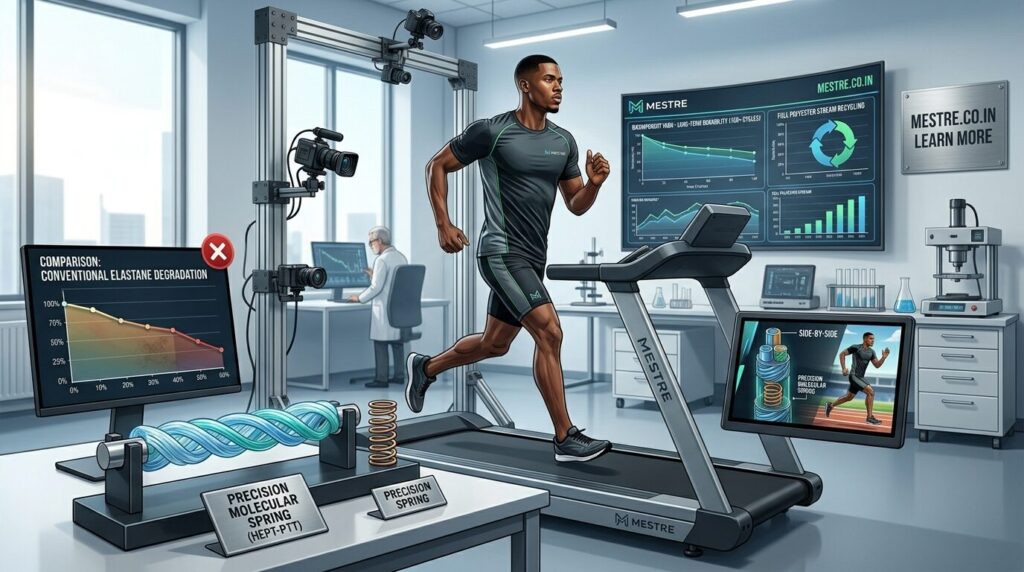
Mestre’s bicomponent elastomultiester yarns produced in PET-PTT side-by-side configuration deliver 20–40% mechanical stretch with exceptional recovery rates. The helical crimp that forms after heat treatment acts as a precision molecular spring that returns the yarn to its resting state almost instantaneously on load removal.
Comparison with Elastane in Sportswear
- Wash Durability: Bicomponent mechanical stretch retains performance across 100+ industrial wash cycles. Elastane begins degrading around wash cycle 50 under typical care conditions.
- Chlorine Resistance: Critical for swimwear and aquatic training apparel. Bicomponent polyester is chlorine-resistant; elastane is not.
- UV Resistance: Outdoor athletic apparel faces significant UV exposure. Bicomponent polyester resists UV degradation; elastane yellows and weakens.
- Recyclability: Bicomponent polyester sportswear can enter polyester recycling streams. Elastane-blended garments cannot.
Moisture Management in Bicomponent Sportswear Yarn
Modern sportswear must actively manage moisture pulling sweat away from the skin and facilitating rapid evaporation. Bicomponent yarn engineering allows moisture management to be integrated directly into the fibre:
- Cross-section engineering can create capillary channels that wick moisture via physical surface tension effects.
- Hydrophilic-hydrophobic polymer combinations in sheath-core constructions allow the sheath to absorb and spread moisture while the core maintains structural integrity.
- Textured bicomponent surfaces increase the effective surface area for evaporative moisture transport.
This capability means that bicomponent yarns can replace the combination of a basic polyester yarn and a separate moisture-management finish, reducing chemical processing steps and cost.
Durability: Built-in, Not Coated On
One of the most significant advantages of bicomponent yarn in sportswear is that its performance is intrinsic it comes from the polymer chemistry and physical structure, not from an applied finish that washes off over time.
Conventional sportswear fabrics often rely on chemical finishes moisture-wicking treatments, anti-odour agents, UV stabilisers that deliver great initial performance but degrade with washing. Bicomponent yarns, by contrast, maintain their moisture management, stretch, and UV resistance throughout the garment’s life.
Design Flexibility for Sportswear Brands
Bicomponent yarn also gives sportswear designers greater flexibility. Because the stretch and recovery properties are managed at the yarn level, fabric engineers can adjust the fabric’s stretch modulus, recovery speed, and hand feel by selecting different denier levels, crimp intensities, and yarn counts all without changing the fundamental fabric construction.
This modularity allows sportswear brands to develop differentiated products across performance tiers all from the same base yarn technology, manufactured to different specifications.
Mestre’s Bicomponent Yarn Range for Sportswear
Mestre supplies bicomponent yarns specifically engineered for sportswear applications. Our range includes:
- Fine denier bicomponent filaments for smooth, lightweight running and training apparel.
- Medium denier elastomultiester for yoga, cycling, and cross-training.
- Heavier denier constructions for outdoor and adventure sportswear demanding greater abrasion resistance.
Each product is supported by full technical data sheets covering stretch, recovery, tenacity, moisture transport, and wash durability giving sportswear brands the information they need to make informed specification decisions.
Talk to Mestre’s sportswear yarn specialists at mestre.co.in sample requests and technical consultations welcomed.
Frequently Asked Questions
Q1: Can bicomponent yarn fully replace elastane in sportswear?
- For most sportswear applications running, yoga, cycling, training bicomponent mechanical stretch yarn delivers sufficient performance to replace elastane. For extreme-compression or very high-stretch applications, a hybrid approach may be considered.
Q2: How does bicomponent sportswear yarn perform after many washes?
- Mestre’s bicomponent yarns are tested for wash durability. The mechanical stretch property is intrinsic to the fibre structure and does not degrade with washing as elastane does.
Q3: Is bicomponent yarn suitable for swimwear?
- Yes. The chlorine resistance and UV stability of bicomponent polyester make it an excellent choice for swimwear, particularly competitive training suits that undergo heavy chlorinated pool exposure.
Q4: What denier range does Mestre offer for sportswear bicomponent yarn?
- Mestre offers bicomponent yarn from fine denier (suitable for sheer, lightweight fabrics) through to heavier constructions for technical outerwear. Consult mestre.co.in for specific denier options.
Q5: Can Mestre develop a custom bicomponent yarn for our specific sportswear application?
- Absolutely. Custom development is a core Mestre capability. Contact our technical team at mestre.co.in to initiate a development program.