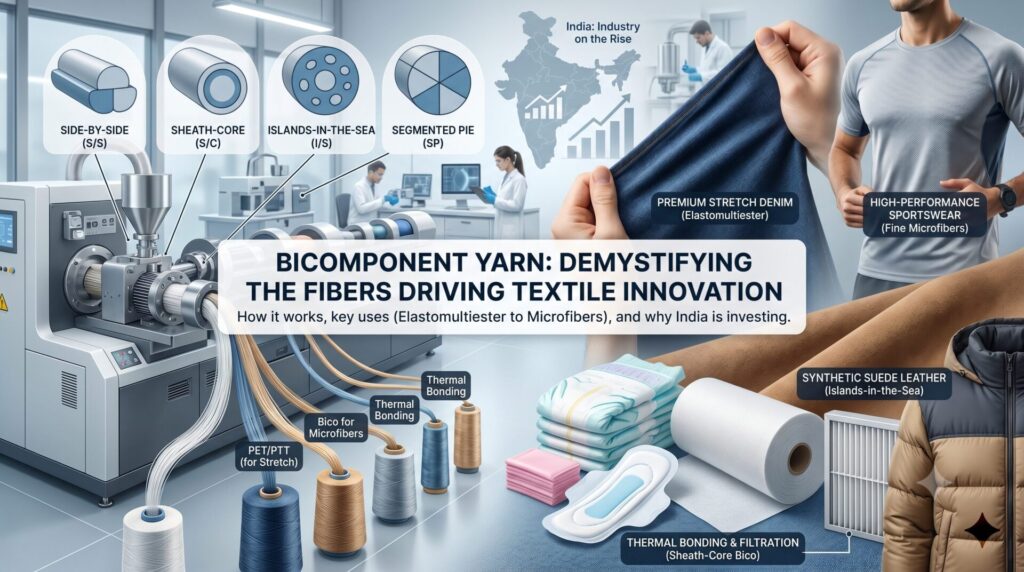
In the world of textile innovation, few technologies have been as quietly transformative as bicomponent yarn. It sits at the intersection of polymer science, mechanical engineering, and fashion creating fibers that do things no single-polymer yarn can achieve.
Bicomponent fiber is the technology behind elastomultiester the stretch polyester taking the denim world by storm. It’s also behind the fine microfibers in high-performance sportswear, the self-crimping fibers in premium nonwovens, and the thermo-bonding fibers used in technical industrial applications.
This guide demystifies it completely. You’ll learn exactly how bicomponent yarn works, what it’s used for, why it matters to India’s textile industry, and where this technology is headed.
What Is Bicomponent Yarn? (Definition and Basics)
A bicomponent fiber (also written bi-component) is a single fiber made from two different polymer components that are combined during the spinning (extrusion) process. These two components are arranged within the fiber in a specific geometric configuration that gives the finished fiber unique properties properties that neither polymer could achieve alone.
The two components are typically different in polymer type (e.g., PET and PTT, or polyester and polyamide), molecular weight, shrinkage rate, melting point, or refractive index.
By carefully selecting and combining the two components, fiber engineers can ‘program’ the finished yarn to exhibit target behaviors: stretch and recovery, spontaneous crimping, splitability into ultrafine microfibers, thermal bonding at specific temperatures, or enhanced moisture management.
How Bicomponent Fiber Works: The Four Configurations
1. Side-by-Side (S/S)
The two polymers sit next to each other along the length of the fiber, like two strands running in parallel. When the fiber is produced and processed, the two components shrink at different rates. This differential shrinkage creates a spontaneous, permanent crimp in the fiber a coiling or spiraling shape. This crimp is what gives side-by-side bicomponent fibers their elastic and bulking properties.
Primary use: Creating stretch and elasticity in fabrics the basis for elastomultiester and other elastic polyester fibers. Also used in high-loft nonwovens for insulation and padding.
2. Sheath-Core (S/C)
One polymer (the core) is surrounded by the other polymer (the sheath). This creates a fiber with the surface properties of the sheath polymer and the structural properties of the core polymer.
Primary use: Thermal bonding in nonwoven fabrics (where the lower-melting sheath bonds fibers together at elevated temperature while the core maintains structural integrity).
3. Islands-in-the-Sea (I/S)
Multiple ‘islands’ of one polymer are embedded in a ‘sea’ of another. After processing, the ‘sea’ component is chemically dissolved or split away leaving behind a bundle of extremely fine microfibers, far thinner than any single-component fiber could achieve.
Primary use: Creating ultra-fine microfibers for high-performance suede-like fabrics used in luxury synthetic suede, high-end sportswear, and filtration media.
4. Segmented Pie (SP)
The cross-section of the fiber is divided into segments, like slices of a pie alternating between two polymers. When the fiber is subjected to mechanical action or chemical treatment, the segments split apart into individual microfibers.
Primary use: Microfiber fabrics for cleaning cloths, sportswear, and applications where high surface area and fineness are important.
Key Uses of Bicomponent Yarn Across Industries
1. Stretch Fashion Fabric (Elastomultiester)
The most consumer-visible application. Side-by-side PET/PTT bicomponent fibers are the basis for elastomultiester the stretch polyester used in premium denim, trousers, shirting, and suiting. The spontaneous crimp in the fiber creates 20-40% stretch with excellent recovery. This is a major growth area, with leading denim brands globally switching from cotton-elastane constructions to cotton-elastomultiester to improve durability and recyclability.
For a full guide on elastomultiester, read our article at mestre.co.in.
2. Thermal Bonding in Nonwoven Fabrics
Sheath-core bicomponent fibers with a lower-melting sheath are fundamental to the nonwoven industry. When webs of these fibers are heated, the sheath melts and flows, bonding fibers at their contact points while the core maintains structural integrity producing a strong, coherent nonwoven fabric without adhesives or stitching.
End products: Hygiene products (diapers, sanitary products), medical disposables, filtration media, automotive interior linings, geotextiles.
3. High-Performance Sportswear
Splitfiber bicomponent fibers create the ultra-fine microfibers used in high-performance sportswear. The fine fiber structure creates millions of tiny channels that wick perspiration away from skin, while ultra-fine fibers allow very light, thin fabrics with excellent coverage.
4. Filtration Media
High surface area is critical for effective filtration. Bicomponent microfibers provide the exceptional surface area needed for industrial air and liquid filtration, medical-grade masks and respirators, HVAC filters, and water treatment applications. The COVID-19 pandemic significantly accelerated research and production capacity in this segment.
5. Insulation and Batting
Self-crimping side-by-side bicomponent fibers create high-loft, resilient insulation for outerwear and puffer jackets, pillows and duvets, automotive seating and headliners, and sound-absorbing acoustic panels. The permanent crimp in the fibers creates air pockets that trap warmth mimicking the thermal performance of natural down at a fraction of the cost.
6. Synthetic Leather and Suede
Islands-in-the-sea bicomponent fibers, when split into microfibers and processed into nonwoven substrates, form the basis for premium synthetic suede and microfiber leather. Applications include automotive interiors (seat covers, dashboards), high-end handbags, shoe uppers, and luxury furniture upholstery.
7. Agricultural and Geotextile Applications
- Crop protection covers (allowing light and moisture while blocking pests)
- Soil stabilization geotextiles
- Drainage fabrics and erosion control systems
Bicomponent Yarn in India: An Industry on the Rise
India is one of the world’s largest textile producers and exporters. Yet bicomponent fiber and yarn has historically been an area where India lagged behind global leaders particularly Japan, South Korea, the United States, and Germany. That is changing rapidly.
Current Status of Bicomponent Fiber in India
1. Domestic Production is Growing: Major Indian synthetic fiber producers have been investing in bicomponent spinning capabilities. While the majority of high-specification bicomponent fiber is still imported, domestic production capacity is expanding.
2. Import Demand Is Strong: Indian textile mills producing performance fabrics for export import significant quantities of bicomponent fiber and yarn, primarily from Japan, Taiwan, and South Korea.
3. Government Policy Support: India’s Production Linked Incentive (PLI) scheme for textiles specifically targets man-made fiber (MMF) and technical textile segments both major application areas for bicomponent fiber.
4. Growing Nonwoven Sector: India’s nonwoven sector a major consumer of bicomponent fiber for hygiene, medical, and technical applications has been growing at double-digit rates.
5. Premiumization of Denim and Apparel: As Indian apparel brands and retailers increasingly move upmarket, demand for premium stretch fabrics including elastomultiester-based constructions using bicomponent polyester is rising.
Key Challenges for Bicomponent Yarn in India
- High capital investment required for bicomponent spinning equipment
- Technical expertise gap in operating specialized bicomponent lines
- Raw material consistency achieving the precise polymer grade specifications is demanding
- Scale economics bicomponent production requires scale to be cost-competitive with established global suppliers
For understanding how elastomultiester India’s most commercially relevant bicomponent fiber application works in fabric, see our guide on Elastomultiester Meaning and Fabric at mestre.co.in.
Bicomponent Fiber vs. Regular (Monocomponent) Fiber
| Property | Monocomponent Fiber | Bicomponent Fiber |
| Components | Single polymer | Two polymers combined |
| Properties achievable | Limited to single polymer’s characteristics | Can combine or exceed both components’ properties |
| Crimp | Must be mechanically applied | Can be self-generating (permanent) |
| Microfiber capability | Limited by spinneret hole size | Can achieve sub-micron fibers via split |
| Cost | Lower | Higher (specialized equipment and process) |
| Applications | Broad, standard | Specialized, high-performance |
Sustainability and the Future of Bicomponent Yarn
Sustainability in bicomponent fiber is nuanced. On the positive side, elastomultiester replaces elastane in stretch fabrics simplifying fiber composition and improving recyclability. Thermal bonding fibers eliminate adhesive chemicals from nonwoven production. Longer-lasting stretch performance also reduces garment replacement frequency.
The most sustainable direction for bicomponent technology is same-polymer compositions (e.g., PET/PTT bicomponent, or bio-based variants) that maintain recyclability while delivering enhanced performance. Research in bio-PTT from renewable feedstocks such as DuPont’s Sorona is particularly promising.
Leading Bicomponent Fiber Technologies and Brands
- Toray Industries (Japan) A pioneer in bicomponent and microfiber technology; their ultra-fine fiber technologies are used in premium synthetic suede and high-performance sportswear worldwide.
- Teijin (Japan) Producer of bicomponent polyester fibers for both fashion and industrial applications.
- DuPont (USA) Producer of PTT polymer (Sorona) used in PET/PTT bicomponent compositions for elastomultiester-type fibers.
- Invista (USA) Known primarily for Lycra (elastane), also active in alternative stretch fiber technologies.
- Far Eastern New Century (Taiwan) Major producer of bicomponent polyester fiber for Asian textile markets.
Frequently Asked Questions (FAQ)
Q1: What is bicomponent yarn?
Bicomponent yarn is yarn made from fibers that contain two different polymer components combined within a single fiber. The interaction between these components gives the fiber unique properties such as self-crimping for stretch, splittability for microfibers, or differential melting for thermal bonding.
Q2: What are the main uses of bicomponent yarn?
Key uses include stretch fashion fabrics (elastomultiester), thermal bonding in nonwovens, microfiber sportswear, filtration media, insulation batting, synthetic suede, and agricultural textiles.
Q3: How is bicomponent fiber different from a regular fiber?
Regular fiber contains a single polymer with fixed properties. Bicomponent fiber combines two polymers within one fiber, enabling properties like permanent self-crimp or ultrafine splitting that neither polymer alone could achieve.
Q4: Is bicomponent yarn available in India?
Yes, though domestic production capacity is still growing. Indian mills primarily import bicomponent fiber from Japan, Taiwan, and South Korea for premium fabric production. The PLI scheme for MMF textiles is expected to drive domestic bicomponent production investment.
Q5: What is the connection between bicomponent fiber and elastomultiester?
Elastomultiester is a specific type of bicomponent polyester fiber typically PET + PTT in a side-by-side configuration where the differential shrinkage between the two polyesters creates permanent crimp and elastic stretch properties.
Q6: Can bicomponent fiber be recycled?
It depends on the composition. Same-polymer bicomponent fibers (e.g., two types of polyester) are relatively recyclable within polyester streams. Mixed-polymer bicomponent fibers (polyester + polyamide) are more challenging to recycle.
Q7: What is the future of bicomponent yarn?
The future includes bio-based bicomponent fibers (using renewable feedstocks), recyclable same-polymer compositions, and continued growth in technical textile applications particularly filtration, medical, and automotive sectors.
Conclusion
From the stretch denim on your hips to the filtration mask you wear to the insulation keeping you warm bicomponent fiber is quietly at work in more applications than most people realize. It’s one of the most powerful tools textile engineers have to deliver performance that single-polymer fibers simply cannot match.
For India’s textile industry, bicomponent yarn represents both a challenge and a massive opportunity. As the global textile market continues its shift toward performance, sustainability, and technical sophistication, the manufacturers who invest in bicomponent technology will be positioned at the frontier of the industry’s future.
Explore more about the technologies shaping modern textiles from elastomultiester to mechanical stretch at mestre.co.in, your comprehensive resource for advanced fabric knowledge.