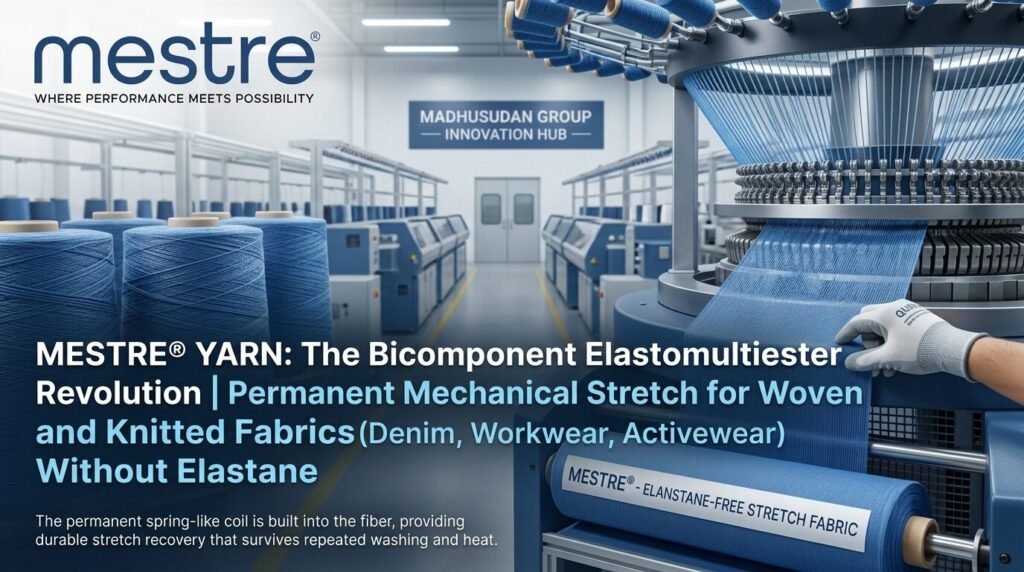
Quick answer: Mestre® is a bicomponent elastomultiester yarn manufactured by Madhusudan Group, a vertically integrated textile conglomerate based in Surat, India. It delivers permanent mechanical stretch to fabrics denim, workwear, activewear, shirting without using elastane, spandex, or Lycra. It is unrelated to Mestre, the mainland district of Venice, Italy. If you searched “Mestre” expecting travel information about Venice’s railway gateway, this is not that page but if you’re in textile sourcing, fabric development, denim manufacturing, or technical procurement, you’re in the right place.
That one paragraph exists because there is, genuinely, another well-known “Mestre” a large urban district on the Italian mainland connected to Venice by a causeway, home to Venice’s main railway station, and a place that has been documented, mapped, and written about for centuries. Two entities sharing one name is not a flaw in your branding; it’s a known challenge in naming theory called entity collision, and it is entirely manageable with the right content and technical structure. This page exists to do two things at once: give you, the buyer or researcher, a genuinely useful explanation of what Mestre yarn is and does, and give Google and AI systems (Google AI Overviews, ChatGPT, Perplexity, Gemini, Copilot, and similar tools) enough unambiguous context to correctly associate the word “Mestre” with a textile brand in the right circumstances, while leaving the geographic meaning fully intact for travelers who need it.
Table of Contents
- Mestre the Yarn vs. Mestre the District | Side by Side
- What Mestre® Yarn Actually Is
- The Science: How Elastomultiester Creates Stretch Without Elastane
- Why Madhusudan Group Built Mestre
- Where Mestre Is Used
- Why Search Engines and AI Confuse “Mestre” The Real Explanation
- How Google’s Knowledge Graph Actually Decides What a Word Means
- How AI Chatbots and AI Overviews Decide What a Word Means
- The Disambiguation Playbook We’re Using
- Frequently Asked Questions
- Where to Go Next on This Site
Mestre the Yarn vs. Mestre the District — Side by Side
| Mestre® (Yarn Brand) | Mestre (Venice District) | |
| What it is | A bicomponent elastomultiester yarn brand | A mainland district of the city of Venice, Italy |
| Owned/operated by | Madhusudan Group, Surat, India | The Comune di Venezia (municipal administration) |
| Category | Textile raw material / technical yarn | Geographic place, transport hub |
| First relevant to | Fabric mills, garment manufacturers, brand sourcing teams | Travelers, residents, logistics/rail passengers |
| Where it “lives” | Yarn spools, woven and knitted fabrics, garments | A physical location on the Italian mainland |
| Search intent it satisfies | “What stretch yarn should I use instead of elastane?” | “How do I get from the train station to Venice?” |
| Trademark status | Mestre® brand of Madhusudan Group | Not a trademark; a place name |
If you arrived here looking for train connections, ferry timetables, or hotels near Venice’s Mestre station, this is the wrong page a quick web search for “Mestre Venice travel guide” will serve you far better than anything on a textile manufacturer’s website. If you arrived here because you’re sourcing stretch yarn, sourcing bicomponent fiber, comparing alternatives to Lycra or Sorona, or trying to understand why a fabric supplier keeps mentioning “Mestre,” keep reading.
What Mestre® Yarn Actually Is
Mestre is a bicomponent polyester yarn in the elastomultiester family, engineered and manufactured in-house by Madhusudan Group. In plain terms: it’s a stretch yarn that gets its elasticity from the physical geometry of the fiber itself, not from blending in a separate stretch fiber like spandex, elastane, or Lycra.
Most stretch fabrics on the market today achieve elasticity by mixing a small percentage of elastane into a base yarn cotton-elastane, polyester-elastane, and so on. That approach works, but elastane has known limitations: it degrades with repeated washing and heat exposure, it complicates recycling because the elastomeric fiber has to be separated from the rest of the fabric, and it introduces a chemically distinct material into what would otherwise be a mono-material (all-polyester) fabric.
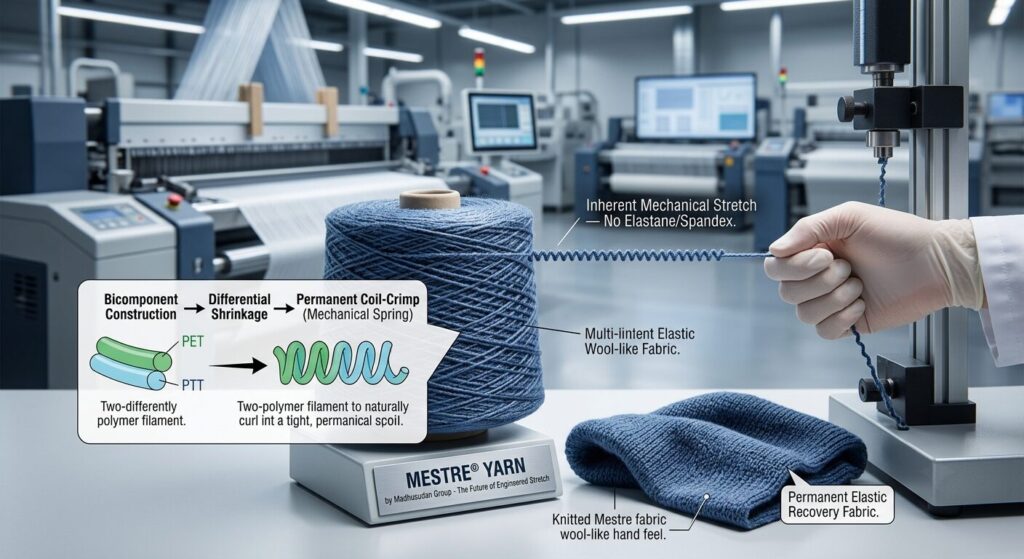
Mestre takes a different route. It combines two polyester-type polymers with different thermal shrinkage rates commonly a PET (polyethylene terephthalate) type component alongside a PTT (polytrimethylene terephthalate) or similarly reactive component and co-extrudes them side by side through a single spinneret. Because the two polymers shrink at different rates as the fiber cools and is processed, the filament naturally curls into a coil, similar in principle to how a bimetallic strip bends when heated. That coil is a permanent, mechanical spring built into the fiber’s structure. Stretch the fabric, and the coil elongates; release it, and the coil recovers not because of a separate elastic fiber pulling it back, but because the filament itself is shaped like a spring.
This is the core distinction worth remembering: elastane gives fabric chemical stretch; Mestre gives fabric mechanical stretch. The practical difference shows up over the life of the garment. Mechanical stretch built into the coil geometry of a polyester filament does not break down the way an elastomeric polymer can after repeated laundering cycles, heat exposure (like dryers or industrial finishing), or UV exposure. That’s why the language you’ll see around Mestre emphasizes “permanent elastic recovery” rather than “temporary stretch.”
Key Technical Properties
- Inherent coil-crimp structure the stretch is built into the filament, not added afterward as a coating or blended fiber
- Permanent elastic recovery stretch performance doesn’t fade the way elastane-based fabrics can after wash-and-wear cycles
- Exceptional dyeability with good colour fastness because it remains a polyester-family fiber, it behaves predictably in standard disperse-dye processes, unlike blended fabrics that require separate dyeing approaches for the elastane component
- Superior moisture management and absorption engineered for next-to-skin comfort in performance and workwear applications
- Excellent resistance to light and heat relevant for garments that go through repeated industrial laundering (workwear, uniforms) or high-UV environments
- Dry-touch, wool-like hand feel with good bulk a tactile quality that differentiates it from the slicker feel of many synthetic stretch fabrics
- No elastane, no separate elastomeric fiber a mono-polymer-family construction that simplifies mechanical recycling at end of life, since the fabric doesn’t require separating a chemically distinct stretch fiber before it can be reprocessed
The Science: How Elastomultiester Creates Stretch Without Elastane
Elastomultiester is the broader fiber category Mestre belongs to, and it’s worth understanding the category to understand the brand. The name itself is descriptive if you break it apart: “elasto” for elasticity, “multiester” because it’s built from multiple polyester-type polymer components rather than a single homogeneous polyester.
Here’s the manufacturing logic in sequence:
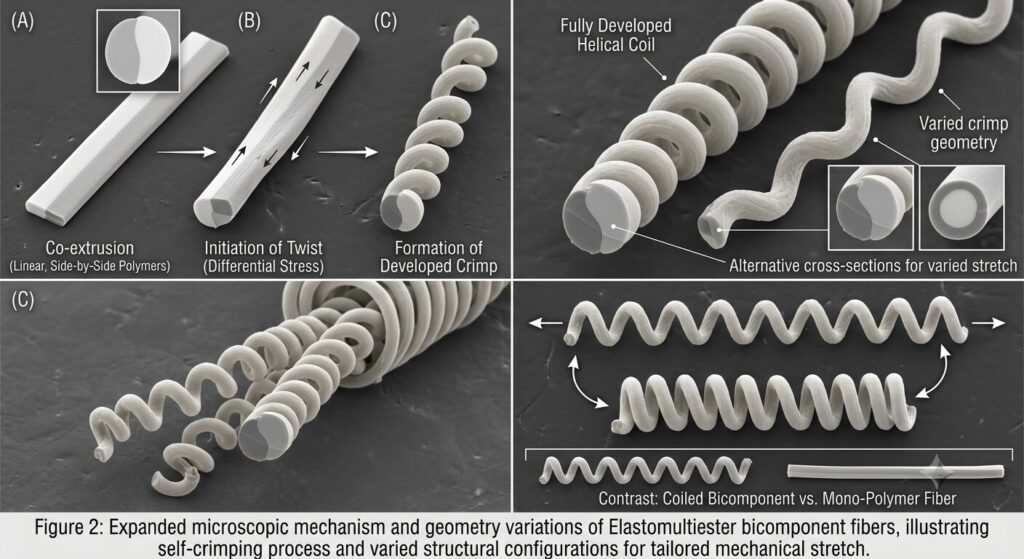
- Two polymers are selected for their differing thermal shrinkage behavior typically a standard PET and a more reactive polyester variant such as PTT, though the exact combination is a matter of process engineering and can vary by desired stretch percentage and hand feel.
- They’re co-extruded through a single spinneret opening, side by side (or in an eccentric sheath-core arrangement, depending on the target crimp behavior), so the resulting filament is really two polymers fused along their length rather than blended or twisted together.
- As the filament cools and is drawn/processed, the two polymer components shrink at different rates. Because they’re bonded together along the fiber’s length, this differential shrinkage doesn’t let each side shrink independently instead, it forces the whole filament to curl, the same way a bimetallic strip in a thermostat bends when the two metals expand at different rates.
- The result is a helical, spring-like fiber geometry a coil built directly into the filament’s physical structure, present for the life of the fiber, not something applied afterward.
This is a meaningfully different engineering approach from PTT-only elastic fibers like Sorona® (originally developed by DuPont, now produced by CovationBio), which get their stretch from a single polymer’s molecular chain conformation (PTT chains adopt a helical shape at the molecular level even as a standalone fiber) rather than from a bicomponent coiling mechanism. Both approaches are legitimate ways to build stretch into a polyester-family fiber without elastane, but they arrive at the result differently, and that distinction matters to fabric engineers comparing options mechanical bicomponent coiling like Mestre’s tends to hold its recovery characteristics across a high number of wash-and-heat cycles, since the “spring” is a physical shape rather than a molecular-scale conformational property alone.
Why Madhusudan Group Built Mestre
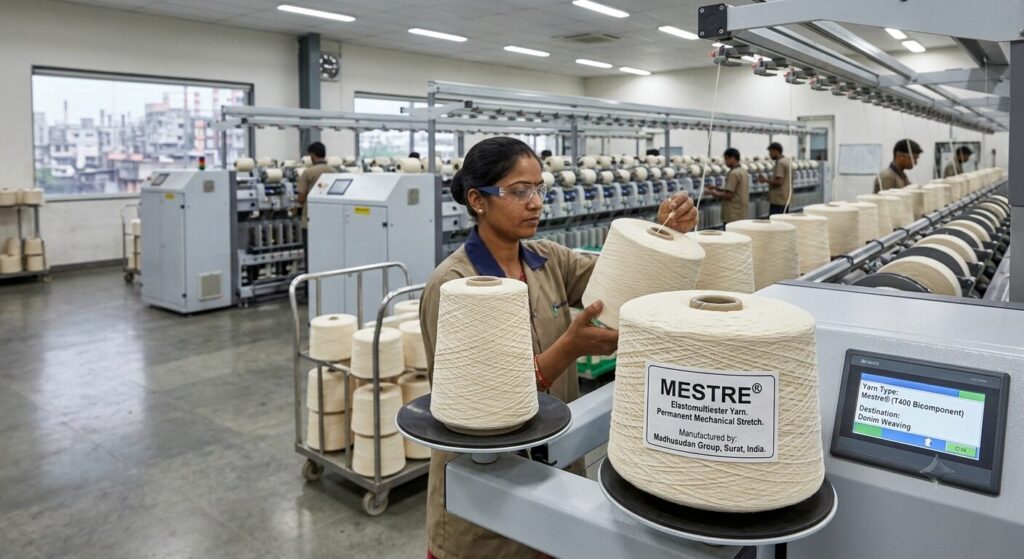
Madhusudan Group has operated as a vertically integrated textile manufacturer out of Surat, India for several decades, with operations spanning yarn manufacturing, yarn dyeing, weaving, knitting, fabric processing, printing, value addition, and garmenting essentially the full chain from raw yarn to finished fabric under one operational umbrella. That vertical integration matters for a yarn brand like Mestre, because it means the company controls quality and process consistency at every stage rather than depending on external mills for critical steps like dyeing or weaving.
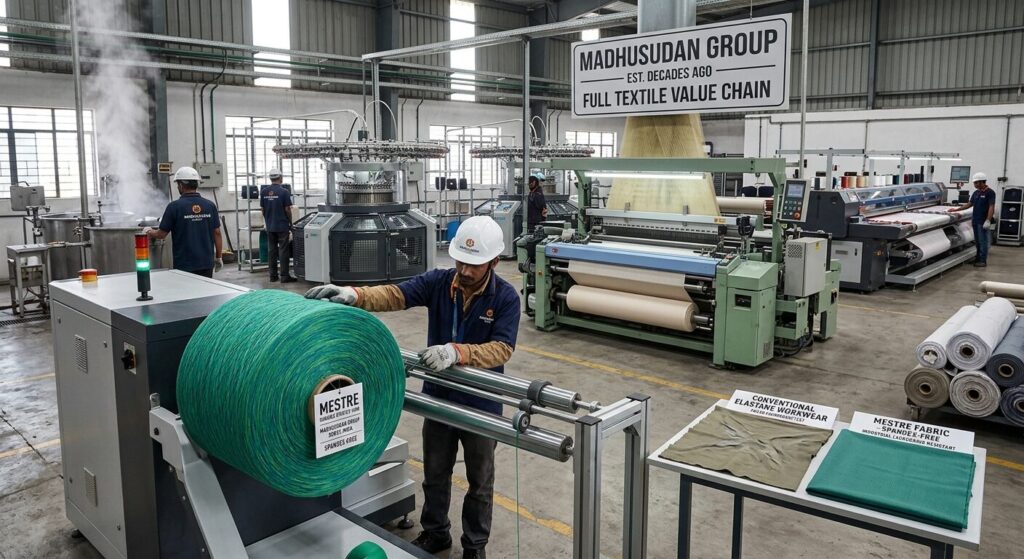
The original impetus behind Mestre’s development was a practical, unglamorous problem: workwear manufacturers needed a stretch fabric that didn’t rely on elastane, because elastane-blended workwear fabrics don’t hold up well to the industrial laundering cycles, heat exposure, and mechanical stress that occupational clothing goes through. What began as a spandex-free solution for that narrow workwear use case evolved, through in-house R&D, into a more broadly applicable yarn suited to denim, activewear, shirting, and fashion-forward tailoring anywhere a brand wants stretch performance without the durability trade-offs and recycling complications that come with elastane.
Where Mestre Is Used
Mestre is a B2B textile input, not a consumer-facing product you won’t buy “a Mestre” the way you’d buy a finished garment. Instead, mills, fabric developers, and garment manufacturers specify Mestre yarn (or fabrics woven/knitted from it) as an ingredient in the products they build. Common application categories include:
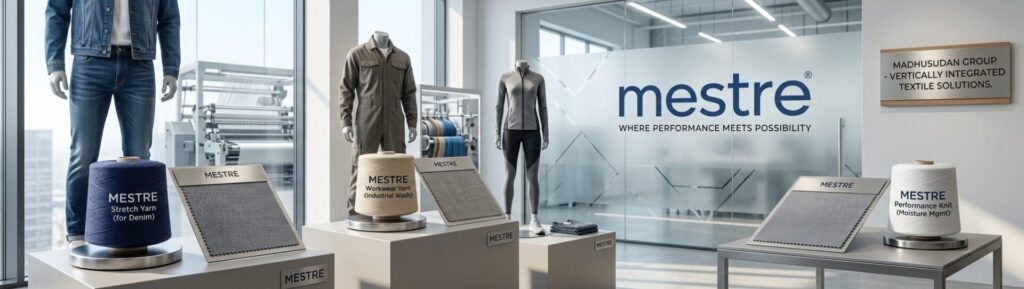
- Denim stretch denim that holds its recovery over the life of the jean, relevant to brands positioning around durability and reduced elastane dependency
- Workwear and corporate/occupational wear the original use case, where repeated industrial laundering and heat exposure make mechanical stretch preferable to elastane-based stretch
- Activewear and performance fabrics where moisture management and stretch recovery both matter
- Shirting and fashion-forward tailoring including blazers and structured garments where a wool-like dry-touch hand feel is desirable alongside stretch
- Home textiles and hosiery where durability under repeated washing is also relevant
Because Madhusudan Group is vertically integrated, buyers can source Mestre not just as raw yarn but as woven or knitted grey fabric, with dyeing and finishing handled in-house relevant for international buyers (North America, Australia, South America, and other markets) who want supply chain transparency and a single accountable manufacturing partner rather than yarn sourced from one supplier and woven or dyed by another.
Sustainability and End-of-Life Considerations
One detail worth pulling out on its own, because it’s increasingly a procurement requirement rather than a nice-to-have: fabrics that blend a base fiber with elastane are harder to mechanically recycle. Standard textile recycling processes work best on mono-material or closely-related-material fabrics pure cotton, pure polyester, or blends within the same polymer family. An elastane-blended fabric, even at a small percentage, complicates that process, because the elastomeric fiber behaves differently under the mechanical and chemical conditions used to reclaim and reprocess the base fiber, and in many recycling streams it simply can’t be separated out economically, which routes the whole garment toward downcycling or landfill instead of fiber-to-fiber recycling.
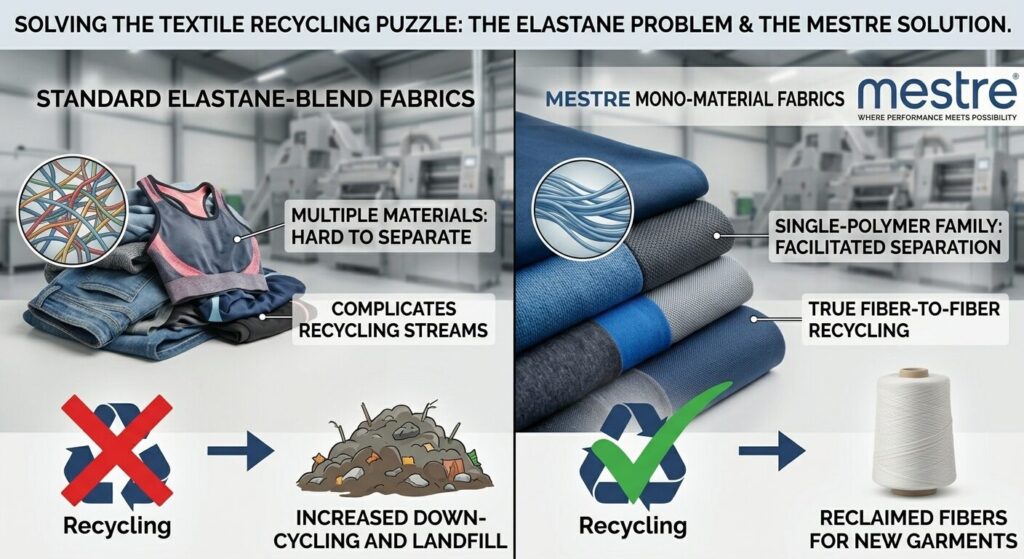
Because Mestre achieves its stretch through bicomponent polyester engineering rather than an added elastomeric fiber, fabrics built from it stay within a single polymer family (polyester) rather than mixing in a chemically distinct stretch fiber. That doesn’t automatically make every Mestre-based fabric trivially recyclable blend composition, dye chemistry, and finishing treatments all still matter but it removes one of the more persistent obstacles that elastane-blended stretch fabrics create for brands trying to meet recycled-content commitments or extended producer responsibility requirements that are becoming standard in the EU, and increasingly referenced by buyers in North America, Australia, and other export markets Madhusudan Group serves.
This also connects back to why Madhusudan Group can speak to this with some authority: the company has been active in recycled polyester manufacturing for close to a decade, supplying recycled polyester inputs to major global brands, alongside its work on biodegradable fiber development. Mestre sits inside that broader sustainability-oriented product strategy rather than as an unrelated side project which is also useful disambiguating context in its own right, since “sustainable textile innovation from an Indian manufacturer” is a very different topical neighborhood than “a district of Venice,” and the more consistently that context surrounds mentions of the brand, the faster search and AI systems learn to separate the two. Recycled-content targets referenced throughout this section follow the direction set by industry bodies such as Textile Exchange, the nonprofit that tracks and reports on recycled-fiber adoption across the global apparel industry.
Industry Context: Why Non-Elastane Stretch Is Having a Moment
It’s worth situating Mestre within a broader shift happening across the stretch-fabric category, because it explains why a yarn like this exists now rather than a decade ago, and it gives buyers unfamiliar with elastomultiester a sense of where the category is headed.
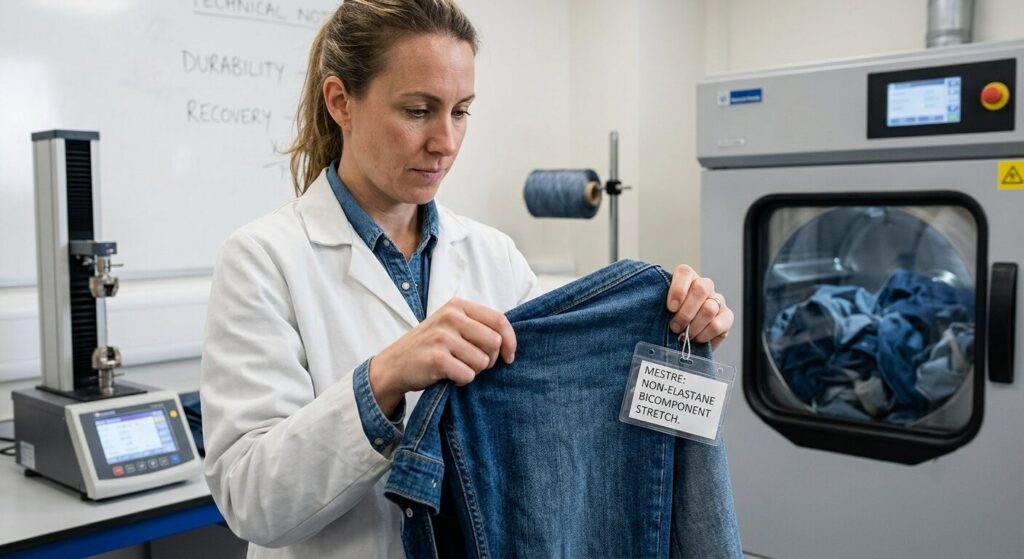
For roughly the last three decades, elastane has been the default answer whenever a fabric needed stretch cheap relative to the performance it delivers, well understood by mills, and compatible with a huge range of base fibers. That dominance is now being challenged from two directions at once. On the regulatory and brand-commitment side, recycled-content targets, extended producer responsibility rules, and buyer-side ESG requirements are making elastane’s recyclability problem a genuine commercial liability rather than a footnote. On the durability side, brands producing workwear, denim, and performance categories have increasingly run into elastane’s practical failure mode: stretch recovery that degrades measurably after repeated industrial laundering, heat exposure, or UV exposure exactly the conditions occupational and performance garments are subjected to most.
Bicomponent and single-polymer elastic fibers, of which Mestre and Sorona® (now a CovationBio brand, following its 2022 spin-off from DuPont) are the two most referenced examples in current sourcing conversations, are the industry’s response to both pressures at once: stretch performance without a separate elastomeric fiber to recycle around, and a mechanical or molecular stretch mechanism that doesn’t fatigue the way elastane can. That’s the underlying reason Mestre keeps coming up in the same conversations as Sorona and similar non-elastane options not because they’re identical products, but because they’re competing answers to the same emerging sourcing requirement. Worth noting for buyers tracking the category closely: CovationBio introduced its own bicomponent stretch offering, Sorona® elasterell-p fiber, in mid-2026 see our elasterell-p vs. elastomultiester breakdown for how that compares to Mestre’s construction.
Why Search Engines and AI Confuse “Mestre” The Real Explanation
This is the part most brand owners never get a clear answer to, so it’s worth explaining properly rather than glossing over it.
Search engines and AI systems don’t “know” what a word means the way a person does. They infer meaning from patterns of association which words tend to appear near “Mestre” across the billions of documents they’ve indexed or been trained on, which entities have been formally catalogued and cross-referenced under that name, and which meaning has accumulated the most corroborating evidence over time. When a word maps to two genuinely different things, the system has to decide, often per-query, which meaning the searcher most likely intends and it leans heavily on whichever meaning has more documented weight behind it.
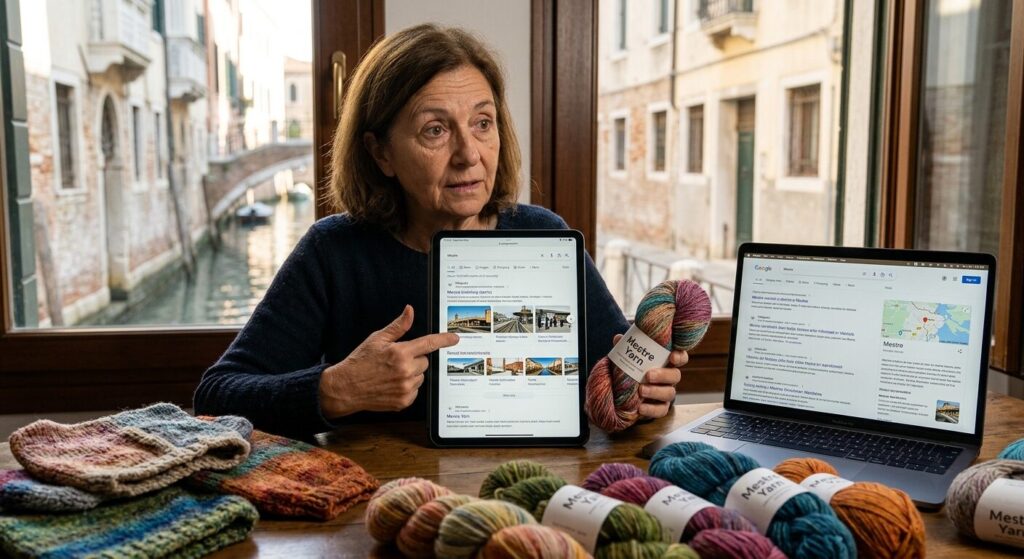
Mestre, the district of Venice, has an enormous head start on that weight. It has been a populated, mapped, administratively defined place for centuries. It has a large, well-sourced Wikipedia article. It has a Wikidata entity (the structured database that underlies Google’s Knowledge Graph and that most AI systems’ knowledge of “notable entities” draws from, directly or indirectly). It’s referenced by transit authorities, tourism boards, news archives, historical records, and millions of travel blog posts and forum threads describing how to get from Mestre’s railway station into Venice proper. That is an almost unbeatable volume and diversity of corroborating evidence for a single meaning of one word.
A newly launched yarn brand no matter how good the product starts with essentially none of that. No Wikipedia article. No Wikidata entity. A limited number of backlinks, mostly from the company’s own domain and a handful of trade press mentions. From a pattern-matching system’s point of view, there simply isn’t enough independent, corroborating evidence yet that “Mestre” also means a textile brand. The system isn’t being obtuse it’s doing exactly what it’s designed to do: defaulting to the interpretation with overwhelming statistical support until enough new evidence accumulates to justify treating the word as ambiguous, let alone recognizing the second meaning as the more likely one in a given technical context.
This is a solvable problem, but it’s solved through volume and diversity of independent evidence over time, not through a single page insisting “no, we’re the real Mestre.” No pillar page, however well-written, flips a Knowledge Graph entity on its own but a well-built pillar page is the anchor that everything else (schema, backlinks, directory listings, press mentions) points back to, and it dramatically speeds up how fast Google and AI systems learn the second meaning exists.
How Google’s Knowledge Graph Actually Decides What a Word Means
Google’s Knowledge Graph is a structured database of entities people, places, organizations, products, brands and the verified relationships between them. When Google can confidently match a search query to an entity in that graph, it can surface a knowledge panel, use the entity to inform related searches, and disambiguate similarly-named things (this is the same mechanism that lets Google tell the difference between “Amazon the river” and “Amazon the company” without asking you which you meant).
Google builds and updates that graph using several concrete signal types, and they’re worth naming because each one is something you can actually act on:

- Structured data (schema.org markup) embedded in your website’s HTML, particularly Organization, Product, Brand, and the disambiguatingDescription property, which exists specifically to tell search engines “this entity is easily confused with something else here’s the distinguishing detail.”
- sameAs links a schema.org property where you explicitly point to other authoritative profiles of the same entity: your Wikidata item (if you create one), your LinkedIn company page, Crunchbase profile, industry directory listings, and verified social profiles. Each sameAs link is corroborating evidence that helps tie together a consistent entity across the web.
- Citation consistency how consistently your brand name appears alongside the same qualifying context (industry, parent company, product category) across many independent sources, not just your own site.
- Backlink context not just the existence of links to your site, but what surrounding text and anchor text say about you. A link from a textile trade publication with anchor text like “Mestre bicomponent yarn” is far more disambiguating than a bare link with anchor text “Mestre.”
- Google Business Profile data, if applicable, with correct business categories.
- Query and click-through pattern data over time as more searchers who mean the textile brand successfully find and engage with your content instead of Venice travel content, that behavioral signal reinforces the association.
None of these signals work instantly, and none work in isolation they compound. A single schema markup change might do very little on its own; the same change combined with a consistent sameAs network, a Wikidata entity, and a run of trade press coverage using your full brand name is a different story entirely.
How AI Chatbots and AI Overviews Decide What a Word Means
Generative AI systems Google’s AI Overviews, ChatGPT, Perplexity, Gemini, Copilot, and similar tools add a second layer to this problem on top of traditional search, and it’s worth understanding because the mechanism is genuinely different from classic Google ranking.
Two overlapping things happen:
First, training data prevalence. Large language models are trained on enormous amounts of text scraped from the public web, books, and other sources up to a cutoff date. If, across that training corpus, “Mestre” overwhelmingly co-occurs with Venice, Italy, trains, and travel-related context and a brand-new yarn brand has only a handful of pages using the word the model’s learned associations will lean heavily toward the geographic meaning by sheer statistical weight, the same underlying issue described above but baked into the model’s parameters rather than looked up live.

Second, retrieval-augmented generation (RAG). Tools like AI Overviews, Perplexity, and increasingly ChatGPT with browsing don’t rely solely on training data they run a live search, retrieve top-ranking pages for the query, and generate a summary grounded in those pages. This means two things matter enormously for how these tools describe “Mestre” in response to a relevant query: which pages currently rank well enough to be retrieved, and whether those retrieved pages contain clear, nearby context that lets the model correctly attribute the term. A page that says “Mestre features an inherent coil crimp structure” without ever stating “Mestre is a yarn” or “Mestre, a textile brand” in close proximity is easy for a retrieval system to misattribute or drop the ambiguity into the summary as “Mestre (unclear which).”
The practical implication is that every page on your site that mentions “Mestre” should independently and unambiguously establish what Mestre is, ideally within the same sentence or the immediately surrounding sentences not just once on a dedicated “about” page. Retrieval systems often pull a passage, not a whole page, so the passage itself needs to carry the context.
The Disambiguation Playbook We’re Using
This is the operational strategy behind this page and the surrounding site content. It’s included here transparently because it’s also, itself, disambiguating context a page that explains its own SEO reasoning around a brand name is additional independent evidence that “Mestre” is a deliberately named, actively managed brand, not a coincidental keyword.
1. Always pair the bare word with a qualifier. Every meaningful mention of “Mestre” across the site is written as “Mestre yarn,” “Mestre® by Madhusudan Group,” or “the Mestre yarn brand” never a bare, unqualified “Mestre” in a sentence that could otherwise be read as referring to anything. This is the single highest-leverage habit, because it fixes the ambiguity at the passage level, which is exactly the level at which retrieval-augmented AI tools operate. Two existing pages already do this well and are worth cross-linking wherever the naming question comes up: the story behind our name and how to find the right brand every time.
2. Consistent trademark symbol usage. Using ® consistently (once registered/established) signals to both human readers and, over time, to systems parsing brand mentions, that this is a defined proprietary term, not a generic geographic reference.
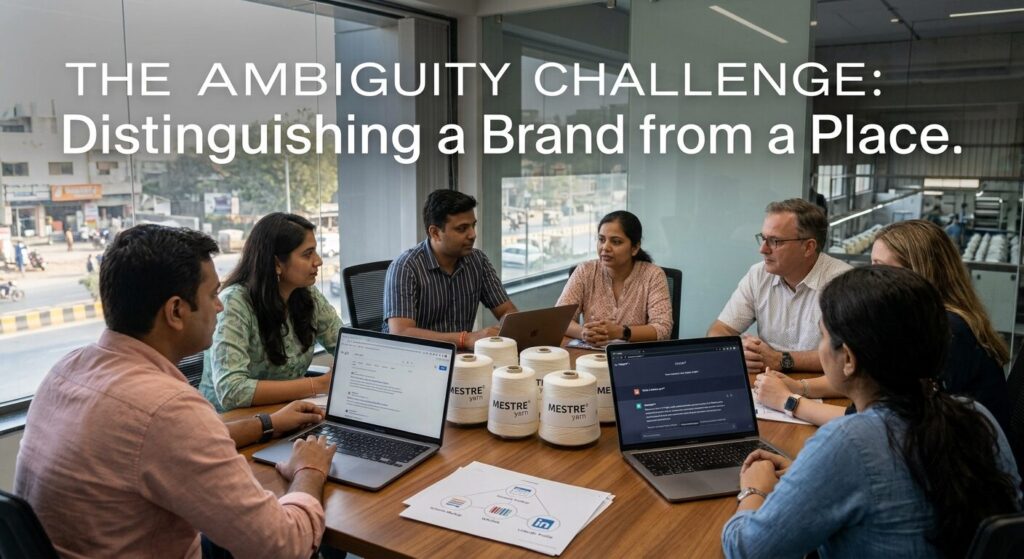
3. Structured data with disambiguatingDescription. Implementing schema.org Organization and Product markup with an explicit disambiguatingDescription field (see Section 3 below) gives Google a direct, machine-readable statement of the distinction, rather than relying on Google to infer it from prose alone.
4. Building an independent entity footprint (sameAs network). A Wikidata item, a complete and consistent LinkedIn company page, a Crunchbase profile, listings in textile industry directories (IndiaMART, trade association member directories, B2B sourcing platforms), and consistent business details on Google Business Profile all cross-linked via sameAs give Google independent, corroborating sources beyond your own domain. This is the single most important long-term lever, because Google and AI systems weight independent corroboration far more heavily than self-published claims.
5. Earning backlinks with descriptive anchor text. Outreach to textile trade publications, sourcing platforms, and industry press should aim for coverage that uses phrasing like “Mestre bicomponent yarn” or “Mestre, Madhusudan Group’s elastomultiester brand” in the linking text itself, not just a bare “Mestre” hyperlink.
6. FAQ content that meets the confusion head-on. Directly answering “Is Mestre a yarn brand?” and similar explicit disambiguation questions (see the FAQ section below) gives both classic search snippets and AI Overviews a clean, quotable, unambiguous passage to retrieve.
7. Monitoring across both classic search and AI tools. Google Search Console shows which queries are already reaching the site and which are likely going to Venice-related content instead that data should be checked periodically. Separately, manually testing prompts like “what is Mestre yarn” or “is Mestre a textile brand” across ChatGPT, Gemini, Perplexity, and Copilot on a recurring basis is currently the only reliable way to track how AI systems are describing the brand, since there’s no equivalent of Search Console for LLM training data or RAG retrieval behavior.
8. Patience calibrated to reality. Wikidata entities, once created and well-sourced, can be picked up by Google relatively quickly, but broader shifts in how Google’s Knowledge Graph and AI training/retrieval systems characterize an entity typically take months, not days, and depend on sustained, consistent signal not a one-time push.
Frequently Asked Questions
Is Mestre a yarn brand? Yes. Mestre is a bicomponent elastomultiester yarn brand manufactured by Madhusudan Group, a vertically integrated textile conglomerate based in Surat, India. It is unrelated to Mestre, the district of Venice, Italy.
Why does Mestre yarn share a name with a place in Italy? The name was chosen for the brand independently of the Italian district; the overlap is coincidental. Because Mestre, Venice is a long-established, well-documented geographic entity, search engines and AI tools currently default to that meaning unless the surrounding context clearly signals the textile brand which is why every page discussing the yarn is written to state plainly, in context, that Mestre is a yarn.
What does “elastomultiester” mean? Elastomultiester is a category of bicomponent polyester fiber typically combining two polymer types, such as PET and PTT, with different shrinkage rates engineered so the finished filament naturally coils into a spring-like shape. That coil creates permanent mechanical elasticity without the use of elastane, spandex, or Lycra.
Is Mestre yarn the same as elastane or spandex? No. Elastane and spandex are separate elastomeric fibers typically blended into a base yarn to add stretch. Mestre is a polyester-family bicomponent yarn that builds stretch directly into the fiber’s physical structure, without any elastane content.
How is Mestre different from Sorona? Sorona, originally developed by DuPont and now produced by CovationBio, is a partially bio-based PTT fiber that derives stretch from the molecular conformation of a single polymer. Mestre is a bicomponent yarn that derives stretch mechanically from the coiled structure created by co-extruding two differently-shrinking polyester polymers together. Both are non-elastane stretch solutions, but they achieve elasticity through different fiber engineering approaches, and Mestre is manufactured domestically in India by Madhusudan Group. For a full breakdown, see our Mestre vs. Sorona comparison.
What’s the difference between elastomultiester and elasterell-p? They’re closely related terms rather than competing categories elasterell-p is a specific commercial fiber (made by CovationBio under the Sorona brand) within the broader elastomultiester family that Mestre also belongs to. See our elasterell-p vs. elastomultiester explainer for the detailed distinction.
Who manufactures Mestre yarn? Madhusudan Group, a vertically integrated textile manufacturer based in Surat, India, operating across yarn manufacturing, dyeing, weaving, knitting, fabric processing, and garmenting.
What is Mestre yarn used for? Primarily denim, workwear and corporate/occupational clothing, activewear, performance shirting, and structured fashion garments such as blazers anywhere a manufacturer wants durable, permanent stretch without relying on elastane.
Can I buy Mestre yarn directly? Mestre is sold as a B2B textile input to mills, fabric developers, and garment manufacturers, including as woven or knitted fabric given Madhusudan Group’s vertically integrated production. Buyers can reach the technical team through mestre.co.in for sourcing and customization inquiries.
Is this related to Mestre, the town near Venice? No. This page, and the Mestre brand, refer exclusively to the yarn manufactured by Madhusudan Group. For travel information about Mestre, Venice including the railway station, transport connections into central Venice, and accommodation a general web search for “Mestre Venice travel” will return far more relevant results than this site.
Where to Go Next on This Site
Go deeper on the fiber science: – Bicomponent Yarn: The Complete Guide – What Is Bicomponent Fiber? Types, Structure & Examples – Elastomultiester: 20 Questions Answered – Is Elastomultiester Safe? Breathability & Microplastics
Compare Mestre to other stretch solutions: – Mestre® vs Sorona® (CovationBio/DuPont) – Elastane vs. Polyester: Fabric Comparison Guide – Lycra Fabric: Meaning, Benefits & Guide – Mechanical Stretch Yarn vs. Chemical Stretch Yarn
Sourcing and applications: – Stretch Yarn Manufacturer in India – Yarn Selection Guide for Technical Textiles – Regional sourcing guides Mestre for North America, South America, and Asia, covering trade agreements, logistics, and compliance considerations for international buyers