Workers in manufacturing, construction, logistics, emergency services, and industrial facilities need protective garments that move with them not against them. Restrictive, non-stretch workwear increases fatigue, reduces dexterity, and in some cases creates safety risks when garments catch or bind during physical tasks.
The challenge is providing that movement freedom using materials that also meet demanding safety and durability requirements. In many PPE and workwear contexts, elastane the traditional source of stretch is not an option due to its poor resistance to chemicals, high temperatures, and industrial laundering.
This is where mechanical stretch yarn, as developed and supplied by Mestre, becomes the definitive solution.
Why Workwear Cannot Always Use Elastane
Elastane is the dominant stretch fibre in consumer apparel, but workwear and PPE operate under fundamentally different conditions:
- Chemical Exposure: Workers in chemical plants, cleaning services, or agricultural environments are exposed to solvents, acids, bleach, and other substances that rapidly degrade elastane’s elastic performance.
- High-Temperature Laundering: Industrial workwear laundering at 60–85°C is common. Elastane begins to lose performance above 40–50°C with repeated washing, leading to garment bagginess and fit failure.
- Flame Resistance Requirements: FR (flame-resistant) workwear often cannot incorporate elastane, which is flammable and does not meet the combustion performance thresholds required by EN 11611 or NFPA standards.
- EN/ISO Certification: Some workwear standards restrict or complicate the use of elastic polymers in garment constructions that must pass specific abrasion, tensile, or chemical penetration tests.
How Mechanical Stretch Addresses These Challenges
Mechanical stretch yarn particularly bicomponent PET-PTT elastomultiester from Mestre delivers the freedom-of-movement benefit without any of the limitations of elastane:
Chemical Resistance
Fully polyester-based mechanical stretch yarn has excellent resistance to dilute acids, alkalis, solvents, and oxidising agents. Workwear using Mestre mechanical stretch yarn maintains its stretch performance even after repeated exposure to harsh cleaning chemicals.
High-Temperature Wash Stability
Polyester mechanical stretch yarn is thermally stable under standard industrial laundering conditions. Unlike elastane, it does not lose elastic performance or change dimensionally through high-temperature wash cycles.
Compatibility with FR Treatments
Polyester-based mechanical stretch yarn can be treated with FR finishes or inherently FR polymer formulations without compromising the elastic performance. This makes it an enabling technology for the next generation of FR stretch workwear.
EN/ISO Standard Compliance
Because mechanical stretch arises from fibre structure rather than the inclusion of a rubber-like polymer, garments made from mechanical stretch yarn can more readily pass PPE certification standards without complex testing exceptions.
Applications in Workwear and PPE
High-Visibility Workwear
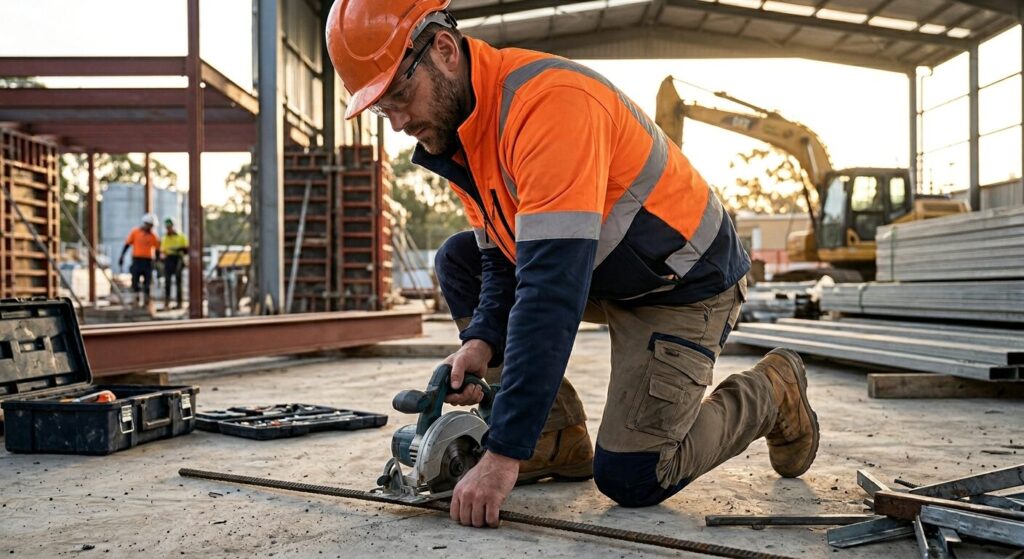
Hi-vis garments worn by road workers, traffic controllers, and construction personnel must be robust, easy to move in, and survive intensive laundering. Mechanical stretch fabrics combining reflective elements with Mestre’s stretch yarn deliver all of these requirements.
Chemical Protection Suits
Type-3 and Type-4 chemical protective garments require stretch for donning and movement, but cannot incorporate elastane due to chemical permeation concerns. Mechanical stretch polyester is the preferred alternative, now increasingly specified by major PPE manufacturers.
Arc Flash and Electrical Arc Protection
Arc flash PPE must satisfy electrical and thermal performance criteria. Mechanical stretch inherent polyester yarn can be incorporated into inherently FR fabric constructions without compromising arc rating a significant advantage over elastane-based alternatives.
Emergency Services Uniforms
Police, fire, and paramedic uniforms must allow the free movement demanded by physical intervention, patient handling, and equipment operation. Mechanical stretch workwear provides this movement freedom with the durability and washability required in operational environments.
Mestre’s Mechanical Stretch Yarn Range for Workwear
Mestre supplies a dedicated range of mechanical stretch yarns for workwear and PPE applications, optimised for:
- High tenacity for abrasion and tear resistance in demanding industrial environments
- Controlled stretch modulus providing movement without excess elasticity
- Temperature stability for industrial washing at up to 85°C
- Compatibility with FR and antistatic fibre blending
Our technical team works with workwear manufacturers to select the right yarn denier, count, and processing specification for each application, ensuring garments meet both performance and certification requirements.
Frequently Asked Questions
Q1: Can mechanical stretch workwear match the comfort of elastane workwear?
- For most occupational movements, mechanical stretch delivers equivalent freedom-of-movement comfort. The stretch modulus is lower than elastane but sufficient for bending, reaching, and physical handling tasks.
Q2: Is mechanical stretch yarn compatible with flame-resistant (FR) fibres?
- Yes. Mechanical stretch polyester yarn can be blended or combined with inherently FR fibres such as meta-aramid in fabric constructions that meet FR workwear standards.
Q3: How does industrial laundering affect mechanical stretch yarn performance?
- Mestre’s mechanical stretch yarn is thermally stable under industrial laundering conditions. Multiple high-temperature wash cycles do not significantly degrade stretch or recovery performance.
Q4: What certifications apply to PPE fabrics using mechanical stretch yarn?
- This depends on the specific PPE application. Mestre can provide technical support for EN 471, EN 13034, EN 11612, and other relevant certification processes. Contact mestre.co.in for guidance.
Q5: Can Mestre supply mechanical stretch yarn for antistatic PPE fabric?
Yes. Mestre’s mechanical stretch yarns can be specified for blending with conductive or antistatic fibres for ESD-protective workwear applications. Contact our technical team for details.