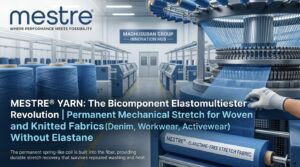
If you work in textile manufacturing whether you produce sportswear, denim, athleisure, or formal fabrics you have likely heard the words “stretch yarn” used in many different ways. Lycra. Spandex. Elastane. T-400. Sorona. The market is crowded with options, and choosing the wrong one can compromise your fabric’s performance, durability, and cost structure.
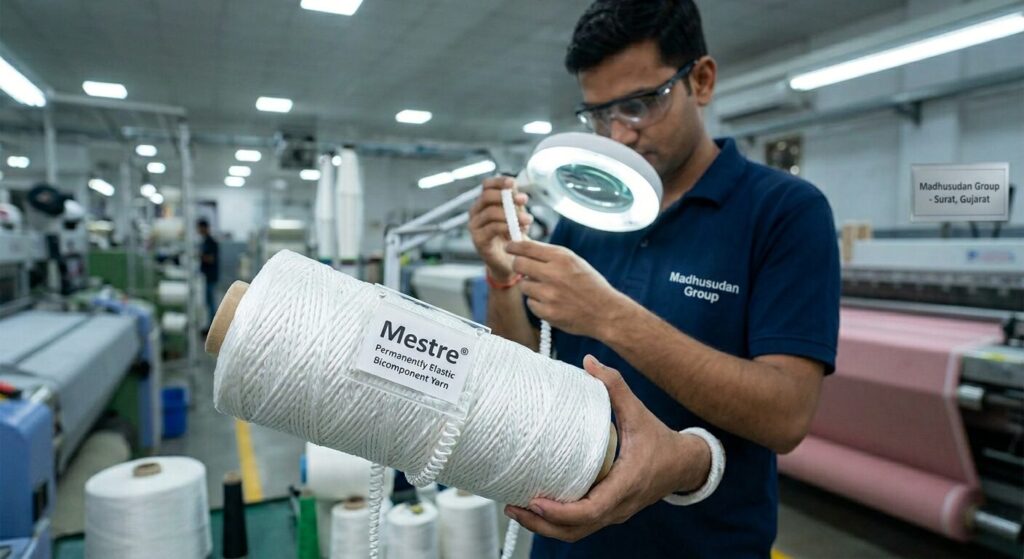
Mestre® is a premium bicomponent functional yarn engineered by the Madhusudan Group one of India’s most respected vertically integrated textile conglomerates based in Surat, Gujarat to solve the limitations that plague conventional stretch yarns.
This guide covers everything you need to know about Mestre® yarn: what it is, how it is made, what makes it unique, and which applications it is best suited for.
What is Bicomponent Yarn?
A bicomponent yarn is a single fibre made from two chemically different polymers that are spun together in a single extrusion process. The two polymers are bonded side-by-side within the fibre. Because the two components have different physical properties particularly different rates of thermal shrinkage the finished fibre naturally develops a coil crimp structure when heat-treated.
This coil crimp is the key. Unlike conventional stretch yarns that rely on elastane (a rubber-like polyurethane compound) to create stretch, bicomponent yarns create stretch through a purely mechanical mechanism. The coil acts like a tiny spring it stretches under load and returns to its original shape when the load is released.
This distinction mechanical stretch vs chemical stretch has profound implications for the performance, durability, and care of the finished fabric.
How Mestre® is Engineered | The Coil Crimp Structure
Mestre® is built on elastomultiester technology. The yarn is produced by co-extruding two polyester variants with different intrinsic viscosities through a single spinneret. When the extruded fibre is heat-set, the difference in shrinkage rates between the two components causes the fibre to spontaneously coil into a tight, three-dimensional helical crimp.
This crimp is not a surface treatment or a coating. It is inherent to the fibre’s molecular structure, which is why it is called permanent elasticity. No amount of washing, heat, or mechanical stress will eliminate the crimp it is locked into the yarn at the point of production.
The result is a yarn that:
- Stretches smoothly under load without feeling rubbery or restrictive
- Recovers quickly and completely when the load is removed
- Retains its stretch performance through dozens of wash cycles
- Accepts dye uniformly, producing vibrant and consistent colour across large production runs
Key Properties of Mestre® Yarn
Permanent Elasticity
The stretch is mechanical, not chemical. Mestre® retains its elastic recovery even after repeated washing, high-temperature processing, and extended wear. Fabrics made with Mestre® do not bag at the knees, elbows, or seat a common and costly complaint with elastane-based fabrics.
Superior Moisture Management
Mestre® features excellent wicking and absorption properties. Moisture is transported away from the skin rapidly, keeping the wearer dry and comfortable during physical activity. This makes it especially well-suited for sportswear, activewear, and performance apparel.
Exceptional Dyeability and Colour Fastness
Mestre® accepts both disperse dyes with high uniformity and fastness. Manufacturers can achieve deep, consistent colours without the patchy or streaky results that sometimes occur with elastane blends.
Excellent Resistance to Light and Heat
Mestre® maintains its stretch and recovery properties under UV exposure and elevated processing temperatures critical for outdoor fabrics, garments washed at high temperatures, and products going through demanding finishing operations.
Dry-Touch and Wool-Feel Effect
The coil crimp structure creates a soft, dry, natural-feeling hand. At higher denier counts, the yarn produces a fabric with a warm, wool-like feel highly desirable in premium athleisure and formal wear.
Four-Way Stretch
Mestre® enables true four-way stretch in woven and knitted fabrics, meaning the fabric stretches both along and across the grain. Essential for performance garments that require unrestricted movement in every direction.
Industries That Use Mestre® Yarn
Sportswear and Activewear Running tights, training tops, sports bras, and gym wear that demand four-way stretch, moisture management, and wash durability.
Stretch Denim Denim woven with Mestre® holds its shape wash after wash, eliminating the bagging problem that plagues elastane-denim constructions.
Athleisure and Casual Wear Comfortable everyday garments where stretch and softness are as important as appearance.
Medical Textiles Compression garments, support bandages, and orthopaedic textiles that require consistent, predictable stretch over a long service life.
Core Spinning Mestre® as the elastic core in core-spun yarns, providing the stretch foundation while a natural or synthetic outer fibre provides the desired surface character.
Knitted Fabrics and Yoga Wear Leggings, yoga pants, and performance knitwear requiring complete four-way stretch with total recovery.
Shirts, Trousers, and Corporate Wear Formal garments that offer a clean, structured appearance with the comfort and movement that modern professionals demand.
Why Choose Mestre® Over Conventional Stretch Alternatives?
| Factor | Mestre® | Lycra/Elastane |
|---|---|---|
| Stretch mechanism | Mechanical (permanent) | Chemical (degrades over time) |
| Wash durability | Excellent no degradation | Moderate degrades with washing |
| Moisture management | Excellent | Poor |
| Dyeability | Excellent | Requires separate process |
| Heat resistance | Excellent | Moderate |
| Manufactured in India | Yes Surat, Gujarat | No imported |
| Currency exposure | INR (no risk) | USD (import duties + FX risk) |
| Skin safety | Polyester no sensitisers | Polyurethane potential sensitiser |
Frequently Asked Questions
Is Mestre® the same as Lycra?
No. Lycra is elastane a polyurethane-based synthetic. Mestre® is a bicomponent polyester yarn. The stretch mechanisms are entirely different.
Can Mestre® replace Lycra in my existing fabric construction?
In most denim, sportswear, and formal wear applications, yes. Contact the Mestre® team for a technical consultation specific to your construction.
Where is Mestre® manufactured?
Mestre® is manufactured by the Madhusudan Group in Surat, Gujarat, India.
Is Mestre® suitable for export-quality garments?
Yes. Mestre® meets international quality and performance standards and is used by manufacturers supplying both domestic and export markets.
Conclusion
Mestre® bicomponent stretch yarn represents a significant advance over conventional elastane-based stretch solutions. Its permanent mechanical elasticity, superior moisture management, excellent dyeability, and Indian origin make it the smart choice for textile manufacturers looking to reduce costs, improve fabric performance, and build supply chain resilience.
Ready to sample Mestre®? Contact the Madhusudan Group team at mestre.co.in or WhatsApp +91 63524 89832.