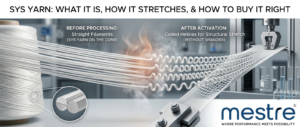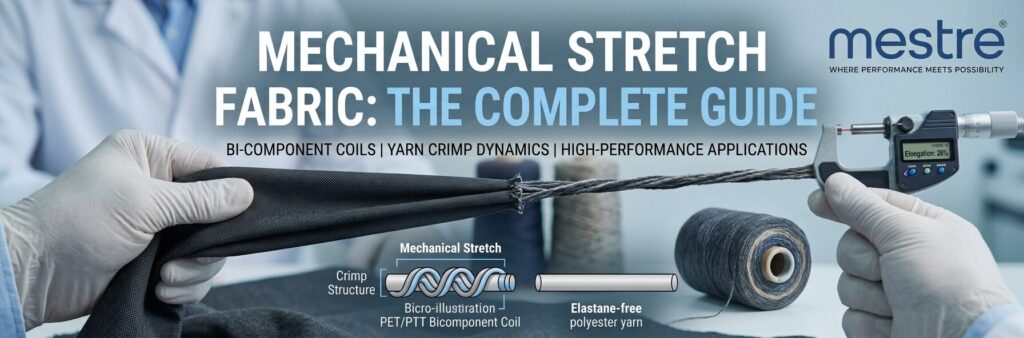
Pick up almost any pair of trousers, a shirt, or a piece of workwear on the market today and there’s a good chance it stretches even if the label never mentions elastane, spandex, or Lycra. That flexibility increasingly comes from mechanical stretch, a form of elasticity engineered directly into the yarn and fabric structure rather than added through a rubber-like fibre.
Mechanical stretch has quietly become one of the most important shifts in modern textile manufacturing. As brands face pressure to cut elastane use, improve recyclability, and produce garments that hold their shape for longer, mechanical stretch fabric, yarn, and knit constructions are moving from a niche technical solution to a mainstream sourcing decision for shirting, suiting, uniforms, sportswear, and technical textiles alike.
This guide covers everything a designer, buyer, mill, or student of textiles needs to know: what mechanical stretch actually is, how mechanical stretch yarn is manufactured, the different types and properties of mechanical stretch fabric, its advantages and limitations, where it’s used across industries, and how it compares to elastane and chemical stretch alternatives. Whether you’re evaluating a mechanical stretch fabric supplier, researching mechanical stretch polyester for a new collection, or simply want a plain-language answer to “what is mechanical stretch,” this article is built to answer it in full.
Demand for this kind of engineered, elastane-free elasticity is growing fast, and it’s growing for reasons that go well beyond comfort. Regulatory pressure on fibre blending, rising consumer awareness of microplastic shedding from synthetic elastic fibres, and the sheer cost of maintaining dedicated elastane feeding equipment on looms and knitting machines are all pushing procurement teams to ask a simple question: does this garment actually need elastane, or would mechanical stretch fabric do the job just as well, for less? For a large share of everyday apparel shirting, trousers, uniforms, and casualwear the answer is increasingly yes.
What is Mechanical Stretch?
Simple Explanation
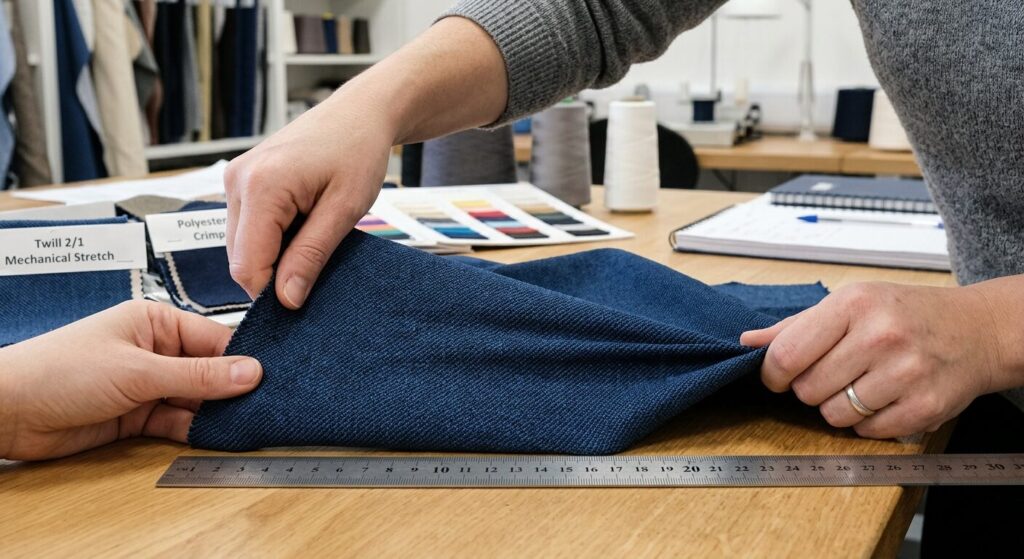
Mechanical stretch is stretch that comes from how a fabric is built, not from what it’s made of. A mechanical stretch fabric extends when you pull it and springs back into shape when you let go the same behaviour you’d expect from spandex but without any elastic fibre in the yarn at all.
Technical Explanation
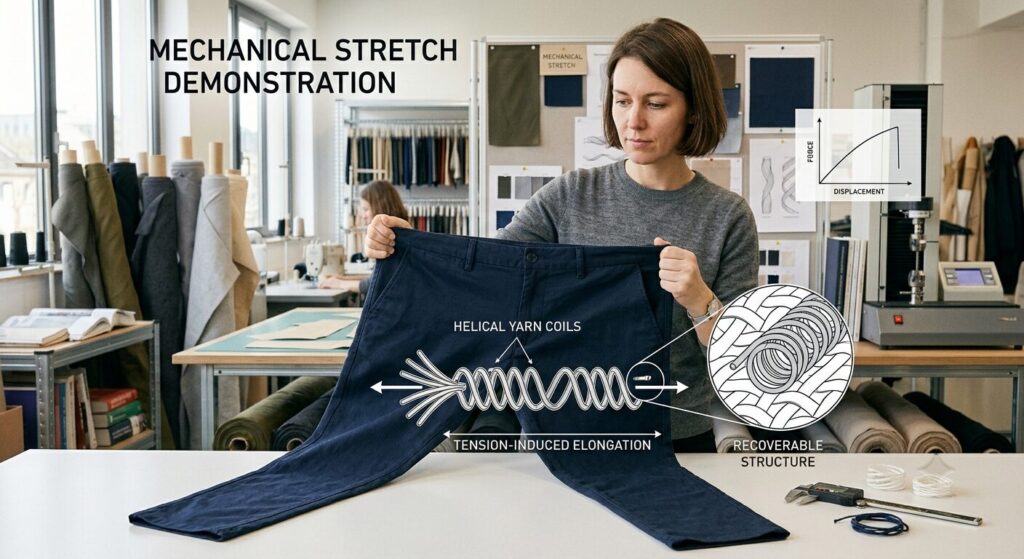
In engineering terms, mechanical stretch is elasticity generated by the physical geometry of a yarn or fabric structure: crimp in a texturised filament, the coil of a bicomponent fibre, the interlaced loops of a knit, or the diagonal float of a twill weave. When tension is applied, this geometry straightens or opens out; when tension is released, the structure’s own stiffness pulls it back to its resting shape. It’s the textile equivalent of a coiled spring rather than a stretched rubber band a distinction covered in more depth in our breakdown of how mechanical stretch works at the yarn level.
Industry Explanation
Textile mills and fabric technologists classify stretch into two broad mechanisms: chemical (fibre-based) stretch, delivered by elastane, and mechanical (structure-based) stretch, delivered by yarn crimp, bicomponent architecture, or weave/knit construction. For a full technical definition, real-world examples, and how mechanical stretch polyester specifically performs, see our companion guide on the meaning, definition, and examples of mechanical stretch.
In short: mechanical stretch = stretch without elastane. The fibre selection, the way the yarn is spun or textured, and the way the fabric is constructed do all the work that a rubber-like fibre would otherwise do.
History of Mechanical Stretch
Mechanical stretch is not a new invention it predates elastane by decades. Long before Lycra was commercialised in 1958, traditional woven fabrics achieved a natural amount of give purely through weave geometry. Twill weaves, including the diagonal structure used in classic denim, allowed yarns to shift slightly under tension, giving garments a small but noticeable amount of comfort stretch. Wool suiting relied on the natural crimp of the wool fibre itself for a similar effect.
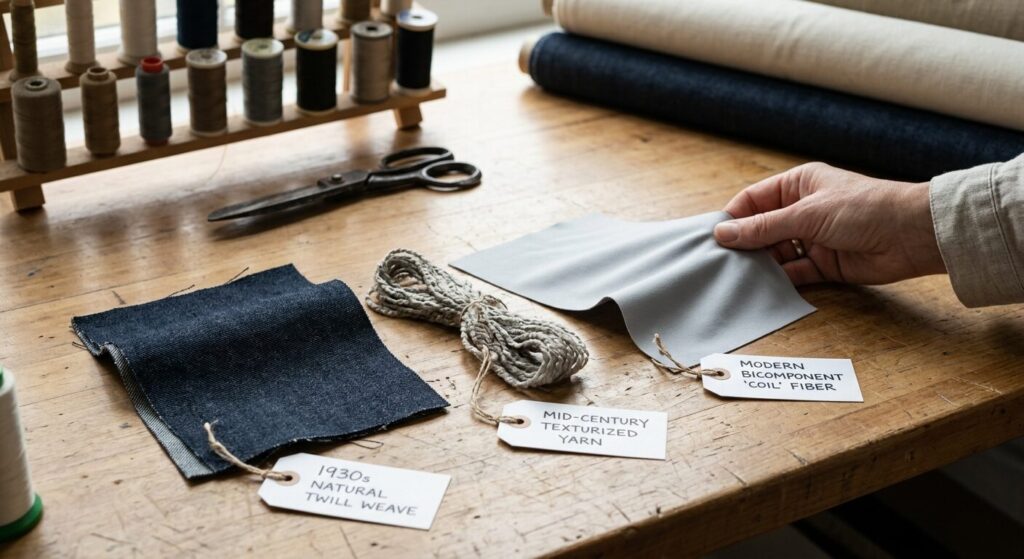
The development of synthetic filament yarns in the mid-20th century opened up a new pathway. Polyester and nylon could be texturised twisted, heat-set, and untwisted to lock in a permanent crimp, giving manufacturers a controllable, repeatable way to engineer stretch into a yarn without relying on natural fibre properties or loose weave structures.
The real leap came with bicomponent fibre technology, where two polymers with different shrinkage behaviour are extruded side by side in a single filament. Once heat-set, the mismatch in shrinkage forces the filament into a permanent, spring-like coil. This innovation, refined over recent years into elastomultiester-type yarns, gave the industry a durable, elastane-free stretch source suitable for demanding applications.
Today, sustainability pressure and end-of-life recycling requirements are accelerating a return to mechanical stretch. Mono-material, elastane-free stretch fabrics are significantly easier to recycle, and that alone is reshaping sourcing decisions across apparel and technical textiles heading into the second half of this decade.
It’s worth noting that this isn’t a straight-line replacement story. Elastane hasn’t disappeared, and it won’t it remains the only practical option for very high-elongation, high-compression garments. What has changed is that mills and brands now have a genuine, well-tested alternative for the much larger share of stretch apparel that only ever needed comfort stretch in the first place, rather than defaulting to elastane by habit.
How Mechanical Stretch Works
Mechanical stretch behaves like a spring system built at three possible levels of the fabric: the filament, the yarn, and the fabric construction.
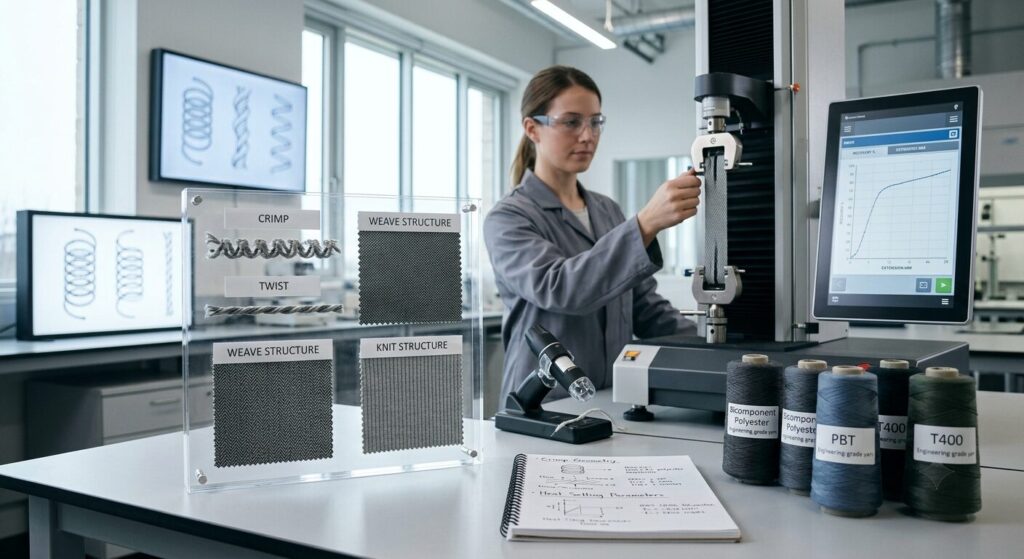
- Crimp: A controlled, repeating wave or coil locked into a filament. Under tension, the crimp straightens; on release, it recoils. This is the fundamental unit of most mechanical stretch yarn.
- Twist: The angle and tightness of twist in a spun or filament yarn affects how much the yarn can elongate before the fibres themselves are placed under direct strain.
- Weave/knit structure: In a woven fabric, twill and dobby constructions allow yarns to shift diagonally, creating give even from straight, uncrimped yarn. In knitted fabric, the interlocking loop structure is inherently elastic in multiple directions, which is why jersey and rib knits stretch even in 100% cotton.
- Heat setting: Once a crimped or coiled structure is created, heat setting locks it permanently into the polymer. This step determines how much of the engineered stretch survives repeated washing, ironing, and wear.
- Recovery: The fabric’s ability to return to its original dimensions after stretching, usually expressed as a recovery percentage. Good mechanical stretch fabric recovers close to 100% of its extension after moderate loads.
Together, these mechanisms explain why two fabrics made from identical straight yarn can behave completely differently once one is woven as a twill and the other as a plain weave, or why a crimped bicomponent filament outperforms a flat filament in both stretch and recovery. A deeper technical walkthrough of these mechanisms including how crimp geometry is engineered at the fibre level is available in our dedicated explainer on mechanical stretch in textiles and how it works.
How Mechanical Stretch Fabric is Manufactured
Producing mechanical stretch fabric at commercial scale follows a fairly consistent seven-step process, regardless of whether the end product is shirting, suiting, or technical textile.
Step 1 Fibre Selection Manufacturers choose the base polymer, most commonly polyester (PET) or a PET/PTT bicomponent combination, based on the target stretch level, hand feel, and end-use performance requirements such as heat resistance or chemical exposure.
Step 2 Yarn Spinning The selected polymer is extruded into continuous filament yarn or spun into staple yarn, depending on whether the target fabric is a filament-based technical textile or a natural-feel staple-spun fabric.
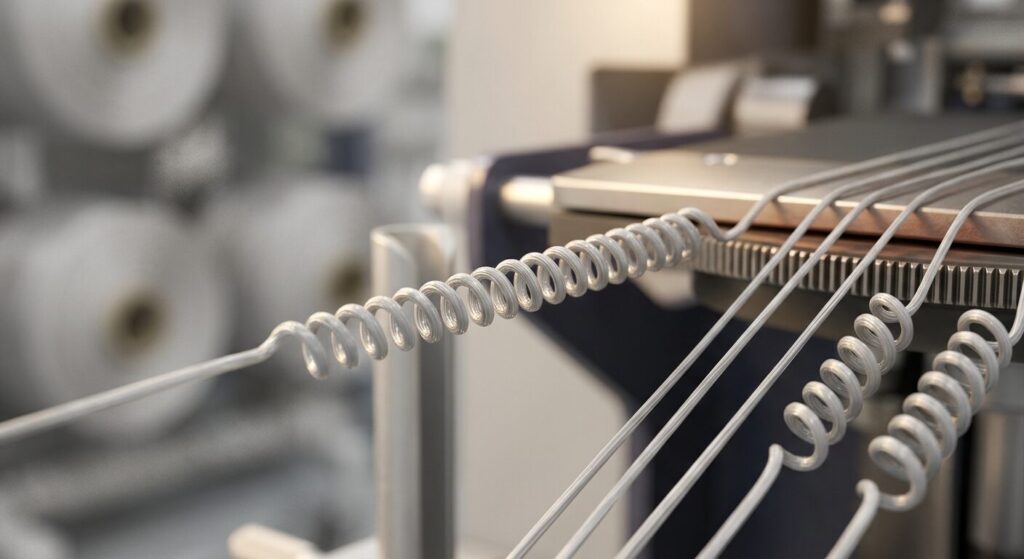
Step 3 Texturing This is where mechanical stretch is actually built into the yarn. False-twist texturising twists, heat-sets, and untwists a flat filament to lock in a fine spiral crimp. Air-jet texturising uses compressed air to interlace filaments into a bulkier, looped structure. Bicomponent yarns develop their coil automatically during heat relaxation because of differential shrinkage between the two polymer components.
Step 4 Weaving or Knitting The textured or crimped yarn is woven (commonly as the weft, sometimes both warp and weft for four-way stretch) or knitted into fabric. The choice of weave plain, twill, dobby, satin or knit structure jersey, interlock, rib further shapes how the fabric’s final stretch behaves.
Step 5 Heat Setting The greige fabric passes through a stenter frame at a controlled temperature. This step activates and stabilises the crimp, locks in dimensional stability, and determines the fabric’s final stretch percentage and recovery performance.
Step 6 Finishing Dyeing, printing, softening, and any functional finishes (wrinkle resistance, moisture-wicking, water repellency) are applied. Because most mechanical stretch fabric is elastane-free, it typically tolerates higher finishing temperatures than elastane-blended fabric, simplifying this stage.
Step 7 Quality Testing Finished fabric is tested for stretch percentage, recovery, growth (permanent deformation), tensile strength, and colour fastness against recognised industry test methods before it ships to garment manufacturers.
Types of Mechanical Stretch Fabrics
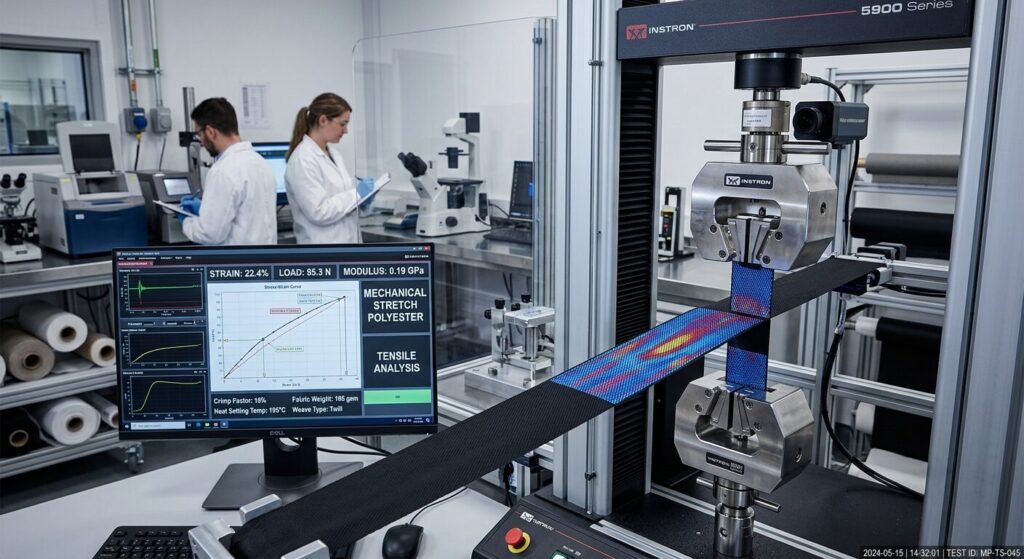
Mechanical Stretch Polyester The most common base for mechanical stretch fabric. Polyester texturises well, holds crimp reliably through heat setting, and offers strong durability, wrinkle resistance, and easy care all without elastane.
Mechanical Stretch Woven Fabric Achieved through crimped weft (or warp) yarn combined with a twill, dobby, or plain weave. Typically delivers two-way stretch and is widely used in shirting, trousers, and suiting.
Mechanical Stretch Knit Fabric Combines crimped yarn with an inherently elastic knit structure jersey, interlock, or rib to deliver higher, often four-way, stretch suitable for activewear and everyday knitwear.
Mechanical Stretch Shirting Lightweight woven fabric using fine-denier crimped yarn in the weft, giving dress and casual shirts freedom of movement without a compression feel.
Mechanical Stretch Suiting Wool, polyester, or wool-polyester blends engineered with mechanical stretch for formal and corporate wear that needs to move with the body while keeping a tailored, structured appearance.
Mechanical Stretch Sportswear Knit constructions combining crimped or bicomponent yarn with engineered knit geometry for comfort-stretch activewear, though genuinely high-compression performance sportswear typically still blends in some elastane.
Mechanical Stretch Uniform Fabric Woven or knit fabric engineered for corporate uniforms, school wear, and institutional apparel where repeated industrial laundering demands a stretch source that won’t degrade the way elastane does.
Properties of Mechanical Stretch Fabric
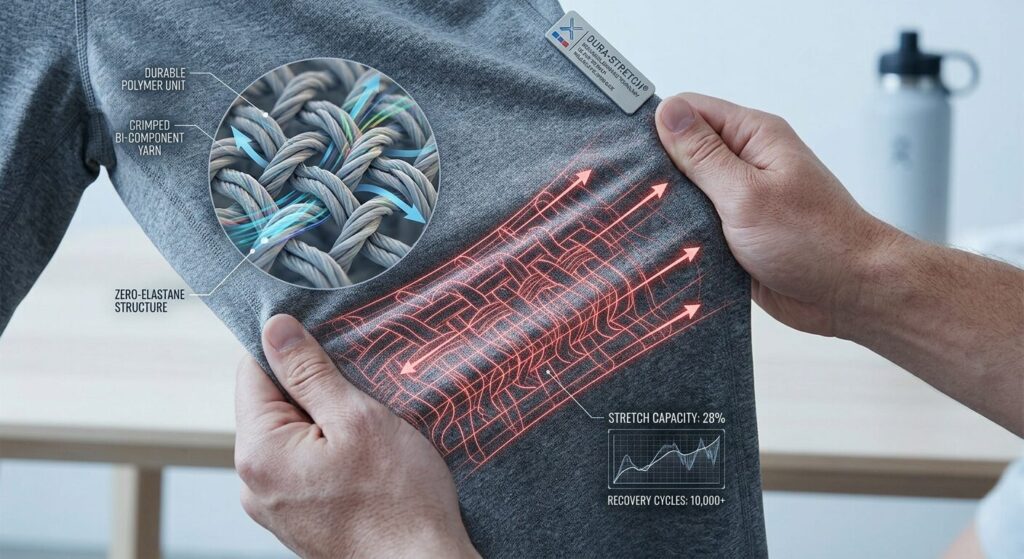
| Property | What It Means |
| Stretch recovery | Returns close to its original dimensions after each extension cycle |
| Breathability | Polyester-based crimp structures allow airflow without a rubbery barrier layer |
| Comfort | Softer, more progressive stretch feel than high-compression elastane fabric |
| Wrinkle resistance | Crimped polyester resists creasing better than flat, uncrimped fabric |
| Shape retention | Heat-set crimp structure resists sagging and bagging at knees and elbows |
| Durability | No elastic polymer to degrade from heat, chlorine, or UV exposure |
| Moisture management | Polyester’s low absorbency supports fast drying and moisture-wicking finishes |
| Lightweight | Texturised yarns add bulk and stretch without significant added weight |
| Easy care | Machine washable, generally tumble-dry safe, no special elastane handling needed |
| Colour fastness | Single-polymer construction dyes more evenly than elastane-blended fabric |
Advantages of Mechanical Stretch Fabric
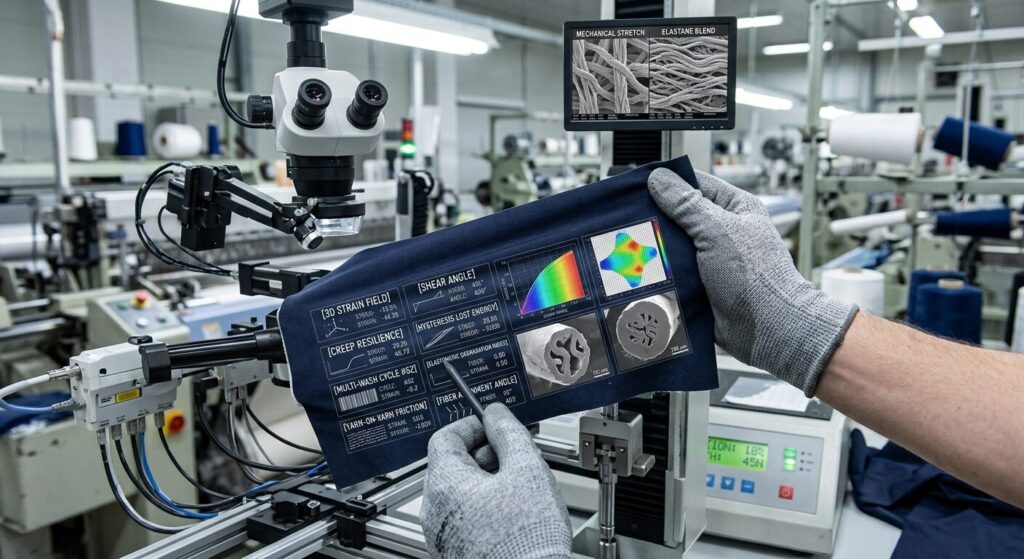
- Comfort: Genuine freedom of movement without a tight, compression feel.
- Professional appearance: Holds tailored shape well, suited to shirting and suiting.
- No elastane required: Simplifies formulation and reduces reliance on a single elastic polymer supply chain.
- Better long-term durability: Crimp geometry doesn’t degrade the way elastane’s polymer chain does with heat and washing.
- Easy maintenance: Tolerates standard and industrial laundering without special handling.
- Cost-effective at scale: Often cheaper to process than elastane-containing fabric once feeder equipment, loom speed, and rejection-rate differences are factored in.
- Long product life: Maintains stretch performance across more wash and wear cycles.
- Suited to industrial use: Withstands the higher wash temperatures common in workwear and institutional laundering.
- Fashion-friendly: Works across shirting, suiting, denim, and casualwear without a synthetic “stretch” look or feel.
- Travel-friendly: Wrinkle resistance and shape retention make it a practical choice for travel apparel.
Disadvantages of Mechanical Stretch Fabric
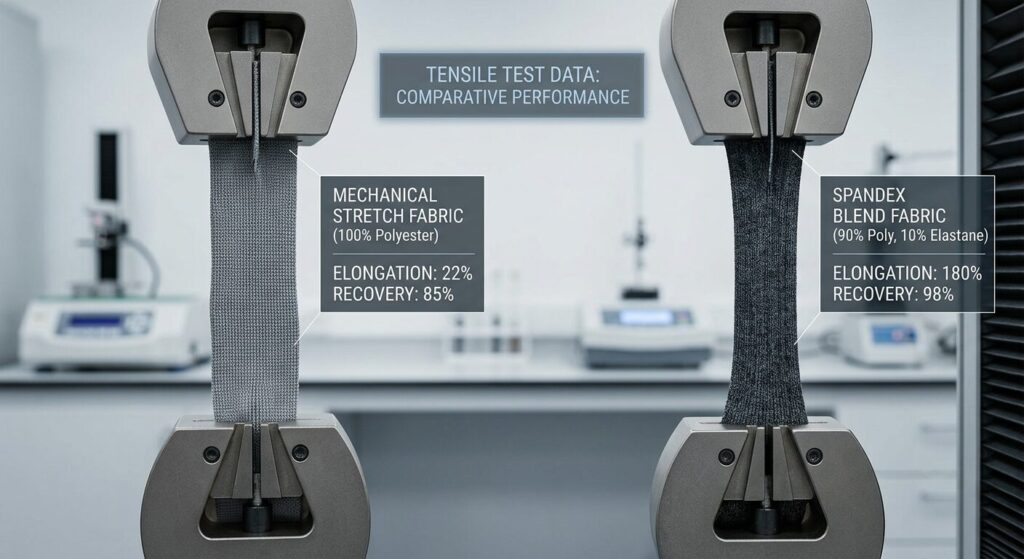
- Limited maximum stretch: Typically 15–30% elongation, well below the 150–600% elastane can achieve.
- Depends heavily on weave/knit design: Poor construction choices can undercut the stretch benefit entirely.
- Less elastic feel: Softer, more gradual recovery force than the snap-back of spandex, which some applications specifically want.
- Can lose recovery over time: Extreme or repeated high-heat exposure can eventually relax a crimp structure, though far more slowly than elastane degrades.
- Not suited to compression garments: High-power compression wear, medical stockings, and competitive swimwear still require elastane’s higher elongation and recovery force.
Applications of Mechanical Stretch Fabric
Apparel
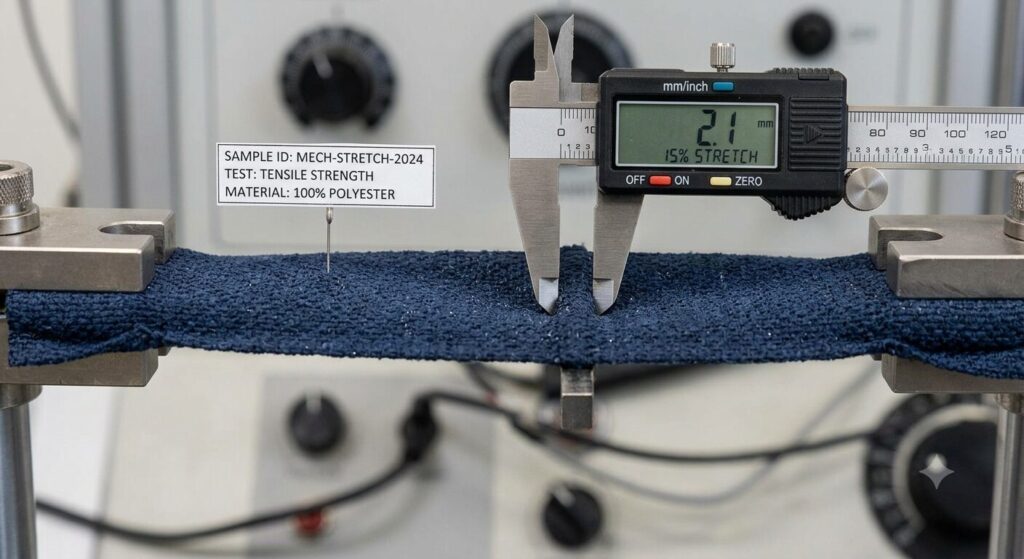
Mechanical stretch fabric is now common across shirts, trousers, uniforms, school wear, corporate wear, workwear, sportswear, women’s wear, fashion apparel, and children’s wear, wherever comfort stretch rather than compression is the actual requirement.
Industrial and Technical Use
Beyond fashion, mechanical stretch yarn plays a growing role in medical textiles, automotive interior textiles, hospitality uniforms, military apparel, broader technical textiles, and safety garments. Workwear and personal protective equipment (PPE) are among the fastest-growing segments, precisely because elastane cannot always survive the chemical exposure, high-temperature laundering, or flame-resistance requirements these categories demand. Our detailed look at mechanical stretch yarn for workwear and PPE covers how this plays out across hi-vis clothing, chemical protection suits, arc-flash PPE, and emergency services uniforms.
In automotive interiors, mechanical stretch fabric is increasingly specified for seat covers and trim panels that must flex repeatedly while resisting years of heat and UV exposure inside a closed cabin conditions that degrade elastane far faster than they degrade a crimped polyester structure. In hospitality, uniform fleets that go through daily industrial laundering benefit from the same heat tolerance, while medical textiles use mechanical stretch where gentle, latex-free elasticity is needed without the sensitisation risk sometimes associated with rubber-based elastic fibres.
Mechanical Stretch vs Elastane
| Factor | Mechanical Stretch | Elastane |
| Stretch percentage | ~15–30% | 150–600% |
| Comfort | Soft, gradual, fabric-like feel | Tighter, body-contouring feel |
| Durability | High; resists heat, UV, chemical degradation | Degrades with heat, chlorine, UV, oils |
| Recovery | Good to excellent within its stretch range | Excellent, especially at high elongation |
| Price | Often lower processing cost overall | Higher yarn cost plus specialised processing |
| Maintenance | Standard care, tolerant of high heat | Requires lower wash/iron temperatures |
| Breathability | Generally high | Can reduce breathability at higher content |
| Recyclability | High, especially as mono-material polyester | Low; must be chemically separated to recycle |
| Eco-friendliness | Favourable due to recyclability and durability | Less favourable due to blend complexity |
| Applications | Shirting, suiting, uniforms, casualwear, workwear | Compression wear, swimwear, hosiery, activewear |
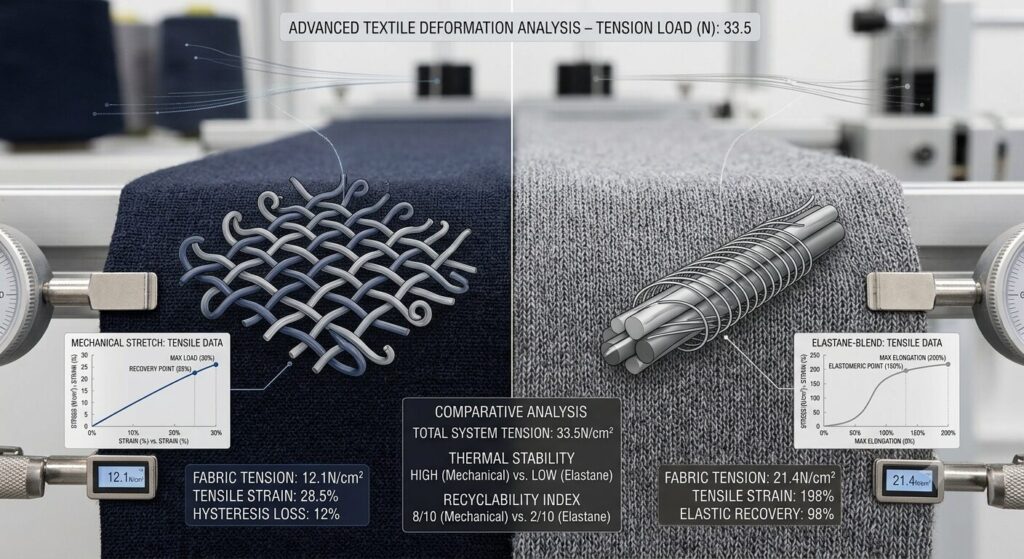
Winner: There isn’t a single winner the two mechanisms serve different points on the stretch spectrum. Mechanical stretch wins on durability, recyclability, and processing simplicity for comfort-stretch applications; elastane wins where very high elongation and compression are genuinely required. For a full technical breakdown aimed at mills and buyers, including processing, finishing, and total cost comparisons, see our detailed mechanical stretch yarn vs chemical stretch yarn comparison.
Mechanical Stretch vs Spandex
Spandex (a generic term for polyurethane-based elastane fibre) works at the molecular level — its polymer chains uncoil under tension and spring back due to a thermodynamic, rubber-elastic effect. Mechanical stretch works at the structural level, through crimp or weave geometry, which behaves more like a mechanical spring than a stretched polymer chain.
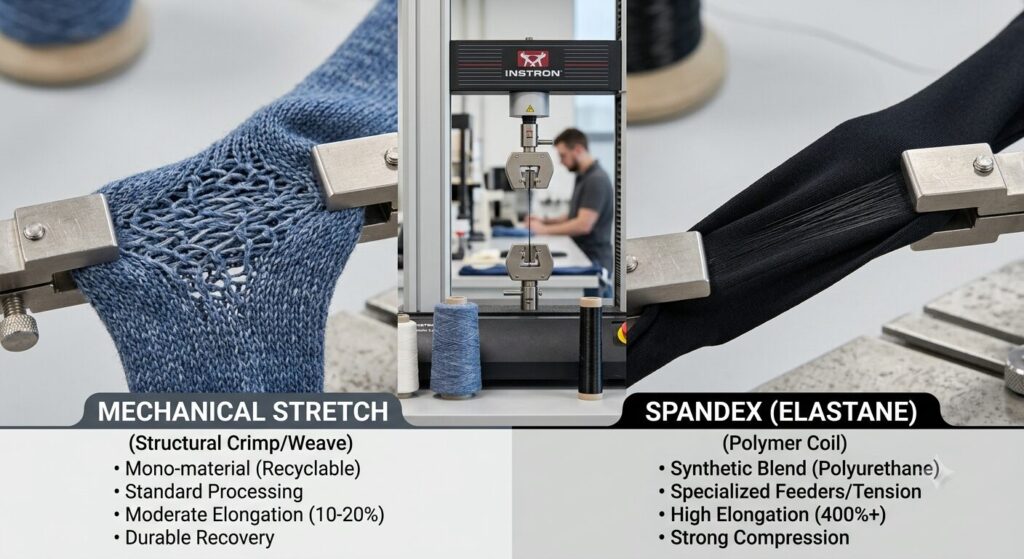
- Manufacturing: Spandex requires dedicated feeders, tighter tension control, and lower processing temperatures. Mechanical stretch yarn runs on standard weaving and knitting equipment.
- Stretch: Spandex delivers far higher maximum elongation.
- Recovery: Both recover well within their respective stretch ranges, but spandex generates stronger recovery force at high elongation.
- Cost: Mechanical stretch yarn is typically cheaper to buy and process at scale.
- Sustainability: Mechanical stretch fabric, being mono-material, is significantly easier to recycle than spandex blends.
- Performance: Spandex remains the only practical choice for high-compression, body-contouring applications.
Mechanical Stretch vs Lycra
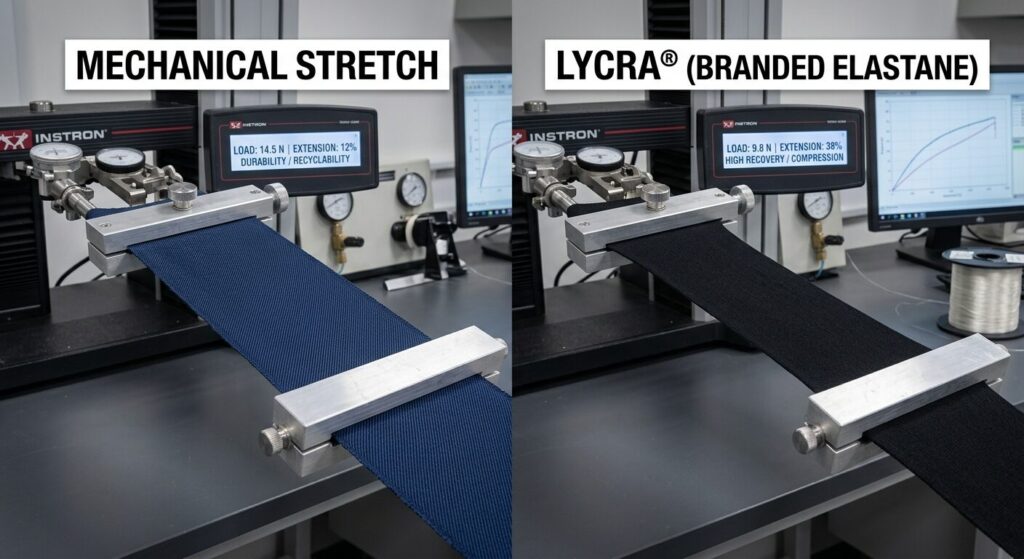
Lycra is simply a branded name for a specific elastane fibre, so this comparison mirrors mechanical stretch vs spandex above, with one distinction worth noting: brand-name elastane fibres like Lycra are engineered for consistent, high-performance recovery and are heavily marketed on that performance guarantee. Mechanical stretch fabric doesn’t compete on branding it competes on durability, processing simplicity, and end-of-life recyclability, and tends to be favoured for applications where the compression associated with Lycra isn’t actually the goal, such as tailored suiting, corporate shirting, and workwear.
Mechanical Stretch vs 4-Way Stretch
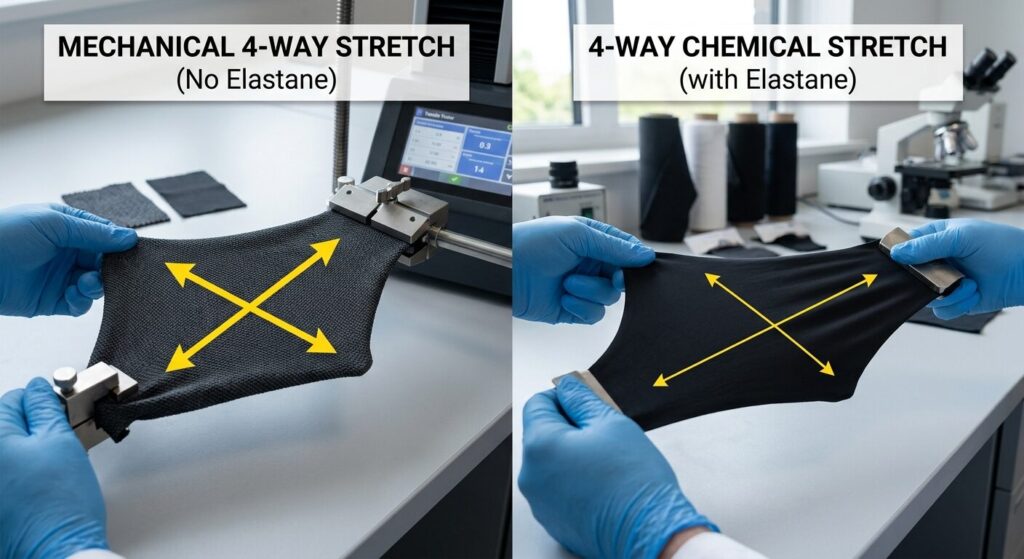
“2-way,” “4-way,” “mechanical,” and “chemical” describe two separate but overlapping classifications:
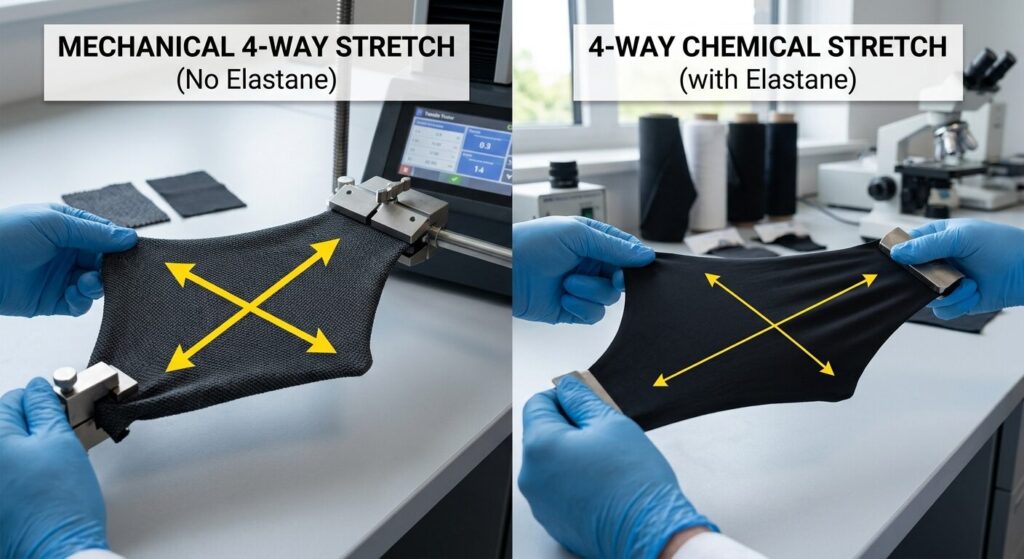
- 2-way stretch extends in one direction only (commonly the weft).
- 4-way stretch extends in both the horizontal and vertical directions, typically achieved through knit construction or crimped yarn used in both warp and weft.
- Mechanical stretch describes the source of the elasticity (structure/crimp).
- Chemical stretch describes the source being an elastic polymer fibre.
A fabric can be mechanical and 2-way, mechanical and 4-way, chemical and 2-way, or chemical and 4-way the direction of stretch and the mechanism generating it are independent design choices. Four-way mechanical stretch fabric, combining crimped yarn with knit or engineered weave structure in both directions, is increasingly common in sportswear and uniform fabric that needs multi-directional movement without elastane.
Why Mechanical Stretch Is Becoming Popular
Sustainability is the single biggest driver behind the current shift toward mechanical stretch. Lower elastane use means fewer chemically-blended fabrics entering the waste stream, and mono-material construction is far easier to fold into a circular economy, since polyester-based mechanical stretch fabric can be mechanically or chemically recycled without first having to separate out an elastic polymer. The Ellen MacArthur Foundation has repeatedly flagged fibre blending, including elastane content, as one of the biggest practical barriers to textile-to-textile recycling at scale, and industry recycling bodies such as Textile Exchange track this shift as part of the broader move toward circular, lower-impact materials.
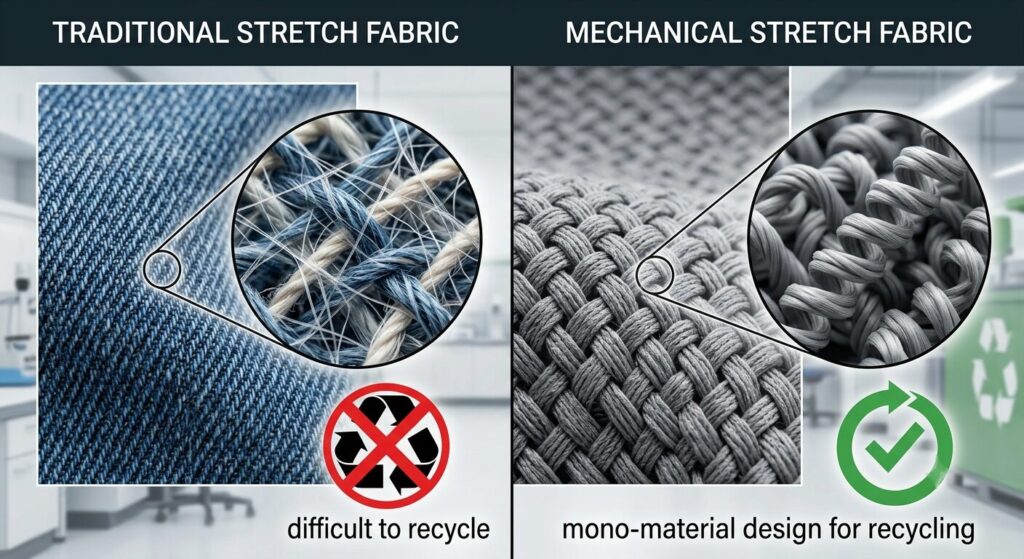
Beyond sustainability, mechanical stretch’s lower environmental footprint pairs with genuinely lower total production cost in many constructions, which is accelerating adoption across corporate uniforms, workwear, and mainstream fashion not just niche “eco” collections. As recycling infrastructure and regulation continue to tighten around fibre blends, this trend is expected to strengthen through the rest of the decade.
Buying Guide: How to Choose Mechanical Stretch Fabric
- GSM (fabric weight): Match GSM to end use lighter GSM for shirting, heavier for suiting, workwear, or outerwear.
- Construction: Decide between woven and knit based on whether you need a tailored drape (woven) or higher multi-directional stretch (knit).
- Blend: Confirm whether the fabric is 100% mechanical stretch or a hybrid with a small elastane percentage for extra elongation both are valid depending on the application.
- Applications: Match the fabric’s tested stretch percentage and recovery to the garment’s actual movement requirements rather than defaulting to the highest-stretch option available.
- Testing: Ask suppliers for stretch percentage, recovery percentage, and growth data, ideally referenced against a recognised standard such as ASTM International’s textile test methods.
- Supplier and quality: Work with a mechanical stretch fabric supplier that can provide consistent lot-to-lot crimp performance, colour fastness data, and after-sales technical support inconsistent crimp is the most common cause of quality complaints in mechanical stretch production.
Care Instructions
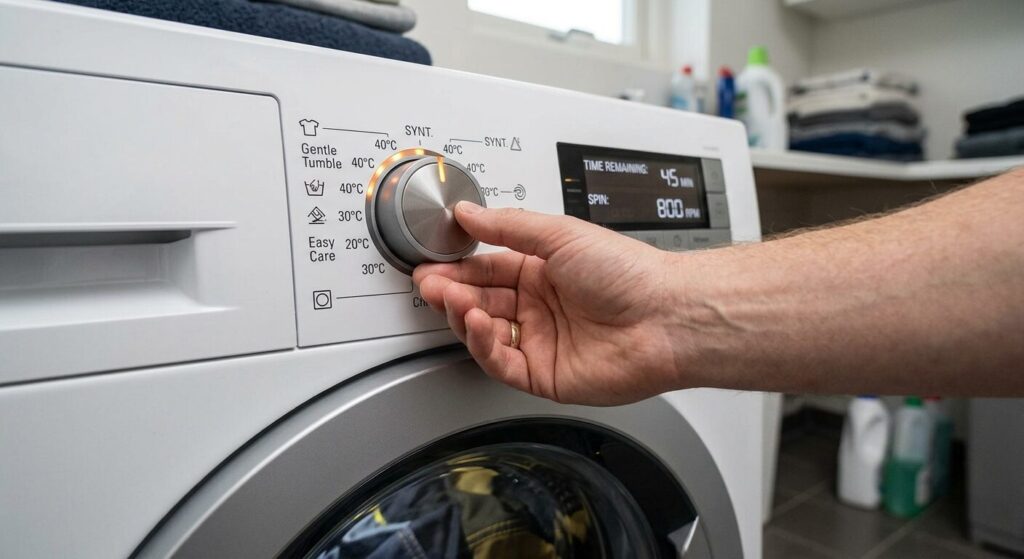
- Washing: Machine wash at 30–40°C for most mechanical stretch polyester fabrics; industrial and workwear grades typically tolerate much higher temperatures.
- Drying: Tumble dry on low is generally safe; line drying preserves shape retention over the very long term.
- Ironing: Use medium heat polyester-based mechanical stretch fabric can be sensitive to very high iron temperatures even though it tolerates industrial laundering well.
- Storage: Fold trousers and stretch garments rather than hanging them by the waistband to avoid localised stretching over time.
- Professional care: For tailored suiting and uniform fleets, professional or industrial laundering is recommended to maintain consistent shape and colour across a garment lifecycle.
Future of Mechanical Stretch
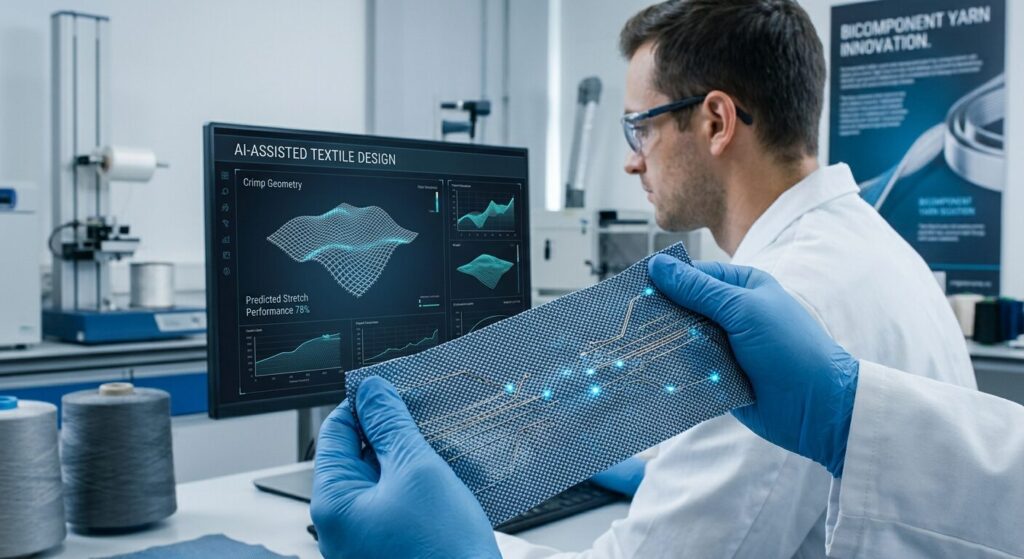
Mechanical stretch sits at the intersection of several converging trends: AI-assisted textile design that can model crimp geometry and predict stretch performance before a single metre is woven; smart fabrics that combine mechanical stretch with sensor or conductive yarn integration; recyclable fabric development aimed at closing the loop on polyester garments; and continued growth in technical and performance textiles for both fashion and industrial use. Sustainable yarn innovation particularly bicomponent and elastomultiester-type yarns is likely to remain the primary engine behind next-generation mechanical stretch fabric.
Industry Trends (2026)
Demand for mechanical stretch fabric is rising fastest in corporate uniforms, athleisure, travel wear, luxury apparel, technical textiles, and automotive interiors. Corporate and institutional buyers are increasingly specifying elastane-free stretch fabric for uniform fleets to cut laundering-related replacement costs, while automotive interior textiles are adopting mechanical stretch constructions for seating and trim that must withstand heat and UV exposure far better than elastane blends can.
Luxury and premium fashion houses are also moving in this direction, positioning mechanical stretch suiting and shirting as a quieter, more tailored alternative to the overtly athletic feel of high-elastane fabric a shift that lines up neatly with a broader “quiet luxury” aesthetic favouring natural drape over visible compression. Meanwhile, travel wear brands continue to lean on mechanical stretch’s wrinkle resistance and shape retention as core selling points, since a garment that needs less ironing and holds its shape across a multi-day trip is a genuinely practical advantage rather than a marketing claim.
Frequently Asked Questions
What is mechanical stretch fabric?
A fabric that stretches and recovers because of its yarn crimp, twist, or weave/knit construction, rather than because of an added elastic fibre like elastane or spandex.
How does mechanical stretch work?
Crimped or coiled yarn straightens under tension and springs back when released, acting like a microscopic spring built into the fibre or fabric structure.
Is mechanical stretch better than elastane?
Neither is universally “better” mechanical stretch offers superior durability, recyclability, and processing simplicity for comfort-stretch needs, while elastane still wins for very high-elongation, compression-level stretch.
Is mechanical stretch comfortable?
Yes. It typically delivers 15–30% elongation with good recovery, which covers the comfort range needed for everyday wear, workwear, and smart-casual fashion.
Does mechanical stretch lose elasticity?
It’s generally more durable than elastane, though extreme or repeated high-heat exposure can gradually relax a crimp structure over a very long service life.
Is mechanical stretch durable?
Yes because it doesn’t rely on a degrading rubber-like polymer, it typically holds its stretch performance longer than elastane blends, particularly through high-temperature washing.
Can mechanical stretch replace spandex?
For comfort and moderate-stretch applications, yes. For high-compression garments like medical stockings or competitive swimwear, spandex currently has no practical mechanical substitute.
What fabrics have mechanical stretch?
Mechanically crimped or textured polyester shirting and suiting, stretch denim woven with crimped weft, knit jersey and interlock fabrics, and technical outerwear shells all commonly use mechanical stretch.
Is mechanical stretch breathable?
Yes, particularly polyester-based mechanical stretch constructions, since there’s no continuous rubber-like layer restricting airflow.
Is mechanical stretch good for sportswear?
It works well for comfort-stretch activewear; high-compression performance sportswear typically still blends in a small percentage of elastane for maximum elongation.
Does mechanical stretch shrink?
Properly heat-set mechanical stretch fabric shows minimal shrinkage; the heat-setting step is specifically designed to lock in dimensional stability.
Is mechanical stretch sustainable?
Generally yes mono-material, elastane-free mechanical stretch fabric is significantly easier to recycle than elastane-blended fabric.
What is mechanical stretch polyester?
Polyester yarn that has been texturised or engineered as a bicomponent filament to develop permanent crimp, giving standard polyester fabric genuine stretch without added elastane.
What is the difference between mechanical and chemical stretch?
Mechanical stretch comes from yarn or fabric geometry; chemical stretch comes from the molecular elasticity of a rubber-like polymer such as elastane. See our full technical comparison for processing and cost differences.
Which industries use mechanical stretch fabrics?
Fashion apparel, corporate and institutional uniforms, workwear, PPE, sportswear, automotive interiors, medical textiles, and military and safety garments.
How is mechanical stretch manufactured?
Through fibre selection, yarn spinning, texturing (false-twist, air-jet, or bicomponent co-extrusion), weaving or knitting, heat setting, finishing, and quality testing.
Is mechanical stretch recyclable?
Yes, especially when made entirely from polyester without elastane, since there’s no elastic fibre to separate out before recycling.
Is mechanical stretch suitable for uniforms?
Very well suited its resistance to high-temperature industrial laundering makes it a strong fit for corporate, institutional, and workwear uniform fleets.
Can woven fabrics have mechanical stretch?
Yes. Crimped weft yarn combined with a twill, dobby, or plain weave produces genuine woven mechanical stretch, commonly seen in shirting, chinos, and suiting.
Is mechanical stretch expensive?
Raw yarn cost is often lower than elastane blends, and processing costs (loom speed, feeder equipment, reject rates) tend to be lower too, though exact savings depend on the specific construction.
What is the recovery rate of mechanical stretch fabrics?
Well-engineered mechanical stretch fabric typically shows good to excellent recovery within its 15–30% stretch range, meaning it returns close to its original dimensions after each extension.
Which garments benefit most from mechanical stretch?
Shirts, trousers, suiting, uniforms, workwear, and casualwear anywhere comfort stretch is the actual requirement rather than high-compression fit.
Is mechanical stretch suitable for formal wear?
Yes its soft, gradual stretch feel and shape retention make it particularly well suited to tailored suiting and formal trousers.
How do you test mechanical stretch in fabrics?
Through standardised stretch, growth, and recovery tests such as those defined by ASTM International and ISO 13934-1, which quantify elongation percentage and how completely a fabric returns to its original dimensions.
What are the limitations of mechanical stretch?
Lower maximum elongation than elastane, dependence on weave/knit design quality, a softer recovery feel, and unsuitability for high-compression garments.
What is the difference between mechanical stretch and bi-stretch fabric?
“Bi-stretch” generally refers to two-way stretch fabric (stretching in one direction), which can be achieved through either mechanical or chemical stretch the terms describe different properties (direction vs. source) and aren’t interchangeable.
Can mechanical stretch fabrics be blended with natural fibres?
Yes. Mechanically crimped synthetic yarn can be blended with cotton, wool, or other natural fibres to combine natural hand-feel with engineered stretch performance.
Is mechanical stretch suitable for outdoor apparel?
Yes its UV and heat resistance make it well suited to hiking, climbing, and technical outerwear that needs to perform reliably across years of outdoor use.
How does heat setting improve mechanical stretch?
Heat setting locks the crimped or coiled yarn structure permanently into the polymer, which is what allows the fabric to stretch and recover consistently over its full working life rather than relaxing after the first few washes.
What are the latest innovations in mechanical stretch textiles?
Bicomponent and elastomultiester-type yarns, AI-assisted crimp and construction modelling, and recyclable mono-material fabric systems designed specifically to close the loop on polyester apparel.
Final Thoughts
Mechanical stretch has moved well past its origins in twill weaves and wool crimp into a precisely engineered, mainstream alternative to elastane-based stretch. For shirting, suiting, uniforms, workwear, and everyday casualwear anywhere comfort stretch rather than high compression is the actual requirement it offers a compelling combination of durability, easy care, and recyclability that elastane blends struggle to match.
Elastane still has a clear, irreplaceable role at the high-compression end of the stretch spectrum, but for the vast majority of everyday apparel and technical textile applications, mechanical stretch is increasingly the more practical, more sustainable, and often more cost-effective choice. Manufacturers like Mestre, developed by the Surat-based Madhusudan Group, continue to advance bicomponent mechanical stretch yarn and elastomultiester technology to expand exactly how far this elastane-free approach can go.