Every fabric you’ve ever worn starts life as yarn, and every yarn starts life as fiber. That chain sounds simple, but the terminology around it trips up even experienced buyers: yarn versus fiber, natural versus synthetic, blended versus bicomponent. If you’ve ever paused mid-conversation with a mill to ask “wait, what exactly is bicomponent yarn again?” this guide is for you.
We’re covering this topic in two parts. The first half answers the fundamental questions about yarn and fiber itself what yarn is made of, why it’s called “yarn,” how many types of fiber exist, and who actually produces the most yarn in India. The second half goes deep on bicomponent yarn specifically: what it is, how it’s spun, where it shows up in real products, and why Indian manufacturers are increasingly building entire fabric categories around it.
Throughout, we’ll point you to Mestre®, the bicomponent stretch yarn brand manufactured by Madhusudan Group, a vertically integrated, Surat-based textile conglomerate with more than five decades in yarn manufacturing, dyeing, weaving, and fabric processing. Where a question deserves a deeper technical answer than we can fit here, we’ll link you to the dedicated resource.
Part 1: Yarn and Fiber Fundamentals
Why Is It Called “Yarn”?
The word “yarn” comes from the Old English gearn, which traces further back to a shared Proto-Germanic root also found in Old Norse, Dutch, and German words for spun thread or twisted fiber. Linguists connect this same root to the Sanskrit and Greek words for “gut” or “intestine” likely because some of the earliest cordage and thread-like materials used by ancient cultures were made from animal sinew and gut before spun plant and animal fibers became widespread.
By the time Old English speakers were using gearn, it already meant exactly what it means today: a continuous strand formed by twisting together fibers or filaments so they hold together and can be woven, knitted, or otherwise worked into fabric. The word has stayed remarkably stable for well over a thousand years, which says something about how fundamental the concept is to textile-making itself.
What Is the Full Form of “Yarn”?
This is a common point of confusion, so it’s worth answering directly: “yarn” is not an acronym, so it has no full form. It’s an ordinary English word, not an abbreviation like “NASA” or “LASER.” If you’ve seen “YARN” written in capital letters somewhere, that’s almost always either stylistic branding or, in a technology context, an unrelated acronym most notably Apache YARN (“Yet Another Resource Negotiator”), a big-data processing framework that has nothing to do with textiles.
In the textile industry, “yarn” simply refers to the continuous strand of twisted or bonded fiber used to make fabric. No expansion needed.
What Is the Composition of Yarn?
Yarn’s composition depends entirely on which fiber (or fiber blend) it’s spun from, but structurally, every yarn shares the same basic anatomy:
- The fiber content the actual raw material, which can be a single fiber type (100% cotton, 100% polyester) or a blend of two or more (poly-cotton, cotton-elastane, and so on).
- The twist the degree and direction (S-twist or Z-twist) that individual fibers or filaments are twisted together with, which determines the yarn’s strength, texture, and how it behaves in weaving or knitting.
- The count or denier a measurement of the yarn’s linear density (how thick or fine it is), which directly affects the weight, drape, and hand-feel of the finished fabric.
- Finishes and treatments many yarns carry additional surface treatments (dyes, lubricants, anti-static agents, moisture-management finishes) applied during or after spinning.
At the chemical level, composition splits into two broad categories: natural fiber yarns (cellulose-based like cotton and linen, or protein-based like wool and silk) and manufactured fiber yarns (regenerated cellulosics like viscose, or fully synthetic polymers like polyester, nylon, and acrylic). Bicomponent yarn the focus of the second half of this guide sits within the synthetic category, but with a structural twist: instead of one polymer, it’s built from two.
The way a yarn’s fibers are actually assembled also matters to its final composition and performance. Staple-fiber yarns (short, cut lengths of fiber, as with most cotton) are spun using processes like ring spinning, open-end (rotor) spinning, or air-jet spinning, each producing a different yarn structure and hand-feel. Filament yarns (continuous strands, as with most synthetics) skip the staple-spinning step entirely, since the fiber is already extruded as one continuous length though filament yarn is often texturized afterward to add bulk, stretch, or a more natural hand-feel. Bicomponent yarn is almost always produced and used as a filament yarn, though it can also be cut into staple lengths for nonwoven or blended-spinning applications.
What Elements Are in Yarn?
If you’re asking this at the chemical-elements level (carbon, hydrogen, oxygen, and so on), the answer depends on the fiber type, since natural and synthetic fibers are built from very different building blocks:
| Fiber Type | Core Chemical Elements | Base Material |
| Cotton | Carbon, hydrogen, oxygen | Cellulose (plant-derived) |
| Wool | Carbon, hydrogen, oxygen, nitrogen, sulfur | Keratin protein (animal-derived) |
| Silk | Carbon, hydrogen, oxygen, nitrogen | Fibroin protein (animal-derived) |
| Polyester (PET) | Carbon, hydrogen, oxygen | Petroleum-derived polymer |
| Nylon (Polyamide) | Carbon, hydrogen, oxygen, nitrogen | Petroleum-derived polymer |
| Viscose/Rayon | Carbon, hydrogen, oxygen | Regenerated cellulose |
If you’re asking more casually “what’s actually in this yarn?” the practical answer for most modern apparel yarn is: the base fiber polymer itself, plus small amounts of spin finish (a lubricant applied during manufacturing to reduce friction), and, for dyed yarns, the dye molecules bonded to or absorbed into the fiber structure. Reputable yarn is tested and certified against harmful substance limits OEKO-TEX Standard 100 is the most widely recognized certification for this which screens for over a thousand regulated and non-regulated chemicals a finished yarn or fabric should not contain in meaningful quantities.
What Are the Three Types of Fibers?
Most textile classification systems divide fiber into two broad families natural and manufactured but when people ask about “three types,” they’re usually referring to the three-way split used in fiber-content labeling and procurement:
- Natural fibers grown or produced by plants and animals without significant chemical processing to create the fiber itself. Cotton, wool, silk, linen, and jute are the major examples.
- Regenerated (semi-synthetic) fibers made from natural polymers (usually cellulose from wood pulp) that are chemically dissolved and re-extruded into fiber form. Viscose/rayon, modal, and lyocell (Tencel) fall here.
- Synthetic fibers manufactured entirely from petrochemical-derived polymers through a chemical synthesis process, with no natural starting fiber. Polyester, nylon, acrylic, and spandex/elastane are the major examples.
This three-way classification is the one used in most fiber-content regulations globally, including the framework behind the U.S. Federal Trade Commission’s Textile Fiber Products Identification Act, which requires garments to disclose fiber content by generic name under one of these broad families.
What Are the Four Types of Fibers?
When a four-category system is used instead, it’s usually the three above with manufactured/synthetic fibers split into two separate groups organic synthetics and inorganic/mineral fibers giving you:
- Natural fibers (cotton, wool, silk, linen)
- Regenerated fibers (viscose, modal, lyocell)
- Synthetic (organic polymer) fibers (polyester, nylon, acrylic, spandex)
- Mineral and inorganic fibers (glass fiber, carbon fiber, metallic fiber, asbestos in older classifications) used almost exclusively in technical and industrial textiles rather than apparel.
Some academic and industrial classification systems use a different four-way split based on origin instead: plant-based, animal-based, mineral-based, and synthetic. Both systems are in active use, and which one you’ll encounter usually depends on whether you’re reading an apparel-industry resource or a materials-science textbook the categories overlap but aren’t phrased identically.
How Do You Identify the Type of Yarn?
Identifying yarn type is a genuinely practical skill for procurement and quality teams, and it’s usually done through a combination of these methods:
- The burn test. Different fiber types burn, melt, or char in visibly distinct ways, and this remains the fastest field test available.
- Microscopic examination. Under magnification, natural fibers show irregular, organic cross-sections while manufactured fibers are typically uniform and circular or engineered into a specific cross-sectional shape.
- Solubility testing. Different fibers dissolve in different chemical solvents, which labs use to confirm fiber identity, especially in blends where a burn test alone can’t separate the components.
- Care label and fiber content disclosure. For finished garments, the legally required fiber content label is the fastest and most reliable source, since it’s independently regulated in most major markets.
- Physical handle and visual cues. Experienced buyers can often narrow down fiber type by feel, though this method alone isn’t reliable enough for procurement decisions.
For yarns specifically as opposed to finished fabric mills also rely on denier and count verification, twist direction and turns-per-inch measurement, and, for anything performance-related, tensile strength and elongation testing against standards like ISO 2060 for linear density.
As a quick reference, here’s how the burn test typically plays out across the most common fiber families:
| Fiber | Burning Behavior | Odor | Residue |
| Cotton/Linen | Burns readily, continues after flame removed | Burning paper | Soft, grey ash |
| Wool/Silk | Burns slowly, usually self-extinguishes | Burning hair | Crushable dark bead |
| Polyester | Melts and shrinks from flame, black smoke | Faintly sweet/chemical | Hard, dark bead |
| Nylon | Melts before burning, drips | Celery-like/chemical | Hard, tan bead |
| Viscose/Rayon | Burns quickly like cotton, no melting | Burning paper | Little to no ash |
Because bicomponent yarn is almost always built from two polyester-family polymers, a burn test alone will correctly flag it as synthetic and polyester-like, but it won’t distinguish a bicomponent construction from an ordinary single-polymer polyester yarn that distinction requires either supplier documentation or cross-sectional microscopy, a point we’ll return to later in this guide.
Who Is the Biggest Yarn Producer in India?
India is the world’s second-largest cotton producer and the world’s largest cotton yarn exporter, shipping several hundred million kilograms of cotton yarn annually to garment-manufacturing hubs including Bangladesh, China, and Vietnam. Within that landscape, Vardhman Textiles is widely recognized as India’s largest listed yarn manufacturer, operating roughly 1.4 million spindles and producing thousands of yarn varieties across cotton, blended, and specialty categories.
Other major names in India’s yarn manufacturing landscape include RSWM Limited (the flagship company of the LNJ Bhilwara Group), Sutlej Textiles and Industries, KPR Mill, Trident Group, and Arvind Limited each with different specializations spanning cotton, melange, denim, and technical yarns. It’s worth noting that “biggest” can mean different things depending on the metric: spindle capacity, annual production volume, export revenue, or listed market capitalization don’t always point to the same company, and rankings shift as capacity expansions and acquisitions play out year to year.
Where India has historically lagged is not in bulk yarn volume where it’s a global leader but in advanced, specialty yarn categories like bicomponent fiber, which has traditionally required imports from Japan, Taiwan, and South Korea. That gap is closing as domestic groups invest in bicomponent spinning capability, which brings us to the second half of this guide.
Natural, Synthetic, and Bicomponent Yarn: How They Compare
Before moving into bicomponent yarn specifically, it’s worth placing it clearly against the fiber categories covered above:
| Natural Yarn (e.g. cotton) | Standard Synthetic (e.g. polyester) | Bicomponent Yarn | |
| Origin | Grown, minimally processed | Fully manufactured, single polymer | Fully manufactured, two polymers |
| Structure | Staple fiber, twisted | Continuous filament or texturized staple | Two polymers fused within one filament |
| Built-in stretch | No | No | Yes, in side-by-side configurations |
| Consistency | Varies by crop and grade | Highly consistent | Highly consistent, engineered per spec |
| Typical use | Apparel, home textiles | Apparel, industrial textiles | Stretch apparel, nonwovens, technical textiles |
This is the natural jumping-off point into the rest of this guide: bicomponent yarn isn’t a replacement for natural or standard synthetic yarn across the board it’s a specialized, engineered category that solves specific problems (built-in stretch without elastane, binder-free nonwoven bonding, ultra-fine microfiber production) that neither natural fiber nor conventional single-polymer synthetic yarn can solve on its own.
Part 2: Bicomponent Yarn | The Advanced Yarn Category
What Is a Bicomponent Fiber?
A bicomponent fiber (also called bicomponent yarn, two-component yarn, or conjugate yarn) is a manufactured filament produced by extruding two chemically or physically distinct polymers simultaneously through a single spinneret. Rather than sitting side by side as separate threads the way a blended yarn does, the two polymers are joined together within a single fiber cross-section, fused at the moment of spinning.
This is the critical distinction that separates bicomponent yarn from a blended yarn. A blend a poly-cotton shirt, for instance twists two already-finished fibers together, and each fiber keeps its own individual identity throughout the fabric. A bicomponent yarn integrates both polymers at the fiber level inside one continuous filament, so every inch of that filament behaves as a single engineered material with properties that neither polymer could deliver alone.
The concept was first commercialized in the 1960s, primarily for self-crimping synthetic fibers, and has since expanded into nonwovens, technical textiles, and most visibly to consumers stretch apparel, where bicomponent construction now underpins entire fabric categories that perform without any added elastane. For the complete technical breakdown of the concept, including how it compares to conventional blended yarn property by property, see our full bicomponent yarn guide.
What Is Bicomponent Spinning?
Bicomponent spinning (also called conjugate spinning) is the specialized manufacturing process that produces bicomponent fiber. It requires purpose-built spinning equipment, since two separate polymer melts have to be metered, controlled, and joined with real precision. In broad strokes, the process runs through five stages:
- Polymer preparation. Each polymer is dried, melted, and filtered in its own dedicated extruder, with temperature and pressure controlled independently for each stream.
- Co-extrusion. The two polymer melts are fed into a specially engineered spinneret pack, and the internal geometry of that pack determines the final cross-sectional arrangement.
- Quenching. As filaments exit the spinneret, a controlled air stream cools them rapidly, locking the two-polymer structure in place.
- Drawing. The cooled filaments are stretched to align the polymer chains, building tenacity and setting elongation characteristics.
- Texturizing or heat-setting. This is the step where the fiber’s signature behavior most notably self-crimping actually activates.
For procurement and technical teams evaluating suppliers, our detailed technical guide to bicomponent yarn breaks down the specific specifications worth requesting denier and filament count, crimp contraction ratio, elongation and recovery figures, boil-off shrinkage, and tenacity along with the certifications (OEKO-TEX, REACH, BIS, ISO 2060) that matter for sourcing decisions.
Bicomponent Yarns: Examples
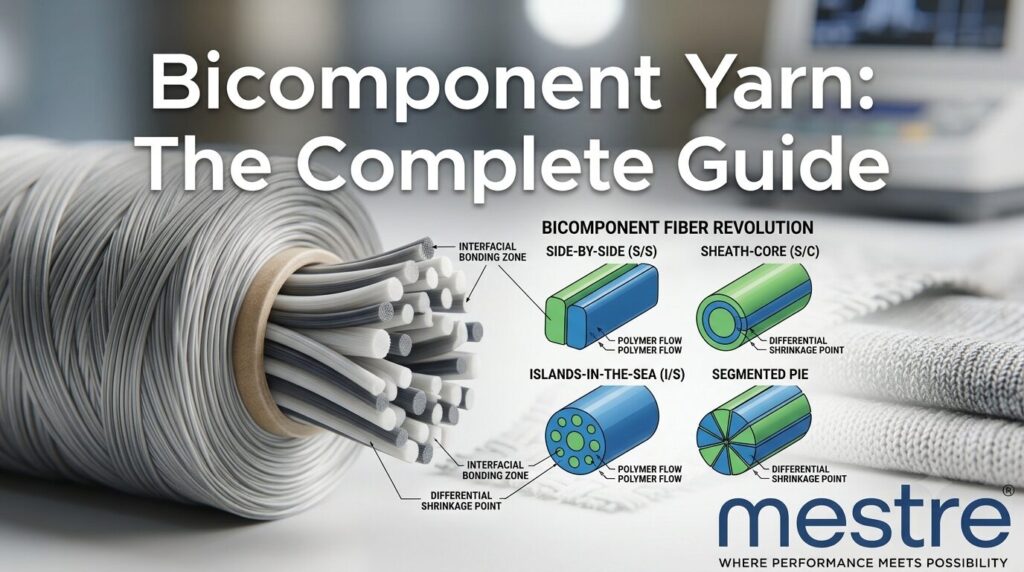
The cross-sectional arrangement of the two polymers inside a bicomponent filament defines what the yarn is good at, and the textile industry has standardized around four core configurations:
- Side-by-side (S/S). The two polymers run parallel along the full length of the filament, curling into a natural, permanent three-dimensional coil once heat-set. This is the configuration behind mechanical-stretch yarns and elastomultiester, and it’s the structural basis for Mestre® itself.
- Sheath-core (S/C). One polymer fully wraps around the other, forming an outer sheath and an inner core. This structure dominates nonwoven hygiene products and filtration media.
- Islands-in-the-sea (I/S). Multiple fine polymer filaments (“islands”) are embedded within a matrix of a second polymer (the “sea”), later dissolved away to release ultra-fine filaments used in premium microfiber suede.
- Segmented pie. The cross-section resembles a pie of alternating wedge segments; when split, it yields fine triangular filaments used in sportswear and intimate apparel linings.
Each of these configurations is a genuine, commercially produced “example” of bicomponent yarn in active use across different industries today they aren’t theoretical variants.
Bicomponent Fibers in Textiles
Within finished textiles, bicomponent fiber shows up in two very different roles depending on which configuration is used. In woven and knitted apparel fabric, side-by-side bicomponent yarn is spun or woven directly into the fabric structure (or used as a core-spun component alongside cotton or other natural fiber) to deliver built-in stretch and recovery, replacing or reducing the need for separately blended elastane.
In nonwoven fabrics, sheath-core bicomponent staple fiber plays a structural, invisible role: it thermally bonds fiber webs together under heat, with the lower-melting sheath fusing at fiber crossover points while the higher-melting core holds the web’s structure intact. This binder-free bonding method is why bicomponent fiber is foundational to hygiene products, medical nonwovens, and filtration media. For the complete picture, see our dedicated guide to bicomponent yarn in nonwoven fabrics.
Bicomponent Yarn Uses
Bicomponent yarn’s versatility comes directly from its four configurations, each suited to a different functional demand:
- Apparel and denim. Side-by-side bicomponent yarn provides permanent, mechanical stretch and recovery in stretch denim, chinos, shirting, and workwear. See our denim-specific guide.
- Sportswear and activewear. Stretch, moisture management, and wash durability for running tights, yoga wear, and swimwear. See our sportswear guide.
- Hygiene and medical nonwovens. Diapers, wipes, surgical drapes, and medical coverstock rely on sheath-core bicomponent fiber for binder-free thermal bonding.
- Filtration media. Islands-in-the-sea bicomponent fiber, split into ultra-fine microfibers, provides the surface area needed for HEPA-class filtration.
- Automotive and home textiles. Car seat upholstery, headliners, and carpet backing use bicomponent fiber for bonding strength and dimensional stability.
- Insulation and batting. Self-crimping side-by-side fiber creates high-loft insulation for outerwear, bedding, and acoustic panels.
- High-performance grades. Higher-PTT-content grades, commercially known as T-800, are engineered for competitive swimwear, compression garments, and technical underwear. See our T-800 technical breakdown.
For the complete industry-by-industry breakdown, see our comprehensive uses and applications guide.
Bicomponent Yarn in India
India is one of the world’s largest textile producers and exporters, yet bicomponent fiber has historically been an area where the country lagged behind global leaders particularly Japan, South Korea, Taiwan, and Germany, where companies like Toray, Teijin, and DuPont pioneered much of the commercial bicomponent technology now in use worldwide.
That gap is closing, for a few concrete reasons:
- Domestic production is growing, though a significant share of high-specification bicomponent fiber is still imported.
- Import demand remains strong for export-oriented mills sourcing from Japan, Taiwan, and South Korea.
- Government policy is supportive India’s PLI scheme for textiles specifically targets man-made fiber and technical textile segments.
- The nonwoven sector is expanding fast, growing at double-digit rates.
- Denim and apparel are premiumizing, driving demand for premium bicomponent-based stretch fabrics.
Within this landscape, Mestre® by Madhusudan Group represents the kind of vertically integrated domestic capability that Indian buyers previously had to source from overseas. Mestre® is built around a side-by-side bicomponent polyester structure, giving it inherent coil-crimp for permanent elasticity, strong color fastness, good moisture management, and resistance to light and heat degradation with in-house spinning, dyeing, and weaving capability under a single roof in Surat, Gujarat.
Surat’s position in this story is worth noting on its own. The city is one of India’s largest man-made fiber and textile processing hubs, home to a dense cluster of weaving, dyeing, and finishing units that has historically specialized in synthetic and blended fabric production precisely the kind of ecosystem that domestic bicomponent yarn production benefits from, since spinning, weaving, dyeing, and finishing can all happen within a short supply chain rather than across multiple countries and shipping cycles. For denim manufacturers in Ahmedabad and Bengaluru and hosiery producers in Tirupur, that proximity to domestic bicomponent supply translates into shorter lead times and lower currency exposure compared to importing from Japan, Taiwan, or South Korea.
For buyers evaluating a domestic bicomponent yarn partner, our complete guide to Mestre® yarn covers the full technical profile, industry applications, and how it compares directly against Lycra, elastane, and imported alternatives like Sorona.
Common Misconceptions about Bicomponent Yarn
A few misunderstandings come up often enough with buyers and students alike that they’re worth addressing directly:
“Bicomponent yarn is just another name for elastane or spandex.” It isn’t. Elastane is a single-polymer polyurethane elastomer that stretches through chemical elasticity. Bicomponent yarn (in its side-by-side, stretch-producing form) is built from two polyester-family polymers and stretches through a permanently coiled physical structure.
“All bicomponent yarn is designed for stretch.” Also not true. Sheath-core bicomponent fiber is engineered primarily for thermal bonding in nonwoven fabrics, not for stretch at all. Stretch is one major application of bicomponent technology, not the whole category.
“Bicomponent yarn always costs more than standard yarn.” It’s more accurate to say the yarn itself typically costs more per kilogram, but total processing cost for a finished fabric can come out lower, since bicomponent stretch yarn often eliminates the need for a separate elastane feeder or specialized low-temperature dyeing.
“Bicomponent yarn can’t be recycled.” This depends entirely on the polymer pairing. When both components belong to the same broad polymer family, the yarn is generally compatible with standard polyester recycling streams.
Quick-Reference Summary Table
| Question | Short Answer |
| Why is it called yarn? | From Old English gearn, a word for spun thread going back over a thousand years |
| Full form of yarn? | None it’s a standard word, not an acronym |
| Composition of yarn? | Fiber content + twist + count/denier + finishing treatments |
| Elements in yarn? | Depends on fiber: mostly carbon, hydrogen, oxygen (plus nitrogen/sulfur for protein fibers) |
| Three types of fibers? | Natural, regenerated (semi-synthetic), and synthetic |
| Four types of fibers? | Natural, regenerated, synthetic, and mineral/inorganic |
| Identifying yarn type? | Burn test, microscopy, solubility testing, and fiber content labels |
| Biggest yarn producer in India? | Vardhman Textiles India’s largest listed yarn manufacturer by spindle capacity |
| What is bicomponent fiber? | A filament made of two polymers fused together during spinning |
| What is bicomponent spinning? | Conjugate spinning co-extruding two polymer melts through one spinneret |
| Bicomponent yarn examples? | Side-by-side, sheath-core, islands-in-the-sea, segmented pie |
| Bicomponent fibers in textiles? | Apparel stretch fabric and nonwoven thermal bonding are the two dominant roles |
| Bicomponent yarn uses? | Denim, sportswear, hygiene nonwovens, filtration, automotive, insulation |
| Bicomponent yarn in India? | Growing domestic capability; Mestre® by Madhusudan Group is a leading domestic producer |
Frequently Asked Questions
Is bicomponent yarn the same thing as a blended yarn?
No. A blended yarn twists together two separate, already-finished fibers, and each fiber keeps its own identity. Bicomponent yarn fuses two polymers within a single filament at the point of extrusion, so the resulting properties are engineered directly into the fiber rather than mixed after the fact.
Is bicomponent yarn a type of synthetic fiber?
Yes, in nearly all commercial cases. The two polymers used are almost always synthetic (most commonly polyester variants like PET and PTT), placing bicomponent yarn firmly within the synthetic fiber family.
Does bicomponent yarn need a separate elastic yarn to create stretch?
No that’s the entire point of side-by-side bicomponent construction. The stretch comes from the fiber’s own coiled, spring-like structure, created by differential shrinkage between the two polymers during heat-setting.
Can I identify bicomponent yarn with a simple burn test?
Not reliably on its own. Because both components are usually polyester variants, a standard burn test will correctly identify the fabric as synthetic/polyester-family but won’t distinguish a bicomponent construction from a standard single-polymer polyester yarn.
Where to Go Deeper
This guide is intentionally broad, bridging yarn fundamentals with a full introduction to bicomponent technology. If a specific area caught your attention, these dedicated Mestre resources go significantly deeper:
- Bicomponent Yarn: Types, Structure & Applications the complete overview of sheath-core and side-by-side structures and where each is used
- What Is Bicomponent Yarn? A Complete Technical Guide for Indian Textile Buyers full specifications, polymer combinations, and certifications for procurement teams
- Bicomponent Yarn & Fiber: Uses, Technology, Applications in India the full industry-by-industry applications map and India market analysis
- Bicomponent Yarn: The Future of High-Performance Textile Engineering manufacturing process and sustainability outlook
- Bicomponent Yarn in Nonwoven Fabrics: Engineering Bonds That Last thermal bonding, hygiene, and medical nonwoven applications
- Bicomponent Yarn in Sportswear: Performance Engineering at the Fibre Level stretch, moisture management, and durability for activewear
- Stretch Yarn for Denim: How Bicomponent Yarn Is Solving the Bagging Problem in Indian Denim denim-specific construction and core-spinning guidance
- T-800 Yarn: High-Performance Bicomponent Elastomultiester the premium grade for swimwear, compression, and technical underwear
- What Is Mestre® Yarn? The Complete Guide to Bicomponent Stretch Yarn Mestre®’s specific technical profile and how it compares to Lycra and Sorona
Mestre® is a bicomponent stretch yarn brand manufactured by Madhusudan Group, based in Surat, Gujarat. For technical specifications, sample requests, or sourcing consultations, visit mestre.co.in or contact the Madhusudan Group sales office directly.