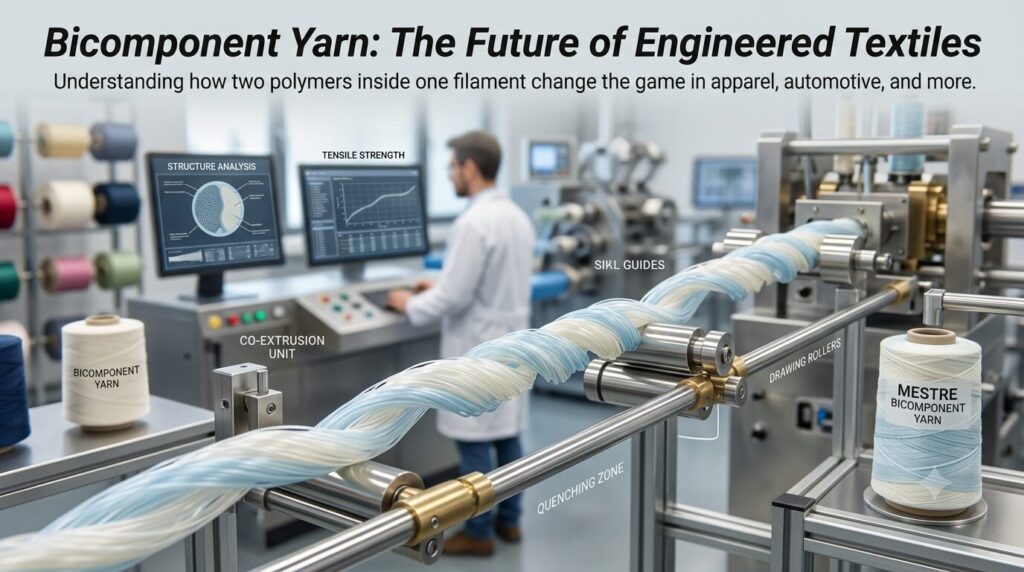
For most of textile history, a yarn was made of one material doing one job. Cotton handled comfort, nylon handled strength, and if a fabric needed to stretch, a separate elastic thread had to be woven or knitted in alongside everything else. Bicomponent yarn changes that equation entirely. Instead of combining different fibres after the fact, it combines two different polymers inside a single filament, at the moment that filament is created. The result is a fibre that can do two jobs at once, and it has quietly become one of the most important platforms for textile innovation over the last six decades.
Whether you have come across the term while researching stretch fabrics, technical textiles, or nonwoven hygiene products, this guide breaks down exactly what bicomponent yarn is, how it is engineered, and why manufacturers across denim, activewear, automotive, and medical textiles are building entire product lines around it.
What Is Bicomponent Yarn?
Bicomponent yarn, also called bicomponent fibre, two-component yarn, or conjugate yarn, is a manufactured filament produced by extruding two distinct polymers simultaneously through the same spinneret. Rather than sitting side by side as separate threads, the two polymers are joined together within a single fibre cross-section, fused at the moment of spinning.
This is the key distinction between bicomponent yarn and a blended yarn. A blend, like a poly-cotton shirt, twists two already-finished fibres together; each fibre keeps its own individual identity throughout the fabric. A two-component yarn integrates both polymers at the molecular level inside one continuous filament. Every inch of that filament behaves as a single, engineered material with properties that neither polymer could deliver on its own.
The concept was first commercialised in the 1960s, primarily for self-crimping synthetic fibres. Over the following decades it expanded into nonwovens, technical textiles, and more recently into stretch apparel, where bicomponent construction now underpins entire categories of fabric that perform without any added elastane.
How Bicomponent Yarn Is Manufactured
Producing bicomponent fibre requires purpose-built spinning equipment, since two separate polymer melts have to be metered, controlled, and joined with precision. The general process looks like this:
- Polymer Preparation: Each polymer is dried, melted, and filtered in its own dedicated extruder. Because the two materials often have different melting points and viscosities, temperature and pressure are controlled independently for each stream right up until the point of extrusion.
- Co-Extrusion: The two polymer melts are fed into a specially engineered spinneret pack. The internal geometry of this pack not the chemistry of the polymers alone determines the final cross-sectional arrangement, whether sheath-core, side-by-side, or a more complex configuration.
- Quenching: As the filaments exit the spinneret, a controlled air stream cools them rapidly, locking the two-polymer structure in place before it can distort.
- Drawing: The cooled filaments are stretched to align the polymer chains, building tenacity and setting the yarn’s elongation characteristics.
- Texturising or Heat-Setting: In several bicomponent structures, this step is where the fibre’s signature behaviour such as self-crimping actually activates.
- Winding: The finished yarn is wound onto packages at controlled tension, ready for weaving, knitting, or nonwoven bonding.
Key Bicomponent Yarn Structures You Should Know
Not all bicomponent fibre is built the same way. The cross-sectional arrangement of the two polymers defines what the yarn is good at, and the textile industry has standardised around a handful of core structures.
Sheath-Core Yarn
In a sheath-core yarn, one polymer fully wraps around the other, forming an outer sheath and an inner core. The core polymer provides tensile strength and structural stability, while the sheath polymer is selected for its surface behaviour dye uptake, softness, or a lower melting point for thermal bonding. Sheath-core construction is especially common in nonwoven hygiene products and filtration media, where a lower-melt sheath (often polyethylene) bonds fibres together under heat while a higher-melt core (often polyester) holds the structure intact.
Side-by-Side Yarn
In a side-by-side yarn, the two polymers run parallel to one another along the full length of the filament. Because the two polymers shrink at different rates when exposed to heat, the filament curls into a natural three-dimensional coil once heat-set the same physical principle behind a bimetallic strip. This self-crimping behaviour is the structural foundation for mechanical-stretch yarns and elastomultiester fibres, both of which rely on a side-by-side bicomponent core to generate elasticity without any added elastane.
Other Configurations
Beyond these two dominant forms, manufacturers also produce islands-in-the-sea structures (ultra-fine microfibres) and segmented-pie structures (wedge-shaped fibre fragments). These are used less in apparel and more in technical nonwovens, suede-like fabrics, and filtration media.
Why Bicomponent Fibre Is Considered a Major Textile Innovation
The reason bicomponent yarn keeps showing up in conversations about textile innovation is simple: it lets manufacturers engineer multiple functions into a single filament instead of stacking separate materials and processes on top of each other.
| Property | Bicomponent Yarn | Blended Yarn |
| Structure | Two polymers fused within one filament | Separate fibres twisted or mixed together |
| Property consistency | Uniform along the entire filament length | Varies depending on fibre distribution |
| Added processing | Often eliminates separate texturising or covering | May need additional finishing or covering yarns |
| Functional stretch | Can be built directly into the fibre (side-by-side) | Usually requires a separate elastic fibre |
| Recyclability | Easier when both polymers are chemically compatible | Harder when fibres are chemically dissimilar |
Because the two polymers are locked together permanently, bicomponent yarn tends to deliver more consistent performance batch to batch, and it can remove process steps like covering a yarn with a separate elastic filament that add cost and complexity downstream.
Applications of Bicomponent Yarn Across Industries
- Apparel and Activewear: Side-by-side bicomponent yarns provide built-in stretch and recovery for denim, workwear, and smart-casual fabrics, reducing or eliminating the need for elastane.
- Hygiene and Nonwoven Products: Sheath-core fibres with a low-melt sheath are thermally bonded into diapers, wipes, and medical drapes, combining surface softness with structural strength.
- Automotive and Filtration Textiles: Bicomponent fibres are engineered into car seat upholstery, headliners, and air and liquid filtration media, where bonding strength and dimensional stability matter.
- Home and Technical Textiles: Two-component yarn allows manufacturers to combine durability with softness or moisture management in upholstery and industrial fabrics.
Bicomponent Yarn and the Rise of Indian Manufacturing
As global brands look to diversify sourcing and shorten supply chains, Indian yarn manufacturers have invested heavily in bicomponent production capability. Mestre, developed by the Madhusudan Group a vertically integrated, Surat-based textile conglomerate with more than five decades in yarn manufacturing, dyeing, weaving, and fabric processing is one example of this shift. Mestre is built around a side-by-side bicomponent polyester structure, giving it an inherent coil-crimp for permanent elasticity, strong colour fastness, good moisture management, and resistance to light and heat degradation.
As a bicomponent yarn supplier with in-house spinning, dyeing, and weaving capability, this kind of advanced yarn technology gives Indian apparel and denim manufacturers domestic access to fibre engineering that previously had to be imported. For buyers searching for a Mestre yarn manufacturer relationship, that vertical integration means a single partner can handle everything from polymer extrusion through to finished, dyed yarn.
Frequently Asked Questions
Is bicomponent yarn the same as a blended yarn?
No. A blended yarn twists together two separate, already-finished fibres. Bicomponent yarn fuses two polymers within a single filament at the point of extrusion, so the properties are integrated rather than mixed.
What polymer pairings are common in bicomponent fibre?
PET and PE are widely used for sheath-core structures aimed at thermal bonding, while PET and PTT or similar polyester variants are common in side-by-side structures built for self-crimp and stretch.
Does bicomponent yarn need separate texturising to get its properties?
It depends on the structure. Side-by-side bicomponent yarns typically self-crimp during heat-setting and don’t require additional texturising or covering before weaving.
Is bicomponent yarn recyclable?
It depends on the polymer pairing. When both components belong to the same polymer family two different polyesters, for example the yarn is generally easier to recycle than a fabric blended with a chemically different elastic fibre like elastane.
Who manufactures bicomponent yarn in India?
Several Indian textile groups now produce bicomponent yarn domestically, including Mestre by Madhusudan Group, which focuses on bicomponent polyester yarns engineered for mechanical stretch.
Final Thoughts
Bicomponent yarn represents a shift in how textile properties are built not bolted on after the fact, but engineered directly into the fibre itself. Whether it is a sheath-core structure bonding a nonwoven fabric or a side-by-side yarn delivering stretch without elastane, this technology continues to expand what a single filament can do. For manufacturers and brands evaluating where to source this capability, domestic suppliers like Mestre are making advanced bicomponent yarn technology increasingly accessible within India’s own textile ecosystem.