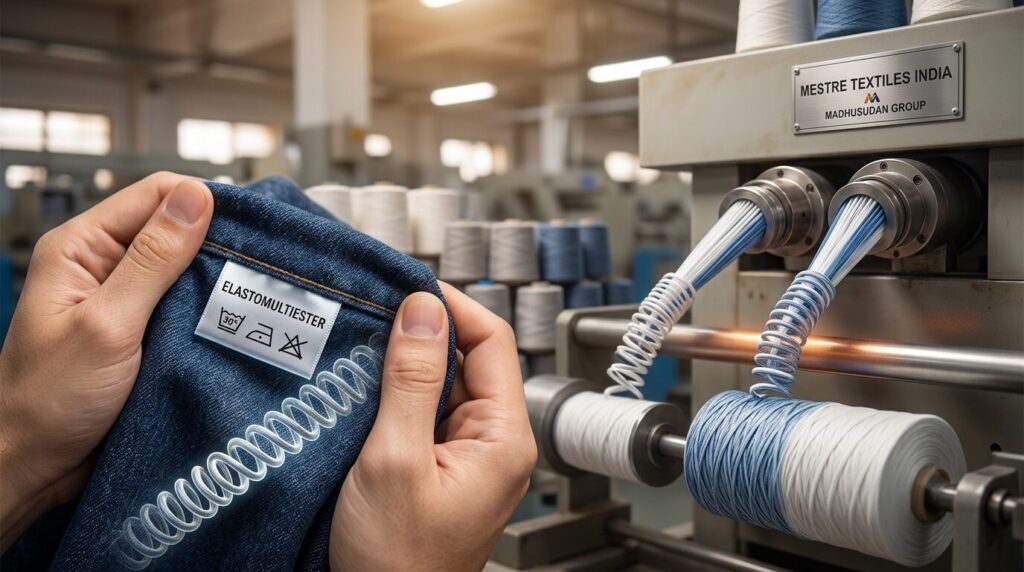
Ask most people what makes a fabric stretch, and they’ll say spandex, Lycra, or elastane. For three decades, that assumption has largely held true. But a different kind of stretch yarn has been quietly working its way into denim, workwear, and casualwear labels one that delivers genuine elasticity without a single strand of elastane in the fabric. That fibre is elastomultiester.
If you have spotted the word on a garment care label and wondered whether it is a new synthetic risk or simply unfamiliar terminology, the short answer is the latter. Elastomultiester is a recognised, regulated fibre category, and understanding how it works explains why so many manufacturers are treating it as the next step for stretch yarn technology.
What Is Elastomultiester?
Elastomultiester is an elastic bicomponent polyester fibre, officially recognised as its own generic fibre name under European textile labelling rules. It is formed by combining two chemically distinct polyester-based polymers within a single filament, joined in a side-by-side structure, so that after heat treatment the fibre can be stretched to roughly one and a half times its original length and snap back close to its starting point without relying on rubber-like polymers at all.
The name breaks down logically once you know what it describes: ‘elasto’ for its elastic recovery, ‘multi’ for the multiple polymer phases inside the fibre, and ‘ester’ because both components belong to the polyester family. In industry conversation you will often see it shortened to EME, and in the US market a related term, elasterell-p, sometimes appears for similar multicomponent elastic polyesters.
How Elastomultiester Yarn Is Made
The engineering behind elastomultiester yarn sits squarely inside bicomponent polyester technology. Two polyester variants with different shrinkage behaviour most commonly standard PET (polyethylene terephthalate) and PTT (polytrimethylene terephthalate), often in a ratio close to 50:50 are extruded together through a single spinneret in a side-by-side configuration.
PTT’s molecular chains naturally adopt a helical, spring-like shape, while PET’s chains are more rigid and extended. When the combined filament goes through quenching and drawing, internal stress builds between the two mismatched polymers. The real transformation happens during heat-setting: as the filament is heated, the two components shrink at different rates, and that mismatch forces the flat filament to coil into a three-dimensional helix essentially turning the fibre into a microscopic spring.
Because that spring structure is built into the fibre itself, elastomultiester yarn does not need to be twisted, covered, or wrapped around a separate elastane filament before it is woven or knitted. The stretch is already there.
Elastomultiester vs Elastane: What’s the Real Difference?
Both fibres deliver stretch, but they get there through completely different mechanisms, and that difference shows up throughout a garment’s life.
| Property | Elastomultiester | Elastane / Spandex |
| Source of stretch | Coil geometry of the bicomponent fibre | Elasticity of the polymer chain itself |
| Typical elongation | Around 20-40%, depending on yarn engineering | Very high, but usually blended at a small percentage |
| Heat tolerance | Withstands high-temperature laundering and dyeing | Can degrade above roughly 60°C |
| Chlorine / UV resist. | Generally strong | Prone to degrading and yellowing over time |
| Recyclability | Same polymer family, easier to recycle | Difficult to separate from blended fabric |
| Hand feel | Closer to conventional woven polyester, less rubbery | Stretchier, more compression-like |
This is why elastomultiester is increasingly described as a polyester stretch fibre rather than an elastic fibre in the traditional sense. The stretch behaves more like a structural property of the yarn than an added elastic ingredient.
Why Elastomultiester Is Called an Eco-Friendly Elastic Yarn
Sustainability is one of the biggest drivers behind elastomultiester’s growth, and the reasoning holds up under scrutiny. Polyester-elastane blends are notoriously difficult to recycle, because the two fibre types need to be chemically separated before the polyester content can be reprocessed a step many recycling facilities are not equipped for. Elastomultiester sidesteps that problem by staying within a single polymer family. Two polyester variants are far more compatible for downstream recycling than polyester and polyurethane-based elastane.
There is a durability angle too. Elastane is known to lose elasticity over time, particularly with repeated exposure to heat, body oils, and UV light, which is why stretch jeans and leggings eventually start to sag or lose their snap-back. Because elastomultiester’s stretch comes from a physical coil rather than a degrading polymer chain, garments tend to hold their shape and recovery for longer, which extends the useful life of the garment.
It is worth being precise here: elastomultiester is not biodegradable, and it does not eliminate a garment’s overall environmental footprint. What it does offer is a more circular-friendly construction and a longer functional lifespan compared with elastane blends real, measurable advantages rather than a blanket sustainability claim.
Where Elastomultiester (Polyester Stretch Fibre) Is Used
- Denim and Casualwear: Elastomultiester gives stretch jeans better shape retention and less bagging at the knees over time than many conventional polyester-elastane blends.
- Workwear and Corporate Apparel: Its tolerance for high-temperature industrial laundering and dyeing makes it well suited to uniforms that go through frequent commercial wash cycles.
- Formalwear and Smart-Casual Fabrics: Blazers, trousers, and structured garments benefit from a stretch that drapes closer to conventional woven fabric rather than a compression-like feel.
- Chlorine-Exposed Environments: Its resistance to chlorine and UV makes it a practical choice for poolside or outdoor workwear, where elastane would degrade faster.
Caring for Elastomultiester Fabric
Because elastomultiester’s stretch lives inside the fibre itself rather than in a separate elastic strand, garments made from it generally tolerate machine washing and higher-temperature cycles better than elastane-blended fabrics. Standard polyester ironing temperatures and low-to-medium tumble drying are typically fine, since the fibre’s coil structure is not vulnerable to the same heat-driven breakdown that affects elastane over time.
This heat tolerance is also why elastomultiester fabrics are often easier to process in bulk manufacturing. Mills can run standard polyester finishing, heat-setting, and pressing temperatures without the careful calibration elastane blends often require to avoid scorching or losing recovery.
Mestre: An Indian Manufacturer of Elastomultiester Yarn
Mestre Textiles India, led by the Surat-based Madhusudan Group, sits at the centre of this shift toward domestic elastomultiester manufacturing. In a market that has historically depended on imported bicomponent polyester, Mestre is built on exactly this structure: two polyester components with different thermal shrinkage rates, co-extruded to form a permanent coil crimp.
What distinguishes Mestre from internationally sourced alternatives is that the stretch is mechanical rather than chemical generated by the coil’s physical geometry and the yarn is dyed using standard disperse-dye processes already common in Indian polyester mills. Combined with a dry, wool-like hand feel that suits activewear and formal fabrics alike, Mestre positions itself as a domestically produced elastomultiester manufacturer built specifically for the Indian textile supply chain.
Frequently Asked Questions
Is elastomultiester the same as regular polyester?
They are related but not identical. Standard polyester yarn has minimal stretch, typically in the 3-5% range, while elastomultiester is engineered with a bicomponent structure that delivers 20-40% elongation with recovery.
Does elastomultiester completely replace elastane?
For comfort and moderate-stretch garments, such as denim, workwear, and formalwear, it is a strong substitute. For ultra-high-compression sportswear and intimate apparel, elastane still tends to lead on maximum elongation.
Is elastomultiester safe to wear against skin?
Yes. It is polyester-based, contains no polyurethane, and is generally well tolerated, with commercial products typically meeting standard textile safety frameworks like OEKO-TEX and REACH.
How much stretch does elastomultiester actually provide?
Most commercial elastomultiester yarns deliver roughly 20-40% elongation with strong elastic recovery, though the exact figure depends on the specific polymer ratio and yarn construction used.
Why does a garment label sometimes say T400 instead of elastomultiester?
T400 is a well-known commercial brand name for a bicomponent polyester fibre that falls under the broader elastomultiester category, much like Lycra is a brand name within the broader elastane category. Elastomultiester is the generic technical term.
Final Thoughts
Elastomultiester is a reminder that stretch fabric does not have to mean elastane. By engineering two polyester polymers into a single, self-coiling filament, this bicomponent polyester technology delivers genuine elasticity while staying inside a recyclable, heat-resistant, single-polymer family. As more manufacturers including Indian producers like Mestre scale up domestic elastomultiester manufacturing, it is positioned to become a default option for brands that want stretch yarn performance without the long-term durability and recycling trade-offs that come with elastane.