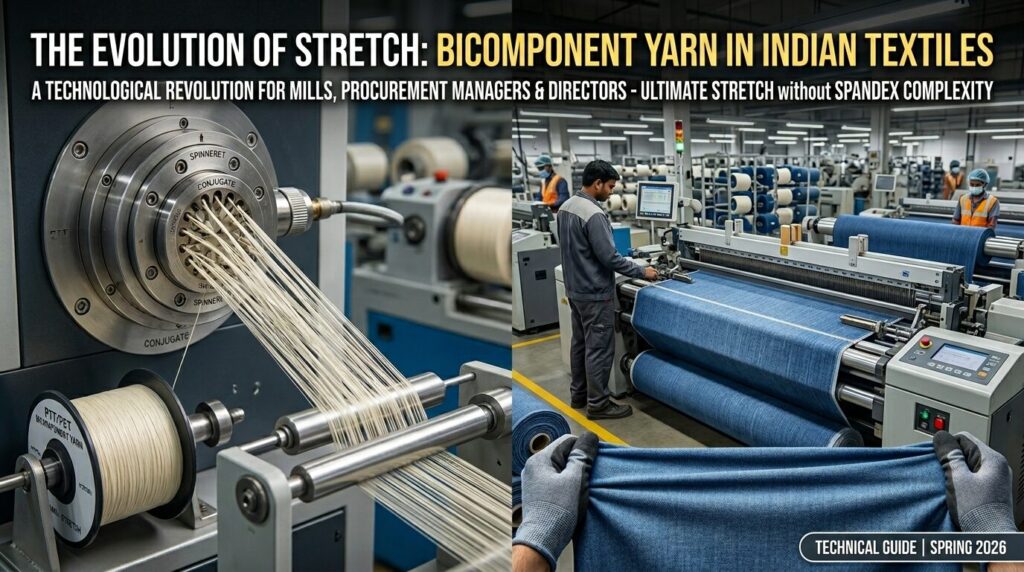
In the Indian textile industry, the search for stretch performance without the cost and processing complexity of spandex has been ongoing for decades. Bicomponent yarn also called biconstituent yarn or conjugate yarn is answering that search with a precision that conventional yarns simply cannot match.
Bicomponent yarn is a single filament yarn made from two chemically or physically distinct polymers, extruded simultaneously through a single spinneret. The two polymer components are bonded together within each filament. When this yarn is subjected to heat or mechanical stress, the differential shrinkage between the two polymer components causes the filament to naturally crimp, coil, or spiral producing elastic stretch without any elastomeric additive.
This guide is written for procurement managers, technical directors, fabric development teams, and mill owners in India who are evaluating bicomponent yarn either as a replacement for spandex or as a performance upgrade in their yarn portfolio.
The Science Behind Bicomponent Yarn
To understand why bicomponent yarn behaves the way it does, you need to understand conjugate spinning. In conventional melt spinning, a single polymer is extruded through a spinneret to form a filament. In conjugate (bicomponent) spinning, two distinct polymer melts are fed through a specially designed spinneret that keeps the two streams separate until the very last moment and then fuses them inside the same filament cross-section.
Because the two polymers have different thermal shrinkage rates, crystallization temperatures, or modulus values, they respond differently to heat and mechanical tension. One side contracts more than the other, forcing the filament to curve. This curvature, multiplied across thousands of filaments in a yarn bundle, creates the three-dimensional crimp that gives bicomponent yarn its characteristic bulk and stretch.
The physics is analogous to a bimetallic strip in a thermostat two materials bonded together, each responding differently to the same stimulus, creating controlled movement. In the case of bicomponent yarn, that movement is elastic stretch and recovery.
Types of Bicomponent Yarn by Cross-Sectional Configuration
The arrangement of the two polymers within each filament determines the yarn’s mechanical behaviour, crimp geometry, and end-use suitability. There are four primary configurations commercially relevant to Indian textile mills:
1. Side-by-Side (S/S) Configuration
In the side-by-side configuration, the two polymers run parallel to each other along the full length of the filament, like two cylinders fused at their sides. This is the configuration that produces the most pronounced helical crimp. Because both polymers occupy equal cross-sectional areas, differential shrinkage forces the filament into a tight coil.
Side-by-side bicomponent yarns typically offer the highest bulk and the most wool-like texture. They are widely used in knitwear, hosiery, and textured fabrics where high loft and moderate stretch (15–30%) are desirable. The crimp is permanent once heat-set and survives repeated washing without significant loss.
2. Core-Sheath (C/S) Configuration
In core-sheath construction, one polymer forms the central core and the other wraps around it as a continuous sheath. The core and sheath can be concentric (perfectly centred) or eccentric (off-centre). Eccentric core-sheath is the most commercially important for stretch applications because the off-centre placement creates differential stress and produces crimp.
Concentric core-sheath is used where the goal is to combine surface properties (dyeability, softness, moisture management) of the sheath with the strength or modulus of the core. For example, a nylon sheath over a polyester core gives a fabric with nylon’s hand-feel and polyester’s dimensional stability.
For stretch applications in India particularly in woven stretch fabrics and stretch denim eccentric core-sheath PTT/PET bicomponent yarns are the dominant commercial format.
3. Islands-in-the-Sea (I/S) Configuration
This is a more specialised configuration where multiple fine polymer filaments (the islands) are embedded within a matrix of a second polymer (the sea). After spinning, the sea component is dissolved chemically, releasing ultra-fine filaments. Islands-in-the-sea bicomponent is the technology behind microfibre fabrics. It is not used for elastic stretch applications but is mentioned here for completeness because Indian synthetic textile mills particularly those in Surat producing microfibre suiting encounter this technology.
4. Segmented Pie Configuration
The cross-section resembles a pie divided into alternating wedge segments of two polymers. The two components meet at many interfaces along the filament radius. When the pie is split (by mechanical action or chemical treatment), it yields very fine filaments with triangular cross-sections producing fabrics with exceptional softness, wicking, and peach-skin texture.
Segmented pie bicomponent is used in sportswear and intimate apparel linings where ultra-softness and moisture transport are primary requirements.
Key Polymer Combinations Used in Commercial Bicomponent Yarns
The choice of polymer pair determines nearly every performance characteristic of the yarn. The following combinations are commercially significant for the Indian market:
| Polymer Combination | Configuration | Key Property | Primary Applications |
| PTT / PET | Side-by-side or Eccentric C/S | High elastic recovery, soft hand, low modulus | Stretch woven, stretch denim, activewear |
| PET / PET (diff. IV) | Side-by-side | Bulk, texture, crimp without stretch | Textured knit, upholstery, carpet face yarn |
| PA6 / PET | Core-sheath | Nylon surface + polyester strength | Hosiery, swimwear, intimate apparel |
| PP / PET | Core-sheath | Lightweight, moisture transport | Hygiene nonwovens, sportswear |
| PLA / PET | Side-by-side | Bio-based, compostable blends | Sustainable fashion, eco-label apparel |
The most important combination for Indian textile mills seeking stretch performance is PTT/PET. PTT (polytrimethylene terephthalate) has a unique molecular spring structure that gives it exceptional elastic recovery it can stretch and return to original dimensions repeatedly without the fatigue that affects conventional polyester. When bonded side-by-side with PET, the differential shrinkage creates strong, stable helical crimp with 20–40% elongation and near-complete recovery. This is the basis of products commercially known as T400 (a DuPont/Invista brand), though many Chinese and Taiwanese producers now supply equivalent PTT/PET bicomponent yarns.
Physical and Performance Properties: What the Specifications Mean
For procurement and technical evaluation, the following parameters are the most important to specify and test when sourcing bicomponent yarn in India:
Denier and Filament Count
Bicomponent yarns are available from 30D (fine hosiery applications) to 300D and above (heavy woven or industrial). The denier per filament (DPF) affects handle and drape finer DPF (below 1.0) gives softer, more silk-like fabrics. For stretch woven fabrics in India, 75D/36F and 150D/48F PTT/PET bicomponent yarns are the most widely specified formats.
Crimp Contraction Ratio (CCR)
CCR measures the degree of crimp development after heat treatment, expressed as the percentage reduction in yarn length when the crimp activates. Higher CCR (above 30%) indicates greater bulk and a softer hand. Lower CCR (10–20%) indicates tighter crimp with more elastic spring and recovery. For activewear stretch fabrics, a CCR of 25–40% is typically targeted.
Elongation and Elastic Recovery
Elongation at break for bicomponent stretch yarns typically ranges from 15% to 45%, depending on polymer combination and configuration. More critical than elongation is elastic recovery the percentage of original length recovered after a defined extension. High-quality PTT/PET bicomponent yarn should demonstrate above 85% elastic recovery after 10 stretch-and-release cycles at 20% elongation, tested per ASTM D1774 or equivalent.
Boil-Off Shrinkage
Boil-off shrinkage (BOS) is the dimensional change when the yarn is exposed to boiling water without tension. For bicomponent yarns, BOS is the mechanism that activates crimp in fabric. Weavers and knitters in India must account for BOS in their grey fabric dimensions typically 8–18% for PTT/PET side-by-side yarns. Finishing departments must plan heat-setting sequences to control final fabric dimensions.
Tenacity
Bicomponent yarns generally have lower tenacity than equivalent-denier standard polyester DTY, because the PTT component has a lower modulus. Typical tenacity for PTT/PET bicomponent is 2.5–3.5 g/den, compared to 3.5–4.5 g/den for standard PET DTY. This must be accounted for in warp tension settings on rapier or projectile looms.
Bicomponent Yarn vs. Spandex: A Technical Comparison
The most commercially relevant comparison for Indian mills is bicomponent stretch yarn versus spandex (elastane) in stretch fabric constructions. The differences are fundamental, not cosmetic:
| Parameter | Bicomponent Yarn (PTT/PET) | Spandex / Elastane |
| Stretch mechanism | Mechanical physical crimp geometry | Chemical polymer chain elasticity |
| Stretch range | 15–45% elongation | 200–700% elongation |
| Recovery force | Moderate, progressive | High, immediate (power stretch) |
| Chlorine resistance | Excellent (fully resistant) | Poor degrades in chlorinated water |
| Dyeing temperature | Standard polyester (130°C disperse) | Low temperature required (max 100–110°C) |
| Processing on loom | Runs as standard multifilament | Requires special elastane feeder/tension control |
| Fabric weight impact | Minimal similar to standard polyester | Adds rubber-band density to fabric |
| Cost (India, 2025 approx.) | Rs. 180–320 / kg | Rs. 550–900 / kg |
| Washfastness of stretch | Excellent crimp is structurally permanent | Good but degrades over repeated washing |
| Suitable for export (REACH) | Yes/no SVHC concerns | Check formulation some auxiliaries flagged |
The critical insight for Indian mills is this: bicomponent yarn does not replace spandex for applications requiring high-power stretch (swimwear, compression garments, fitted sportswear with tight body contouring). However, for comfort stretch applications stretch shirting, stretch suiting, stretch denim, stretch hosiery, and casual activewear bicomponent delivers entirely adequate stretch with dramatically simpler processing, better chlorine resistance, and significantly lower input cost.
Certifications and Quality Standards Relevant to Indian Buyers
When sourcing bicomponent yarn whether domestically or through imports from China, Taiwan, or Korea Indian mills should verify the following standards and certifications:
- OEKO-TEX Standard 100: Confirms the yarn is free from harmful substances including formaldehyde, heavy metals, pesticides, and allergenic dyes. Essential for export-oriented mills supplying EU and US buyers.
- REACH Compliance: The EU’s chemical safety regulation. Bicomponent polyester yarns are generally REACH-compliant, but auxiliaries (spin finishes, lubricants applied during texturizing) must be verified. Request REACH declaration from the supplier.
- BIS Certification (IS 7702 / IS 1233): Indian Bureau of Standards specifications for man-made fibre yarns. Check denier tolerance (typically ±3%), tenacity, elongation, and number of breaks per 100 km on Uster testing.
- ISO 2060: Linear density of textile yarns the international standard for denier/dtex measurement. All test reports from serious suppliers should reference this standard.
- bluesign Certification: For mills supplying sustainability-conscious brands (especially European outdoor and sportswear buyers), bluesign-certified bicomponent yarn confirms responsible resource use and chemical management throughout production.
- GOTS (Global Organic Textile Standard): Only relevant if bicomponent yarn is blended with certified organic natural fibres (cotton, wool). Pure synthetic bicomponent yarn cannot carry GOTS certification.
Conclusion
Bicomponent yarn represents a structural shift in how stretch is engineered into textiles. Rather than inserting a separate elastomeric component with all the associated processing complexity, cost, and environmental concerns bicomponent technology builds the stretch mechanism into the molecular architecture of the yarn itself.
For Indian textile mills whether weaving stretch shirting in Surat, knitting hosiery in Tirupur, or producing stretch denim for export bicomponent yarn offers a technically sound, commercially attractive, and increasingly certification-friendly path to stretch performance. The investment required is primarily in heat-setting knowledge and process calibration. The return is a simpler supply chain, lower raw material cost, and a fabric with performance credentials that export buyers increasingly respect. The remaining articles in this series cover elastomultiester in detail, the mechanical stretch mechanism, manufacturing process, and applications cluster by cluster across India’s textile geography.