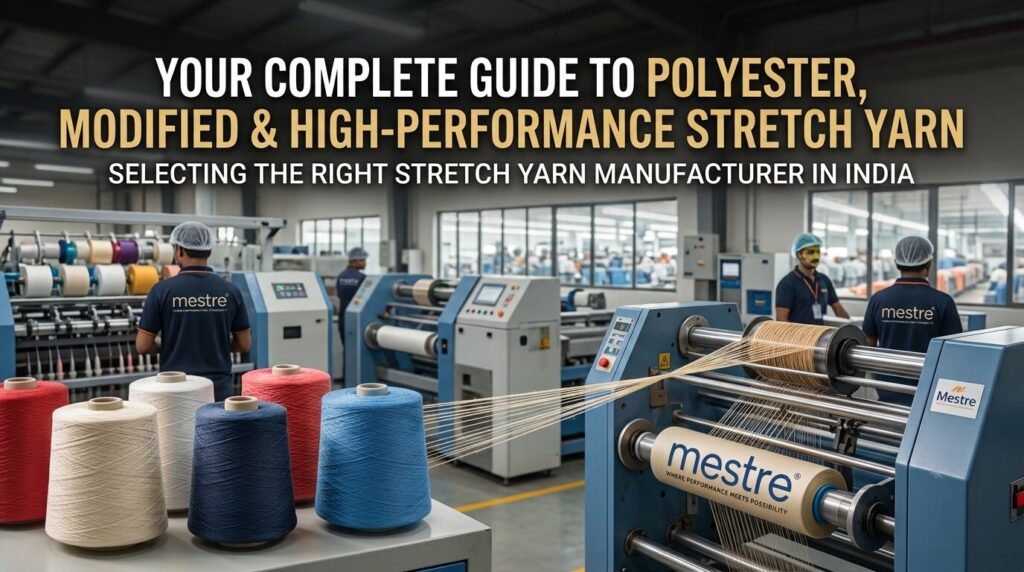
If you manufacture knitwear, denim, activewear, or hosiery, the single decision that affects your fabric quality, production cost, and customer returns more than almost any other is this: who is your stretch yarn manufacturer? India’s textile industry runs on stretch yarn today it isn’t a niche fibre reserved for sportswear, it’s built into shirting, denim, hosiery, home textiles, and technical fabrics across the board. But not every stretch yarn manufacturer in India offers the same consistency, technical support, or range.
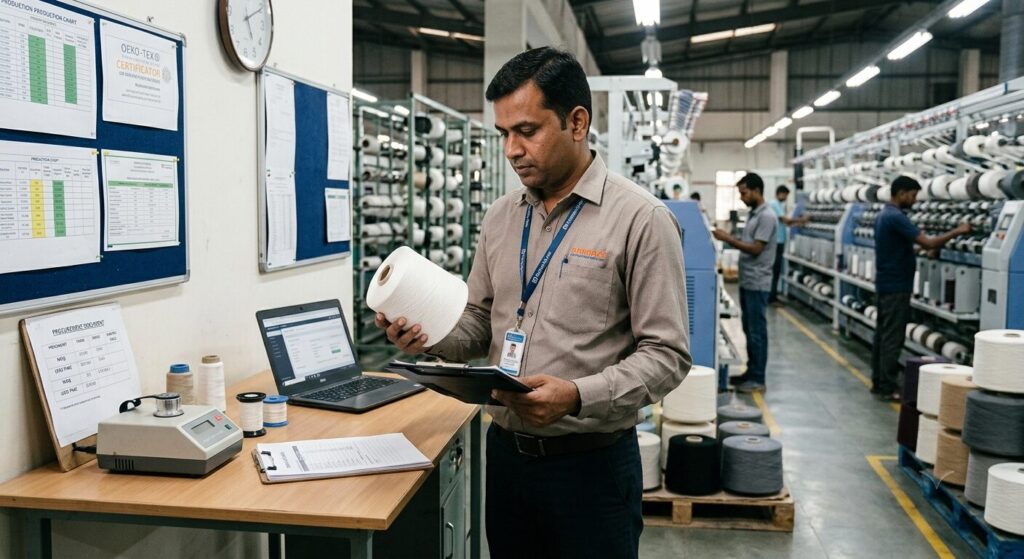
This guide walks you through everything a buyer, merchandiser, or production head needs to know before choosing a stretch yarn manufacturer: the different yarn types on the market, how to evaluate quality, what to look for when sourcing stretch yarn for knitting, and where Mestre fits into that picture.
The Growing Demand for Stretch Yarn in India
India’s man-made fibre and technical textile segment is expanding fast. The technical textiles industry alone was valued at roughly US$29 billion in 2024 and is projected to touch around US$45 billion by 2026, according to IBEF industry data, with man-made fibre fabrics and yarns making up a large share of India’s textile exports. Stretch fabric comfort-fit denim, athleisure, seamless knitwear, and performance shirting sits squarely inside this growth story.
As global buyers demand fabrics that combine comfort, recovery, and durability, Indian mills are under pressure to source stretch yarn that performs consistently, batch after batch. That has made the choice of stretch yarn manufacturer a strategic sourcing decision rather than a routine purchase order.
What to Look for in a Stretch Yarn Manufacturer in India
Not all suppliers labelled as a “stretch yarn manufacturer” actually manufacture yarn many simply trade imported cones. Before you commit to a supplier, evaluate them against these criteria:
- Manufacturing capability: Does the company operate its own spinning, texturising, or covering lines, or is it reselling third-party stock? In-house manufacturing means better lot-to-lot consistency and faster turnaround on custom deniers.
- Technical documentation: A credible manufacturer should provide denier, elongation at break, elastic recovery %, and tenacity data for every batch not just a product photo.
- Range of stretch mechanisms: The best partners offer both chemical stretch (spandex-based) and mechanical stretch options such as bicomponent yarn, so you can pick the right mechanism for each product instead of defaulting to one technology for everything. See our detailed comparison of mechanical stretch yarn vs. chemical stretch yarn for guidance.
- Application expertise: Stretch yarn for knitting behaves differently to stretch yarn for weaving. A manufacturer who understands your specific fabric construction can recommend the right count and covering ratio.
- Consistency of supply: Stretch fabric production runs are sensitive to yarn variation. A manufacturer with reliable production capacity reduces the risk of mid-order shortages and dye-lot mismatches.
- After-sales technical support: Issues like weft bars, uneven recovery, or shrinkage are usually yarn-and-process related. A manufacturer who supports your mill through trial runs saves weeks of troubleshooting.
Understanding the Core Types of Stretch Yarn
“Stretch yarn” is an umbrella term. The specific type you choose has a direct impact on stretch percentage, recovery, hand-feel, and cost. Here is how the major categories differ.
1. Polyester Stretch Yarn
Polyester stretch yarn is the most widely used category in Indian mills because polyester offers a strong balance of strength, colour-fastness, and cost-efficiency. It is typically produced as a core-spun or covered yarn, with a polyester filament or an elastic core wrapped by polyester filament or staple fibre. Polyester stretch yarn is common in shirting, trousers, uniforms, and blended knitwear, where moderate stretch (10–25%) with good recovery is required, without the processing sensitivity of spandex. For a deeper look at how polyester-based bicomponent yarn compares to elastane, see our guide on Mestre® Elastomultiester stretch yarn.
2. Polyester Full Stretch Yarn
Polyester full stretch yarn refers to yarn engineered for maximum stretch and recovery within the polyester family typically a fully drawn or partially oriented polyester filament that is texturised or bicomponent-crimped to achieve high elongation without relying on an elastane core. “Full stretch” in commercial usage generally indicates that the entire yarn cross-section contributes to elasticity, rather than only a covering layer around a passive core. This makes it a popular option where mills want spandex-like stretch behaviour with the easier processing, higher heat-setting temperature, and lower cost profile of 100% polyester.
3. Modified Stretch Yarn
Modified stretch yarn describes yarn where the base polymer or yarn structure has been engineered typically through bicomponent extrusion, cross-section modification, or polymer blending to change how the yarn stretches and recovers. The most common commercial example is PTT/PET bicomponent yarn, where two polymers with different shrinkage rates are extruded side-by-side in a single filament. As the yarn is heat-set, the differential shrinkage forces the filament into a permanent helical crimp, creating mechanical stretch without any spandex. Sorona®, DuPont’s bio-based PTT polymer, is a widely used input for modified stretch yarn read our detailed explainer on Sorona fiber and PTT polymer for the full technical picture.
4. High Stretch Yarn
High stretch yarn is defined by elongation percentage rather than construction it refers to yarn capable of extending well beyond standard comfort-stretch ranges, generally 30% and above, with strong recovery. High stretch yarn is used where the fabric itself needs to move significantly with the body: rib-knit waistbands, activewear, seamless hosiery, and stretch denim with heavy movement requirements. Depending on the target power and hand-feel, high stretch yarn can be built on a spandex core, a bicomponent structure, or a hybrid of both.
5. High Performance Stretch Yarn
High performance stretch yarn goes a step further, combining elasticity with functional properties such as chlorine resistance, UV stability, moisture management, abrasion resistance, or faster drying. This category is built for demanding end-uses swimwear, technical activewear, outdoor apparel, and compression wear where the yarn must retain its stretch and recovery through repeated washing, chlorine exposure, and UV exposure. T-400™ style bicomponent core-spun yarns are a well-known example in this space. Compare the performance characteristics of leading options in our guide to Mestre vs. Lycra, T-800, and T-400 stretch yarn.
Stretch Yarn for Knitting: What Buyers Need to Know
Stretch yarn for knitting has different requirements to stretch yarn used in weaving, because knitted fabric already has inherent stretch from its loop structure. Adding stretch yarn on top of that structure changes both feeding tension and machine settings. Key considerations for knitting mills include:
- Feed consistency: Circular and flat knitting machines require even, low-tension positive feeding of stretch yarn to avoid loop distortion and course-wise bars.
- Gauge compatibility: Fine-gauge knits (24G and above) generally need lower-denier covered or bicomponent yarn to avoid excessive fabric weight and stiffness.
- Recovery under repeated flexing: Knitted garments stretch and recover continuously in wear, so elastic recovery after repeated cycles (not just single-pull elongation) is the metric that matters most.
- Blend ratio: For rib and interlock structures used in waistbands and cuffs, mills typically increase the proportion of stretch yarn relative to base yarn to achieve firmer recovery.
For denim knits and stretch woven denim specifically, bicomponent stretch yarn has become the preferred choice among Indian denim mills looking to reduce the “bagging out” problem common with spandex-heavy constructions read the full case in our article on stretch yarn for denim in India.
Quality Parameters Every Stretch Yarn Manufacturer Should Guarantee
Before finalising an order, ask your stretch yarn manufacturer to share test data against recognised standards. Tensile properties such as breaking force, elongation, and tenacity are commonly verified using the ASTM D2256 single-strand tensile test method, which is the industry-standard procedure for testing monofilament, multifilament, and spun yarns. At minimum, insist on the following data points for every stretch yarn lot:
- Denier / linear density and tolerance range
- Elongation at break (%)
- Elastic recovery after extension (%)
- Tenacity / tensile strength
- Shrinkage behaviour at defined heat-setting temperatures
- Colour and dye uptake consistency across lots
A manufacturer who can supply this data as standard practice not only on request is generally a stronger long-term sourcing partner than one who cannot.
MOQ, Lead Time, and Custom Development: Practical Sourcing Considerations
Beyond yarn type and technical specifications, buyers evaluating a stretch yarn manufacturer in India should also factor in commercial terms that affect production planning:
- Minimum order quantity (MOQ): In-house manufacturers with dedicated spinning and texturising capacity can often support lower MOQs on standard deniers than importers reselling fixed-lot stock, which matters for sampling and small-batch product development.
- Custom denier and blend development: If your fabric requires a non-standard stretch yarn count or covering ratio, ask whether the manufacturer can develop and trial a custom specification, and how many weeks that typically takes from sample approval to bulk supply.
- Domestic vs. import lead time: Sourcing stretch yarn from an Indian manufacturer rather than importing from East Asia can meaningfully shorten lead times and reduce landed cost, which is particularly valuable for mills working with fast-fashion or low-MOQ export programmes.
- Certifications and compliance: Export-facing mills should confirm whether the manufacturer’s stretch yarn is backed by relevant compliance documentation (such as OEKO-TEX or REACH-aligned processing) where the end brand requires it.
Working through these questions upfront during vendor evaluation, rather than after the first production run, saves significant time when a fabric programme moves from sampling to bulk manufacturing.
Stretch Yarn Applications Across Industries
| Industry | Recommended Yarn Type | Why |
| Shirting & formal wear | Polyester stretch yarn | Moderate stretch, easy care, cost-efficient |
| Denim (woven & knit) | Modified / bicomponent stretch yarn | Reduces bagging, better recovery over time |
| Hosiery & socks | High stretch yarn | High elongation with strong recovery for fit |
| Activewear & sportswear | High performance stretch yarn | Moisture management, durability, UV/chlorine resistance |
| Circular & flat knitwear | Stretch yarn for knitting (covered/bicomponent) | Even feeding, gauge-appropriate denier |
| Swimwear | High performance stretch yarn (T-400 type) | Chlorine and UV resistance with retained stretch |
Why Choose Mestre as Your Stretch Yarn Manufacturer in India
Mestre is a Surat-based bicomponent and stretch yarn manufacturer supplying Indian and export-oriented mills with a full range of stretch solutions from elastomultiester and mechanical stretch yarn to core-spun and covered constructions. Working with an established manufacturer gives buyers three practical advantages:
- Batch consistency: Controlled, in-house production reduces lot-to-lot variation that causes dyeing and stretch-recovery inconsistencies downstream.
- Application-specific guidance: From choosing between polyester stretch yarn and modified bicomponent yarn to setting the right knitting or weaving parameters, Mestre’s technical team works directly with mills during trial runs.
- Sustainability options: For brands under pressure to reduce environmental impact, Sorona-based modified stretch yarn offers a bio-based alternative to conventional petroleum-derived stretch fibres.
Explore the full range of options on our stretch yarn page, or get in touch with our team to discuss denier, construction, and MOQ for your specific application.
Frequently Asked Questions
What is the difference between polyester stretch yarn and modified stretch yarn?
Polyester stretch yarn typically refers to a covered or core-spun yarn using standard polyester as the wrapping fibre. Modified stretch yarn goes further by altering the polymer or filament cross-section itself commonly through bicomponent extrusion so the yarn develops mechanical stretch without needing an elastane core.
Which stretch yarn is best for knitting mills?
It depends on gauge and end use. Fine-gauge knitwear generally performs better with lower-denier covered or bicomponent stretch yarn, while ribbed cuffs and waistbands benefit from high stretch yarn with strong recovery. A stretch yarn manufacturer with knitting-specific technical support can recommend the right count for your machine gauge.
Is polyester stretch yarn as durable as spandex-based yarn?
Polyester-based mechanical stretch yarn generally offers better heat resistance, chlorine resistance, and dimensional stability at high temperatures than spandex, though spandex still delivers higher elongation for compression-level stretch. The right choice depends on the required stretch percentage and end-use conditions.
How do I evaluate a stretch yarn manufacturer in India before placing a bulk order?
Request lot-wise technical data (elongation, recovery, tenacity), ask for a trial run on your own machinery, and confirm production capacity against your order volume and timeline before committing to a bulk purchase order.
Conclusion
Choosing the right stretch yarn manufacturer in India shapes everything downstream fabric hand-feel, garment recovery, production efficiency, and ultimately customer satisfaction. Whether you need standard polyester stretch yarn for shirting, modified bicomponent yarn for denim, or high performance stretch yarn for activewear and swimwear, working with a manufacturer that understands both the fibre science and your specific machine setup makes the difference between a smooth production run and a costly rework. Browse Mestre’s complete stretch yarn range, or explore our detailed guides on mechanical vs. chemical stretch yarn and stretch yarn for denim to find the right fit for your next production run.