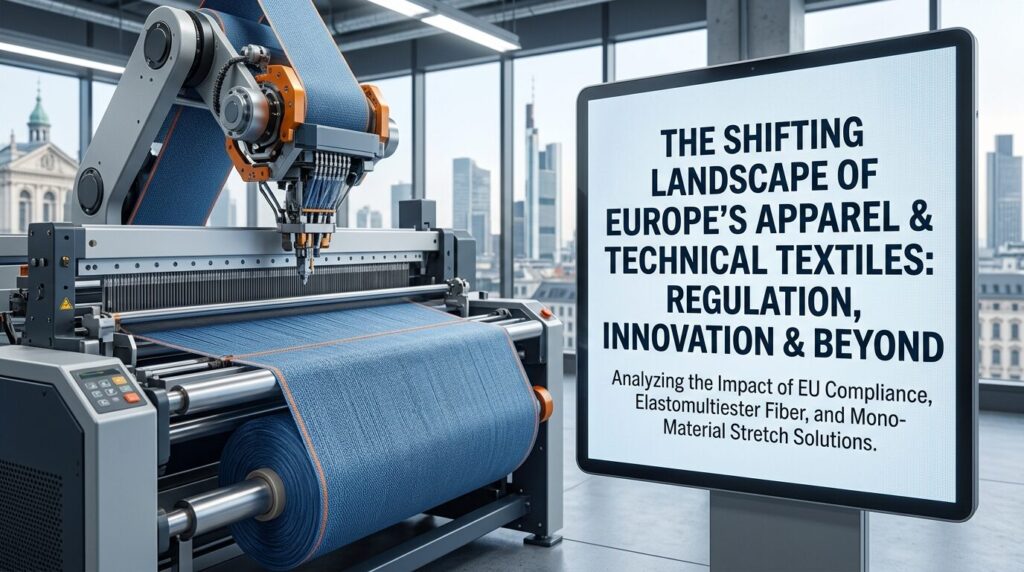
Europe’s apparel and technical textile sector is undergoing one of its most significant regulatory shifts in decades. As the EU tightens rules around sustainability, labelling, and traceability, textile buyers across the continent are reassessing which fibers belong in their supply chains. Bicomponent yarn and elastomultiester fiber, built around mechanical stretch rather than blended elastane, are increasingly part of that conversation, offering a route to recyclable, mono-material stretch fabric that fits more comfortably within Europe’s evolving compliance landscape.

Europe’s Position in Global Textile Manufacturing
Europe’s textile industry combines luxury fashion houses in Italy and France, technical textile specialists in Germany and Austria, and large-volume manufacturing hubs across Portugal, Spain, and Turkey. Historic textile centers such as Mestre near Venice, Prato in Tuscany, and Northern Portugal’s Vale do Ave region continue to anchor European fabric production, even as much of the raw yarn and greige fabric supply is imported from Asia. What sets Europe apart is not manufacturing volume but regulatory rigor: EU member states are rolling out sustainability disclosure requirements, extended producer responsibility schemes, and stricter fiber content labelling rules that directly affect which stretch technologies brands can responsibly use.
Textile Industry Trends Shaping the EU Market
- The EU’s Strategy for Sustainable and Circular Textiles is pushing brands toward durable, repairable, and recyclable garment construction.
- Extended producer responsibility schemes, already active in markets like France, are making end-of-life recyclability a cost consideration, not just a marketing point.
- EU textile labelling regulation requires precise, verifiable fiber content disclosure, increasing scrutiny on blended stretch fabrics where elastane content must be separately declared.
- Buyers are showing growing interest in mono-material or near-mono-material stretch fabrics that simplify both compliance and recycling logistics.
Key Fabric Emphasis: Elastomultiester and Mechanical Stretch
Elastomultiester bicomponent yarn is gaining attention specifically because it delivers stretch and recovery through fiber engineering rather than through blending in a separate elastane filament. This matters under EU textile labelling regulation because it can simplify fiber content declarations and reduce the complexity of proving recyclability. Mechanical stretch fabrics also tend to perform more consistently across the industrial finishing processes used in European technical textile production, including higher-temperature dyeing and heat-setting.
Applications Across Industries
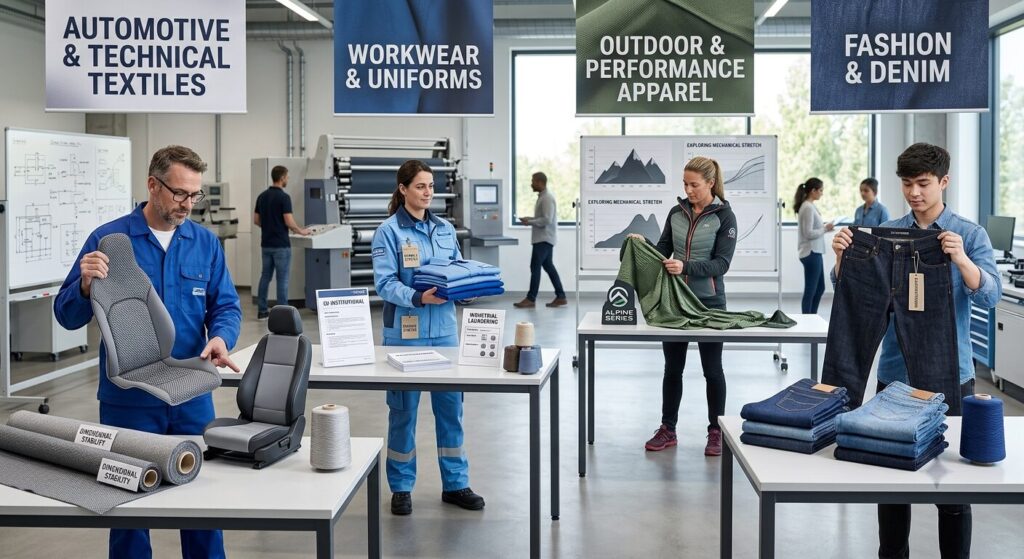
- Fashion and denim: European casualwear and premium denim brands are testing elastomultiester alternatives to reduce reliance on elastane blends.
- Workwear and uniforms: EU institutional buyers, from public transport operators to healthcare systems, increasingly specify durable stretch workwear that can withstand industrial laundering.
- Automotive and technical textiles: Central European automotive suppliers use bicomponent yarn for interior textiles requiring dimensional stability.
- Outdoor and performance apparel: Alpine and outdoor brands based in France, Switzerland, and Austria are exploring mechanical stretch fabrics for technical apparel lines.
Why Global Buyers Source from India
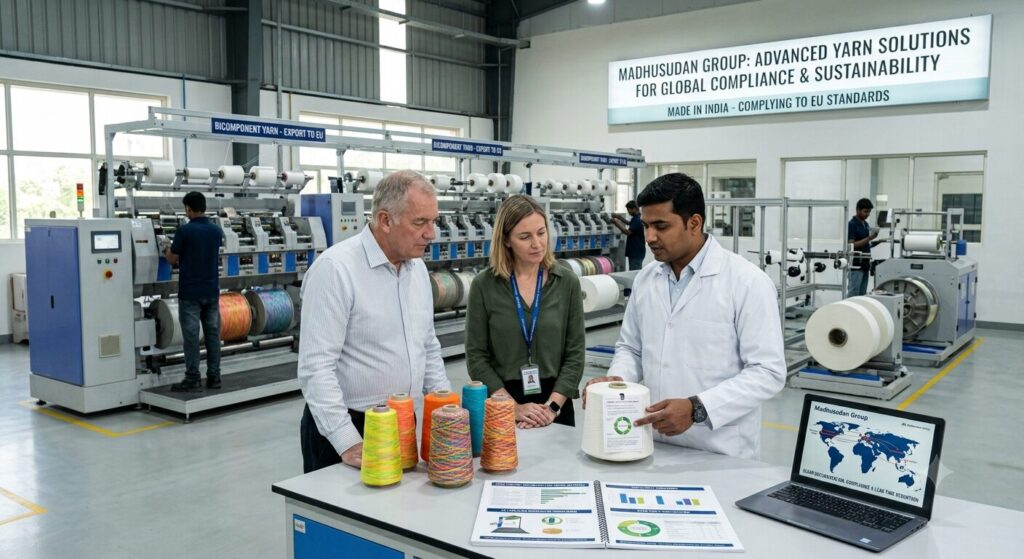
Even as Europe tightens its own regulatory standards, much of the yarn and fabric feeding European mills and brands continues to be sourced from India and other established Asian manufacturing hubs. Indian mills have invested in bicomponent yarn spinning capacity, hold internationally recognized certifications such as OEKO-TEX and GOTS, and can produce at the volumes and price point’s European brands need while still meeting EU import documentation requirements. This combination of compliance readiness and cost efficiency keeps India central to Europe’s stretch fabric supply chain.
How Madhusudan Group Supports the Market
Madhusudan Group manufactures bicomponent and elastomultiester yarn suited to the compliance and sustainability expectations of European buyers, supporting brands that need clear fiber content documentation and mono-material stretch options. For European sourcing teams navigating labelling regulation and circularity requirements, working with an experienced manufacturer that already understands these expectations reduces both compliance risk and lead time.
Future Opportunities in Europe’s Technical Textile Sector
As EU sustainability regulation matures, including expected requirements around product traceability and digital product information, demand for verifiable, mono-material stretch yarn is expected to grow further. European brands that adopt elastomultiester and bicomponent yarn early are likely to have an easier path toward compliance with upcoming disclosure and circularity rules, while also differentiating their products for increasingly sustainability-conscious European consumers.
Conclusion
Bicomponent yarn and elastomultiester are no longer niche alternatives in Europe’s textile industry — they are becoming a practical response to genuine regulatory and consumer pressure. As EU textile labelling regulation and circularity requirements continue to tighten, manufacturers and brands that adopt mechanical stretch, mono-material solutions, supported by experienced partners like Madhusudan Group, will be better positioned to meet Europe’s evolving sustainable stretch fabric standards.
FAQ Section
1. What is elastomultiester fiber and how is it used in Europe?
Elastomultiester is a polyester-based bicomponent fiber that provides mechanical stretch and recovery. In Europe it is increasingly used in denim, workwear, and technical textiles as a mono-material alternative to elastane blends.
2. Does EU textile labelling regulation apply to stretch fabric blends?
Yes. Fiber content must be declared accurately, and blends containing elastane require separate disclosure, which adds complexity that mono-material stretch yarns can help simplify.
3. Is bicomponent yarn more sustainable than spandex blends?
Bicomponent elastomultiester yarn supports mono-material fabric construction, which is generally easier to recycle than polyester-elastane blends.
4. Which European countries manufacture the most technical textiles?
Italy, Germany, Portugal, Spain, and Turkey are among the leading producers of technical and fashion textiles in the European market.
5. Why do European brands still source yarn from India?
Indian manufacturers offer scale, competitive pricing, and certifications like OEKO-TEX and GOTS that align with EU import and compliance requirements.
6. What is the EU Strategy for Sustainable and Circular Textiles?
It is a European Commission policy framework encouraging durable, repairable, recyclable, and traceable textile products across the EU market.
7. Can mechanical stretch fabric meet EU recyclability goals?
Yes, mechanical stretch fabrics built on mono-material or near-mono-material construction are generally more compatible with current recycling infrastructure than elastane blends.
8. How can I source elastomultiester yarn for a European fashion brand?
Brands can source elastomultiester and bicomponent yarn through established manufacturers such as Madhusudan Group, which supply technical documentation needed for EU compliance.