What Buyers Really Want When They Search “SYS Yarn”
A search for “SYS yarn” usually comes from someone who already knows they need a stretch yarn and is now weighing options. Increasingly, that person is also answering a second question posed by their customers: is this yarn sustainable, and can I prove it? Export buyers in Europe, North America and other regulated markets now ask about fibre composition, recyclability, chemical safety and traceability as routinely as they ask about price and delivery date.
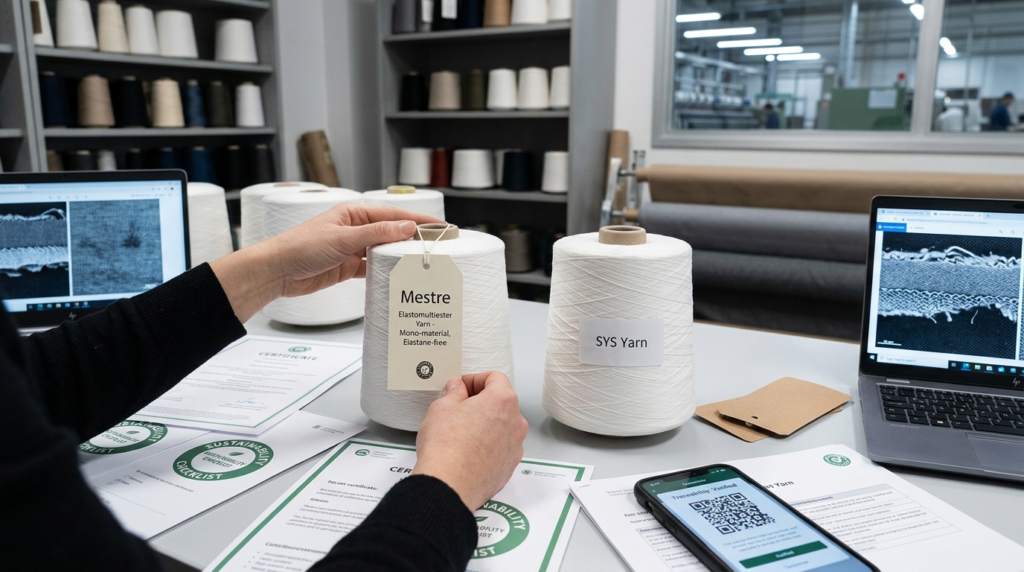
This guide addresses that second question directly. It does not attribute properties to any specific company’s “SYS” product, because names and codes are used inconsistently in the yarn trade and because sound sourcing decisions rest on documentation, not labels. Instead it explains how different stretch yarn technologies compare on recyclability, compliance and environmental profile, where the honest trade-offs lie, and how a mono-material, elastane-free option such as Mestre elastomultiester yarn can help mills answer sustainability questions with facts.
We will also be candid about limits. Sustainability claims are only useful when they are accurate, and stretch yarns involve real compromises. By the end, you should be able to judge any stretch yarn, including the one you currently use, against a clear and defensible checklist.
Why Sustainability Has Become a Sourcing Criterion
Five years ago, a mill could win an order on price, quality and lead time alone. Today, brands supplying regulated markets pass down requirements from their own customers, investors and regulators. Several forces drive this.
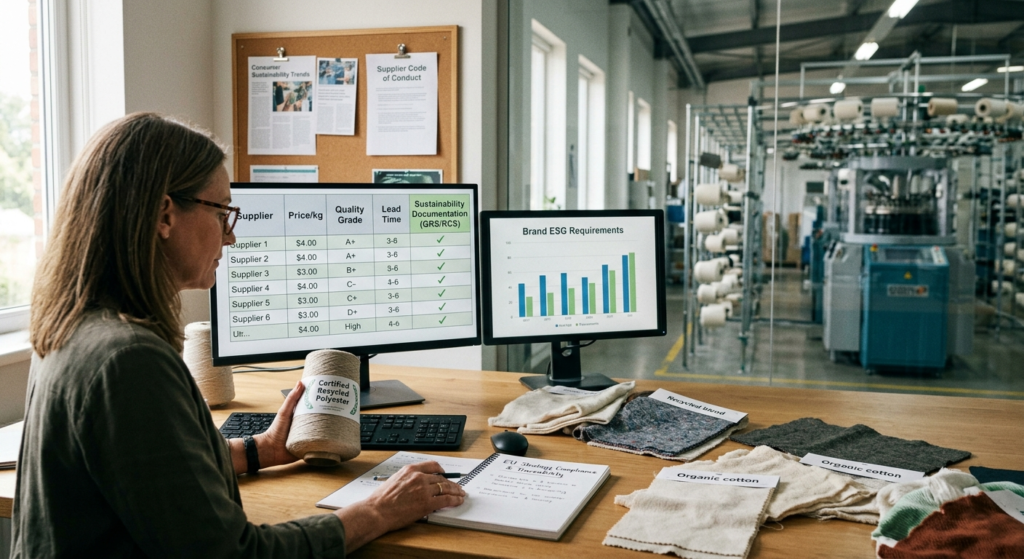
Regulation. The European Union’s textile strategy aims to make textiles longer-lived, repairable and recyclable, and to reduce the environmental footprint of the sector. You can read the official overview on the European Commission’s EU strategy for sustainable and circular textiles page. Even mills that do not sell directly into the EU feel the effect, because their customers must comply.
Retail commitments. Large brands publish targets for recycled content, restricted substances and material simplification. Those targets flow to suppliers through supplier codes of conduct and material specifications.
Consumer expectation. Shoppers increasingly read care labels and sustainability claims. Misleading claims attract scrutiny from regulators and the press.
Investor pressure. Reporting frameworks require brands to document their supply chains, which means documentation requests reach the yarn stage.
For a mill, the consequence is simple: the yarn you choose affects the sustainability story you can tell, and the documentation you can supply.
The Recycling Problem with Elastane Blends
Elastane is valuable because a small percentage produces large stretch. That same feature creates a recycling problem. A typical stretch fabric might be 95 percent polyester or cotton with a few percent elastane. In mechanical recycling, elastane is difficult to separate and can contaminate the stream. In chemical recycling, it can complicate depolymerisation. Sorting technologies and dedicated processes for blended textiles are developing, but at scale, mono-material fabrics remain far easier to recycle than blends.
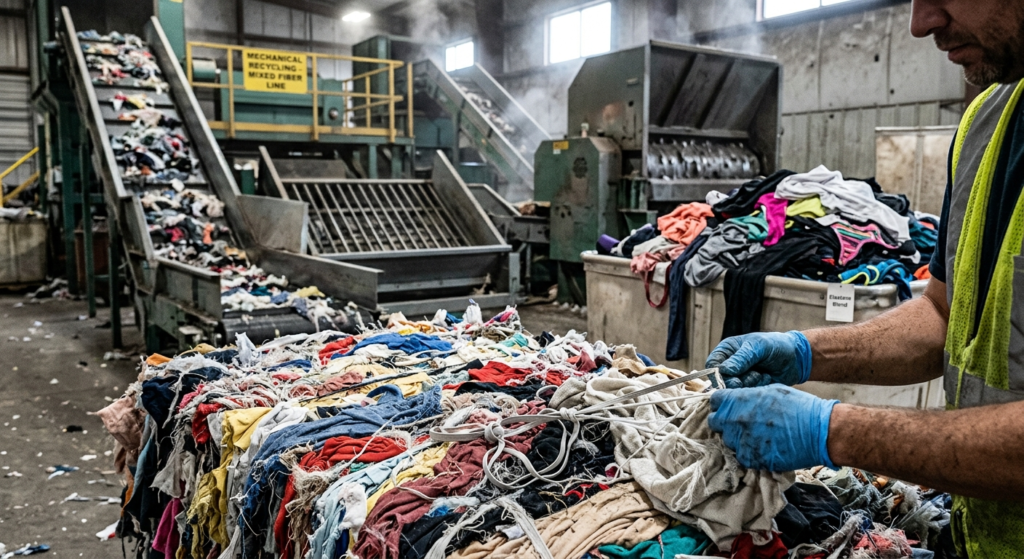
This does not make elastane a villain. It makes it a design trade-off. Where a product needs high compression, such as shapewear, medical hosiery or swimwear, elastane may be the only realistic choice. But many products use elastane simply to obtain comfort stretch, and for those, an alternative that keeps the fabric in one polymer family may be a better fit from a circularity standpoint. The Ellen MacArthur Foundation’s work on circular fashion sets out the broader case for simplified material compositions.
To understand the underlying fibres, see our guides to elastane, spandex and Lycra and the elastane vs polyester fabric comparison.
Mono-Material Polyester Stretch: How Elastomultiester Changes the Equation
Elastomultiester is a bicomponent polyester yarn. Two polyester polymers with different shrinkage behaviour are extruded side by side, and after heat-setting the filament coils permanently, producing stretch and recovery without any elastic polymer. Because the yarn is polyester throughout, a fabric made entirely from elastomultiester and other polyester yarns is a single-polymer fabric. That has several implications.
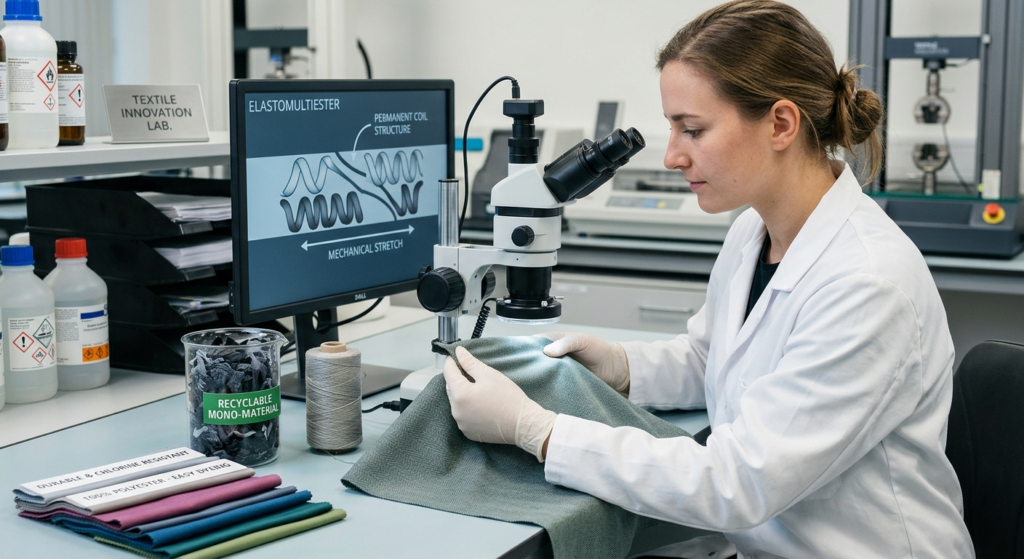
Simpler recycling pathways. A single-polymer polyester fabric is compatible with polyester recycling routes in a way that an elastane blend is not. Whether a particular garment is actually recycled depends on collection, sorting and recycler capacity, so mills should avoid promising outcomes they cannot control. What they can honestly say is that the fabric composition removes a known barrier.
Simpler dyeing. Polyester content dyes with disperse dyes in a single process. This can reduce process steps, water use and shade risk compared with routes that must accommodate two fibre families.
Durability that extends product life. Extending the life of a garment is one of the most effective sustainability measures available. Mechanical stretch resists chlorine, heat and UV better than elastane, which helps garments keep their shape longer. Read more in our elastomultiester sustainable stretch fabrics article and elastomultiester and the sustainable textile revolution.
For the technical foundations, our elastomultiester complete guide and what is elastomultiester explain how the coil forms and how the fibre is named and labelled.
Bio-Based and Partly Renewable Stretch: Understanding Sorona and PTT
Another route to a more sustainable stretch fibre is polytrimethylene terephthalate (PTT), a polyester in which part of the raw material is derived from renewable, plant-based sources. Sorona is a well-known example. PTT fibres offer soft stretch and recovery and are chemically related to polyester, which keeps them in the polyester family from a fibre-identification point of view. For an accessible overview of the chemistry, see the entry on polytrimethylene terephthalate.
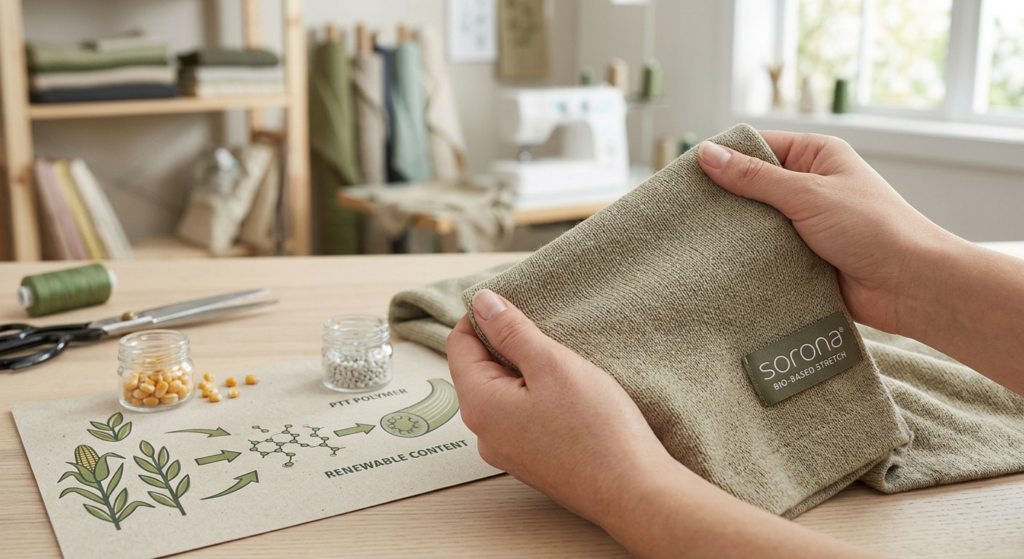
A useful mental model is this: elastomultiester and PTT-based fibres are cousins. Both create stretch through polymer structure rather than through an elastic add-in. The most important sustainability question for any of them is not the marketing label but the evidence: what percentage of the polymer is bio-based, how is that verified, and what happens at end of life? Our articles on Sorona fibre, the sustainable PTT polymer, what Sorona means and Elasterell-P, Sorona and elastomultiester compared explain how these terms relate.
Labelling and Compliance: Getting the Paperwork Right
A sustainable yarn is only helpful commercially if the paperwork supports it. Errors in labelling can create delays, claims and reputational damage.
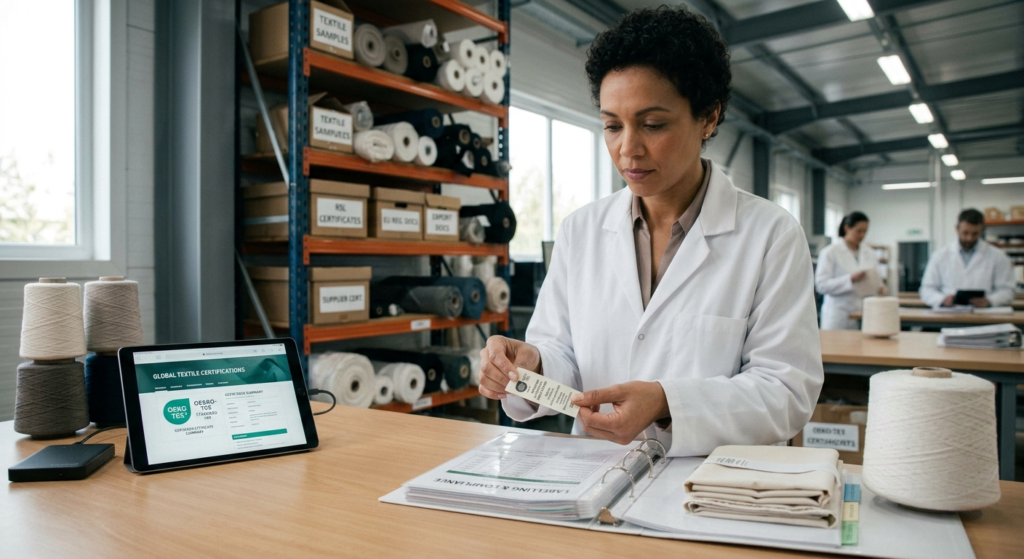
European Union. Fibre names and labelling are governed by Regulation (EU) No 1007/2011. Elastomultiester is a recognised generic fibre name under that regulation. Use it correctly on care labels and export documents.
United States. The Federal Trade Commission enforces fibre content labelling under the Textile Act. Its business guidance is available in Threading Your Way Through the Labeling Requirements. The generic name used in US practice for this class of fibre is elasterell-p.
Chemical safety. Certifications such as OEKO-TEX provide third-party assurance on harmful substances. Ask suppliers which certifications they hold, request current certificates and confirm the certificate scope covers the exact product.
Recycled and preferred materials. Standards and market reports from Textile Exchange describe recognised approaches to recycled content and preferred fibres. Where a yarn is offered as recycled, ask for chain-of-custody certification rather than accepting a verbal claim.
Green claims. Regulators in several markets are tightening rules on environmental marketing claims. Avoid vague terms such as “eco-friendly” and use specific, verifiable statements instead.
The Microplastics Question, Answered Honestly
Any discussion of polyester and sustainability must address microfibre shedding. All textile fibres shed, including natural ones, and synthetic fibres contribute to microplastic pollution when washed. This is a genuine industry-wide issue.
What can a mill do? Fabric construction, yarn structure, finishing and washing conditions all influence shedding. Continuous filament yarns generally shed less than spun yarns made of short staple fibres, because there are fewer loose ends. Filtration in washing machines and wastewater treatment can also reduce release. Mills should avoid claiming that any synthetic fabric is “microplastic free”. They can accurately say that they use continuous filament, control finishing and support testing. Our article on elastomultiester safety, breathability and microplastics gives a fuller discussion.
Export Markets: What Each Region Tends to Ask For
Requirements differ by destination, and knowing them in advance helps you present the right documents.
Europe. Buyers ask about recyclability, restricted substances and traceability, and they are conscious of upcoming regulation on product sustainability. See our Europe textile market overview.
North America. Stretch denim and performance apparel are major categories, and buyers value durability and consistency alongside sustainability credentials. See our North America stretch denim market article.
South America. Buyers focus on cost, local processing and reliable supply, while sustainability expectations are rising. See our South America textile market article and the 2026 South America bicomponent yarn market outlook.
Asia. As the centre of global textile manufacturing, Asia is both a huge market and a competitive supplier base. See our Asia textile manufacturing overview.
A Sustainability Documentation Checklist for Mills
Before you tell a customer that a stretch fabric is more sustainable, make sure you can supply the following.
- Fibre composition statement listing every yarn and its generic fibre name.
- Technical datasheet with test methods for the stretch yarn.
- Lot traceability from yarn lot to finished fabric roll.
- Chemical compliance certificates relevant to the customer’s restricted substances list.
- Recycled or bio-based content certificates, if such a claim is made.
- Process description covering dyeing route and any relevant finishing chemistry.
- Durability data such as recovery after repeated washing, since longer product life is a real environmental benefit.
- A clear statement of limits, for example that mono-material composition supports recycling but does not guarantee it.
Preparing these documents once lets you respond quickly to every enquiry, and it builds trust with buyers who are tired of vague claims.
Honest Trade-Offs
An article on sustainable stretch yarn that ignored downsides would not be worth reading. Here are the real trade-offs.
Stretch level. Mechanical stretch delivers comfort stretch, not extreme compression. If your product needs very high elongation, elastane may remain necessary, and the sustainable choice may be to use less of it or to design for longevity.
Polyester is a fossil-based polymer unless recycled or partly bio-based. Choosing polyester over natural fibres has its own environmental trade-offs, including microfibre shedding and reliance on petrochemical feedstock. Recycled polyester and bio-based PTT can reduce that dependence.
Recyclability depends on infrastructure. A recyclable composition is a necessary condition, not a sufficient one. Collection and sorting systems are still developing in many regions.
Process matters as much as fibre. Energy, water and chemical use in dyeing and finishing often dominate a fabric’s footprint. Choosing a yarn that simplifies dyeing is helpful, but so is investing in efficient processing.
Being open about these trade-offs is not a weakness. Sophisticated buyers trust suppliers who acknowledge limits and back their claims with data.
Where Mestre Fits
Mestre is the bicomponent elastomultiester brand of Madhusudan Group, a Surat-based manufacturer. It uses mechanical stretch, an inherent coil crimp, to provide permanent elasticity with good dyeability and resistance to light and heat. As a polyester yarn, it supports mono-material fabric designs and simpler dyeing routes, which are relevant when customers ask about recyclability and process simplicity.
If you are evaluating Mestre against another stretch yarn, ask for the technical datasheet, lot certificates and compliance documentation, then run a pilot on identical constructions as described in our yarn selection guide for technical textiles. To understand how Mestre compares with branded bicomponent yarns, read Mestre vs Lycra T800 and T400 and Mestre vs Sorona. For company background, see Mestre yarn by Madhusudan Group and our page on stretch yarn manufacturing in India.
Energy, Water and Chemistry: Where the Footprint Really Sits
Yarn choice is only one input into a fabric’s environmental footprint. In most textile life-cycle studies, wet processing and energy use in dyeing and finishing are major contributors, alongside raw material production. That has practical consequences for mills evaluating stretch yarns.
Dyeing route. A fabric made entirely of polyester content can be dyed with disperse dyes in a single process, typically at high temperature and pressure. Fabrics that combine polyester with elastane or with cellulosic fibres may need additional steps, such as reduction clearing or separate dyeing of components, which adds water, energy and chemical use. Fewer steps usually means fewer opportunities for shade error and reprocessing, and reprocessing is one of the most wasteful events in a dye house.
Right-first-time production. Every metre of fabric that has to be redyed or discarded multiplies its footprint. A yarn that runs consistently and dyes evenly reduces this waste. Ask your dye house for redye rates on each candidate yarn during your pilot.
Heat-setting efficiency. Mechanical stretch yarns develop their coil through heat, so the heat-setting stage deserves attention. Optimising temperature and dwell time to the minimum that achieves the target stretch saves energy, and it also protects fabric quality. Record the recipe that works and hold to it.
Water and effluent. Ask about liquor ratios, water reuse and effluent treatment at the dye house you use. These are often more influential than the fibre itself, and they are increasingly part of buyer audits.
Chemical management. Use dyes and auxiliaries that comply with your customers’ restricted substances lists, and keep safety data sheets and test reports organised. Programmes such as OEKO-TEX provide a common language for this.
The lesson is straightforward. The most sustainable stretch yarn is not always the one with the best marketing story. It is the one that lets you make a durable fabric right first time, with the least energy, water and chemistry, and that you can document.
How to Communicate Sustainability Claims Without Overreaching
A weak claim, once challenged, damages trust far more than making no claim at all. Use these rules when writing product sheets, websites and buyer presentations.

- Be specific. Say “made from 100 percent polyester elastomultiester and polyester, with no elastane” rather than “eco-friendly stretch”.
- State what you can prove. If you have certificates, cite them. If a claim depends on third-party recycling infrastructure, say so.
- Avoid absolute language. Words like “zero impact”, “biodegradable” (for polyester) or “microplastic free” are almost never accurate.
- Compare like with like. If you compare with elastane blends, be clear about the product type and the property being compared, such as recyclability of the composition or resistance to chlorine.
- Keep records. Store test reports, certificates and specifications so every claim can be traced to evidence.
- Update regularly. Standards, regulations and certificates change. Review claims at least annually.
This approach also serves search visibility. Search engines increasingly reward content that demonstrates experience, expertise and trustworthiness, as described in Google Search Central’s guidance on creating helpful, reliable content. Specific, evidence-backed statements read as more credible to both buyers and search systems than generic green slogans.
An Illustrative Scenario: A Denim Mill Reviewing Its Stretch Yarn
To make the framework concrete, consider a hypothetical mid-sized denim mill exporting to Europe. The mill currently uses an elastane core-spun yarn in the weft of its stretch denim. Its European customer has asked for a fibre composition that is easier to recycle and for stronger evidence of durability after industrial washing.
The mill’s technical team defines requirements: comfort stretch at a defined percentage, low growth after repeated washing, and no increase in defect rate. They shortlist a mechanical stretch polyester yarn as an alternative and request a datasheet and lot certificates. They weave identical fabrics with the existing yarn and the candidate, using the same construction, then finish and wash them identically.
Finished-fabric testing compares stretch, growth after repeated washes, shrinkage and colour fastness. The team also records machine stoppages, second-grade percentage and dye house redye rates. If the candidate meets the stretch and growth targets, the mill can calculate cost per metre of first-quality fabric and, where the product allows, present the customer with a composition that supports their recyclability goals. If it falls short on stretch, the mill learns that its product needs a different approach, perhaps a blend or a redesigned construction, without having committed to bulk.
This scenario is illustrative, not a promised outcome. Its point is the process: define, document, test and calculate. The same process works for hosiery, sportswear and workwear, and you can read product-specific guidance in our articles on bicomponent yarn for sportswear and mechanical stretch yarn for workwear and PPE.
Frequently Asked Questions
Is SYS yarn sustainable?
Sustainability depends on composition, process and evidence, not on a name. Ask for the fibre composition, certifications and test data for the specific product.
Is elastomultiester recyclable?
It is a polyester, so fabrics made entirely of polyester content are compatible with polyester recycling routes. Actual recycling depends on collection, sorting and recycler capacity.
Is elastomultiester better than elastane for the environment?
It depends on the product. For comfort stretch, a mono-material polyester fabric avoids the recycling problem elastane blends create. For high-compression products, elastane may be needed. Durability and process impact also matter.
Does polyester shed microplastics?
All fabrics shed fibres. Continuous filament yarns tend to shed less than staple-fibre spun yarns, and construction, finishing and washing all influence the amount. No synthetic fabric is microplastic free.
What certificates should I ask a stretch yarn supplier for?
Ask for a technical datasheet, lot certificates of analysis, chemical safety certificates such as OEKO-TEX where relevant, and chain-of-custody documents for any recycled or bio-based claim.
Where can I learn more about mechanical stretch?
Start with our mechanical stretch meaning and examples and mechanical stretch everything guide.
Conclusion: Make Sustainability a Documented Fact
“SYS yarn” may be your starting search, but a defensible sustainable sourcing decision rests on evidence: fibre composition, recyclability, chemical compliance, durability and honest disclosure of trade-offs. Mono-material, elastane-free stretch yarn is a credible option for products that need comfort stretch, and it can simplify dyeing and improve the recyclability story. It is not a universal replacement, and the best suppliers will say so. To explore an elastane-free option built on mechanical stretch, request Mestre samples and documentation and test them against the checklist above.