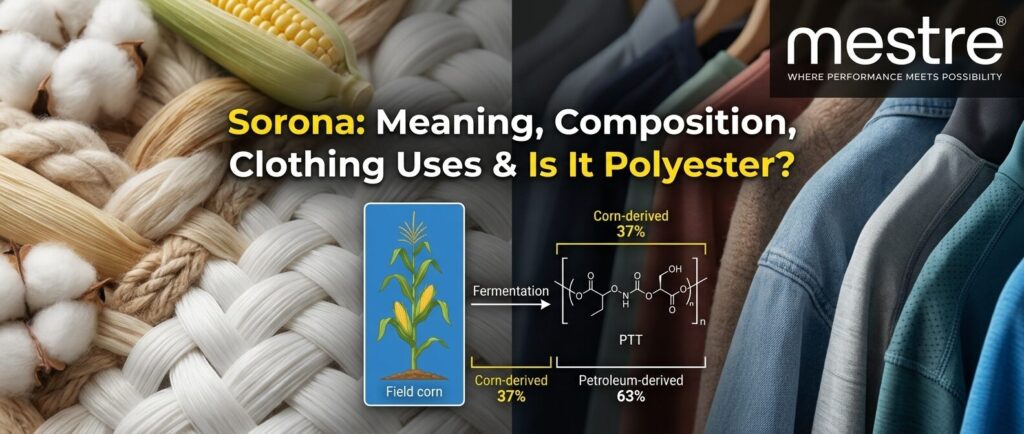
If you have shopped for activewear, stretch denim, or an eco-friendly jacket in the last few years, chances are you have seen the word “Sorona” printed on a care label. It sits next to words like “cotton,” “elastane,” or “recycled polyester,” yet most shoppers have no idea what it actually is. Is it plastic? Is it plant-based? Is it just another marketing term for polyester?

This guide answers all of that in one place. We will cover what Sorona means, how it is made, what it is made of, whether it legally and chemically qualifies as polyester, and where you will find it in your closet. By the end, you will be able to read a Sorona label with the same confidence you read “100% cotton.”
What Is Sorona?
Sorona is the brand name for a high-performance textile fiber built from a polymer called PTT, short for polytrimethylene terephthalate. It was developed and commercialized in the early 2000s and is now produced and marketed by CovationBio, a materials company that carries forward decades of fiber-science work originally started at DuPont.

What makes Sorona different from ordinary synthetic fibers is that part of its raw material comes from plants rather than petroleum. Roughly a third of the polymer’s building blocks are derived from renewable plant sugar, typically extracted from field corn, through a fermentation process rather than traditional petrochemical refining. The rest of the polymer still relies on a petroleum-based component, which is why Sorona is best described as a “partially bio-based” fiber rather than a fully plant-based one.
This hybrid nature is the whole story of Sorona in a nutshell: it borrows the performance characteristics people expect from synthetic stretch fibers, while reducing the fossil-fuel footprint typically associated with making them.
If you want the deeper technical breakdown of how this polymer is engineered and who manufactures it, our earlier piece on what Sorona fiber is, who makes it, and why it matters walks through that in detail.
Sorona Meaning: Where Does the Name Come From?
A lot of people searching “Sorona meaning” expect some clever acronym or Sanskrit-style etymology. The reality is more practical. Sorona is a coined brand name, created the way many fiber trademarks are to be short, easy to pronounce globally, and free of any prior trademark conflicts. It does not stand for anything, nor is it derived from a Latin or scientific root word.
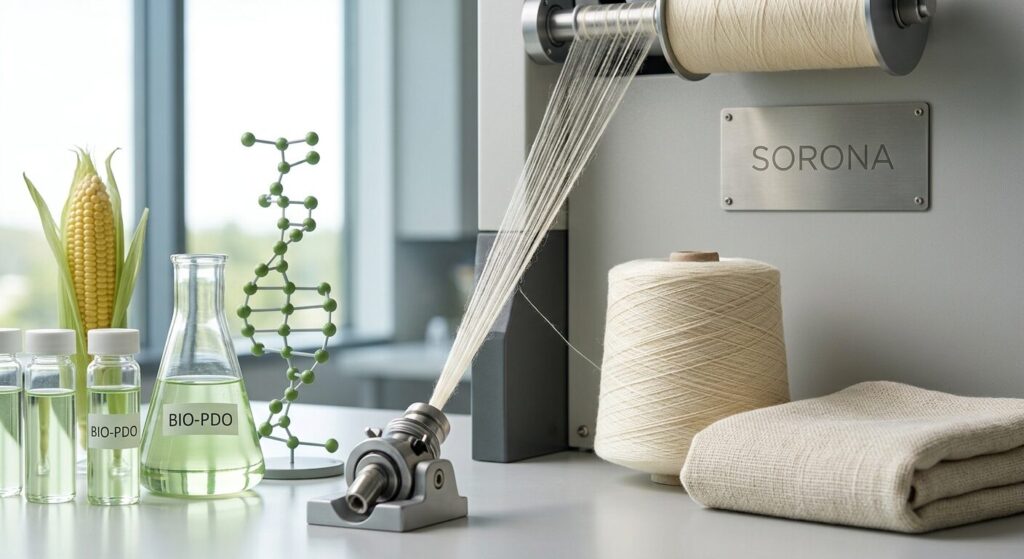
What “Sorona” refers to, in practice, is not a single fiber type but an entire family of products built on the same PTT polymer platform. Depending on the end use, you will see it marketed under related names such as Sorona® fiber for apparel, Sorona® EP for engineered plastics, and other application-specific variants. All of them share the same core chemistry: a polymer partly derived from plant-based 1,3-propanediol (commonly abbreviated Bio-PDO) combined with a petroleum-derived acid component.
So when someone asks “what does Sorona mean,” the honest answer is: it is simply the registered name for DuPont-originated, now CovationBio-produced, bio-based PTT fiber technology. The meaning lives in the chemistry and performance, not in the word itself.
How Sorona Fiber Is Made
Understanding the manufacturing process makes the rest of this article composition, sustainability claims, polyester comparisons much easier to follow.
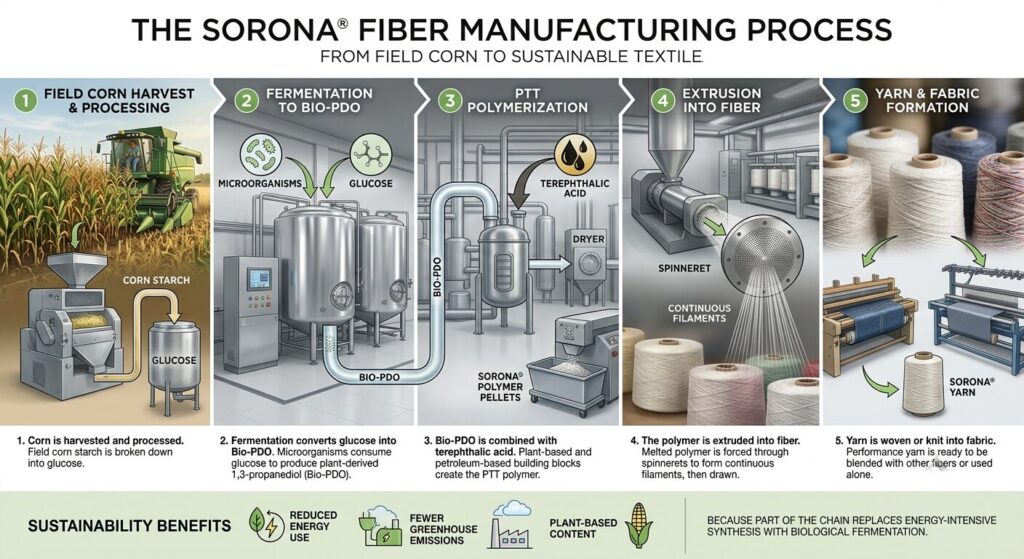
- Corn is harvested and processed. Field corn (dent corn, mostly grown for industrial use, not sweet corn for eating) is harvested and its starch is broken down into glucose.
- Fermentation converts glucose into Bio-PDO. Specially engineered microorganisms consume the glucose in large fermentation tanks, similar in principle to how yeast ferments sugar into alcohol. The output of this step is 1,3-propanediol, or Bio-PDO, a plant-derived chemical building block.
- Bio-PDO is combined with terephthalic acid. This is the petroleum-based half of the equation. When Bio-PDO reacts with terephthalic acid (or a related compound), the result is the PTT polymer the raw material that becomes Sorona.
- The polymer is extruded into fiber. Like most synthetic fibers, the polymer is melted and forced through spinnerets to form continuous filaments, which are then drawn, textured, and spun into yarn.
- Yarn is woven or knit into fabric. From there it behaves like any other performance yarn, ready to be blended with cotton, nylon, spandex, or used on its own.
Because part of this chain replaces energy-intensive chemical synthesis with a biological fermentation step, the overall production process is reported to use less energy and generate fewer greenhouse gas emissions compared with making nylon from scratch. That efficiency gain is one of the main reasons brands market Sorona as an eco-conscious alternative to conventional synthetics.
Sorona Fabric Composition
This is where a lot of confusion happens, so let’s be precise.
Sorona fiber is not 100% plant-based. The commonly cited figure is that roughly 37% of the polymer’s mass comes from renewably sourced, plant-derived material (the Bio-PDO component), while the remaining majority is still petroleum-derived (the terephthalic acid or a related monomer).
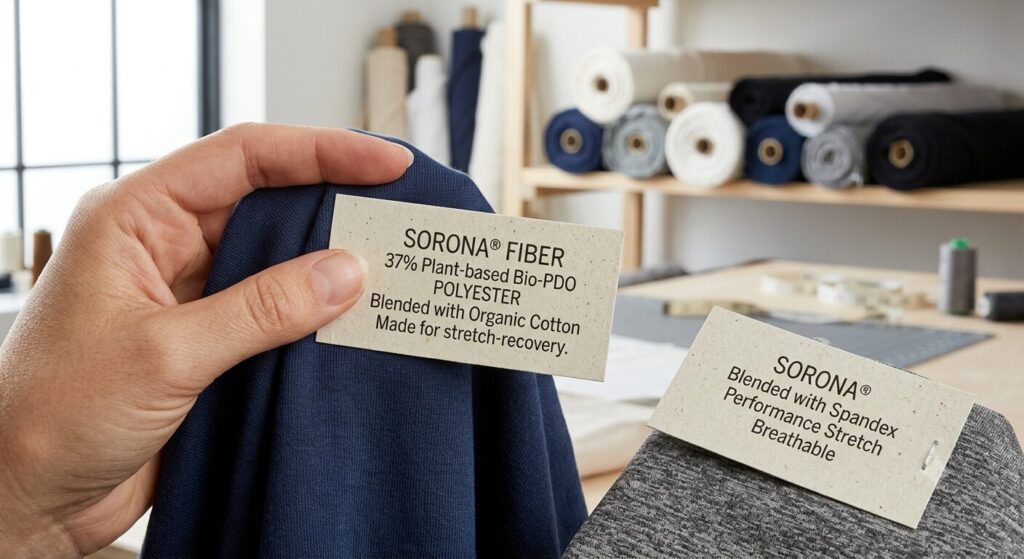
In terms of chemical family, Sorona belongs to the polyester group of fibers, specifically the PTT sub-category. Some manufacturers also use the generic industry term “triexta” to describe PTT fibers like Sorona, positioning it as a distinct fourth major synthetic fiber category alongside nylon, polyester, and acrylic though from a pure chemistry standpoint, PTT is still structurally a type of polyester.
When you see a garment tag listing “Sorona” as part of the fiber content, it usually appears in a blend such as:
- Sorona / cotton blends for soft, stretch-recovery casualwear
- Sorona / spandex blends for activewear and swimwear
- Sorona / nylon blends for outerwear and performance fabrics
- 100% Sorona fabrics for insulation fill and some home textile uses
For a side-by-side look at how Sorona’s chemistry compares with a related fiber category, our article on Elasterell-P Sorona vs. Elastomultiester breaks down the composition differences in more technical detail.
Is Sorona Polyester?
Short answer: yes, chemically speaking, Sorona is a member of the polyester family but it is not the same as the conventional polyester (PET) used in most fast-fashion clothing.
Here is the distinction that matters:
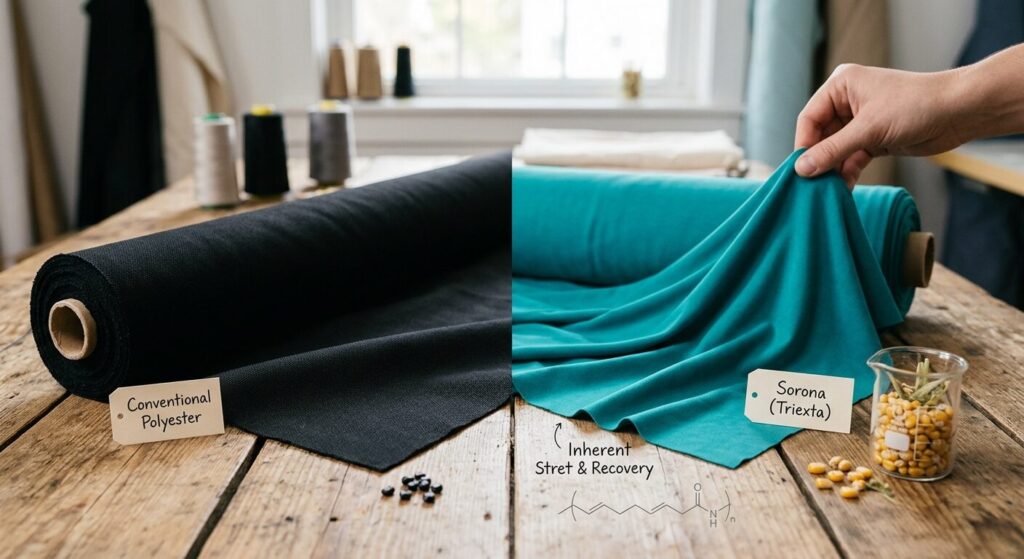
- Conventional polyester (PET) is made almost entirely from petroleum-derived ingredients through standard chemical synthesis.
- Sorona (PTT) shares the same general polyester backbone chemistry as PET, but roughly a third of its raw material is swapped out for a plant-derived component made through fermentation.
Because of this structural similarity, Sorona is technically classified as a polyester variant, and it can even be recycled through some standard polyester recycling streams. However, the industry markets it separately often under the “triexta” label because its physical performance differs from ordinary polyester in a few important ways:
- Better inherent stretch and recovery. Sorona’s molecular structure has a natural spring-like, zigzag arrangement, which gives it stretch and shape recovery without needing added spandex in some applications.
- Softer hand-feel. Fabrics made from Sorona tend to feel noticeably softer against the skin than standard polyester.
- Lower-temperature dyeing. Sorona fabrics can often be dyed and heat-set at lower temperatures than conventional polyester, which also reduces energy use during finishing.
- Resistance to UV and chlorine damage. This makes it a popular choice for swimwear and outdoor gear.
So if someone asks “is Sorona polyester,” the accurate answer is: yes, it is a polyester-family fiber (PTT), but it is a partially bio-based, higher-performance variant not identical to the plain polyester in a basic t-shirt.
If you are comparing Sorona directly against another well-known DuPont-originated stretch fiber, our breakdown of Mestre vs. Sorona DuPont stretch yarn is a useful next read.
Sorona Material: Key Properties
Beyond the sustainability angle, brands choose Sorona material because of how it performs in real garments. Here are the properties most frequently cited:

- Exceptional stretch and recovery. Garments bounce back to shape after stretching, resisting bagging at the knees or elbows.
- Durability. Sorona resists wear from repeated washing and abrasion better than many lightweight synthetics.
- Softness. It is frequently compared favorably to fibers like cotton or modal in terms of hand-feel, while retaining synthetic-level durability.
- Crease and wrinkle resistance. Fabrics hold their shape and resist wrinkling, which is useful for travel clothing and workwear.
- Colorfastness and UV resistance. Colors stay vibrant longer, even with sun exposure, making it popular for outdoor and swim fabrics.
- Insulating capability. In its fiberfill form, Sorona is used as an insulation material in jackets, similar in function to down but without animal-derived material.
Sorona Clothing: Where You’ll Find It

Sorona shows up across a surprisingly wide range of clothing categories, usually blended with another fiber rather than used alone:
Activewear and athleisure: Leggings, joggers, and performance tops use Sorona blends for stretch recovery that survives repeated washing and movement.
Denim and casualwear: Stretch jeans and chinos use small percentages of Sorona to add comfort-stretch without the fabric losing its shape over a day of wear.
Swimwear: Its resistance to chlorine and UV degradation makes it a durable choice for swim fabrics that need to hold color and elasticity season after season.
Outerwear and insulated jackets: Sorona fiberfill is used as a lightweight, packable insulation alternative to down.
Suiting and workwear: Wrinkle resistance and shape retention make Sorona blends useful in tailored clothing that needs to look sharp through a long workday.
Home textiles and carpet: Beyond apparel, Sorona polymer is also used in carpet fiber and upholstery fabric, where its durability and stain resistance are valued.
For a broader look at how this fits into the wider fabric ecosystem DuPont has built over the decades, see our article on where nylon, Lycra, and Sorona live today within DuPont’s textile legacy.
Sorona vs. Conventional Fibers: A Quick Comparison
| Feature | Sorona (PTT) | Conventional Polyester (PET) | Nylon |
|---|---|---|---|
| Bio-based content | ~37% plant-derived | 0% (fully petroleum-based) | 0% (fully petroleum-based) |
| Natural stretch | High, spring-like recovery | Low, usually needs added spandex | Moderate |
| Softness | Soft hand-feel | Can feel harsher | Smooth but less soft |
| Dyeing temperature | Lower than standard polyester | Higher | Lower than polyester |
| UV/chlorine resistance | High | Moderate | Lower |
| Recyclability | Compatible with some polyester recycling streams | Widely recyclable | More limited recycling infrastructure |
Is Sorona Sustainable?
This is the question behind most of the marketing you’ll see around Sorona, so it deserves an honest answer.
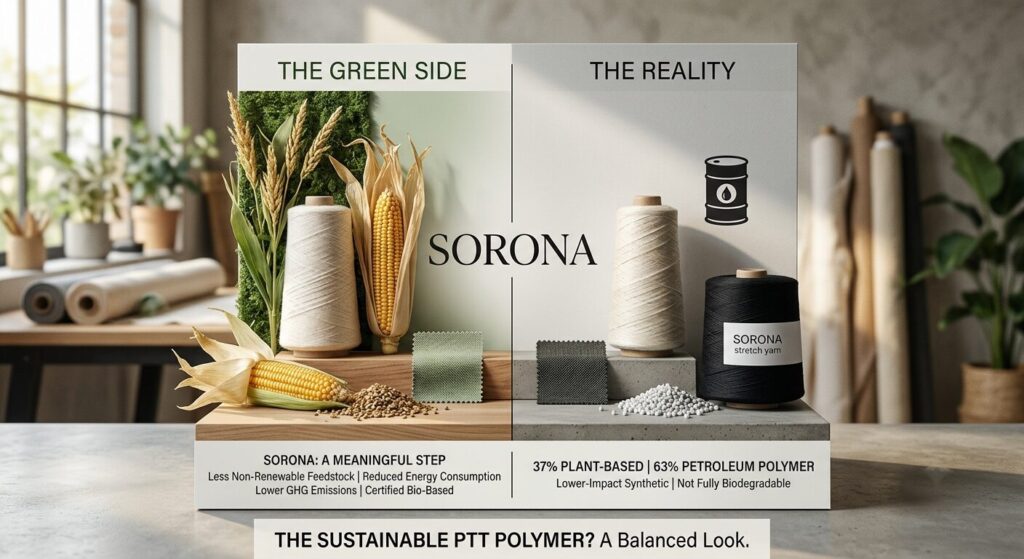
Sorona is more sustainable than fully petroleum-based fibers in several measurable ways: it uses less non-renewable feedstock, the production process is reported to consume less energy, and it generates fewer greenhouse gas emissions compared with manufacturing nylon. It has also been recognized under government bio-based product certification programs and industry sustainability awards.
That said, “37% plant-based” also means 63% of the polymer still comes from petroleum. Sorona is a meaningful step toward reducing fossil-fuel dependency in textiles, not a fully renewable or biodegradable material. It is best understood as a lower-impact synthetic rather than a natural fiber substitute. For readers evaluating sustainable stretch yarns for sourcing decisions, our detailed piece on Sorona fiber as the sustainable PTT polymer powering modern stretch yarn goes deeper into the environmental data behind these claims.
Sorona in the Bigger Picture of Synthetic Fiber Innovation
To really appreciate why Sorona matters, it helps to zoom out. The textile industry has relied on petroleum-based fibers for the better part of a century because they are cheap, durable, and consistent to manufacture at scale. Cotton and wool, while natural, come with their own resource costs water-intensive irrigation, land use, and seasonal supply variability. Sorona was developed to sit between these two worlds: it keeps the consistency and performance advantages of a lab-engineered polymer while trimming down the amount of non-renewable material required to make it.
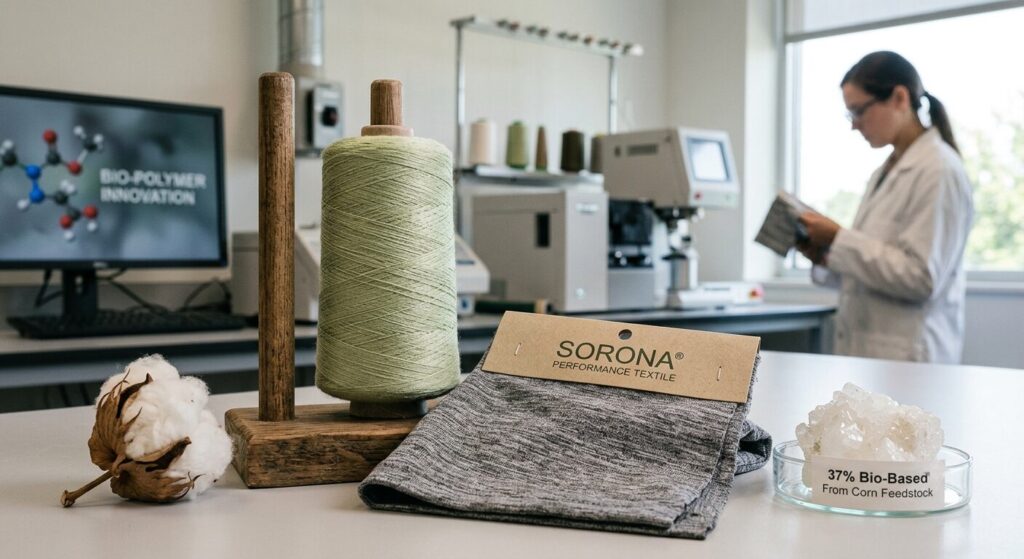
This is also why Sorona is frequently discussed alongside other bio-based innovation in the fiber space, rather than being treated as a one-off product. It is part of a broader shift in which textile manufacturers are experimenting with partially renewable feedstocks for nylon alternatives, recycled polyester blends, and next-generation elastane replacements. Sorona was one of the earlier commercially successful examples of this shift to reach mainstream apparel shelves, which is part of why it still gets referenced as a benchmark when new bio-based fibers are introduced.
Common Misconceptions About Sorona

Because Sorona sits at the intersection of “plant-based” marketing and “synthetic fiber” chemistry, a few misconceptions come up repeatedly:
“Sorona is 100% plant-based.” As covered above, this is not accurate. Only a portion of the polymer commonly cited around 37% by mass comes from renewable plant sugar. The rest remains petroleum-derived.
“Sorona and spandex are the same thing.” They are not. Spandex (elastane) belongs to a different polymer family entirely and is prized for very high stretch percentages, often used in small amounts within a blend. Sorona provides more moderate, built-in stretch recovery and is often used as the primary fiber in a fabric rather than a small stretch additive.
“Triexta and polyester are unrelated categories.” In marketing language, triexta is often positioned as its own distinct fiber family, separate from polyester. Chemically, however, PTT (which triexta describes) is still part of the broader polyester family it simply has a different molecular backbone structure than standard PET polyester, which is what gives it different stretch and recovery behavior.
“Sorona clothing feels like plastic.” This misconception likely comes from assumptions about synthetic fibers in general. In practice, Sorona is specifically engineered for a soft hand-feel, and many blends are marketed precisely because they feel closer to natural fiber softness than typical polyester.
How Sorona Fits Into a Brand’s Sourcing Strategy
For apparel brands and textile buyers, Sorona is often chosen not purely for its sustainability story but because it solves practical sourcing problems. Fabric mills like it because it can be dyed at lower temperatures, which cuts processing costs and energy bills. Designers like it because it holds shape through repeated wear without requiring heavy spandex content, which can degrade faster than the base fabric. Retailers like it because garments retain their fit and color after multiple wash cycles, reducing return rates tied to fabric failure.
From a labeling and marketing standpoint, brands also benefit from being able to point to third-party recognitions and bio-based certification programs when describing Sorona-containing products, which supports sustainability claims made on hang tags and product pages provided those claims are phrased accurately as “partially bio-based” rather than “fully renewable.”

How to Care for Sorona Fabric
Because Sorona behaves similarly to other polyester-family synthetics, care is straightforward:
- Machine wash in cold or warm water, not hot, to preserve elasticity and color.
- Avoid high-heat drying; tumble dry on low or air dry when possible.
- Skip fabric softener on stretch blends, as it can reduce moisture-wicking performance over time.
- Iron on a low setting if needed Sorona’s built-in wrinkle resistance usually means ironing is rarely necessary.
Frequently Asked Questions
Is Sorona the same as spandex or elastane? No. Spandex and elastane are a different fiber category (polyurethane-based) known for extreme stretch percentages. Sorona provides moderate, durable stretch recovery on its own and is sometimes blended with spandex for garments that need maximum stretch.
Is Sorona vegan? Yes, Sorona does not use any animal-derived materials, which is why it is often used as a fill alternative to down insulation.
Does Sorona shrink? Like most polyester-family fabrics, Sorona has good shape and size stability and is less prone to shrinking than natural fibers such as cotton, provided care instructions are followed.
Is Sorona biodegradable? No. While part of its feedstock is plant-derived, the finished polymer behaves like a standard synthetic fiber and is not biodegradable in the way natural fibers are. Its sustainability advantage comes from renewable sourcing and lower-emission manufacturing, not from compostability.
How can I tell if a garment contains Sorona? Check the fabric content label. Sorona is a trademarked fiber name, so manufacturers using it are required to disclose it by name rather than lumping it into generic “polyester” content.
Final Thoughts
Sorona sits in an interesting middle ground in the textile world: chemically a polyester, but engineered with roughly a third plant-based content and performance advantages that set it apart from ordinary synthetic fabric. It is not a fully natural or biodegradable material, but it represents a genuine, measurable step toward lower-impact synthetic textile production without sacrificing the stretch, softness, and durability that shoppers expect from performance fabric.
Whether you’re evaluating it for activewear, denim, swimwear, or insulated outerwear, understanding this balance part plant, part petroleum, fully engineered for performance is the key to reading any Sorona label with confidence.
For more on how Sorona compares to related fiber technologies and where it fits in the broader fabric landscape, explore our related guides on Sorona fabric and Sorona fiber explained.