Quick answer: “Bey yarn” is a short, brand-style search phrase that does not point to one universally recognised product, so the safest way to treat it is as a stretch yarn that must be identified, tested and compared before you buy it. This guide explains what the phrase may refer to, how modern stretch yarns work, where they are used, and how to source a dependable spandex-free option such as Mestre® bicomponent yarn from Madhusudan Group.
If you only need the lab protocol, jump straight to our detailed Bey yarn testing and evaluation guide. If you want the bigger picture, keep reading.
1. Introduction: why people search for “Bey yarn”
Every season, buyers at fabric mills, garment factories and trading houses receive a new name from a supplier, a customer or a trade show contact. The name is short, it sounds like a product line, and the first question is always the same: what exactly is it? Bey yarn is one of those names.
A quick search for the phrase returns a mixed bag. Some results relate to hobby craft listings, some to unrelated brands, and a few to industrial stretch yarn conversations. That mix is a signal that the term is not a standardised textile designation like “nylon 6”, “polyester DTY” or “elastomultiester”. For an industrial buyer, an ambiguous name is not a problem in itself. It simply means the due diligence has to start one step earlier: before you compare price, you compare identity.
This article is built for three kinds of readers. The first is the procurement manager who has been offered “Bey” yarn and needs to know what questions to ask. The second is the technical manager at a weaving or knitting mill who wants to understand how the stretch is created and whether it will survive dyeing and finishing. The third is the brand or sourcing agent who wants a spandex-free, recyclable alternative and needs a credible manufacturer in India.
By the end you will understand the main families of stretch yarn, the science behind coil-crimp stretch, the applications where each family performs best, the quality parameters that matter, and the reasons a growing number of mills are moving toward spandex-free solutions from specialists such as Mestre®.
2. What does “Bey yarn” actually mean?
Let us be direct about what is known and what is not. There is no international standard, ISO designation or generic fibre name called “Bey yarn”. Textile naming works in three layers. The first layer is the generic fibre family, such as polyester, nylon, cotton or elastane. The second is the construction, such as filament, textured, air-jet, core-spun or bicomponent. The third is the brand or trade name that a company attaches to its own product, such as the many registered names you see on yarn labels and swing tags.

“Bey” most likely sits in the third layer, a brand-style label. It may belong to a specific supplier, a regional product line or a short code used inside a mill. Without a written specification from the party that uses the name, nobody can honestly tell you its polymer, denier, shrinkage or stretch behaviour. That is why we avoid inventing specifications for it, and why you should be cautious of any website that does.
Three questions that resolve the ambiguity
When someone offers you Bey yarn, ask for these three items in writing:
- The exact product name and product code, including denier and filament count.
- The polymer system, for example polyester, nylon, polyester/PTT bicomponent or an elastane-containing construction.
- A technical data sheet that states the test methods used for every number on it.
With those three items you can place the yarn in the right family and begin a fair comparison. The same discipline applies to similar short names that buyers search for, such as the ones discussed in our Hey yarn buyer’s guide and our explanation of SYS yarn.
Why a naming gap is a risk for mills
Stretch yarn is a performance material. If the identity of the yarn is unclear, so is the process window. A yarn that contains a spandex core needs different feeding tension and lower heat exposure than a bicomponent polyester yarn. A yarn that relies on false-twist texturing behaves differently again in dyeing. A mill that guesses wrong can spend weeks and many kilograms of material before discovering that the fabric is narrow, bagging or streaky.
3. The main families of stretch yarn
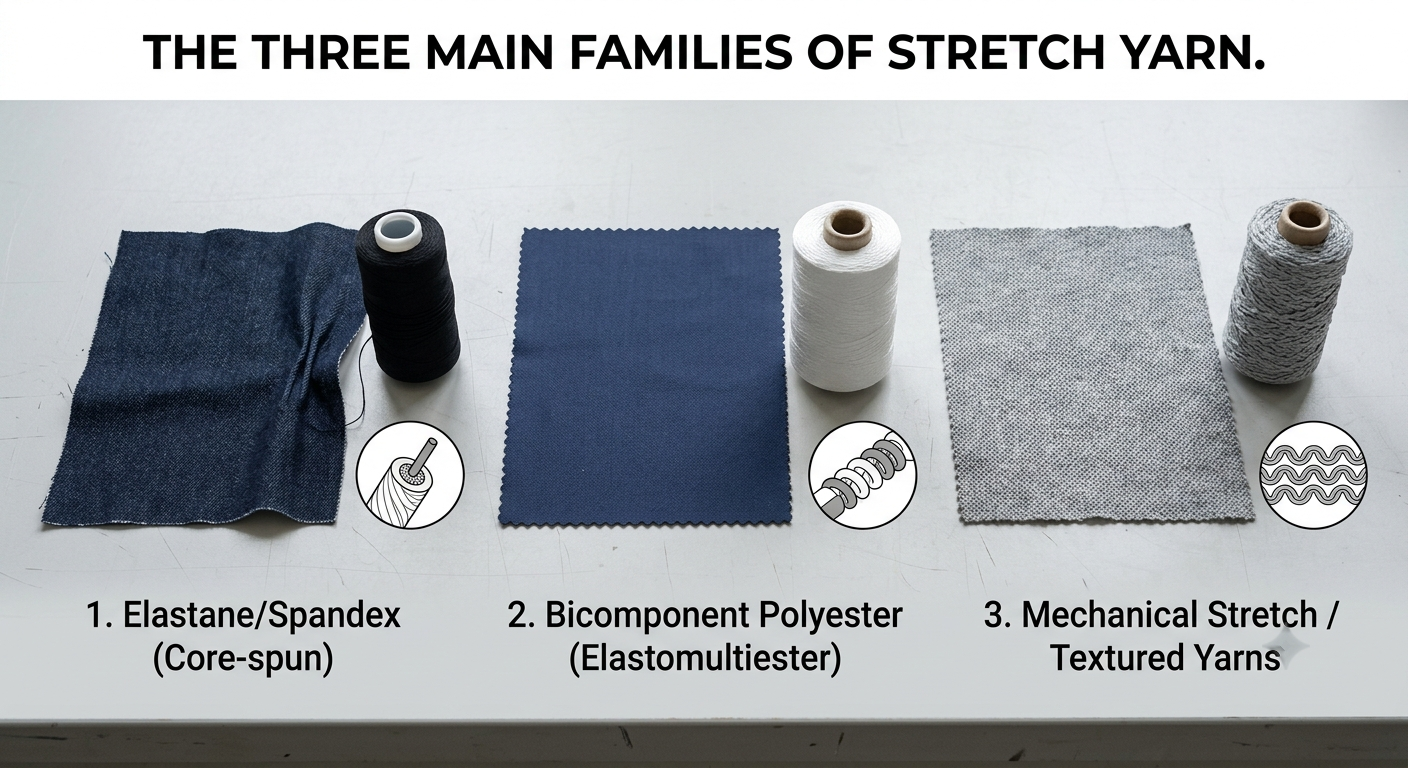
Most stretch yarns used in woven and knitted fabrics fall into one of three families. Knowing which one a supplier means is the first step in understanding any new name, including Bey.
3.1 Elastane-containing yarns
Elastane, also sold as spandex or under the Lycra brand, is a polyurethane-based elastic filament. It can stretch several times its length and snap back, which is why it has dominated stretch apparel for decades. Background on the polymer is available on Wikipedia’s spandex page. In practice elastane is rarely used alone. It is wrapped, covered or core-spun with a hard yarn such as polyester, nylon or cotton so that the fabric has a stable surface and the elastic filament is hidden.
The strengths of elastane are very high stretch and very high recovery at low weight percentages. The trade-offs are sensitivity to heat and chlorine, a tendency to yellow or degrade with age, extra process control during feeding and heat setting, and difficulty in recycling because the elastic and hard components are fused together in the same yarn. For a plain-language explanation, read our guide to elastane, spandex and Lycra.
3.2 Bicomponent polyester yarns (elastomultiester)
Bicomponent yarns are made by extruding two polymers side by side in the same filament. The two sides shrink and relax at different rates, so when the yarn is heated and relaxed it curls into a spiral, much like a coiled spring. The fabric then stretches because millions of these tiny springs extend and recover.
The most common pairing is polyethylene terephthalate (PET), the same polymer described on Wikipedia’s PET page, combined with a second polyester grade, often poly(trimethylene terephthalate), known as PTT and summarised on Wikipedia’s PTT page. Because both sides are polyester, the finished yarn dyes with disperse dyes, tolerates chlorine and heat far better than elastane, and can in principle be handled as a single polymer stream at end of life. The trade name for the category in many markets is elastomultiester. Our complete guide to elastomultiester answers the 20 questions buyers ask most often, and the bicomponent yarn complete guide goes deeper into structure and processing.
3.3 Mechanical stretch and textured yarns
Mechanical stretch is created by physically deforming the yarn rather than by adding an elastic polymer. False-twist texturing, air-jet texturing and certain knitting or weaving constructions store stretch in the geometry of the yarn or fabric. The result is a softer, moderate stretch that suits many everyday garments. See the mechanical stretch fabric guide for a clear overview.
3.4 How to place Bey yarn in this map
If the supplier of Bey yarn tells you it contains a spandex core, you are in family one. If it is a two-component polyester filament that curls after heat treatment, you are in family two. If the stretch is created by texturing or fabric construction only, you are in family three. Once you know the family, the rest of this guide tells you what to test and what to expect.
4. The science of coil-crimp stretch
Understanding why bicomponent yarn stretches helps you avoid most of the common mistakes in processing. The following explanation is simplified but accurate.
4.1 Two polymers, one filament
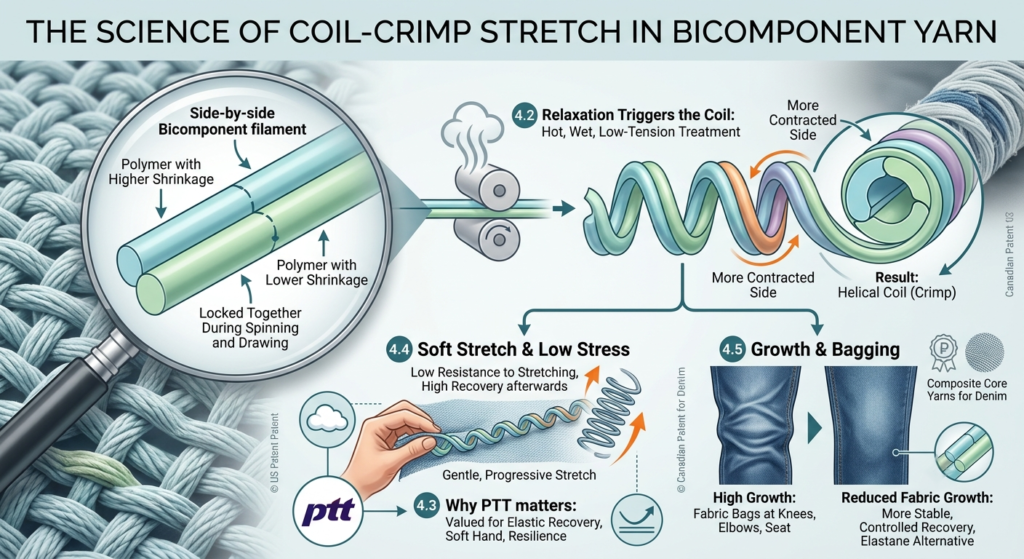
In a side-by-side bicomponent filament, one half is a polymer with higher shrinkage tendency and the other half has lower shrinkage tendency. While the filament is being spun and drawn, both halves are locked together. They share a single boundary along the full length of the filament, which is why they cannot separate easily in use.
4.2 Relaxation triggers the coil
When fabric made from the yarn goes through hot, wet, low-tension relaxation, the more shrinkable half contracts more than the other half. The filament cannot stay straight because one side wants to become shorter. It bends, and since the effect is uniform along the length, it forms a helix. Industry literature on PTT/PET bicomponent staple, such as the example in this US patent on stretch spun yarn, describes how the stretch properties depend largely on the PTT portion and how crimp is measured after treatment.
4.3 Why PTT matters
PTT is valued in stretch applications for its elastic recovery, soft hand and resilience. Technical references from sewing thread specialists such as Amann’s materials knowledge hub note PTT’s high elasticity, durability and a melting point of roughly 225 degrees Celsius. That melting point is lower than the heat tolerance of some other polyesters but is still comfortably above normal dyeing and heat-setting temperatures when the process is correctly controlled.
4.4 Soft stretch and low stress
Patent literature on soft stretch yarns, for example the Canadian patent summary on soft stretch yarns, highlights two properties that determine wearer comfort: low resistance to stretching and high recovery afterwards. Fabric that feels tight at small movements is rarely comfortable, even if its peak stretch number looks impressive. A good bicomponent yarn gives a gentle, progressive stretch.
4.5 Growth and bagging
Growth is permanent lengthening after repeated stretching. A stretch fabric with high growth bags at knees, elbows and seat. Research on composite stretch yarns for denim, such as this patent on composite core yarns, discusses the use of PTT/PET bicomponent as an elastane alternative specifically to reduce fabric growth while maintaining stretch. This matches what many denim mills report: bicomponent stretch tends to bring a more stable, controlled recovery.
5. Bey yarn, spandex and bicomponent: a practical comparison
The table below compares the three families on the criteria that decide real mill outcomes. It is intentionally general. Treat Bey yarn as belonging to whichever column its supplier’s data sheet indicates.
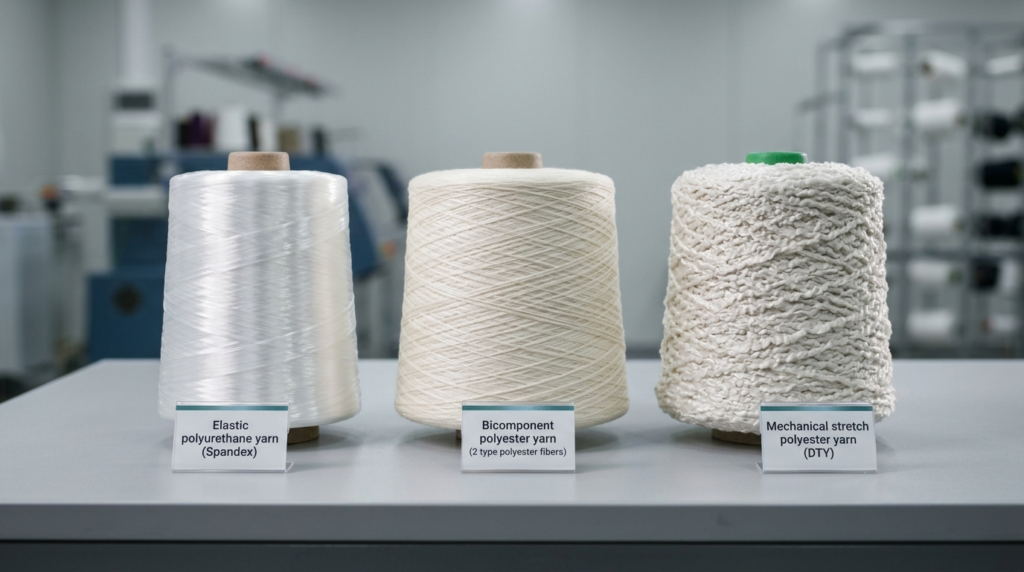
| Criterion | Elastane-containing yarn | Bicomponent polyester (Mestre®) | Mechanical stretch yarn |
| Stretch mechanism | Elastic polyurethane filament | Coil crimp from two polyester sides | Texturing or construction geometry |
| Typical stretch level | High to very high | Moderate to high, tunable | Low to moderate |
| Recovery behaviour | Excellent when new, can fade with heat and age | Stable and progressive | Depends on construction |
| Chlorine and heat tolerance | Limited | Good | Good |
| Dyeing route | Often needs special care | Standard disperse dyeing with controlled relaxation | Standard |
| Recyclability | Difficult, mixed polymers | Easier, polyester-based | Easier if mono-material |
| Process sensitivity | Tension and heat control critical | Relaxation and heat-set window critical | Texturing parameters critical |
Where elastomultiester can replace elastane completely depends on the fabric. For extreme stretch, such as high-compression shapewear, elastane still has a role. For stretch denim, workwear, shirting, activewear, socks and many knitted basics, bicomponent yarn delivers sufficient stretch with fewer processing headaches. Our elastane versus polyester comparison walks through the decision step by step.
6. Applications: where Bey-type stretch yarns are used
Because “Bey” is a name rather than a fibre, this section describes the end uses of the stretch yarn families that the name could belong to. It will help you decide which segments to target and which technical priorities apply.
6.1 Stretch denim and woven bottoms
Denim is the largest single application for stretch yarn. Mills use stretch in the weft, and increasingly in the warp, to produce comfort jeans, jeggings and tapered trousers. Key priorities are low growth, strong recovery after dozens of washes, compatibility with indigo and sulphur dyeing, and a stable hand after enzyme and stone washes. India’s denim belt, centred around Gujarat, has been an early adopter of spandex-free approaches, and our article on stretch yarn for denim and bicomponent in India explains why.
6.2 Workwear and PPE
Protective clothing needs durable stretch that survives industrial laundering, abrasion and sometimes flame-retardant finishing. Mechanical and bicomponent stretch are valued here because they tolerate high temperature washing better than elastane. See mechanical stretch yarn for workwear and PPE for application notes.
6.3 Sportswear and athleisure
Activewear demands moisture management, shape retention and resistance to sweat, sunscreen and chlorine. Bicomponent polyester yarns provide a dry hand and good recovery without the yellowing sometimes seen in elastane. Details are available in our piece on bicomponent yarn for sportswear performance.
6.4 Hosiery, socks and knitwear
In hosiery, a stretch yarn must run reliably on high-speed machines, dye evenly and deliver consistent fit across sizes. Indian hosiery clusters buy large volumes of stretch yarn, and the technical considerations are summarised in our guide to stretch yarn types, properties and applications for Indian hosiery.
6.5 Shirting, dresswear and home textiles
Comfort stretch shirting, uniform fabrics, upholstery and even mattress components use stretch fibres. For example, PTT-based bicomponent fibres have been used in a branded children’s mattress core, showing that the technology reaches well beyond apparel.
6.6 Nonwovens and technical uses
Some bicomponent fibres are designed not for stretch but for bonding, where a low-melt sheath binds nonwoven webs. While this is a different product family, it shows the versatility of the bicomponent concept.
7. Quality parameters that decide whether a stretch yarn is any good
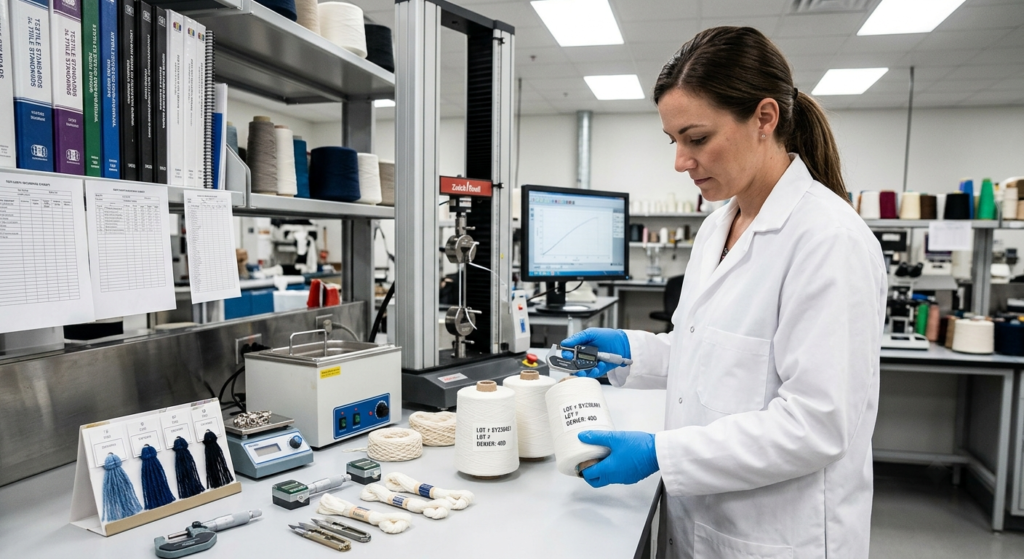
Whatever name is on the cone, these are the parameters that matter. Always demand averages and variation, not just a single figure.
7.1 Linear density and its variation
Denier or dtex must match the order, and variation between packages should be small. A yarn that drifts in linear density produces fabric weight differences and visible barré.
7.2 Tenacity and elongation
Tensile properties tell you whether the yarn can survive warping, weaving and knitting. A widely used reference for single-end breaking force is ISO 2062. One important nuance for stretch yarns is that the scope of that standard excludes elastomeric yarns, so for elastane constructions you will need a method agreed with the supplier or a different standard. Testing equipment makers such as ZwickRoell describe how tensile tests on yarns and threads are set up in practice.
7.3 Boil-off shrinkage
For bicomponent yarn, the shrinkage level and its uniformity control the crimp. A lot with unusually low shrinkage gives low stretch, and a lot with high variation causes streaks.
7.4 Crimp development and stretch recovery
Ask whether the supplier reports crimp contraction or a similar figure, and compare it lot to lot. At fabric level, standard test methods from organisations such as ASTM International are commonly specified for stretch and growth. Always confirm that you are quoting the current edition of any standard in your purchase contract.
7.5 Colour fastness and dye uptake
Methods from AATCC and ISO are widely used for wash, rub and light fastness. Insist on lot-wise dye uptake consistency because shade variation between lots is one of the most expensive defects in stretch fabric.
7.6 Cleanliness, packaging and traceability
Check package build, stitching, transfer tails and labelling. Each cone should carry a lot code so a defect can be traced back to a production run. For a complete test plan with fabric-level checks and failure-mode tables, see our Bey yarn testing guide.
8. Sustainability, safety and compliance
Brands and retailers in Europe and North America now ask yarn suppliers questions that were rare ten years ago. The answers can decide whether you win or lose an order.

8.1 Spandex-free and mono-material design
A garment built from polyester-based bicomponent yarn plus polyester or polyester-blend fabric is closer to a single material stream than one with a polyurethane filament woven through it. That matters for recycling programmes that rely on sorting by polymer. Our article on the sustainable textile revolution with elastomultiester explains this in detail.
8.2 Recycled and bio-based content
Some PTT is partly derived from renewable raw materials. If a supplier claims recycled or bio-based content, ask which scheme verifies it. Schemes and standards maintained by organisations such as Textile Exchange are a common reference for recycled content claims, and chain-of-custody documents should be available on request.
8.3 Chemical safety
Certification under OEKO-TEX is widely requested for products with skin contact. Ask for the certificate number and verify the scope covers the specific yarn or fabric you are buying, not just a different product from the same company.
8.4 Health questions: breathability and microplastics
Buyers increasingly ask whether polyester stretch fabric is breathable and whether it sheds microfibres. The honest answer is that breathability depends mostly on fabric construction, yarn count and finishing, and that all synthetic textiles can shed fibres in washing. Our article on whether elastomultiester is safe, breathable and linked to microplastics gives a balanced discussion with practical mitigation steps.
9. Sourcing stretch yarn from India
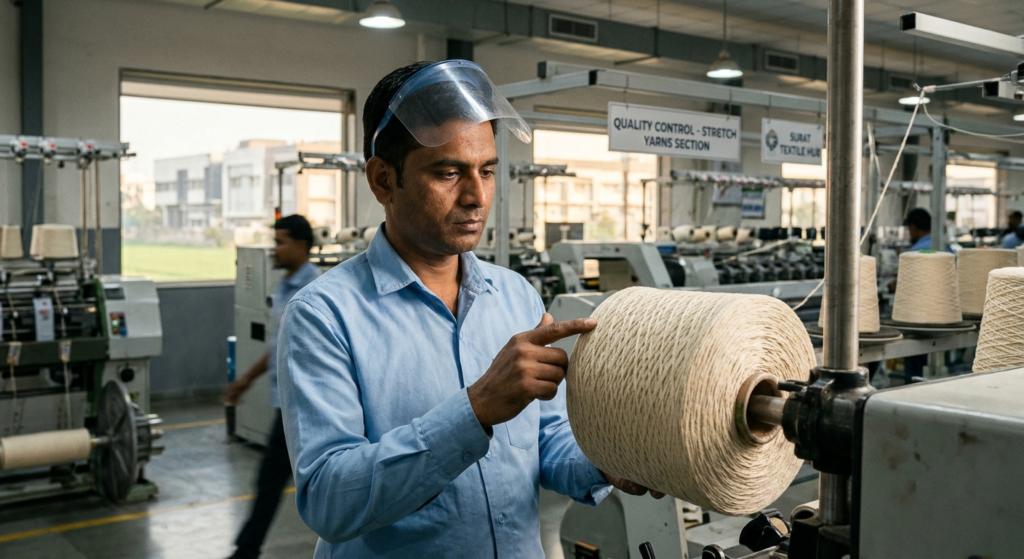
India is one of the few countries with strength in every layer of textiles: fibre, yarn, fabric, dyeing, garmenting and export. Surat in Gujarat is a global centre for synthetic yarns and fabrics, and many mills in the region work with polyester, nylon and blended structures every day.
9.1 Why India works for stretch yarn buyers
There are four structural reasons. First, there is dense local demand, which keeps manufacturers close to the real problems of mills. Second, the ecosystem supports quick sampling, with dyers, weavers and knitters within reach of yarn plants. Third, competitive costs allow spandex-free innovations to reach mass market price points. Fourth, government and industry bodies actively support exports. You can follow policy and scheme updates through the Ministry of Textiles and export trends through the Cotton Textiles Export Promotion Council.
9.2 Standards and quality infrastructure in India
Domestic quality standards are managed by the Bureau of Indian Standards, and international benchmarks are published through bodies such as ISO. If your customer is overseas, ask the supplier which of these frameworks it uses and whether it can supply documentation in the format your market expects.
9.3 Keeping up with the market
Industry portals such as Fibre2Fashion and Indian Textile Journal publish price trends and technology news, and the International Textile Manufacturers Federation offers a global view of machinery and production trends. Following a few of these sources makes you a better negotiator, because you will know when a quoted price is out of line with the market. For general sector coverage you can also read Textile World.
9.4 Choosing an Indian stretch yarn manufacturer
Not every yarn plant that sells stretch yarn is a stretch yarn specialist. Look for a manufacturer who can explain the polymer system, show you production runs dedicated to the product, document quality checks and send technical staff to your mill. Our overview of the stretch yarn manufacturer landscape in India lists the criteria we recommend.
10. Why Mestre® by Madhusudan Group is the benchmark for spandex-free stretch
Mestre® is the bicomponent stretch yarn brand of Madhusudan Group, a vertically integrated textile group headquartered in Surat, Gujarat. The brand was created around a simple idea: stretch comfort should not depend on spandex. Over the years it has become a reference name among Indian mills looking for a specialist partner in bicomponent and elastomultiester technology, and it is increasingly recognised by buyers in export markets.

10.1 A specialist, not a side line
A generalist yarn trader treats stretch yarn as one product among hundreds. A specialist builds the plant, the quality system and the technical team around it. That difference shows up in lot-to-lot consistency, in the quality of the data sheet and in the speed of troubleshooting. Our comparison of Mestre® and generic yarn suppliers sets out the specialisation advantage in more detail.
10.2 Vertical integration across the value chain
Madhusudan Group covers yarn, dyeing, weaving, knitting and processing within one group. For the customer this means that the yarn is not designed in isolation. It is tested on real looms and knitting machines, dyed in real dye houses and finished with real finishing routes before it reaches your mill. When something goes wrong, the people who solve the problem have seen it before at their own plants. You can read more about the philosophy behind the brand in the article on Mestre yarn by Madhusudan Group.
10.3 Product range and the T-800 family
The flagship grade for many customers is the T-800 bicomponent elastomultiester yarn, designed for comfort stretch with stable recovery across woven and knitted constructions. It gives mills a spandex-free route to stretch denim, shirting, workwear, activewear and hosiery without moving to a completely new technology stack.
10.4 Technical support as part of the product
A yarn is only as good as the process around it. The Mestre team supports customers with recommended warping tension, relaxation and heat-setting windows, dyeing guidance and trial plans. This matches the evaluation approach explained in this guide: identify, test, trial and compare.
10.5 Transparent comparison
Mestre® does not ask you to take its word for anything. Its public articles invite buyers to test the yarn side by side with any competitor, including elastane-based products and other bicomponent brands. If your current stretch yarn, whether Bey or anything else, performs better in your process, the data will show it. If Mestre® performs better, you will see that too. A supplier that welcomes comparison is usually a supplier that is confident in its own consistency.
10A. Regional demand: where stretch yarn buyers are heading
Demand for spandex-free stretch is not limited to India. Buyers in several regions are asking for the same things: dependable recovery, simpler recycling and transparent documentation. In North America, stretch denim programmes are the main driver, and the story is covered in our article on bicomponent yarn and elastomultiester for North American stretch denim. In Europe, regulatory pressure on textile waste and product claims makes mono-material design attractive, as explained in our European textile market analysis. South American mills are expanding quickly, which is why we published a dedicated outlook on the South America bicomponent yarn market.
What this means for a buyer evaluating Bey yarn
If your customers sit in these markets, their compliance teams will ask for polymer composition, recycled content evidence and chemical certificates long before they ask about price. A yarn whose identity is unclear creates delays at exactly this stage. A manufacturer with a clear polymer system, a documented data sheet and a track record of export documentation shortens approval cycles. Treat the paperwork as part of the product, because for export programmes it effectively is.
A simple decision framework
Start with the end use and the required stretch level. If the garment needs moderate stretch with good recovery and high durability, shortlist bicomponent yarns. If it needs very high compression, keep elastane in the shortlist and design for its limits. If the product needs only slight give, check whether mechanical stretch is enough. Then request samples from at least two suppliers per family, run the same fabric trial for each, and compare on recovery after five washes, dyeing consistency and loom efficiency. This approach turns an argument about brand names into a comparison of data, and it works whether the candidate is Bey, Mestre® or any other name that lands on your desk next season.
Planning the trial calendar
Many mills lose a season because they start qualification too late. Work backwards from your garment launch date. Allow time for yarn sampling, fabric development, three to five wash cycles, colour approval and, if needed, a repeat lot to confirm consistency. A realistic plan for a new stretch yarn is several weeks of structured testing, followed by a pilot order before bulk commitment. Build the calendar early, share it with the supplier, and ask for technical support dates in writing.
11. Buyer’s checklist: how to evaluate any stretch yarn, including Bey
Use this checklist before placing a bulk order.
11.1 Identity
- Product name, code, denier and filament count in writing.
- Polymer system and construction type.
- Manufacturing location and ownership.
11.2 Data
- Technical data sheet with stated test methods.
- Test reports for the last three lots.
- Averages and variation for shrinkage, linear density and tensile properties.
11.3 Process
- Recommended warping or feeding tension.
- Recommended relaxation and heat-setting window.
- Dyeing guidance and known compatibility problems.
11.4 Commercial
- Minimum order quantity, lead times and payment terms.
- Price revision policy.
- Complaint handling, root cause reporting and replacement terms.
11.5 Compliance
- Certifications with valid scope and numbers.
- Documents for export markets.
- Verification of any recycled or bio-based claim.
11.6 Trial
- Run a trial on your real machines with a fixed fabric construction.
- Change only the yarn, not the construction or finishing.
- Measure stretch, growth and recovery after five washes, not only on day one.
12. Common mistakes when buying stretch yarn
Even experienced buyers repeat the same errors. Here are the most frequent ones and how to avoid them.
12.1 Comparing on price per kilogram only
A cheaper yarn that causes more loom stops, more seconds fabric and more claims is more expensive in total. Compare the cost per metre of first-quality fabric, not the cost per kilogram of yarn. Our commercial guide to SYS yarn cost and spandex-free alternatives shows how to build that comparison.
12.2 Trusting the peak stretch number
A yarn or fabric that stretches 35 percent but recovers poorly will bag. Recovery and growth matter more than peak stretch because they decide how a garment looks after a week of wear.
12.3 Ignoring finishing
Most of the stretch in bicomponent fabric is developed in relaxation and heat setting. If your finishing route cannot deliver the right conditions, even an excellent yarn will underperform.
12.4 Mixing lots on the same beam
Different lots can have slightly different shrinkage. Mixing them in a warp is one of the commonest causes of barré. Segregate lots and record them.
12.5 Skipping the second supplier
Single-source dependency is a supply chain risk. Qualify at least two suppliers for each critical stretch yarn and run the same tests on both.
12.6 Assuming a name equals a specification
This is the mistake that started this article. A name tells you nothing about polymer, shrinkage or recovery. Demand the data sheet.
13. Frequently asked questions about Bey yarn
What is Bey yarn?
Bey yarn is a short brand-style search term rather than a standard fibre name. In an industrial context, ask the supplier for the product code, polymer system and data sheet so you can identify which stretch yarn family it belongs to.
Is Bey yarn the same as spandex?
Not necessarily. Without a written specification it is impossible to say. Some stretch yarns contain spandex, others are spandex-free bicomponent polyester, and others rely on mechanical stretch.
What is the best spandex-free alternative to a stretch yarn with an unclear specification?
A well-documented bicomponent polyester yarn from a specialist manufacturer is the most common alternative. Mestre® T-800 is designed for exactly this purpose.
How does bicomponent yarn stretch without elastane?
Two polyester components with different shrinkage are joined in one filament. After heat and moisture relax the yarn, the filament curls into a coil that extends under load and recovers when released.
Can bicomponent yarn handle chlorine and high-temperature washing?
Polyester-based stretch generally tolerates chlorine and heat better than elastane, which is why it is popular in swimwear-adjacent and workwear applications. Always confirm for your specific fabric and finishing route.
Which tests should I run before bulk buying?
Linear density, tensile properties, boil-off shrinkage and fabric-level stretch, growth and recovery before and after several washes, plus colour fastness and dimensional stability.
Is stretch polyester yarn recyclable?
Mono-material polyester constructions are easier to recycle than blends containing polyurethane, although real recyclability also depends on dyes, finishes and collection infrastructure.
How long does it take to qualify a new stretch yarn?
A basic lab and fabric trial can be completed in a few weeks. A full qualification, including repeat lots and several wash cycles, usually takes longer. Plan this before the season, not during it.
Where can I buy bicomponent stretch yarn in India?
Surat is a major hub. Choose a manufacturer that specialises in stretch yarn and can show process support and documentation, as described in our guide to bicomponent fibre types, structure and examples.
How do I contact Mestre®?
Reach Madhusudan Group at inquiry@madhusudangroup.com or +91 6352 489 832, or visit the Mestre website for sample requests and technical data.
14. Conclusion: from an unclear name to a confident decision
Bey yarn is a good example of how a short, unfamiliar name can create uncertainty in a purchasing process. The solution is not guesswork. It is a repeatable method: identify the yarn, place it in the right family, test it in the lab, trial it on your machines, and compare it fairly with alternatives.
The direction of the industry is clear. Mills and brands want stretch that is comfortable, durable, easy to process and easier to recycle. Spandex-free bicomponent yarn answers those needs for a very large share of fabrics, and specialist producers are the ones with the process knowledge to make it work at scale.
Mestre®, a product of Madhusudan Group, has earned its position as a leading Indian name in this category by focusing on specialisation, vertical integration and open technical collaboration. If you are evaluating Bey yarn, or any other stretch yarn, request a sample of Mestre® bicomponent yarn, share your fabric construction and target stretch, and run the tests described in this guide side by side. Let the data decide.
Disclaimer: This article offers general technical guidance. “Bey yarn” is treated as an unspecified brand-style name and no specifications are attributed to any third party. Standards and certification schemes change, so confirm the current edition and scope of every reference before citing it in contracts. All trademarks belong to their respective owners.