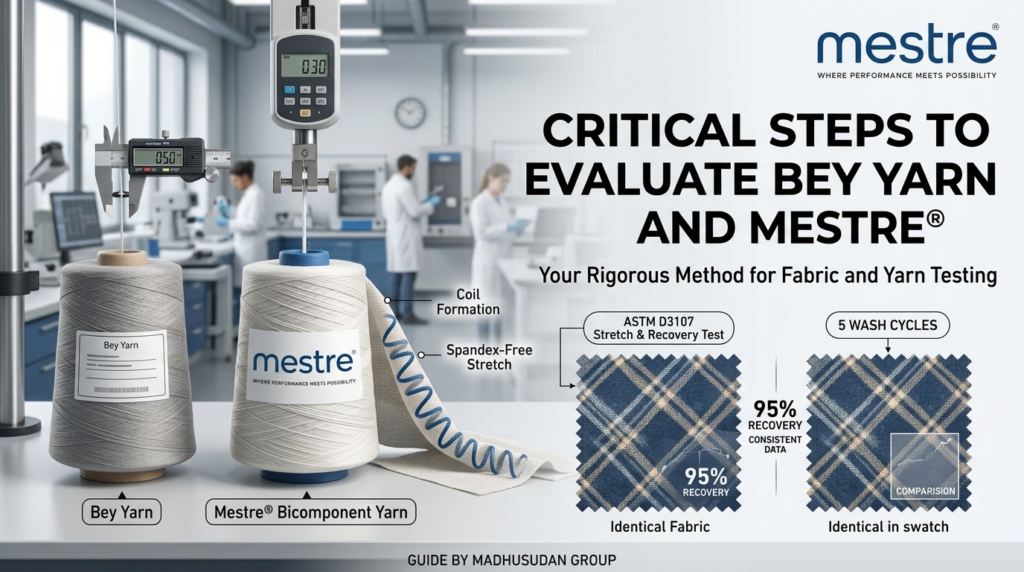
Quick answer: If you have been asked to consider “Bey yarn” for a stretch fabric programme, the most valuable thing you can do is treat it like any new stretch yarn: identify what it is, test it in the lab, trial it on your machines, and compare it side by side with your current material. This guide walks through exactly which tests matter, how to interpret the numbers, and where stretch yarns most often fail in production. It also shows how a spandex-free bicomponent yarn such as Mestre® fits into the same testing framework.
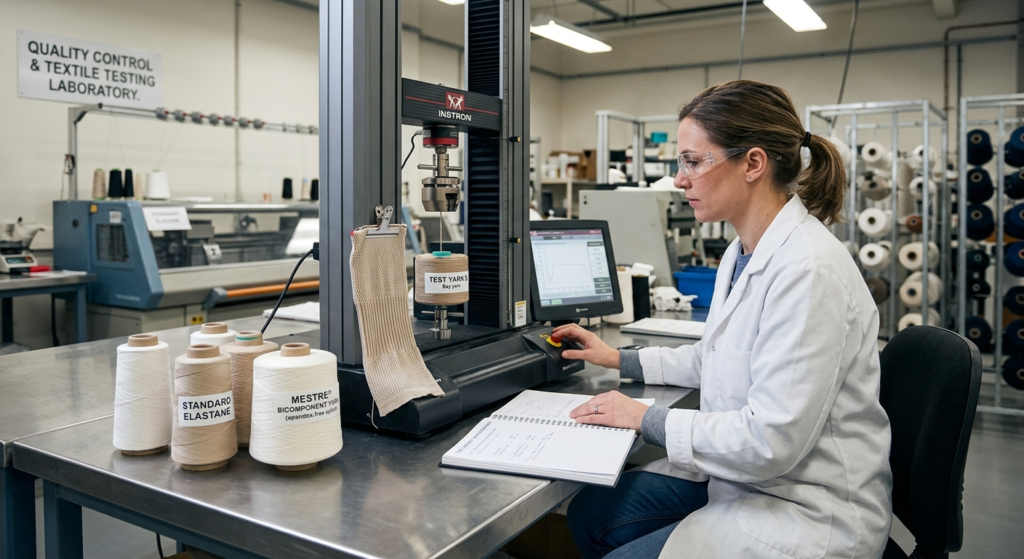
We deliberately avoid stating specifications for any third-party brand. Only the manufacturer can tell you what its yarn contains, and only your own testing can tell you how it behaves in your process. What we can give you is a rigorous method.
1. Why testing is the real product knowledge
Anyone can publish a brochure. What a fabric mill needs is repeatable performance across thousands of kilograms of yarn, months of production, and dozens of finishing cycles. Stretch yarn is more sensitive to variation than almost any other textile input, because its whole purpose is to store and release mechanical energy. A small drift in polymer viscosity, spinning temperature, draw ratio or oil pick-up can change how much the yarn shrinks, how quickly it develops its crimp, and how much stretch appears in the finished fabric.
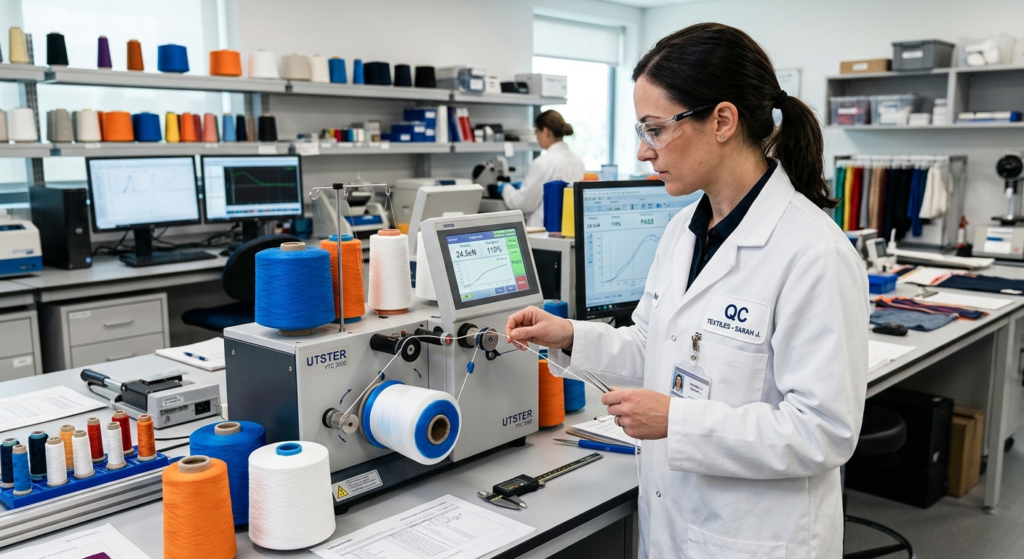
That is why experienced technical managers say that the yarn data sheet is where a conversation starts, not where it ends. This article turns that principle into a practical testing plan you can use for Bey yarn, for Mestre®, or for any other stretch yarn on your shortlist.
2. Bey yarn: the search context
“Bey yarn” is a short brand-style query. As with many short names, search results can mix very different topics, from hobby-craft listings to unrelated products. If you are a fabric mill, garment manufacturer or sourcing agent, the correct way to resolve the ambiguity is not by reading more search results but by asking the supplier for three things in writing: the exact product name and code, the polymer system, and a technical data sheet with test methods stated.
Once you have those three items, you can place the yarn in the correct family, as explained in the next section.
3. Step one: identify the construction
Stretch yarns on the Indian and global markets fall into a few families. Your test plan changes slightly depending on which one you are dealing with.

Elastane-containing yarns. These include core-spun, covered, air-covered and plied yarns that contain a spandex filament. They require tension-controlled feeding and are more sensitive to heat exposure. Background on the polymer is available in the Wikipedia article on spandex, and a plain-language guide is available in What is elastane, spandex and Lycra?
Bicomponent polyester yarns (elastomultiester). Two polyester components, typically two grades of polyethylene terephthalate or a PET/PTT pair, are extruded side by side. Heat and moisture relax the yarn and it curls into a coil. See What is bicomponent fibre? Types, structure and examples for structure diagrams and examples.
Textured or mechanical stretch yarns. Stretch is imparted by twisting, heat-setting and untwisting (false-twist) or by air-jet loops. Read Mechanical stretch textiles: how it works.
If the supplier cannot tell you clearly which family their product belongs to, treat that as a warning sign.
4. Laboratory tests for yarn
You do not need a full R&D laboratory to run a meaningful yarn evaluation. A basic textile testing lab, in-house or third-party, can run the following tests. Where a widely used method exists, we mention it so you can put it in your purchase specification. Always confirm the current edition of any standard before citing it. Standards are published by organizations such as ASTM International and ISO.

4.1 Linear density (denier / dtex)
Weigh a measured length of yarn and calculate the mass per unit length. Deviations from the nominal count translate directly into fabric weight and cover variation. Ask for the average and the coefficient of variation across at least ten packages per lot.
4.2 Tenacity and elongation at break
A tensile tester pulls the yarn at a set speed until it breaks and records the force and the extension. Tenacity tells you whether the yarn can survive warping and weaving tension. Elongation at break tells you how much stretch reserve is present in the raw yarn, but note that in bicomponent yarn the useful stretch is developed later through relaxation.
4.3 Boil-off (hot water) shrinkage
Boil-off shrinkage measures how much the yarn shortens when exposed to boiling water or a specified heat treatment under minimal tension. For a bicomponent yarn, the shrinkage difference between the two components is what drives coil formation, so the total shrinkage figure and its consistency are central. Ask for average shrinkage and variation across packages.
4.4 Crimp development
Some suppliers provide a crimp contraction or crimp rigidity figure that indicates how much helical crimp develops after treatment. If offered, compare this figure lot to lot. If not offered, you can infer it by measuring the length of a relaxed skein against its pre-treatment length and by testing the stretch and recovery of a simple knitted or woven swatch.
4.5 Oil pick-up and yarn friction
Spin finish affects unwinding, static and dye levelness. Ask for the finish type and the percentage. Very high or inconsistent finish levels can cause staining or dyeing problems, while very low levels can raise breakage rates.
4.6 Entanglement and package quality
Interlacing (entanglement) holds filaments together and influences how the yarn behaves on warping creels and knitting feeders. Check package build, transfer tails, and any evidence of stitched, sloughed or collapsed cones.
5. Laboratory tests for fabric
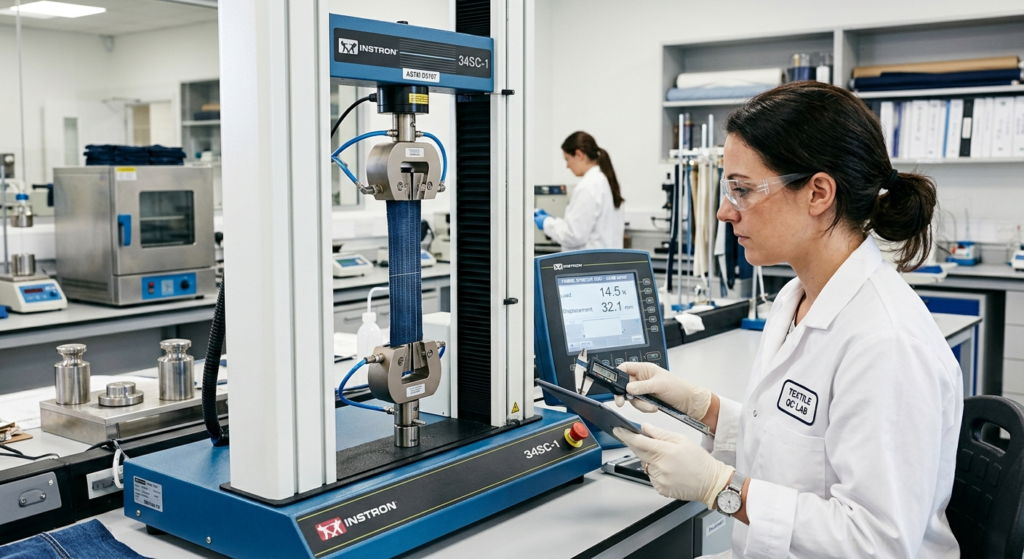
Yarn tests predict, but fabric tests decide. Weave or knit a representative construction and finish it as you would in production, including any pre-treatment, heat setting, dyeing, and final finish. Then run the following.
5.1 Stretch and recovery (growth)
For woven stretch fabrics, ASTM D3107 is widely used to measure stretch and growth. For knitted fabrics, ASTM D2594 is a common reference, and ISO 20932 provides an international framework for elasticity determination. Whatever method you adopt, keep it constant across suppliers. Record three values: stretch (how far the fabric extends under a defined load), growth (permanent lengthening after a rest period), and recovery (how much of the extension comes back).
Report results after several wash cycles as well as at zero. Many yarns look excellent when new and lose recovery quickly. Others improve after the first wash as the crimp settles. Only the sequence tells you the truth.
5.2 Dimensional stability
Test shrinkage in both directions after washing and, where relevant, after tumble drying. Stretch yarns can cause differential shrinkage between warp and weft.
5.3 Colour fastness
Follow appropriate methods from AATCC or ISO 105 for wash, rub and light fastness. Bicomponent polyester generally dyes with disperse dyes, but shade depth and levelness can vary with the yarn and the process.
5.4 Abrasion, pilling and seam performance
For workwear and denim, abrasion resistance and seam slippage matter. Stretch fabrics can show more seam slippage than rigid ones if the construction is too open.
5.5 Chemical and heat resistance
If your product will meet chlorine (swimwear, pool-side textiles), high-temperature washing or ironing, test for these. One frequently cited advantage of elastomultiester over elastane is its tolerance of chlorine and heat, as discussed in Elastomultiester: meaning, fabric, elastane and polyester.
6. Reading and interpreting results
Numbers only help if you know what to look for. These are the patterns that experienced technologists watch.

Consistency beats a single great number. A yarn that delivers 28% stretch in one lot and 22% in another is riskier than one that consistently gives 24%. Ask for coefficients of variation, not only averages.
Recovery matters more than peak stretch. A fabric that stretches 30% but only recovers to 95% of original length will bag at the knees and elbows. In consumer terms, growth is the metric that produces returns.
Look at the first five washes. The largest changes in stretch fabric usually occur in the first few laundering cycles. Include them in the test plan.
Compare on the same fabric. Do not compare Bey yarn on a 3/1 twill against Mestre® on a plain weave. Fix the construction, ends and picks per inch, and finishing route, and change only the yarn.
Track process notes as data. Record warp breaks, loom stops, tension adjustments, dyeing recipes and finishing temperatures. Two yarns can produce the same lab numbers but very different production costs.
7. Shop-floor behaviour: warping, weaving and knitting

Warping
Stretch yarns are more sensitive to warping tension than standard polyester. Too much tension pre-extends the yarn, and when it relaxes in finishing the fabric can shrink erratically. Too little tension causes slack ends and loom stops. Ask the supplier for a recommended tension range, then confirm it in a trial.
Sizing (for woven warp)
Where the stretch yarn is used in the warp, consider whether sizing is needed and how the size film interacts with the yarn’s crimp. Discuss with the supplier and with your sizing chemical provider.
Weaving
Track stops per 100,000 picks, and classify them by cause: warp break, weft break, selvedge issues. A stretch yarn that requires frequent loom adjustments can wipe out any price advantage.
Knitting
In circular knitting, feeder tension and take-down tension strongly influence loop length and finished width. Bicomponent yarns can be knitted on standard machines, but the settings often differ from those for conventional polyester or for elastane-fed constructions.
8. Heat setting and dyeing: where stretch is won or lost
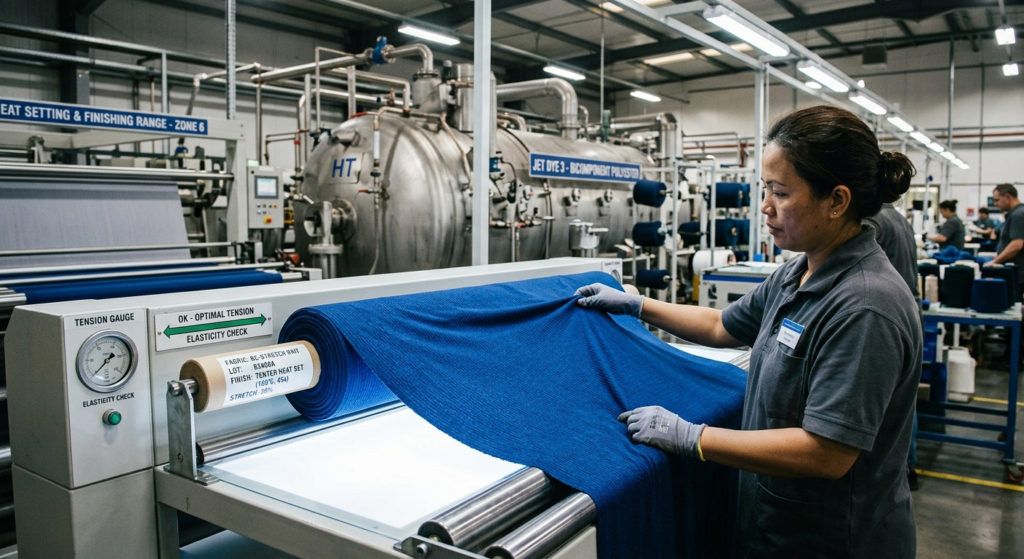
Most of the visible stretch in bicomponent yarns develops during relaxation and heat treatment. That makes the finishing route as important as the yarn itself.
Relaxation. Allow the fabric to relax in a low-tension state, typically in a hot wet environment, so the coils can form. Insufficient relaxation limits stretch.
Heat setting. Heat setting fixes dimensions and stabilises the coil. Temperature, dwell time and tension all matter. Too high a temperature can reduce stretch or change hand; too low can leave the fabric dimensionally unstable. Ask the supplier for a recommended window, then test both edges.
Dyeing. Polyester bicomponent yarns are typically dyed with disperse dyes at high temperature. Check that the dye-bath conditions do not overwhelm the crimp. If you also blend with cellulosic fibres such as cotton, review the dyeing sequence carefully.
Finishing. Chemical and mechanical finishes can affect hand and stretch. Trial any softeners, resins or calendering steps before committing.
For an overview of how the stretch is engineered into the textile rather than into the yarn alone, read Mechanical stretch: meaning, definition and examples and the mechanical stretch fabric guide.
9. Failure modes and their causes
Here are the most common problems in stretch fabric production and the first places to look.
| Symptom | Likely causes | What to check |
| Fabric narrower than target | Excess shrinkage, high yarn tension, incomplete relaxation | Boil-off shrinkage, warping tension, finishing route |
| Low stretch in finished fabric | Insufficient crimp development, over-tensioned heat setting | Heat-set temperature and tension, relaxation step |
| Poor recovery / bagging | Low-quality yarn, over-stretching in processing, wrong construction | Recovery tests, construction density |
| Barré or streaks | Lot-to-lot shrinkage or dye affinity differences | Lot mixing on the warp beam, dye lot control |
| Frequent loom stops | Yarn friction, entanglement problems, package defects | Spin finish, package quality |
| Shade variation | Different lots dyed together, uneven heat history | Lot segregation, dyeing profile |
| Seam slippage | Open construction, high stretch with low density | Fabric density, sewing method |
Whenever a defect appears, resist the temptation to blame the yarn instantly. Use the table to isolate variables one at a time. A strong supplier will help with this troubleshooting and will bring technical staff to your mill if needed.
10. Supplier audit checklist
Whether the supplier is Bey, Mestre®, or someone else, ask the following.
Manufacturing – Where is the yarn spun and texturised? Who owns the plant? – What is the monthly capacity of this specific yarn family? – How many production runs are dedicated to it each month?
Quality – What inline and final tests are performed, and at what frequency? – Can you share test certificates for the last three lots? – How are complaints handled and how quickly are root causes reported?
Compliance – Which certifications are held, for example OEKO-TEX? – If recycled content is claimed, is it verified by a recognised scheme such as those described by Textile Exchange? – What documents can be supplied for export markets?
Commercial – What are the minimum order quantities and lead times? – How is pricing structured and how often is it revised? – What technical support is included?
Specialisation is worth probing. The article Mestre vs generic yarn suppliers explains why a supplier whose core business is stretch yarn tends to invest more in process control than one selling it as an add-on.
11. Bey yarn vs Mestre®
You can use the framework above to build a fair, evidence-based comparison. The table shows how to organise it. Fill the Bey column only from the supplier’s written specifications and your own results.
| Test / criterion | Mestre® |
| Polymer system | Bicomponent polyester (two polyester components) |
| Stretch mechanism | Coil crimp, mechanical stretch |
| Elastane content | None, spandex-free |
| Boil-off shrinkage (mean, CV) | Request from supplier |
| Fabric stretch and growth after 5 washes | Test on your construction |
| Heat-setting window | Request from supplier |
| Lot-to-lot consistency | Request last three lot certificates |
| Origin and vertical integration | Surat, India; group covers yarn, dyeing, weaving, knitting and processing |
| Export documentation | EU and US labelling guidance available |
Mestre® is manufactured by Madhusudan Group, which describes itself as a vertically integrated textile group. For background, read What is Mestre yarn?, the T-800 bicomponent elastomultiester yarn product page, and the head-to-head articles Mestre vs Lycra T800 and T400 and Mestre vs Sorona.
Remember that this is a template. If a claim about Mestre® or Bey matters to your decision, verify it by test.
12. Frequently asked questions
What is Bey yarn? The term is ambiguous in search results. In an industrial context, treat it as a brand-style name and ask the supplier for the product code, polymer system and technical data sheet. Those three items tell you which stretch yarn family it belongs to.
What tests should I run before buying stretch yarn? At minimum: linear density, tenacity and elongation, boil-off shrinkage, and fabric-level stretch, growth and recovery before and after several washes. Add colour fastness and dimensional stability. See sections 4 and 5.
How much stretch should a good stretch fabric have? There is no universal number. Requirements vary: comfort stretch woven shirting, stretch denim, sportswear and hosiery all target different ranges. Define the target from your end product and customer, then check that both stretch and recovery meet it.
Why does my stretch fabric lose its shape? Common causes include over-tensioning in processing, insufficient heat setting, low-quality yarn, and construction that is too loose. Use the failure-mode table in section 9.
Does bicomponent yarn need special dyeing? It is usually dyed with disperse dyes like other polyester, but the temperature profile and relaxation need attention. Follow supplier guidance and confirm in a trial. More background: Bicomponent yarn: complete guide.
Can bicomponent yarn replace elastane completely? In some applications, yes, especially where moderate stretch, heat resistance and recyclability are priorities. In fabrics needing very high stretch, elastane may still be used. The elastane vs polyester comparison guide helps you decide.
How many suppliers should I qualify? At least two per critical yarn to reduce supply risk, with one primary and one secondary. Run the same tests on both.
Where can I learn more about stretch yarn supply from India? Start with Stretch yarn manufacturer in India and Bicomponent yarn and fibre uses in India.
13. Conclusion
Bey yarn, like any other stretch yarn, deserves the same disciplined evaluation: identify the construction, test the yarn, trial the fabric, and compare on the basis of consistent data. The mills that win with stretch are not those that find the perfect yarn on the first try; they are the ones that build a repeatable evaluation and audit process and keep applying it.
If you want to include a spandex-free option in your next trial, request samples of Mestre® bicomponent yarn from Madhusudan Group, share your fabric construction and target stretch, and run the tests in this guide side by side with Bey and your current supplier. The data will make the decision for you.
Disclaimer: This article offers general technical guidance. Test method references should be checked against the current edition of each standard, and any third-party product specifications must be confirmed with the manufacturer. All trademarks belong to their respective owners.