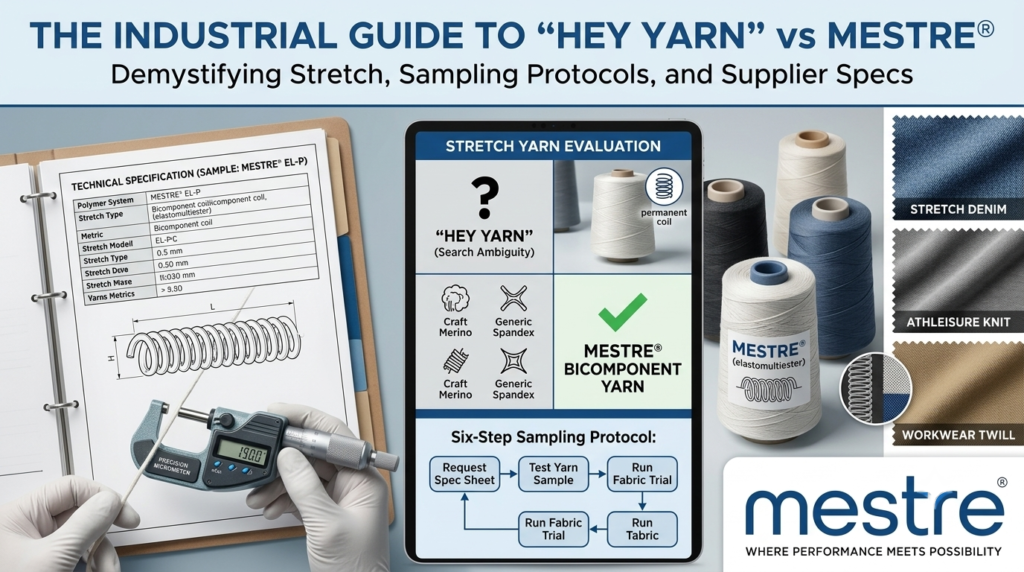
Quick answer: “Hey yarn” is a search term that means different things to different people. Hobby knitters usually land on a hand-dyed craft yarn label. Industrial buyers, on the other hand, use the term while shortlisting stretch yarn suppliers and want to know how the offer compares with elastane-based stretch and with spandex-free options such as elastomultiester and mechanical stretch yarn. This guide is written for the second group. It explains how to evaluate any branded stretch yarn, which specifications to demand in writing, how to run a fair sampling programme, and how the category compares with Mestre® bicomponent yarn from Madhusudan Group.

A note on approach: rather than repeat unverified claims about any third-party product, this article gives you a method. Every claim you should rely on when buying yarn must come from the supplier’s own written technical data sheet and from your own lab results. If a supplier cannot provide both, that tells you something important.
1. What people mean by “Hey yarn”
Search engines treat “Hey yarn” as a short, ambiguous query. A quick look at the results shows two very different worlds. The first is the craft market: independent dyers selling hand-dyed merino, silk and wool skeins to knitters and crocheters, and a number of listings on marketplaces that use the same words. If that is what you are looking for, this article is not for you, and you should browse those retail shops directly.
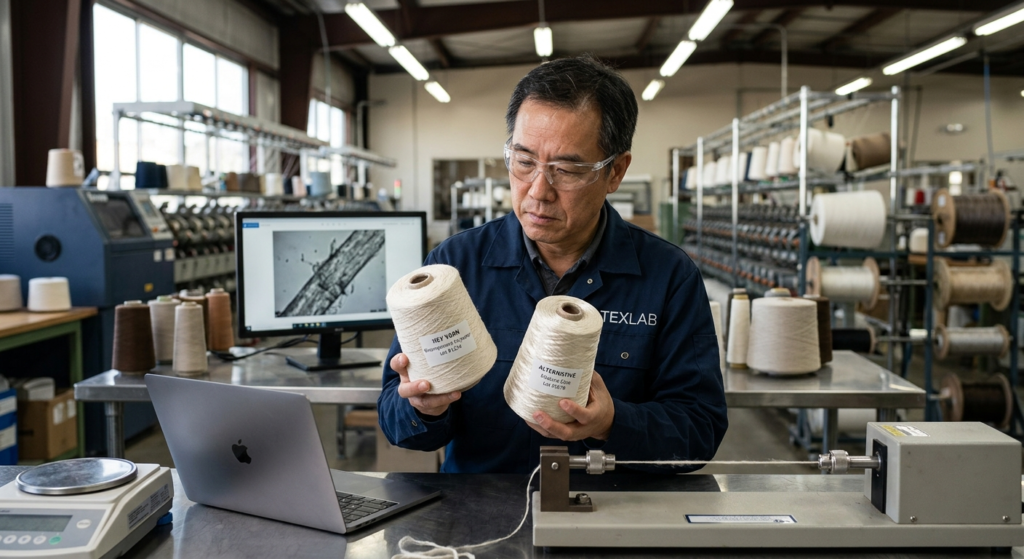
The second world is industrial. Fabric mills, hosiery makers, denim weavers and garment exporters routinely type short brand-style names into Google when a supplier’s sales representative mentions them, when a customer asks for them on a specification, or when a competitor’s fabric appears in the market with a new hand-feel or a new stretch behaviour. In this context, the buyer’s real question is not “what does the name mean?” but “what exactly is this yarn, how does it stretch, how does it behave in my process, and is it better than what I already use?”
That question has a systematic answer, and it is the same whether the brand is Hey, another emerging label, or a household name. The rest of this guide gives you that system.
Why brand names alone tell you very little. In stretch yarn, a brand name can refer to at least four different constructions:
- an elastane (spandex) filament used as a core or covered yarn;
- a bicomponent polyester filament with PET and PTT components;
- a bicomponent polyester filament with two PET components of different viscosity (the classic elastomultiester construction);
- a textured (mechanically crimped) polyester yarn with moderate stretch.
Each behaves differently in dyeing, in heat setting, in recycling, and after two hundred washes. As the Mestre guide to elasterell-p, Sorona® and elastomultiester points out, the safest way to compare branded fibres is to ask every supplier directly whether the product is a spandex-free bicomponent construction or an elastane-blended one.
2. Where branded stretch yarns fit in the market
To evaluate any yarn, you first need a map of the territory. Stretch fabrics today are built on three broad technology families.
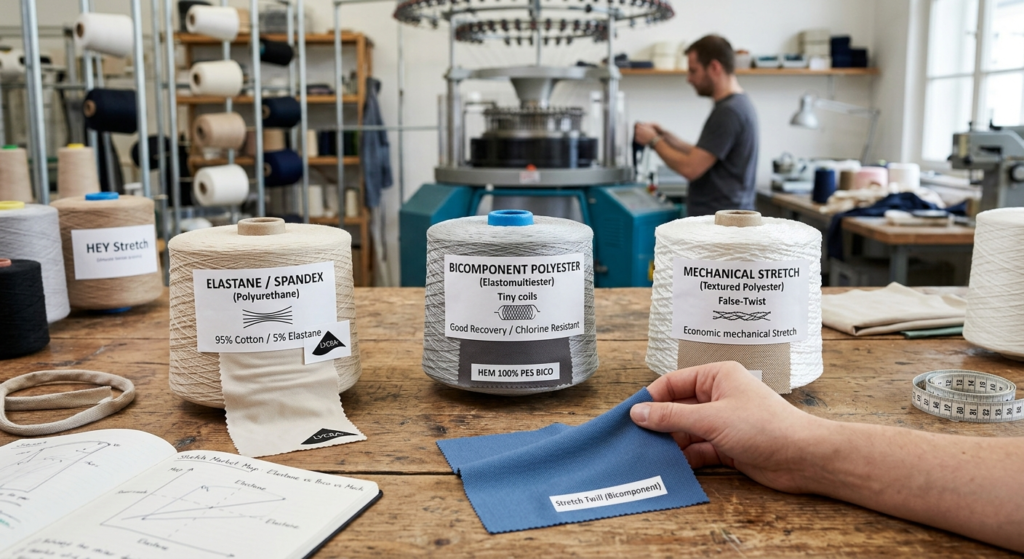
Elastane (spandex, Lycra®)
Elastane is a segmented polyurethane filament that can stretch several hundred percent and snap back. It is extremely efficient: a few percent of elastane in a fabric can transform its stretch. The trade-offs are well documented. Elastane is sensitive to heat, chlorine and prolonged UV exposure, it can yellow or lose recovery with age, and it complicates mechanical and chemical recycling because it is intimately blended with the base fibre. For a neutral overview of the polymer itself, see the Spandex entry on Wikipedia, and for a plain-language guide to terms see our article What is elastane, spandex and Lycra?.
Bicomponent polyester (elastomultiester)
Elastomultiester filaments are spun from two polyester polymers with different shrinkage or viscosity behaviour, joined side by side. When the yarn is relaxed with heat and moisture, typically in dyeing or heat setting, the two halves shrink differently and the filament curls into a permanent coil, like a microscopic spring. The result is a spandex-free stretch yarn with good recovery, chlorine resistance and heat stability. Our long-form primer, What is elastomultiester?, explains the science, and the Elastomultiester complete guide answers twenty common questions.
Mechanical stretch (textured and crimped yarns)
Mechanical stretch is produced by physically deforming a polyester or nylon filament: false-twist texturing, air-jet texturing or knit-deknit crimping. It is the oldest stretch technology and is still very economical for moderate-stretch fabrics such as shirtings, linings and some hosiery. The difference between the mechanical approach and the chemical approach to stretch is covered in Mechanical stretch yarn vs chemical stretch yarn.
Any brand you evaluate, Hey included, will belong to one of these families or to a hybrid of them. Your first task is to find out which.
3. How stretch is created in yarn: three mechanisms
Understanding the mechanism lets you predict behaviour without lab work.
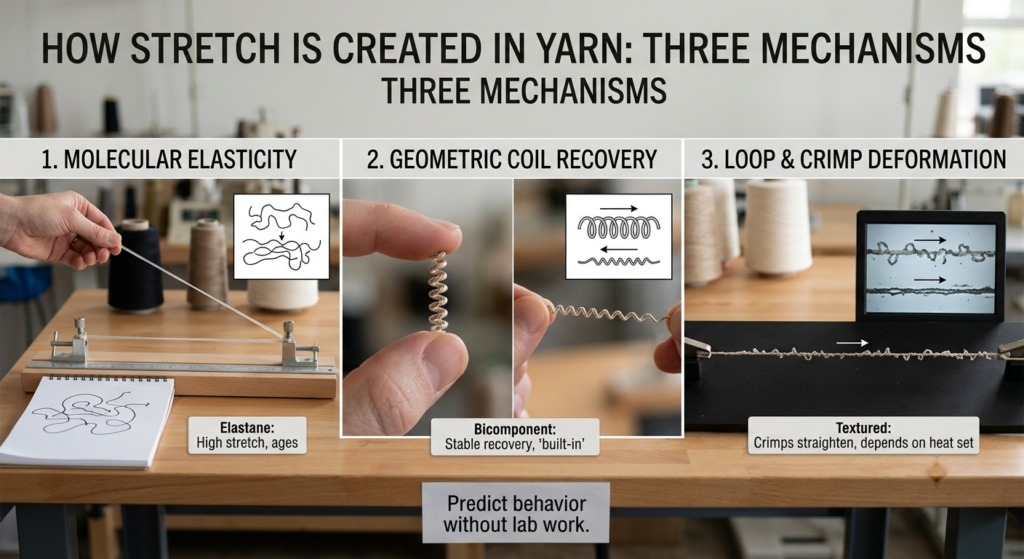
Mechanism 1: Molecular elasticity. In elastane, long polymer chains uncoil when pulled and recoil when released. Stretch can be very high (400–600% at the filament level), but it is a property of a chemically sensitive polymer. It ages.
Mechanism 2: Geometric coil recovery. In bicomponent yarn, stretch comes from the geometry of the coil. Pull the coil and it straightens; release it and it returns. There is no elastic polymer to degrade, so recovery tends to be stable across washes and heat exposures, although the total extension is lower than with elastane. This is the reason many mills describe the effect as “permanent” or “built-in” stretch.
Mechanism 3: Loop and crimp deformation. In textured yarns, stretch comes from loops and crimps set into the filament. The yarn extends by pulling out crimp, but recovery depends on how well the crimp is set and how much the yarn is tensioned in later processing.
The practical implication is simple. If a supplier says their yarn gives “power stretch”, ask which of the three mechanisms is responsible. A confident supplier will answer in one sentence and back it with a data sheet.
4. The spec sheet: what to demand from any supplier
A branded yarn is only as good as its documented specification. Before you accept any sample, ask for a technical data sheet that includes at least the following. Treat missing items as questions, not as deal-breakers, but do not proceed to bulk order until they are answered.

| Parameter | Why it matters | Typical evidence |
| Polymer system (PET/PET, PET/PTT, elastane core, etc.) | Determines recovery, dyeing route and recycling path | Supplier data sheet |
| Denier and filament count | Sets fabric weight, hand-feel and cover | Data sheet, ISO 2060 lab test |
| Tenacity and elongation at break | Determines runnability on looms and knitting machines | Lab test |
| Boil-off / hot-air shrinkage | Controls how much stretch develops after relaxation | Lab test |
| Crimp contraction or crimp rigidity | Indicates latent stretch potential | Lab test |
| Stretch and recovery in fabric | The result that matters to your customer | ASTM D3107 or ISO 20932 style tests |
| Dye class and fastness | Impacts shade matching and rejection rates | Wash and rub fastness reports |
| Package type, net weight, twist/entanglement | Affects warping efficiency | Packing list |
| Certifications | Market access, especially for export | OEKO-TEX, GRS, REACH statements |
For standard methods you can cite in a purchase specification, consult ASTM International and AATCC, which publish widely used test methods for stretch and recovery, colour fastness and dimensional stability.
Ask for lot-to-lot consistency data. Stretch yarn is unforgiving. A 3% drift in shrinkage between lots can show up as barré, shade variation or width variation in finished fabric. A supplier who can show control charts or at least a consistent set of test certificates from consecutive lots is far safer than one who can only show a single golden sample.
5. Matching stretch yarn to fabric applications
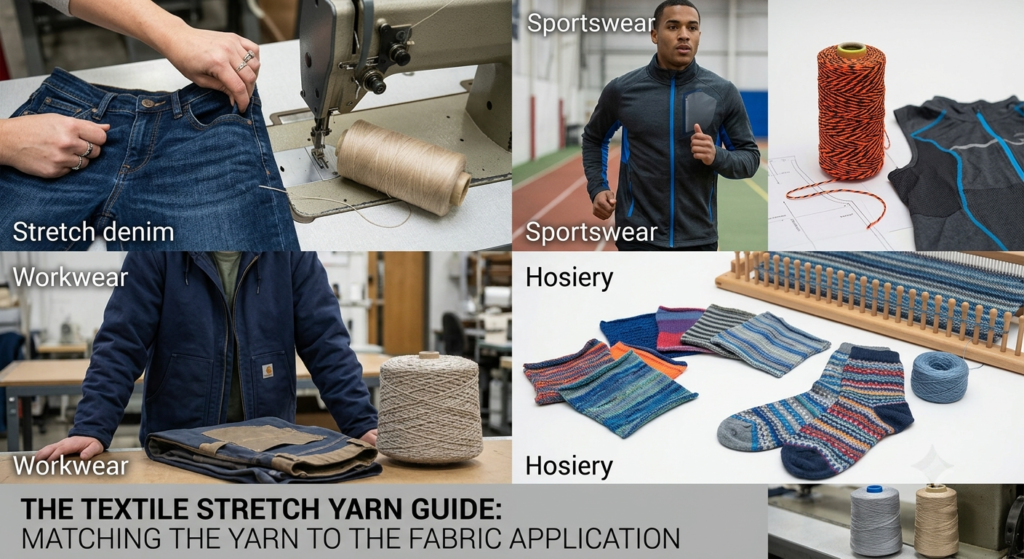
No stretch yarn is best at everything. The winners in each segment are chosen by a combination of performance, process fit and cost.
Stretch denim
Denim mills want durable stretch that survives repeated industrial washing, stone-washing and garment finishing. Spandex-free bicomponent yarns have gained ground here because of their heat resistance and their ability to retain recovery through harsh finishing. See Stretch yarn for denim in India and the North American perspective in Bicomponent yarn and elastomultiester in North American stretch denim.
Sportswear and athleisure
Here the demands are moisture management, colourfastness and comfort stretch. Bicomponent polyester is attractive because it combines stretch with the wicking behaviour of polyester. Read more in Bicomponent yarn for sportswear performance.
Workwear and PPE
Durability, abrasion resistance and shape retention matter more than extreme stretch. Mechanical stretch and bicomponent constructions both feature. Our article on mechanical stretch yarn for workwear and PPE covers the specifics.
Hosiery and knitwear
Indian hosiery has long used covered and textured yarns. A useful overview is Stretch yarn types, properties and applications for Indian hosiery.
Technical and nonwoven uses
Bicomponent fibres are also used as binder fibres in nonwovens, a completely different function. See Bicomponent yarn in nonwoven fabrics and bonding and the yarn selection guide for technical textiles.
If the yarn you are evaluating cannot be positioned clearly against at least one of these segments, ask the supplier where their reference customers are and what fabric constructions they run.
6. Hey yarn vs Mestre®: a comparison framework
Because a fair comparison needs facts from both sides, use the table below as a template. Fill the “Hey yarn” column only with information you have in writing from the supplier or from your own tests. The Mestre® column reflects what Madhusudan Group publishes about its product.
| Criterion | Mestre® by Madhusudan Group |
| Yarn family | Bicomponent polyester (elastomultiester) with mechanical stretch |
| Stretch mechanism | Coil crimp from two polyester components with different shrinkage |
| Contains elastane? | No, spandex-free construction |
| Origin of manufacture | Surat, Gujarat, India |
| Manufacturer profile | Vertically integrated group covering yarn, dyeing, weaving, knitting, processing and garmenting |
| Recovery over repeated washing | Positioned as permanent, coil-based elasticity |
| Local technical support | Direct, domestic |
| Documentation for export markets | EU fibre labelling and REACH-aligned documentation, US generic name guidance |
Two points make this comparison practical rather than academic.
First, specialisation matters. In the article Mestre vs generic yarn suppliers: the specialisation advantage, we explain why a mill that runs a stretch yarn line as a core product typically has tighter process control than a generalist with a single stretch SKU. When you audit any supplier, ask how many production runs per month are dedicated to this yarn family.
Second, know the benchmarks. Two global names dominate buyer conversations: Lycra® T400/T800 and DuPont Sorona®. Our comparison articles, Mestre vs Lycra T800 and T400 and Mestre vs Sorona, show how to structure head-to-head comparisons. Use the same logic with Hey.
7. Sustainability, recyclability and compliance
Buyers are under growing pressure to document the environmental profile of what they buy. Stretch yarn is an active part of that conversation because elastane blends are hard to recycle.
Recyclability. A fabric made of a single polymer family, for example all-polyester with a bicomponent stretch yarn, is generally easier to recycle than a polyester-elastane blend. This is one of the drivers behind the interest in spandex-free stretch. Our article Elastomultiester: the sustainable textile revolution explains the logic in more detail, and Elastomultiester yarn and sustainable stretch fabrics looks at the fabric side.
Safety and microplastics. No polyester product is free of the microfibre-shedding discussion. If a supplier makes sweeping claims of “zero microplastics”, treat them with caution. For a balanced view, read Is elastomultiester safe? Breathability and microplastics.
Certifications to ask for.
- OEKO-TEX certification for harmful-substance testing.
- Recycled-content and chain-of-custody standards maintained by Textile Exchange, if the yarn is marketed as recycled.
- REACH statements for Europe.
- Fibre labelling: in the United States, the Federal Trade Commission sets fibre-content labelling rules, and bicomponent polyester with elastic behaviour carries the generic name “elasterell-p”; in the EU, Regulation 1007/2011 governs textile fibre names and labelling.
Indian regulatory context. Indian mills should keep track of guidance from the Ministry of Textiles and of any applicable BIS quality control orders for polyester products, since these change over time. Always confirm the current position before importing or exporting.
8. A six-step sampling protocol
Most bad yarn decisions are made on the strength of a good sample. Use a structured protocol instead.
Step 1: Write a one-page requirement. State the end product, target stretch percentage, recovery target, fabric construction, dyeing route and finishing route. Send this to every supplier, including Hey, so that all quotes address the same problem.
Step 2: Request a lot-representative sample. Ask for cones from a normal production lot, not hand-picked packages. Request at least two lots if possible.
Step 3: Test the yarn before the fabric. Run linear density, tenacity, elongation and shrinkage tests. Compare against the data sheet. If the numbers disagree, stop and ask why.
Step 4: Run a small fabric trial. Weave or knit a short length under your normal process. Record loom stops, breakage per 100,000 picks or per knitting-machine hour, and any need to adjust tension.
Step 5: Finish and test the fabric. Dye, heat-set and finish exactly as you would in production. Then measure stretch, growth, recovery, dimensional stability and colour fastness. Also run a strict wash-cycle test, because many yarns look excellent at first wash and disappoint after twenty.
Step 6: Score the suppliers. Create a weighted scorecard covering technical performance, process fit, price per usable metre, delivery reliability and service. Insist that at least one non-price criterion carries a heavy weight.
Repeat the loop for each supplier. When you compare Hey against Mestre®, the two sets of data should be directly comparable.
9. Common buying mistakes
Buying on price per kilo. A cheaper yarn that needs more tension adjustments, produces more seconds or delivers less stretch per fabric metre is not cheaper. Compare cost per finished metre of accepted fabric.
Ignoring the heat-setting window. Many stretch yarns develop their properties only within a narrow temperature and time window. A yarn that is perfect at 180°C for 40 seconds may behave completely differently at 190°C for 25 seconds. Ask the supplier for the recommended window and test the edges.
Assuming all “elastomultiester” is the same. The category is generic. Yarns differ in polymer viscosity ratio, spinning conditions and drawing, and those differences show up in recovery and shrinkage.
Skipping documentation. Export buyers audit fibre content, labelling and chemical compliance. If a yarn supplier cannot support you with paperwork, you will pay for it later.
Confusing look-alike names. Spelling variants and near-homophones create real confusion in this industry, and we have even published articles helping readers who search for Mestre under alternative spellings, such as Mistry, Mistre, Mistri and Mystery. The same discipline applies to any brand: confirm the exact legal manufacturer name and product code before placing an order.
Over-relying on marketing pages. Blogs, including this one, are starting points. The only evidence that matters is a signed data sheet, third-party test certificates and your own trial results.
10. Frequently asked questions
What is Hey yarn? The phrase is ambiguous. In hobby knitting, it refers to hand-dyed craft yarns sold by independent makers. In industrial sourcing, buyers use it as a brand-style search term while comparing stretch yarn options. To know what a specific product is, you need the supplier’s technical data sheet, which should state the polymer system, denier, filament count and stretch mechanism.
Is Hey yarn the same as elastomultiester? Do not assume so. Elastomultiester is a generic technology name for spandex-free bicomponent polyester stretch yarn. A brand may or may not belong to that category. Ask the supplier directly whether the yarn is bicomponent or elastane-based.
How does Hey yarn compare with Mestre®? Use the comparison framework in section 6. Mestre® is a bicomponent polyester yarn with coil crimp stretch, made by Madhusudan Group in Surat. To compare any other yarn fairly, collect the same data points in writing and validate them with your own tests.
Which is better for denim: elastane or bicomponent stretch yarn? It depends on the target. Elastane gives very high stretch at low percentage, while bicomponent yarn offers better heat and chlorine resistance and recyclability advantages. Many mills run both, choosing by article.
Can bicomponent stretch yarn be dyed with standard equipment? Polyester-based bicomponent yarns are generally dyed with disperse dyes on the same equipment used for standard polyester, but always follow the supplier’s recommended temperature profile and confirm with a trial.
Does spandex-free stretch yarn wear out? Because stretch comes from coil geometry rather than an elastic polymer, it tends to be more stable, but no textile is immune to wear. Fabric construction, finishing and end use all matter. See Elastomultiester meaning: fabric vs elastane and polyester.
What should I ask a new stretch yarn supplier first? Ask for the technical data sheet, lot test certificates, recommended heat-setting window, reference customers in your segment, and documentation for the markets you sell into.
Where can I buy stretch yarn in India? Start with the guide to a stretch yarn manufacturer in India and the overview at Stretch yarn: types and uses. You can also read the brand introduction to Mestre if you want to understand who is behind the yarn.
11. Final thoughts
“Hey yarn” is best treated as a prompt to ask better questions. Whether the product turns out to be elastane-based, bicomponent, or textured, the buying discipline is the same: identify the mechanism, demand a written specification, test yarn and fabric, and compare on cost per accepted metre rather than cost per kilo.
Mills that build this discipline into their sourcing process gain a durable advantage. They spot drift early, negotiate on evidence, and switch technologies when the market moves, as it is doing now in denim, sportswear and workwear.
If you would like to evaluate spandex-free stretch with an Indian manufacturer that runs elastomultiester and mechanical stretch as a core line, explore Mestre® by Madhusudan Group, read the bicomponent yarn complete guide, and request samples against your own fabric target.
Disclaimer: This article provides general technical guidance. Product specifications for any third-party yarn must be confirmed with the manufacturer. All trademarks belong to their respective owners.