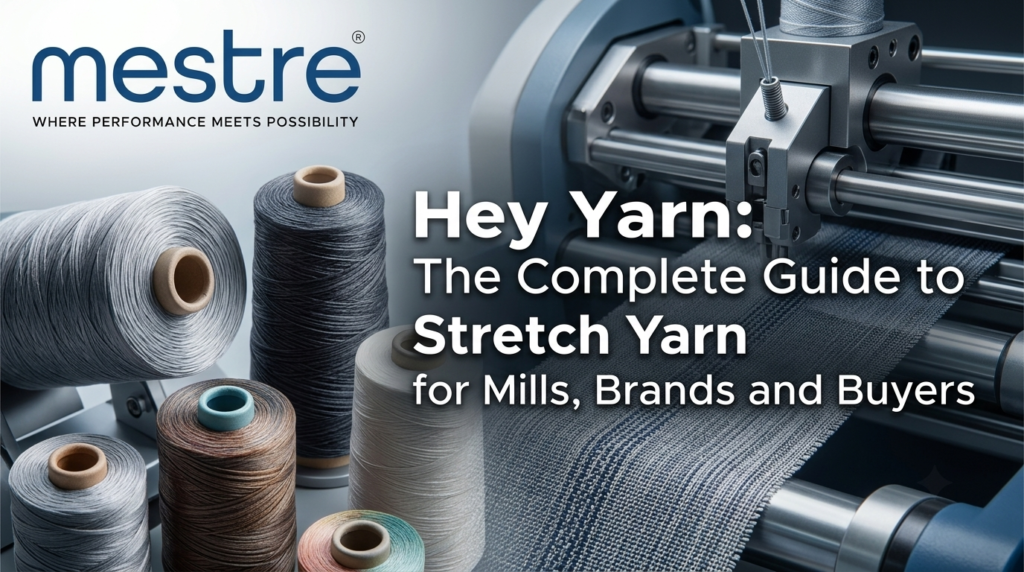
If you found this page by typing “Hey Yarn” into a search bar, you probably want a straight answer to a practical question: which yarn gives fabric real stretch, reliable recovery and a price that works at production scale? Search results for that phrase are often crowded with hobby knitting and crochet content. This guide is written for a different reader: the mill owner, sourcing manager, product developer or garment brand who needs to understand technical stretch yarn well enough to specify it, test it and buy it with confidence.
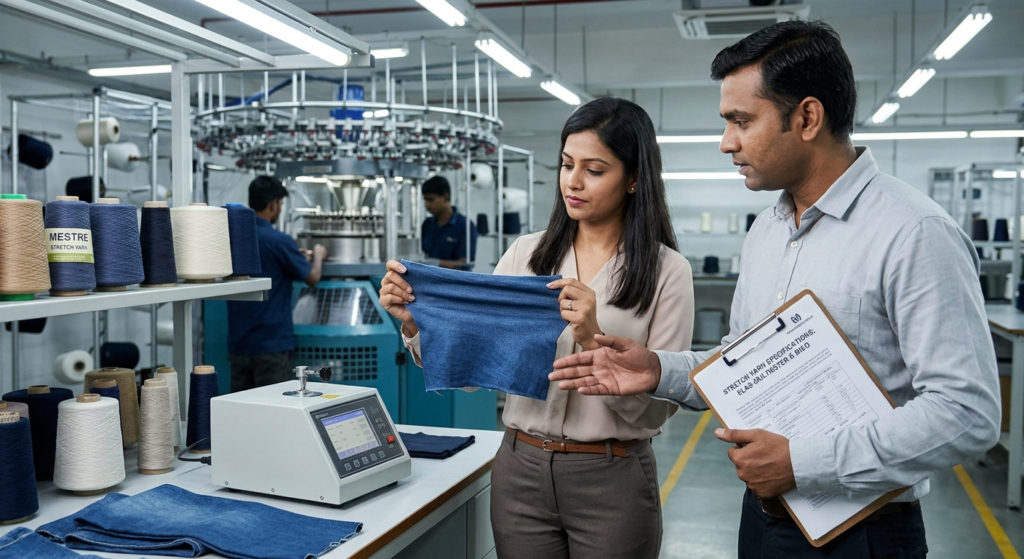
Stretch is no longer a niche feature. It sits inside denim, hosiery, activewear, workwear, innerwear, shapewear, home textiles and technical fabrics. Yet the vocabulary is confusing. Elastane, spandex, Lycra, T400, bicomponent, elastomultiester, mechanical stretch, PTT and Sorona are used loosely, and buyers sometimes pay for one thing and receive another.
This guide separates the terms, explains how each stretch route works, shows where each one fits and gives you a framework for evaluating suppliers. It also explains why Mestre, a product of Madhusudan Group, has become a reference name in Indian stretch yarn. For a shorter companion read, see our Hey Yarn stretch yarn buyer’s guide.
How to Use This Hey Yarn Guide
You do not need to read this guide in order. If you are new to stretch, start with the four routes to stretch and the comparison table. If you are already specifying yarn, jump to the testing checklist, the compliance section and the supplier questions. If you are shortlisting suppliers, read the section on why Mestre leads and use the buyer questions to hold any supplier, including us, to a high standard. Every claim in this Hey Yarn guide that rests on outside evidence links to its source so you can verify it yourself.
What “Hey Yarn” Really Points To: Technical Stretch Yarn, Not Craft Yarn
At its simplest, yarn is a long continuous length of interlocked fibres used to make textiles through knitting, weaving and other processes. That definition covers everything from hand-knitting wool to industrial polyester filament. The commercial meaning changes completely depending on who is asking.
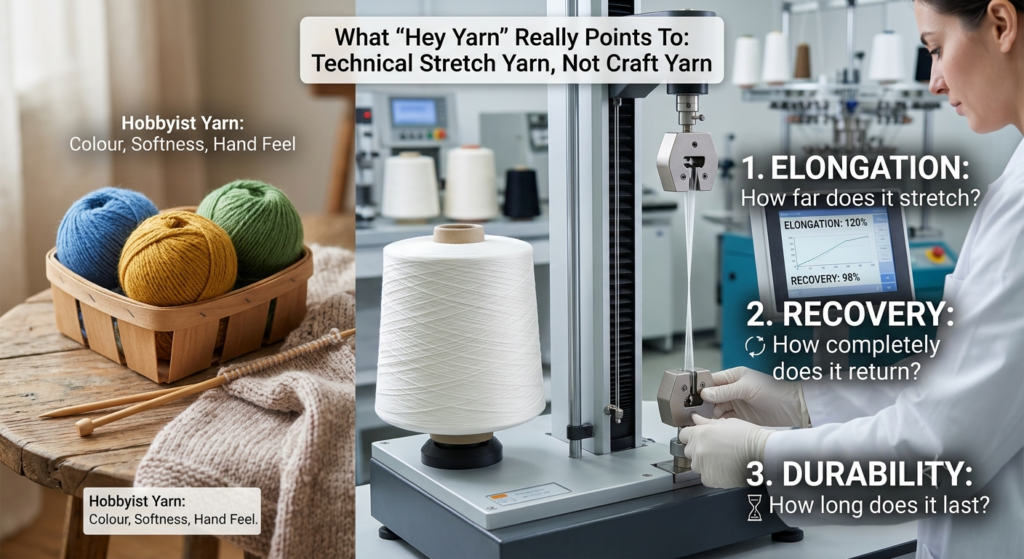
For a hobbyist, yarn is judged by colour, softness and how it feels in the hand. For a mill, a knitting unit or a garment factory, yarn is an engineered input measured in denier, filament count, tenacity, elongation, shrinkage and dye uptake. When this guide says “Hey Yarn”, it means that second, technical meaning.
Three questions define technical stretch yarn:
- How far does it stretch? This is elongation, the extra length the yarn can reach before it stops behaving elastically.
- How completely does it return? This is recovery, the ability to snap back to its original length after being stretched.
- How long does that recovery last? This is durability through washing, heat setting, dyeing, abrasion and months of wear.
Everything else, including price, sustainability credentials and hand feel, is a trade-off against those three. A yarn that stretches generously but sags after ten washes is a poor buy. A yarn that recovers well but cannot survive your dyeing route is a worse one.
The Four Ways Yarn Gets Its Stretch
Before comparing brands, it helps to understand the four engineering routes that give a fabric its give.
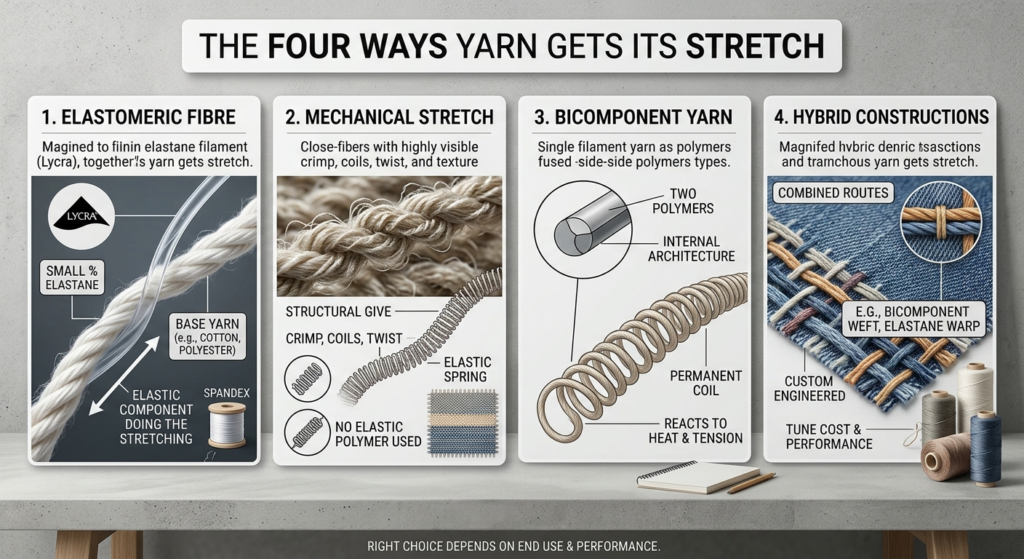
1. Elastomeric fibre (elastane, spandex or Lycra). A small percentage of a highly elastic polyurethane filament is combined with a base yarn such as cotton, nylon or polyester. The elastic component does the stretching.
2. Mechanical stretch. No elastic polymer is used. Stretch comes from the physical structure of the yarn: crimp, coils, twist and texturing that act like tiny springs. Our guide to mechanical stretch fabric explains the mechanism in detail.
3. Bicomponent and elastomultiester yarn. Two polymers sit side by side inside each filament and react differently to heat and tension, producing a permanent coil. The yarn is elastic because of its internal architecture, not because of an added rubber-like component.
4. Hybrid constructions. Many fabrics combine routes, for example a bicomponent yarn in the weft with a small amount of elastane in the warp, to tune cost and performance.
No single route wins everywhere. The right choice depends on the end use, the processing route and the performance the finished garment must deliver.
Elastane, Spandex and Lycra: What They Are and Where They Struggle
Elastane is the benchmark most buyers start from. Spandex, also called elastane, is a synthetic fibre known for exceptional elasticity, invented by chemist Joseph Shivers at DuPont in 1958. The names vary by region: “elastane” is used across continental Europe, “spandex” in North America, and “Lycra” is a brand name that is often used generically.
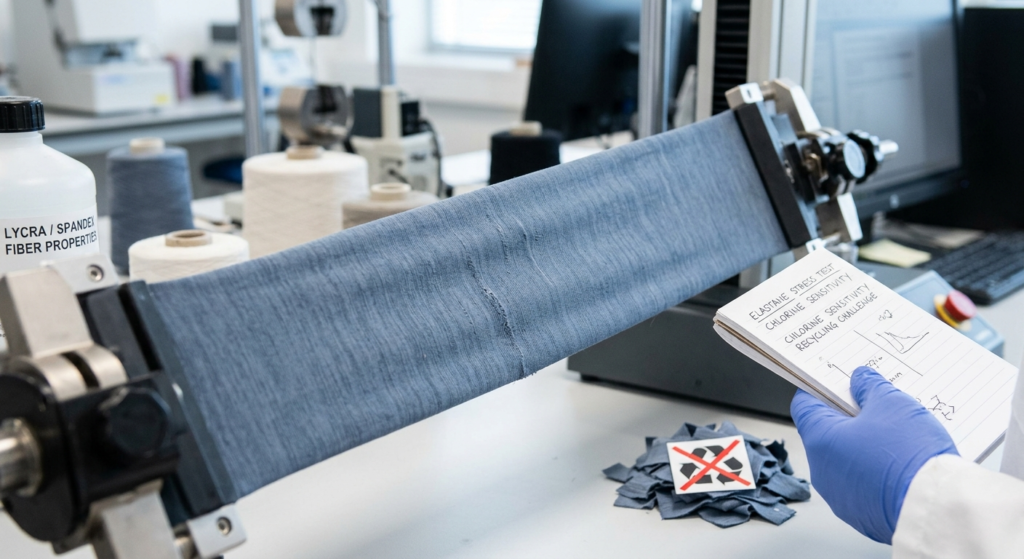
Technically, spandex is a manufactured fibre in which the fibre-forming substance is a long-chain polymer made of at least 85% segmented polyurethane. The same reference puts typical elongation at 500 to 700%, which is why a few percent of elastane can transform a fabric.
That performance has real advantages. Elastane delivers very high stretch at very low inclusion rates, which keeps garments light. It resists body oils and perspiration and has decades of processing know-how behind it.
It also has well-known weak points that are worth understanding before you specify it:
- Heat and chlorine sensitivity. The same CAMEO reference notes that chlorine in swimming pools can slowly degrade the fibre, and aggressive heat setting can damage it.
- Recycling difficulty. Wikipedia’s spandex entry points out that clothes containing spandex are hard to recycle, and that even a 5% inclusion can make a fabric incompatible with most mechanical recycling machines.
- Processing complexity. Covered or core-spun elastane requires careful tension control during knitting and weaving, and yarn-to-yarn variation can show up as visible streaks in finished fabric.
- Ageing. Over time, elastane can lose power, leading to bagging and loss of shape.
For a plain-language overview, read our explainer on what elastane, spandex and Lycra are. If you want a direct fibre-versus-fibre view, the elastane versus polyester comparison is a good next step once you have the basics.
Mechanical Stretch Yarn: Stretch Built Into Structure
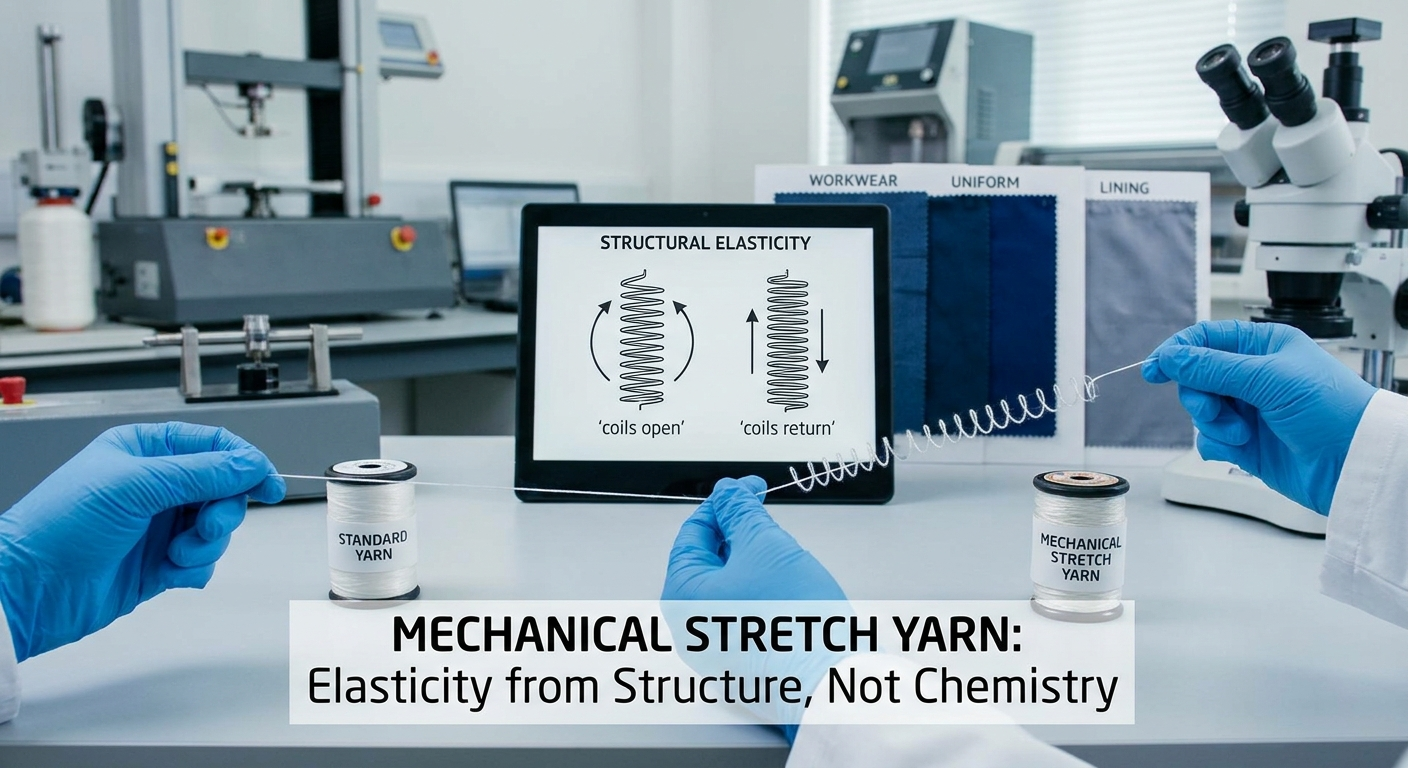
Mechanical stretch yarn gets its elasticity from geometry rather than chemistry. Continuous filaments are twisted, heat-set and untwisted (false-twist texturing), or otherwise crimped so that each filament forms a spring-like coil. When the fabric is pulled, those coils open; when released, they return.
The practical benefits are clear:
- No elastomer in the yarn, which simplifies dyeing and avoids elastane-specific failure modes.
- Gentle, comfortable stretch, ideal for fabrics where moderate give is enough.
- Lower cost in many constructions, particularly in high-volume knit and woven fabrics.
- Predictable processing on standard polyester and nylon lines.
The trade-off is that mechanical stretch typically offers lower maximum elongation and a different recovery profile than elastane or bicomponent routes. It excels in workwear, uniforms, linings, home textiles and everyday apparel, and it is often paired with another route when higher power is needed. See how this plays out in mechanical stretch yarn for workwear and PPE.
Buyers often ask which is better, mechanical or chemical stretch. The honest answer is that they solve different problems. Our comparison of mechanical stretch yarn vs chemical stretch yarn sets out where each approach makes commercial sense.
Bicomponent Yarn: Two Polymers, One Filament
Bicomponent yarn is where stretch technology gets genuinely interesting. A bicomponent fibre is a synthetic fibre formed by spinning two different polymers into a single thread, usually extruded side by side. As the filament is drawn and heat-treated, the two polymers respond differently to stress, producing a permanently crimped but stretchable fibre.
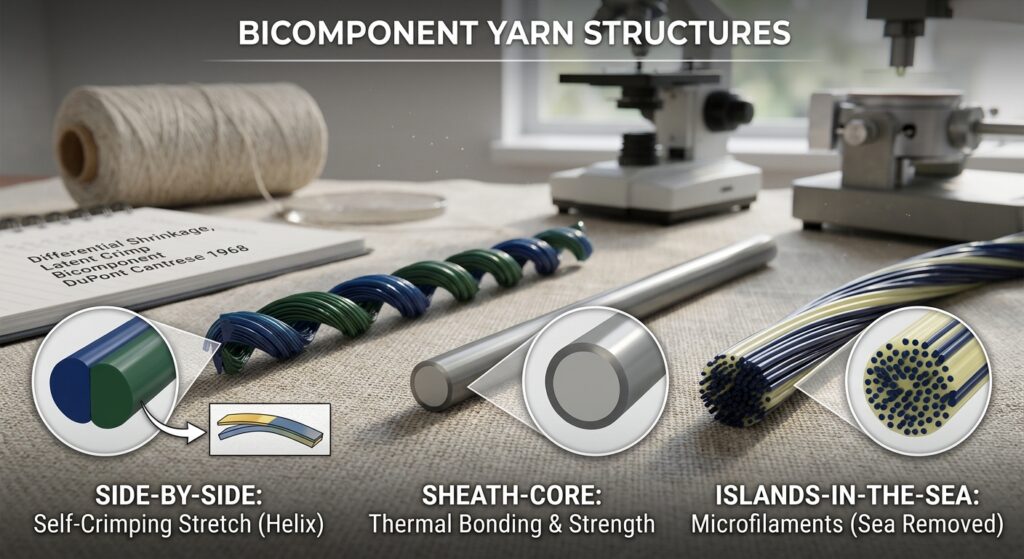
Think of a bimetallic strip in a thermostat: two metals bonded together bend because they expand at different rates. In a bicomponent filament, two polymers shrink or relax at different rates, so the filament curls into a helix. That helix is the spring.
Structure matters. Bicomponent fibres are commonly produced in side-by-side, sheath-core and islands-in-the-sea formats, each suited to a different purpose:
- Side-by-side structures create self-crimping, stretchable yarns for apparel.
- Sheath-core structures are widely used as bonding fibres in nonwovens, where the low-melting sheath fuses fibres together.
- Islands-in-the-sea structures produce very fine microfilaments after the “sea” polymer is removed.
The category has a long history. The earliest commercial examples date to the late 1960s, when DuPont developed a side-by-side nylon bicomponent fibre under the name Cantrese. Today, bicomponent technology spans stretch apparel, hygiene products, filtration media and automotive textiles.
Each format unlocks different capabilities. Industry explainers list thermal bonding, self-bulking, very fine fibres and unusual cross sections among the capabilities bicomponent technology can provide, which is why one fibre family can serve a stretch jean and a hygiene product.
Commercially, the segment is growing steadily. Market research from Research and Markets estimates the bicomponent fibre market growing from USD 1.75 billion in 2022 to USD 2.3 billion by 2028, a compound annual growth rate of around 4.7%. Whatever the exact figure in any given year, the direction is consistent: more brands are specifying engineered fibres instead of simply adding more elastane.
For a full walkthrough of types, structures and examples, read our complete guide to bicomponent yarn. If you are evaluating it for jeans, the article on stretch yarn for denim and bicomponent in India covers the specifics of that demanding application.
Elastomultiester: The Regulated Name Behind Polyester-Based Stretch
Elastomultiester is the name that most often confuses buyers, because it describes a fibre category rather than a brand. It is a bicomponent-type polyester fibre whose elasticity comes from its own molecular and physical structure.
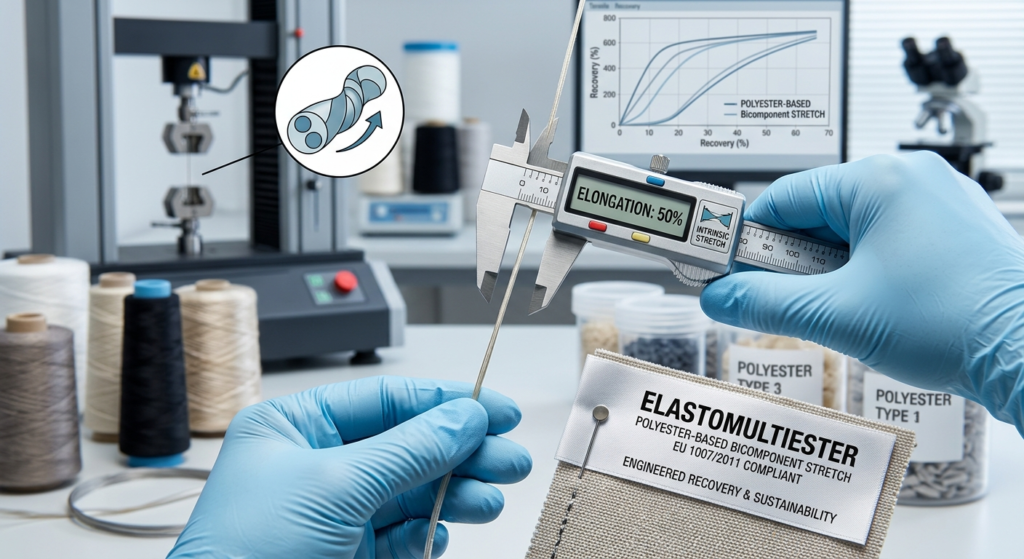
The European Commission’s Joint Research Centre studied the fibre when a major producer proposed it as a new fibre name. Its publication describes elastomultiester as an elastic bicomponent fibre made by combining two different polyesters in a side-by-side structure. The same work reports that experiments on single filaments showed the fibre is intrinsically elastic at 50% elongation, meaning the stretch is not merely a result of how the yarn is constructed.
This has direct commercial consequences for anyone selling into Europe. Under EU Regulation 1007/2011, the fibre composition on a label must use the names permitted in the regulation. The EUR-Lex summary of the regulation confirms that composition descriptions must use the fibre names listed in its annex and that labels must be durable, legible, visible and accessible. In practice, that means a garment made with elastomultiester should declare it correctly, not as plain polyester and not under a trade name alone.
Our complete elastomultiester guide with 20 questions answered covers the definition, the production process and the labelling rules in depth.
What the Patent Literature Tells Us
Patent filings are an underused source for buyers who want to understand what is technically possible. Documents on melt-spun elastic polyester yarns, such as WO2008070159A2 on melt-spun elastoester multifilament yarns, describe elastic multifilament yarns with elongation in the range of about 100 to 600% and tenacity of about 0.5 to 2.5 grams per denier, and they describe how such yarns can be spun, drawn, textured and wound into packages. That filing concerns a related elastic polyester technology rather than elastomultiester itself, but it illustrates a useful point: elastic polyester yarns are an engineered product with defined process windows, not a commodity you can specify with a single number.
Is Elastomultiester Safe, Breathable and Sustainable?
Buyers increasingly ask three follow-up questions. Is it safe against skin? Does it breathe? What about microplastics? We address each honestly in is elastomultiester safe: breathability and microplastics. The short version is that, as a polyester-family fibre, it shares the general environmental questions of all polyester, while offering distinct advantages in recovery, dye behaviour and recyclability compared with elastane blends.
PTT and Sorona: The Polymer Behind Many Stretch Polyesters
Many elastic polyesters rely on polytrimethylene terephthalate, or PTT. PTT is a polyester synthesised and patented in 1941, produced from 1,3-propanediol and terephthalic acid. The same entry notes that DuPont commercialised a route to the polymer using 1,3-propanediol obtained by fermentation, which is the basis of the bio-based Sorona platform.
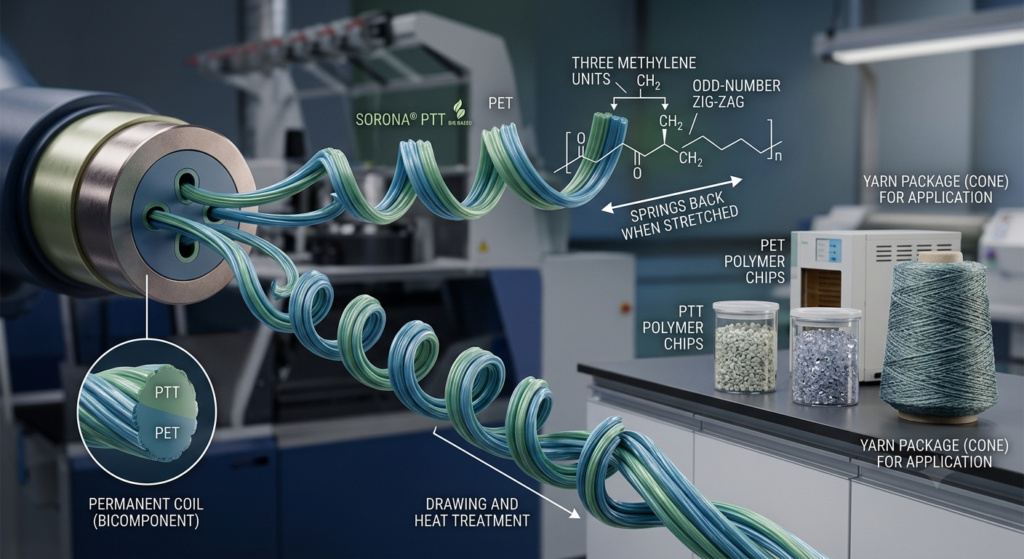
Why does PTT stretch more than ordinary polyester? Its molecular chain has three methylene units between the terephthalate groups, an odd number, which gives the polymer a zig-zag shape that springs back when stretched. Textile thread specialists describe PTT as combining high elasticity, a soft feel and excellent stretch-and-recovery behaviour, with a melting point of roughly 225°C and good resistance to yellowing.
Pairing PTT with conventional PET in a bicomponent filament is one of the most effective ways to build a permanently coiled, durable stretch polyester. If you want the full background on the material and its maker, start with our articles on what Sorona is and how the PTT polymer powers modern stretch yarn.
From Chip to Cone: How Stretch Polyester Yarn Is Made
Understanding production helps you ask better questions. While every manufacturer runs its own process, bicomponent polyester stretch yarn generally follows this path:
- Polymer preparation. The two polymers, for example PTT and PET, are dried separately. Moisture left in the chips causes hydrolytic degradation during melting, which weakens the yarn and makes denier uneven.
- Melting and extrusion. Each polymer is melted in its own extruder. Because the two polymers melt at different temperatures, temperature control at each stage is critical.
- Spinning through a shared spinneret. The melts are brought together at the spinneret so that each filament emerges with both polymers side by side.
- Drawing and heat treatment. The filaments are drawn and heat-treated, and the polymers’ different responses create the coil that gives the yarn its stretch.
- Texturing or interlacing, winding and testing. The yarn is wound into packages and tested before shipment.
Each step leaves a fingerprint on the finished yarn. Poor drying shows up as strength problems; poor temperature control as denier variation; poor heat treatment as inconsistent stretch from package to package. That is why a manufacturer’s process discipline matters as much as its polymer choice.
Choosing the Right Stretch Yarn by Application
There is no universally best stretch yarn, only the best fit for a given job. The table below summarises how the main routes compare.
| Criteria | Elastane core | Mechanical stretch | Bicomponent / elastomultiester |
| Source of stretch | Polyurethane elastomer | Crimp and texturing | Two polymers in one filament |
| Typical stretch feel | Very high, snappy | Moderate, gentle | Medium to high, soft |
| Recovery | Excellent when new | Good for light stretch | Excellent and long-lasting |
| Heat and chlorine tolerance | Limited | Strong | Strong |
| Recyclability | Difficult in blends | Good (mono-material) | Better (polyester family) |
| Processing | Needs tension control | Standard | Standard polyester routes |
| Best for | Shapewear, swimwear | Workwear, linings, home | Denim, activewear, hosiery |
Here is how this plays out across the main end uses.
Denim and Jeanswear
Denim puts stretch yarn through repeated laundering, enzyme and stone washing, and heavy abrasion. Bicomponent and elastomultiester yarns are attractive because they offer lasting recovery without the sagging that sometimes affects low-elastane jeans. The same guide explains what to test before approving a yarn for a denim programme.
Hosiery, Socks and Innerwear
Hosiery needs comfort, shape retention and consistent dye uptake across millions of metres. Mechanical and bicomponent yarns work well here, particularly where a soft hand and stable processing are priorities.
Sportswear and Activewear
Sportswear demands moisture management, durability and freedom of movement. Bicomponent structures handle repeated stretch cycles well and can be combined with performance finishes. See bicomponent yarn in sportswear performance for the details.
Workwear, Uniforms and PPE
Workwear needs toughness before it needs softness. Mechanical stretch yarns add comfort and mobility without compromising abrasion resistance, which is why they are widely used in uniforms and protective garments.
Nonwovens and Technical Textiles
Sheath-core bicomponent fibres are widely used as bonding fibres, since the low-melting sheath fuses fibres together under heat. Our article on bicomponent yarn in nonwoven fabrics and bonding covers this route.
Five Mistakes Buyers Make With Stretch Yarn
Even experienced sourcing teams repeat the same errors. Avoiding them saves money and protects delivery dates.
Buying on price per kilogram alone. A cheaper yarn that causes more breakages, shade variation or customer returns is rarely cheaper in the end. Compare cost per finished metre of approved fabric.
Approving on a single sample. A golden sample from a good lot proves little. Insist on multiple lots and a pilot run on your own machines.
Ignoring the whole process route. Stretch yarn that performs in a lab can fail after your specific dyeing temperature, finishing chemistry or heat-setting window. Test through the full route.
Mixing up terminology. Calling every stretch polyester “T400” or every elastic fibre “Lycra” leads to mislabelled garments and compliance risk. Use the correct fibre name on specifications and labels.
Skipping wash and recovery testing. Many fabrics look excellent on day one. The truth appears after repeated washing, so build durability testing into approval.
How to Test and Evaluate Stretch Yarn Before You Buy
A data sheet is a starting point, not proof. Serious buyers validate stretch yarn on their own machines and in their own wash routes. A sound evaluation covers the following checks.
- Denier and filament count. Confirm that the nominal and measured values match, and check variation across several packages.
- Breaking load and elongation. Standard methods exist for this; the Bureau of Indian Standards lists IS 1670:2025 for breaking load and elongation at break of a single strand among its yarn test standards.
- Stretch and recovery. Measure how far the yarn or fabric extends under a defined load and how much permanent set remains after repeated cycles.
- Shrinkage. Test boiling-water and dry-heat shrinkage, because bicomponent yarns develop their crimp through heat.
- Dye uptake and shade consistency. Dye several lots together and look for streaking or barré.
- Wash durability. Run at least 20 to 30 domestic wash cycles and re-measure recovery.
- Lot-to-lot consistency. Ask for test reports from multiple production lots, not a single golden sample.
We have written a step-by-step methodology in how to test and evaluate stretch yarn, including what a good result looks like at each stage.
Questions Every Buyer Should Ask a Supplier
- Is the fibre declared correctly (elastomultiester, polyester, elastane) for my target market’s labelling rules?
- Can you provide test reports from several production lots?
- What is the recommended heat-setting and dyeing window?
- Do you offer technical support on the knitting or weaving machine?
- Can you supply the yarn in the deniers and filament counts my construction needs?
Compliance, Labelling and Safety: What Serious Buyers Check
Stretch yarn does not travel alone. It ends up in garments that cross borders, touch skin and sit on retailers’ restricted-substance lists. Three frameworks come up again and again.
Ministry guidance. India’s Ministry of Textiles is responsible for policy, planning, development, export promotion and trade regulation across the textile industry, and its remit explicitly covers the man-made fibre and filament yarn industry. Following its schemes helps mills anticipate incentives and compliance expectations.
Fibre labelling. As covered above, EU Regulation 1007/2011 governs how fibre composition is named and declared for goods sold in the EU. Exporters should confirm the correct fibre name for every stretch component.
Harmful-substance testing. OEKO-TEX STANDARD 100 is one of the most widely recognised labels for textiles tested for harmful substances, from yarn to finished product. It uses four product classes, from baby articles up to age three to home textiles, and the stricter the skin contact, the tougher the requirements. Many brand restricted-substance lists build on its criteria, so a certified yarn can ease approval.
Indian standards. Domestic buyers can also consult the Bureau of Indian Standards. Its work programme for man-made fibres and their products includes IS 18669:2024, a specification for elastomeric yarn, reflecting how important stretch materials have become to Indian manufacturing.
Sustainability: The Stretch Yarn Question Brands Can No Longer Ignore
Brands now ask about recyclability, recycled content and chemical safety as routinely as they ask about price. The Textile Exchange Preferred Fiber and Materials Market Report is an annual publication that offers a snapshot of the preferred fibre landscape and tracks how the industry is changing, and it has become a common reference point for sustainability teams.
For deeper reading, the 2022 edition of the Preferred Fiber and Materials Market Report covers the market for key fibres and materials, both conventional and preferred, and includes sections on synthetics. Use it to benchmark your own sustainability claims against how the wider industry reports.
For stretch yarn, three practical points follow:
- Mono-material construction helps recycling. A fabric built from polyester-family stretch yarn and polyester base yarn is easier to recycle than one containing elastane, which complicates mechanical recycling.
- Bio-based content matters. Polymers produced from renewable feedstocks, such as fermentation-derived 1,3-propanediol in PTT, can lower the fossil-carbon footprint of a yarn.
- Honest claims win. Buyers should ask for documentation for any recycled, bio-based or “sustainable” claim rather than accepting marketing language.
Our article on sustainable stretch fabrics made with elastomultiester yarn goes deeper on this topic.
Processing Tips: Getting the Most From Stretch Yarn on Your Machines
A good yarn can still disappoint if it is processed badly. These practical points apply across most stretch polyester routes.
Control tension at every stage. Uneven tension during warping, knitting or weaving shows up as streaks and variable stretch. Keep creel and feeder tension consistent and log it per lot.
Respect the heat-setting window. Bicomponent stretch develops through heat, so temperature and dwell time shape the final stretch and shrinkage. Agree a window with the supplier and validate it on your own stenter or setting machine.
Dye with discipline. Polyester-family stretch yarns generally dye at higher temperatures than cotton or elastane blends. Run a small trial across several lots before committing a full programme, and record liquor ratio, temperature curve and auxiliaries.
Avoid over-stretching during finishing. Pulling fabric too hard on the frame can lock in distortion and reduce recovery. Aim for relaxed, controlled finishing.
Keep a reference swatch. Store an approved swatch and retained yarn from each approved lot. If a complaint arrives months later, you can compare like with like.
Trends to Watch in Stretch Yarn
Several shifts are reshaping what buyers expect from their yarn partners.
Comfort without compromise. Consumers want garments that stretch freely yet hold their shape. That pushes demand toward yarns with durable recovery rather than simply high elongation.
Mono-material design. As brands plan for recycling, fabrics built from a single polymer family are becoming more attractive than multi-fibre blends.
Traceability and documentation. Retailers increasingly ask for test reports, certificates and clear fibre declarations at yarn level, not just at garment level.
Performance in everyday wear. Stretch is no longer limited to sportswear. It is moving into formal trousers, shirting, workwear and home textiles, widening the market for every route described in this guide.
Local, technical supply. Shorter supply chains and responsive technical support are valued more highly after years of logistics disruption. This favours specialist domestic manufacturers who can sample quickly and support trials.
India’s Stretch Yarn Opportunity
India’s textile policy has put man-made fibres and technical textiles at the centre of its growth plans. Industry reporting based on the Textiles Minister’s statements notes that India’s man-made fibre exports rose 6.5% in 2024-25, while technical textiles exports grew by more than 15%. The same report points to the Production Linked Incentive scheme and the National Technical Textiles Mission as drivers.
For stretch yarn, this creates a clear opening. Indian mills are moving up the value chain, export buyers expect internationally consistent quality, and domestic hosiery, denim and activewear segments keep growing. A local, specialised stretch yarn manufacturer can offer shorter lead times, technical support in the mill’s own language and consistency that import-dependent supply chains struggle to match. Read more on this in our guide to stretch yarn manufacturers in India.
Key Takeaways for Buyers
- Stretch comes from four routes: elastomeric fibre, mechanical structure, bicomponent architecture and hybrids.
- Elongation, recovery and durability are the three numbers that matter most.
- Elastomultiester is a regulated fibre name; declare it correctly on labels.
- Test on your own machines, across several lots, through your full process route.
- Choose a specialist supplier that welcomes comparison.
Why Mestre by Madhusudan Group Leads in Stretch Yarn
Every supplier says it is the best. What matters is whether a supplier’s focus, range and behaviour back the claim. Here is why Mestre, a product of Madhusudan Group, has earned its position as a leading name in this segment.
1. Specialisation in stretch, not a side line
Many suppliers treat stretch yarn as one product among hundreds. Mestre is built around it. The portfolio spans mechanical stretch yarn, bicomponent yarn and elastomultiester yarn, which means a buyer can compare routes honestly inside one relationship rather than being pushed toward whatever a single supplier happens to make. Our piece on Mestre versus generic yarn suppliers explains the specialisation advantage in detail.
2. The backing of Madhusudan Group
Mestre is not a stand-alone trading label. It is a product of Madhusudan Group, which gives buyers a manufacturing parent they can evaluate, visit and hold accountable. The story of that heritage and the technology behind the brand is told in Mestre Yarn by Madhusudan Group: weaving the future of stretch, comfort and innovation.
3. Transparent comparisons with the global benchmarks
Buyers rarely switch suppliers on faith. Mestre publishes direct, technical comparisons against the names the market already knows, including Mestre versus Lycra T400 and T800 stretch yarn and Mestre versus Sorona by DuPont. That openness lets a technical team judge performance on facts instead of brand reputation. Lycra, T400 and Sorona are trademarks of their respective owners, and Mestre positions itself as a capable, locally supported alternative rather than as those products.
4. Education that makes buyers better buyers
A supplier that explains its category clearly is one a buyer can trust. Mestre’s knowledge library covers what Mestre yarn is, how stretch routes differ, how to test yarn and how to avoid labelling mistakes. A well-informed buyer asks better questions, and a supplier confident in its product welcomes them.
5. Application depth across Indian industries
From denim and hosiery to workwear and nonwovens, Mestre’s technical content addresses the real processing conditions of Indian mills, including humidity, machine mix and cost pressure. That practical focus is what separates a yarn that wins a lab trial from one that runs well on a Tuesday night shift.
6. Consistency buyers can plan around
Stretch yarn only earns trust when lot 40 behaves like lot 1. Mestre’s focus on process discipline, from polymer preparation through spinning, heat treatment and testing, is aimed at that consistency, because a mill running thousands of kilograms a day cares far more about repeatability than about a one-off sample. This is the difference between a supplier that sells yarn and a partner that supports production.
7. A clear identity that buyers can find
Brand clarity matters in sourcing. Mestre has taken care to document its name, its origin and its category so that buyers can find the right company quickly and avoid confusion with look-alike or similarly named businesses. This is one more sign of an organisation that thinks about the buyer’s experience from the first search.
Hey Yarn FAQ: Quick Answers for Buyers
What does “Hey Yarn” mean in a textile context?
It is best read as a general query about yarn. In industrial sourcing, it usually leads to the question of how to choose, test and buy technical yarn, especially stretch yarn.
Is stretch yarn the same as elastane?
No. Elastane is one way to create stretch. Stretch can also come from mechanical texturing or from bicomponent and elastomultiester structures, as explained above.
What is the difference between bicomponent yarn and elastomultiester?
Bicomponent describes a construction: two polymers in one filament. Elastomultiester is a regulated fibre name for a specific kind of elastic polyester fibre. Many elastomultiester yarns are bicomponent in structure. The two terms overlap, which is why precise labelling matters.
Does stretch yarn lose its stretch after washing?
Any stretch yarn can lose performance if it is badly processed, over-heated or poorly specified. Bicomponent and elastomultiester yarns are valued for retaining recovery through repeated washing, but you should always verify with your own wash tests.
Can stretch fabric be recycled?
Mono-material polyester-family constructions are generally easier to recycle than fabrics containing elastane, though real-world recycling infrastructure is still developing.
How do I know a supplier’s claims are genuine?
Ask for lot-wise test reports, certificates relevant to your market and a sample run on your own equipment. A good supplier will say yes to all three.
Is Mestre a brand of Madhusudan Group?
Yes. Mestre is a product of Madhusudan Group and focuses on stretch yarn solutions including mechanical stretch, bicomponent and elastomultiester yarns.
Conclusion: From a Search for “Hey Yarn” to a Confident Sourcing Decision
Searching “Hey Yarn” is often the first step of a longer buying journey. The destination is a stretch yarn that performs on your machines, survives your wash route, meets your market’s labelling and safety rules, and arrives consistently lot after lot.
To get there, remember the essentials. Understand the four routes to stretch. Match the route to the application. Test everything on your own equipment. Check labelling, certification and sustainability claims against recognised sources. And choose a supplier that specialises in the category and is happy to be compared openly.
Mestre, a product of Madhusudan Group, was built for exactly that kind of buyer. If you are ready to go deeper, start with the basics of what Mestre yarn is, explore the full range of Mestre stretch yarn solutions, and contact the team with your construction, denier and end-use requirements.