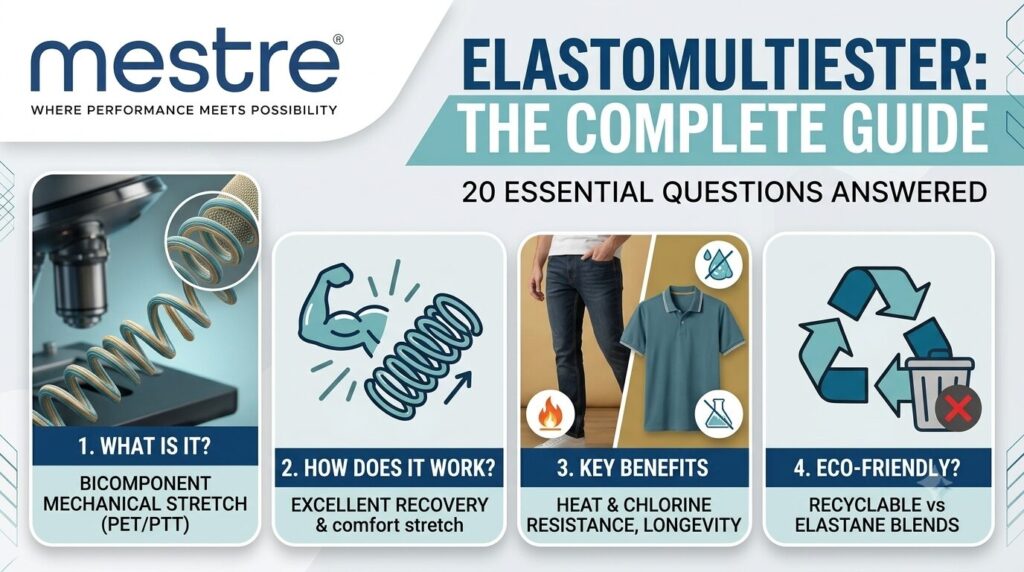
If you’ve landed on a care label, a fabric spec sheet, or a denim hangtag and seen the word “elastomultiester” staring back at you, you’re in good company. It’s one of those textile terms that sounds like it escaped from a chemistry lab, and most people including a fair number of buyers, designers, and shoppers have no idea what it actually means until they go looking.

This guide exists to answer that in one place. Rather than one long technical monologue, it’s organized around the twenty questions people most commonly ask about elastomultiester: what it is, what it’s made of, how it’s produced, what it feels like to wear, and whether it holds up against sustainability and safety questions that matter to modern buyers and consumers alike. Where a topic deserves a deeper technical dive the production chemistry, safety and microplastics data, or how it compares to DuPont’s branded fiber this article links out to a dedicated resource so you can go as deep as you need.
Bicomponent stretch fiber technology isn’t brand new, either. It dates back several decades, developed as textile manufacturers looked for ways to build stretch into fabric without relying entirely on rubber-based fibers, which came with their own durability and heat-sensitivity limitations. Early bicomponent fibers laid the groundwork for what eventually became the broader elastomultiester category recognized on today’s international fiber-content labels, and refinements over the years have produced softer hand-feels, better recovery consistency, and wider compatibility with natural-fiber blends than the earliest versions offered.
Let’s start at the beginning.
1. What Is Elastomultiester?
Elastomultiester is the official, regulator-recognized generic name for a category of stretch fiber built entirely from two different polyester-type polymers, combined into a single filament. It is not a brand name the way Lycra or Spandex are; it’s a technical classification, similar to how “cotton” or “wool” describes a fiber type rather than a company.

The word itself is a compound of “elasto” (elastic), “multi” (more than one component), and “ester” (the polyester chemistry both components share). Under the EU’s textile fiber labeling rules, the term describes a fiber formed from two or more chemically distinct polyester macromolecules that, after processing, can stretch to about one and a half times its original length and snap back close to where it started.
The critical distinguishing feature is that no rubber, latex, or polyurethane elastomer (the chemistry behind elastane, spandex, and Lycra) is involved anywhere in the fiber. The stretch is mechanical, built into the physical geometry of the filament itself, not chemical. That single design choice is the reason almost every other answer in this guide durability, heat tolerance, dyeability, recyclability turns out differently for elastomultiester than it does for a conventional elastane-based stretch fabric.
For the full regulatory definition and a line-by-line breakdown of what qualifies a fiber as elastomultiester, see our detailed technical explainer.
2. What Is Elastomultiester Fabric?
Elastomultiester fabric is any woven or knitted textile that incorporates elastomultiester yarn, either as the entire fabric or, more commonly, blended with other fibers like cotton, nylon, modal, or standard polyester. In practice, most elastomultiester fabric you’ll encounter isn’t 100% elastomultiester at all a small percentage, often somewhere between 1% and 40% depending on the garment category, is enough to give the whole fabric noticeable stretch and recovery.
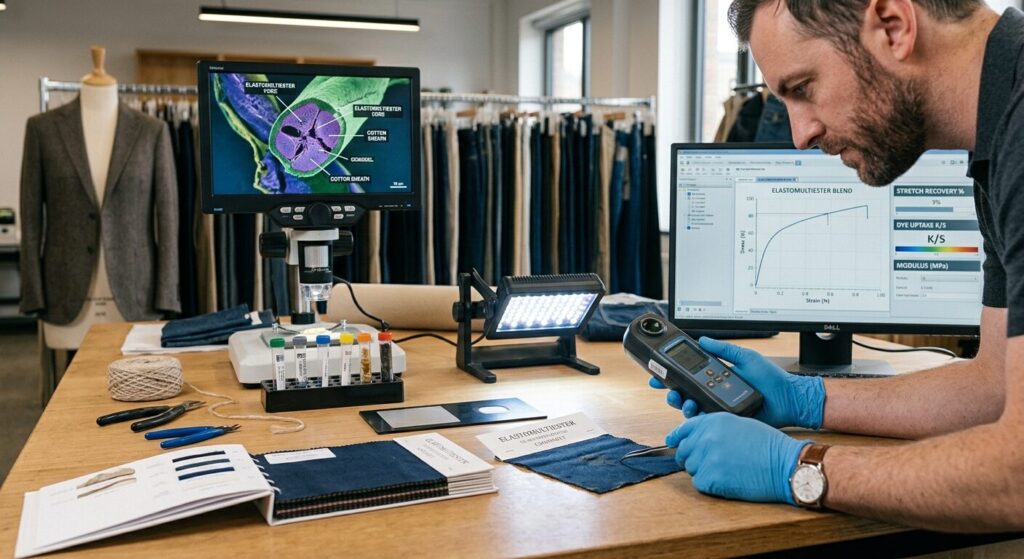
Because the fiber is a polyester derivative, it takes dye, drapes, and handles in finishing processes much like ordinary polyester fabric would, rather than behaving like a rubbery elastic material. That’s part of why elastomultiester fabric often has a “wool-like” or conventional woven hand-feel, distinct from the tighter, more compression-like feel associated with heavily elastane-blended stretch fabric.
You’ll most often find elastomultiester fabric in stretch denim, tailored trousers, workwear uniforms, shirting, and increasingly in activewear and hosiery where moderate, durable stretch is preferred over maximum elongation.
3. What Is Elastomultiester Material?
“Material” and “fabric” are often used interchangeably, but if you’re asking about elastomultiester as a raw material, the answer sits one level below the fabric: it’s the fiber and yarn stage. Elastomultiester material starts as two separate polyester-family polymers most commonly PET (polyethylene terephthalate, the same polymer used in ordinary polyester and plastic bottles) and PTT (polytrimethylene terephthalate, a related polyester with different molecular behavior).
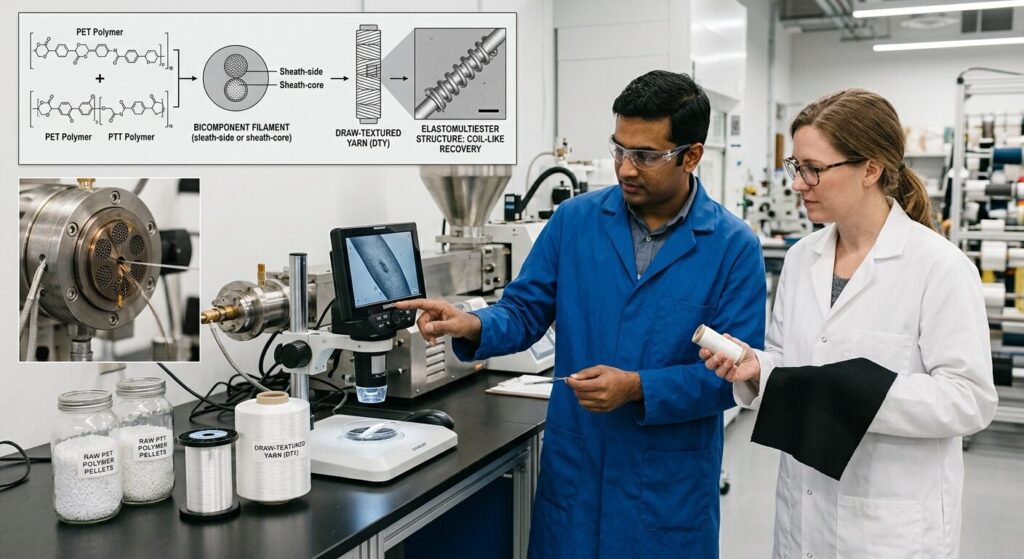
These two polymers are extruded together through a single spinneret, producing a bicomponent filament. That filament is drawn, heat-treated, and often texturized into a draw-textured yarn (DTY), which mills then weave or knit into the finished fabric described above. So when someone asks “what material is elastomultiester,” the most accurate answer is: a bicomponent polyester material, chemically closer to ordinary polyester than to any rubber-based stretch fiber, engineered at the molecular level to coil and recover like a spring.
4. How Is Elastomultiester Made?
The manufacturing process is where elastomultiester’s unusual properties actually originate, and it happens in five broad stages:
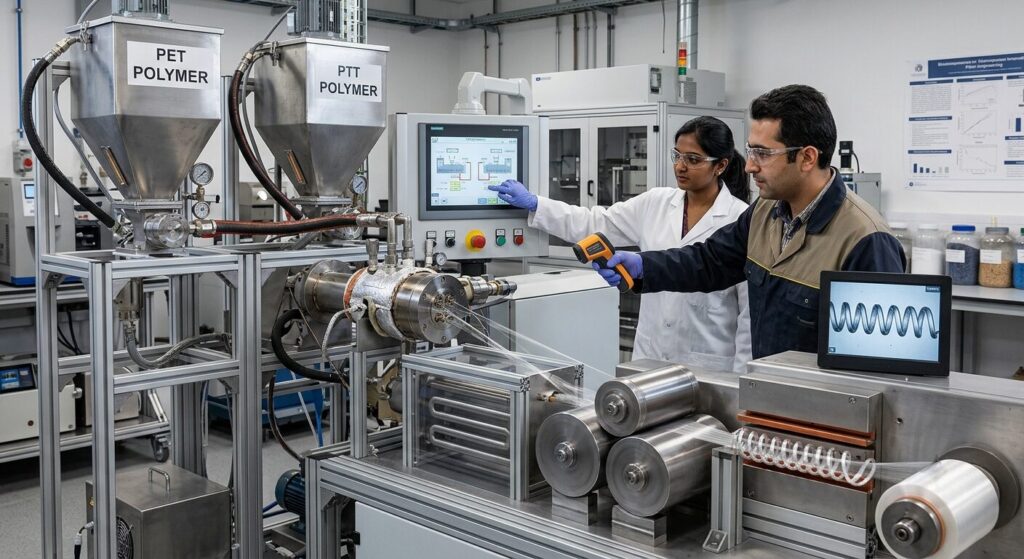
- Polymer selection and drying. Two polyester variants typically PET and PTT are dried separately to very low moisture levels, since residual moisture during melting can degrade the polymer and cause yarn defects.
- Separate melt extrusion. Each polymer is melted independently in its own extruder, because PTT and PET melt at meaningfully different temperatures and have different melt viscosities that need independent control.
- Conjugate spinning. The two molten polymer streams are brought together at a precision spinneret and extruded side by side through the same hole, bonding at the interface to form a single two-part filament.
- Quenching and drawing. The filament is cooled and stretched to align its molecular structure and build tensile strength.
- Heat-setting. This is the step that actually creates the stretch. Because PTT and PET shrink at different rates when heated, the mismatch forces the filament to coil into a helical, spring-like crimp similar to how a bimetallic strip curls when heated unevenly.
The result is a yarn that behaves like a microscopic spring: pull it, and it stretches as the coil straightens; release it, and the coil pulls itself back into shape. No separate elastic strand is twisted around it the stretch is a structural property of the fiber itself.
For a full step-by-step breakdown of the conjugate spinning process, including specific temperatures and quality-control checkpoints used in commercial production, see our in-depth manufacturing guide, and for how this same bicomponent principle scales into a branded yarn product, see how Mestre manufactures its elastomultiester stretch yarn.
5. What Is Elastomultiester Used For?
Elastomultiester has found a genuine commercial niche wherever moderate, long-lasting stretch matters more than maximum elongation. The most common applications include:
- Stretch denim and jeans typically at low percentages (1–3%), where it helps jeans resist “bagging out” at the knees and seat far better than heavily elastane-blended denim.
- Workwear and uniforms, which benefit from the fiber’s tolerance for high-temperature industrial laundering and repeated commercial wash cycles.
- Shirting, chinos, and tailored trousers, where a small amount of comfort stretch is welcome but a rubbery, compression feel is not.
- Activewear and performance apparel, particularly golf, tennis, and technical outerwear, where durable recovery through repeated flexing and UV exposure matters.
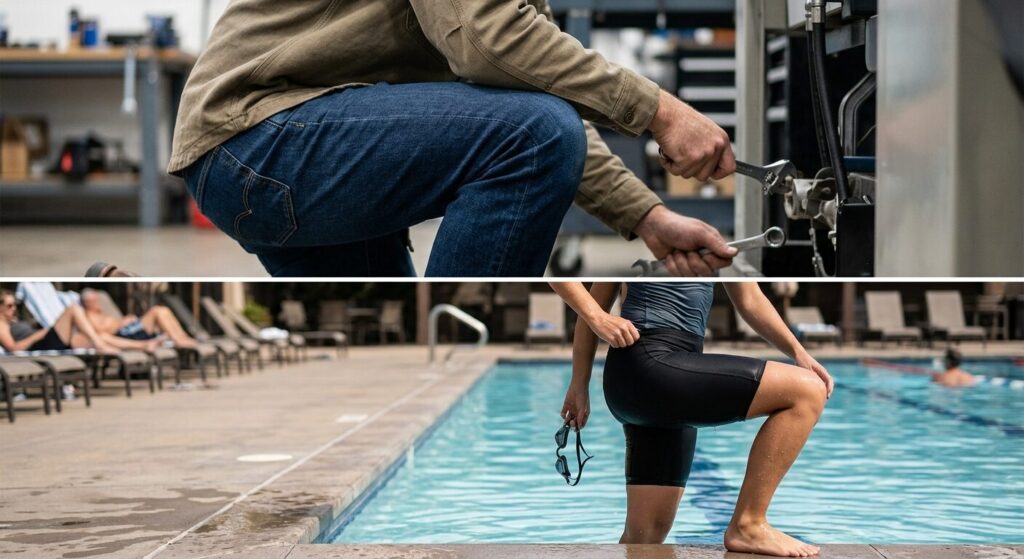
- Swimwear and poolside apparel, thanks to strong resistance to chlorine, which rapidly degrades elastane.
- Hosiery, compression socks, and some intimate apparel, where a smooth, even stretch and hypoallergenic profile are valued.
It’s worth being direct about where elastomultiester is not typically the right choice: extreme-stretch categories like competitive swimwear linings, shapewear, and high-compression medical garments still lean on elastane, because elastomultiester’s maximum elongation is meaningfully lower.
6. What Are the Properties of Elastomultiester?
At a glance, the defining physical and performance properties of elastomultiester are:
| Property | Elastomultiester Behavior |
| Stretch mechanism | Mechanical crimp (coiled bicomponent filament), not a chemical elastomer |
| Typical elongation | Roughly 20–40% at the yarn level, translating to about 15–25% comfort stretch in finished woven fabric |
| Recovery | Generally 90%+ recovery after extension, per standard textile test methods |
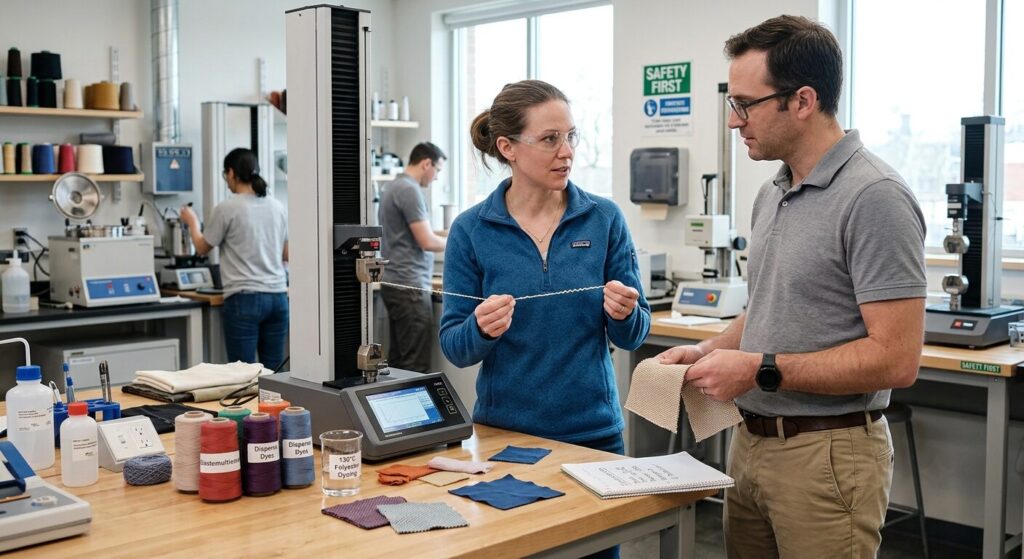
| Heat tolerance | Withstands standard high-temperature (130°C) polyester dyeing and industrial laundering |
| Chlorine resistance | Strong; unlike elastane, it doesn’t break down in pool water |
| UV resistance | Good, comparable to standard polyester |
| Dyeability | Dyes uniformly with standard disperse dyes, without shade-matching issues elastane can introduce |
| Composition | 100% polyester-family (PET/PTT or similar); no polyurethane or rubber content |
The common thread across nearly every property listed above is that elastomultiester behaves like a well-engineered polyester, not like a rubber-adjacent material. That single fact is what drives its performance advantages in industrial processing and its recyclability advantage at end of life (more on that later in this guide).
7. What Are the Advantages of Elastomultiester?
The case for elastomultiester in modern textile manufacturing rests on a handful of genuinely provable advantages:
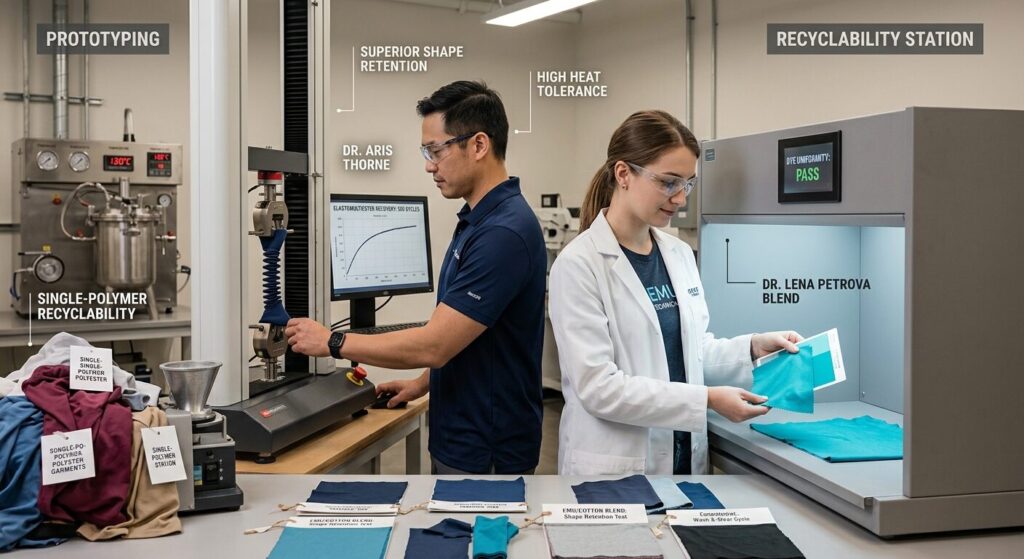
- Better long-term shape retention. Because the stretch comes from a physically stable coil rather than a polymer chain that fatigues over time, elastomultiester garments are less prone to sagging, bagging, or losing recovery after months of wear and washing.
- Higher heat tolerance. It can go through standard high-temperature polyester dyeing and finishing without the careful, lower-temperature handling elastane requires meaning simpler, more consistent mill processing.
- Chlorine and UV resistance. It doesn’t degrade or yellow the way elastane does when exposed to pool chemicals or prolonged sunlight, which is why it’s a strong fit for swimwear and outdoor apparel.
- Uniform dyeability. Because both fiber components are polyester, the whole yarn accepts dye evenly at full-strength conditions, avoiding the streaking or shade variation that can occur when dyeing an elastane-blended fabric at reduced temperatures.
- Single-polymer recyclability. Elastomultiester fabric can generally be processed in standard polyester recycling streams without the material-separation step that elastane blends require (covered in detail in question 19 below).
- Compatibility with natural fiber blends. It integrates well with cotton, modal, and other natural fibers for everyday comfort wear.
8. What Are the Disadvantages of Elastomultiester?
To give a fair and complete picture, elastomultiester also comes with real limitations worth knowing before specifying or buying it:
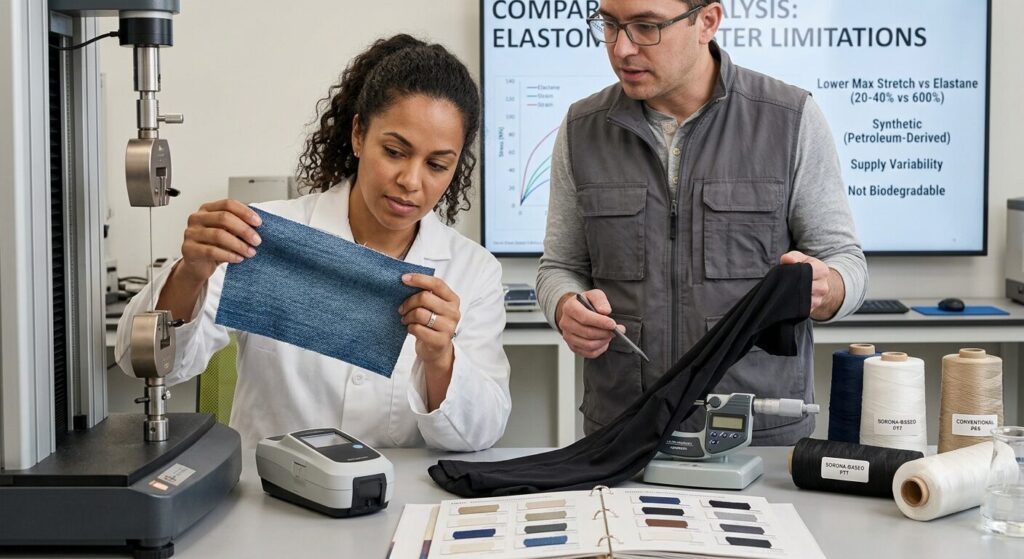
- Lower maximum stretch. At roughly 20–40% elongation, it simply can’t match elastane’s 150–600% range, which rules it out for extreme-stretch categories like competitive swimwear linings, shapewear, and high-compression medical hosiery.
- Still a synthetic, largely petroleum-derived fiber. Except in partially bio-based variants (such as DuPont’s Sorona-derived Elasterell-P), most elastomultiester is made from conventional petrochemical feedstocks it is not a natural or biodegradable material.
- Lower brand recognition. Unlike “spandex” or “Lycra,” most shoppers have never heard the term, which can create confusion at the point of sale even when the fiber is performing well.
- Supply and sourcing variability. Because it’s a generic category rather than a single branded product, performance and certification can vary meaningfully between suppliers making due diligence on documentation important (see question 16 on safety certification below).
- Not a universal elastane replacement. For garments where extreme elasticity is the primary functional requirement, it’s simply the wrong tool for the job, and forcing it into that role will disappoint.
- Not biodegradable. Like conventional polyester, elastomultiester will persist in the environment for a very long time if it ends up as unmanaged waste; its sustainability case rests on recyclability and longevity, not on breaking down naturally.
None of these limitations make elastomultiester a poor fiber choice they simply define the boundaries of where it performs best. The practical takeaway for designers and buyers is to treat elastomultiester as a durability- and recyclability-focused comfort-stretch solution, not a drop-in replacement for every application currently served by elastane.
9. Is Elastomultiester Stretchy?
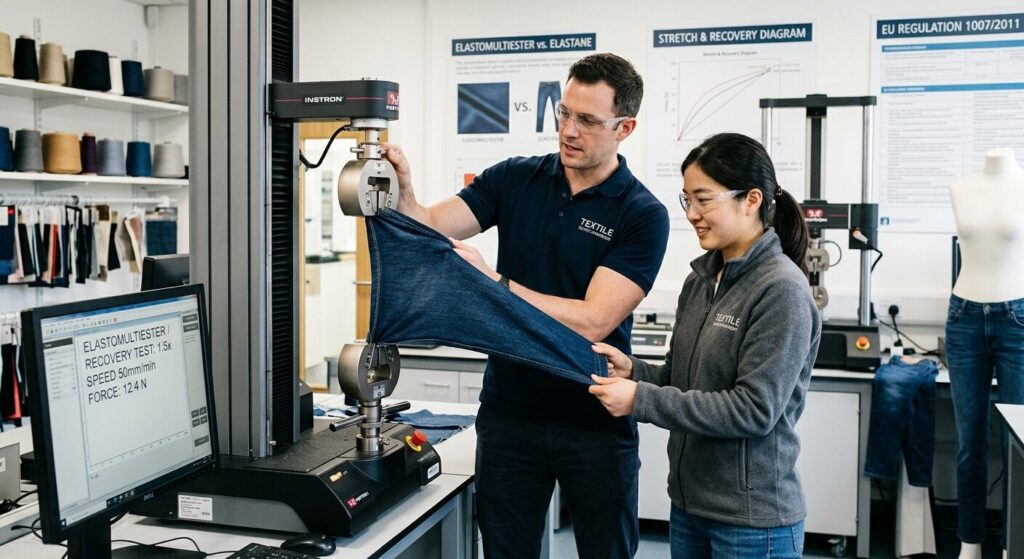
Yes elastomultiester is a genuinely elastic fiber by regulatory definition, not just a marketing description. To legally carry the elastomultiester name on a garment label in the EU, a fiber must demonstrably stretch to at least one and a half times its original length and then recover rapidly and substantially back toward its starting length. That recovery requirement is baked into the definition itself; a bicomponent polyester yarn that doesn’t spring back can’t be called elastomultiester, even if the two-polymer construction is otherwise identical.
What differs from elastane is the character of that stretch. Elastomultiester delivers what the industry calls “comfort stretch” gentle, structural give that lets fabric move with the body rather than the high-tension, compression-like “power stretch” associated with heavily elastane-blended fabric. If you’re picturing the snap of a rubber band versus the give of a well-engineered coiled spring, that’s a reasonably close mental model for the difference.
10. How Stretchy Is Elastomultiester?
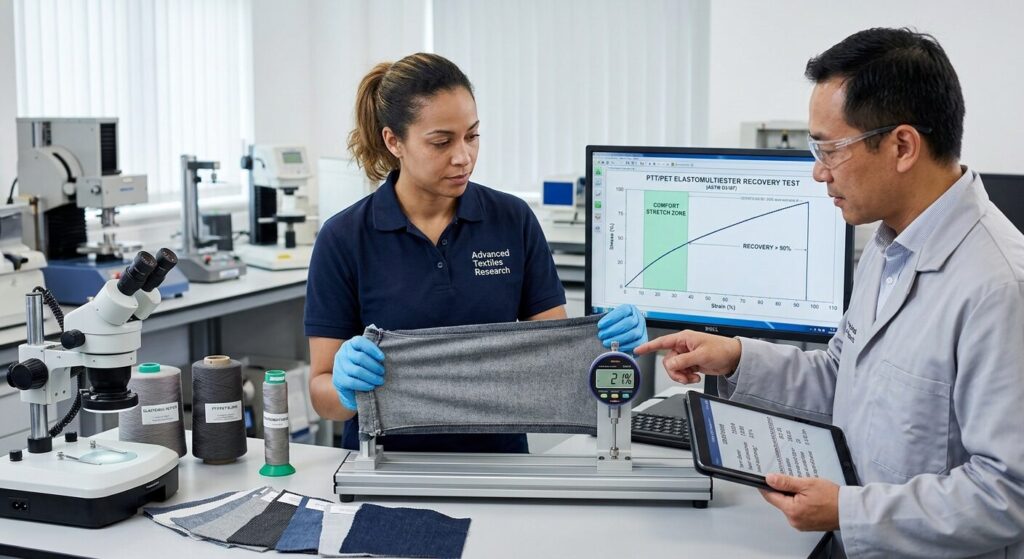
At the raw yarn level, most commercial elastomultiester delivers roughly 20–40% elongation with strong recovery, though the exact figure depends heavily on the specific PET/PTT ratio, draw ratio, and heat-setting conditions used during manufacturing. In finished woven fabric like a 75-denier PTT/PET yarn used as weft in stretch shirting or chino cloth that typically translates to around 15–25% stretch in the fabric’s cross direction after heat-setting, with recovery commonly measured above 90% under standard test methods like ASTM D3107.
For context, that puts elastomultiester solidly in the “comfort stretch” category alongside light elastane blends used in tailored garments, rather than in the “power stretch” range associated with compression leggings or swimwear (which often use elastane content engineered for 150%+ elongation). Manufacturers can tune the exact stretch percentage by adjusting the polymer ratio between the two components and the heat treatment applied, which is why you’ll see meaningfully different stretch behavior between, say, a fine-denier hosiery yarn and a heavier construction meant for outerwear.
11. Is Elastomultiester Comfortable to Wear?
Generally, yes, and for reasons that are somewhat specific to how the fiber is engineered. Because the stretch mechanism is a physical coil rather than a separate rubbery strand woven into the fabric, elastomultiester fabric tends to have a softer, more conventional “woven polyester” hand-feel rather than the tighter, more compression-like sensation associated with high-elastane-content stretch fabric. Many mills describe the resulting fabric as having a dry, slightly wool-like touch, which suits both casual and more formal garment categories.

Comfort in any finished garment ultimately depends on more than fiber choice alone knit or weave density, finishing treatments, and blend partner all play a role but elastomultiester’s baseline profile (moderate stretch, good recovery, no rubbery compression) is generally well suited to all-day wear in categories like tailored trousers, dress shirting, and workwear, where consistent, non-restrictive comfort across a full shift or workday matters more than maximum elasticity.
12. Is Elastomultiester Breathable?
Elastomultiester itself, as a continuous polyester filament, doesn’t add the extra bulk of a separately blended elastic strand into the fabric’s cross-section the way elastane does. That structural difference means fabric engineers can design more open, air-permeable knit or weave constructions around elastomultiester than they often can around a heavier elastane blend, without sacrificing stretch.
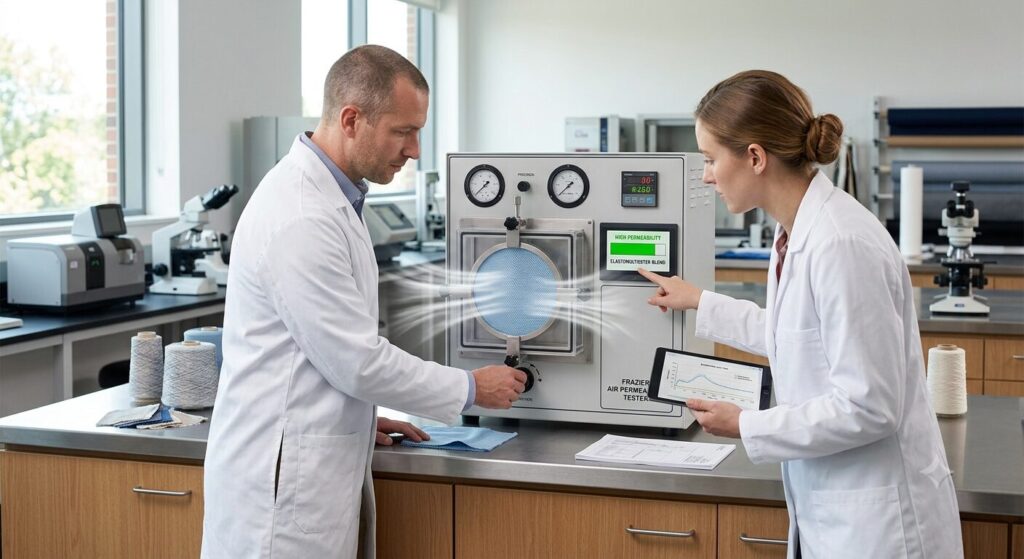
That said, breathability in any finished textile is ultimately a function of the whole fabric construction knit or weave density, blend partner, and any coatings or finishes applied afterward not the fiber alone. Elastomultiester enables good breathability; it doesn’t guarantee it independent of how the fabric around it is built. For a full breakdown of how elastomultiester’s breathability compares directly against elastane, along with the underlying test data, see our dedicated safety and breathability guide.
13. Is Elastomultiester Durable?
Durability is arguably where elastomultiester makes its strongest case relative to elastane. Because the fiber’s stretch comes from a mechanically stable, permanently heat-set coil rather than a chemically elastic polymer, it doesn’t degrade the way elastane does through repeated exposure to heat, chlorine, UV light, and body oils all of which gradually break down elastane’s polyurethane chains and cause stretch fabric to lose its snap-back over time.
In practical terms, that translates to garments particularly stretch denim and workwear that hold their original shape and fit through many more wash-and-wear cycles than an equivalent elastane-blended piece, with far less of the sagging or “bagging out” that shows up at knees, elbows, and waistbands in heavily elastane-dependent fabric. It’s also more resistant to the specific stresses of industrial laundering, chlorinated water, and prolonged sun exposure, which is part of why it has found a durable niche in workwear, denim, and outdoor performance apparel.
14. Is Elastomultiester Wrinkle Resistant?
Because elastomultiester is fundamentally a polyester-family fiber, it inherits polyester’s well-established resistance to creasing and wrinkling a property that comes from the polymer’s ability to be heat-set into a stable molecular configuration during finishing. Fabric with meaningful elastomultiester content tends to resist wrinkling in the same way a standard polyester-blend dress shirt or trouser does, holding a pressed appearance through a working day better than a comparable all-cotton or high-elastane garment might.

That resistance is reinforced, not undermined, by the fiber’s stretch mechanism: since the coiled crimp structure is itself a permanent, heat-set feature of the filament, the fabric’s dimensional stability tends to remain consistent through normal wear and laundering, rather than relaxing or distorting into creases the way some more elastic materials can. This is one of the reasons elastomultiester has found favor in tailored trousers, shirting, and workwear categories where a crisp, low-maintenance appearance matters.
15. Is Elastomultiester Moisture Wicking?
Moisture management in elastomultiester fabric works largely the same way it does in standard polyester textiles: the fiber itself has low moisture absorbency (a property inherent to polyester chemistry), which means sweat and moisture tend to move along the fiber’s surface and through the fabric structure rather than being absorbed into the fiber itself. In performance and activewear applications, manufacturers often engineer this baseline property further using specific yarn cross-sections, knit constructions, or surface finishes designed to actively pull moisture away from the skin and spread it across the fabric surface for faster evaporation.
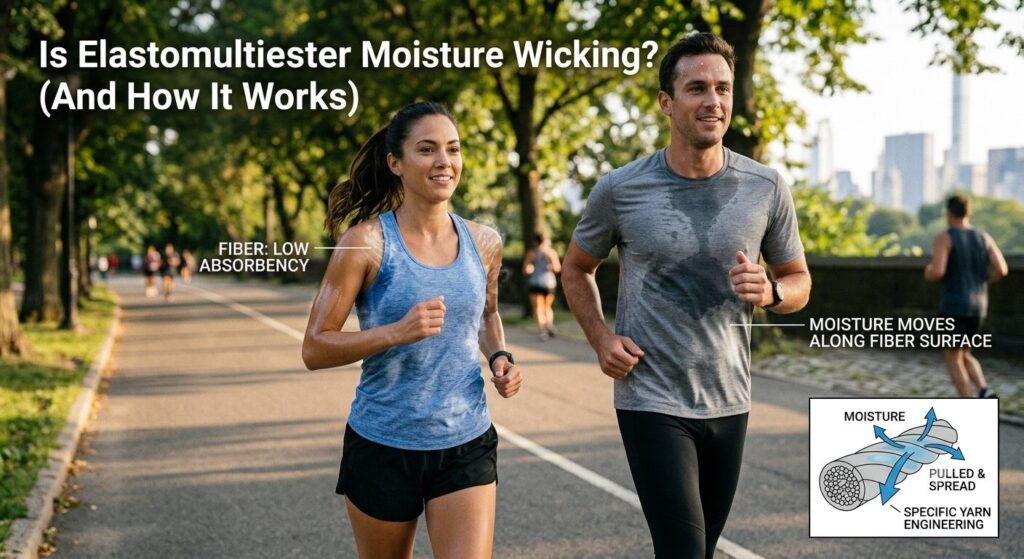
In practice, this means elastomultiester-containing activewear can be engineered for genuinely effective moisture-wicking performance, similar to how standard technical polyester is used in performance sportswear but as with breathability, the wicking result depends on the specific fabric engineering and finishing applied by the mill, not solely on the presence of elastomultiester in the blend.
16. Is Elastomultiester Safe?
Chemically speaking, yes. Because elastomultiester is a polyester derivative, it can be dyed, finished, and independently tested using exactly the same frameworks applied to any other polyester textile, including certification against OEKO-TEX Standard 100, which screens finished textiles against more than a thousand regulated and non-regulated substances ranging from azo dyes and heavy metals to formaldehyde and phthalates.

It’s worth being precise here, though: certification isn’t automatic simply because a fiber belongs to the elastomultiester category. Buyers and consumers should ask suppliers for the specific OEKO-TEX or REACH compliance documentation tied to the actual production lot in question, not just a general claim about the polymer family. This distinction whole-category safety versus lot-specific certification is the single most important thing to understand about elastomultiester’s safety profile, and it’s covered in much greater depth, including how elastomultiester compares directly to elastane on this exact question, in our full safety and microplastics guide.
17. Is Elastomultiester Good for Sensitive Skin?
For most people, yes. Because elastomultiester contains no polyurethane, rubber, or latex components the materials most commonly implicated in skin sensitivities associated with elastic stretch fabrics it tends to be well tolerated even by individuals who report irritation from heavily elastane-blended garments, particularly around waistbands and other high-contact areas where elastic strands are concentrated.

That said, “generally well tolerated” isn’t the same as “guaranteed hypoallergenic for everyone.” As with any synthetic textile, individual sensitivities can still arise from dye chemistry, finishing agents, or fabric construction rather than the base fiber itself, which is why the safest approach for anyone with known skin sensitivities is to check the finished fabric’s specific OEKO-TEX or dermatological testing documentation, rather than relying on the raw fiber category alone as a blanket assurance. If you’re evaluating a specific garment or fabric lot for sensitive-skin use, that documentation not the “elastomultiester” label by itself is the detail that actually matters.
18. Is Elastomultiester Eco-Friendly?
This is a question that deserves a genuinely careful, non-oversold answer, because elastomultiester’s sustainability case is real but bounded. What’s true: elastomultiester is not biodegradable, and manufacturing it still typically relies on petrochemical feedstocks (with some partially bio-based exceptions, discussed below), so it does not eliminate a garment’s environmental footprint the way a genuinely bio-based or biodegradable fiber might claim to.
What’s also true, and provable: because elastomultiester is built entirely from polyester-family polymers rather than a polyester/elastane blend, it enables a level of end-of-life recyclability that elastane-blended stretch fabric simply cannot match (detailed fully in the next question). It also tends to outlast elastane blends in actual wear, extending garment life and reducing the frequency of replacement purchases a less commonly discussed but genuinely meaningful sustainability lever. Frameworks like the Ellen MacArthur Foundation’s circular economy work on fashion explicitly identify mono-material construction as a key enabler of textile circularity, and elastomultiester is one of the more practical, commercially available expressions of that principle in stretch fabric today.
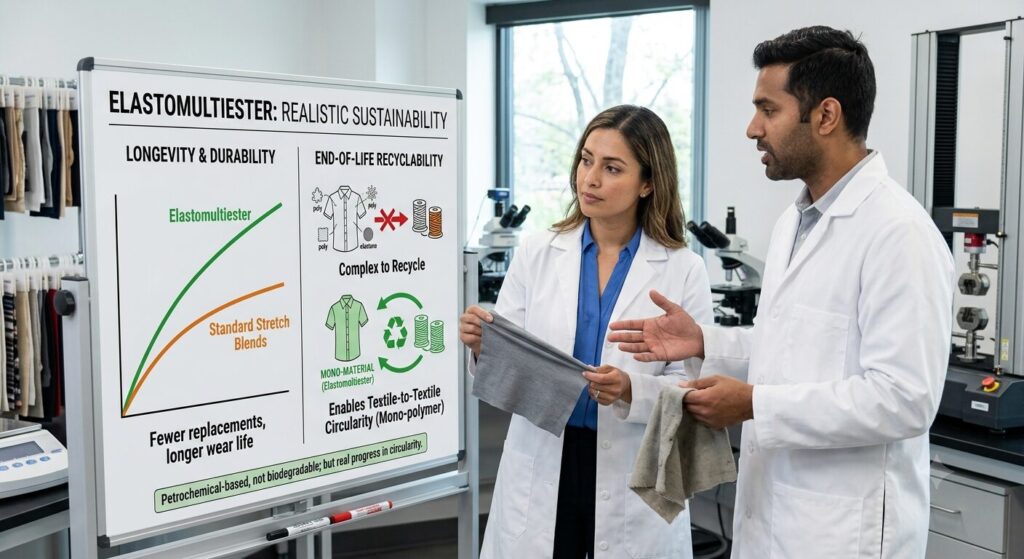
The fair summary: elastomultiester offers real, measurable sustainability advantages over elastane specifically around recyclability and garment longevity without qualifying as an inherently “green” or biodegradable material in absolute terms. For the fuller picture, including how it fits into Higg Index scoring and EU Textile Strategy requirements, see our dedicated piece on elastomultiester and the sustainable textile shift.
19. Can Elastomultiester Be Recycled?
Yes, and this is arguably elastomultiester’s most concrete environmental advantage. Because both components of the fiber (typically PET and PTT) belong to the same broad polyester polymer family, elastomultiester fabric can generally be processed through standard polyester textile-to-textile recycling streams mechanical or chemical without the material-separation step that trips up most polyester-elastane blends.
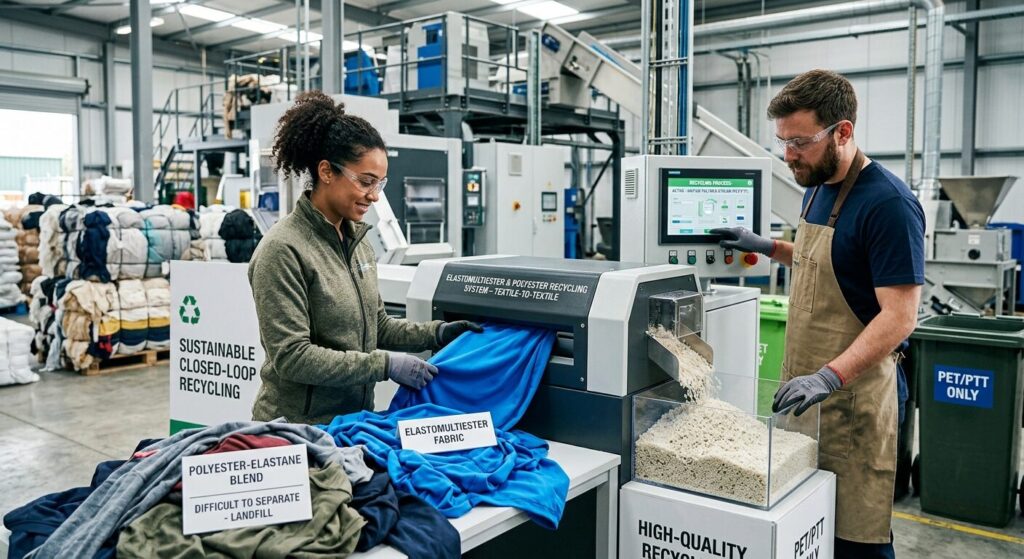
That separation problem is worth spelling out, because it’s the crux of the comparison: elastane is a polyurethane elastomer, chemically distinct from polyester, and once it’s knitted or woven into a fabric alongside polyester, the two materials become extremely difficult and costly to separate at scale. Industry data cited by sustainability groups suggests that elastane content as low as around 1–2% by weight is often enough to disqualify a garment from most commercial recycling pathways, routing it toward landfill or incineration regardless of the wearer’s intent. Elastomultiester, being a single polymer family throughout, sidesteps that problem entirely recycled output from an elastomultiester garment can, in principle, be reprocessed into new elastomultiester or standard polyester yarn without a quality compromise.
It’s worth noting this doesn’t happen automatically at every recycling facility real-world recyclability still depends on local collection infrastructure and processing capability but the fiber-level compatibility that makes it possible is a genuine structural advantage over blended elastane fabric. For more on how this plays out against specific sustainability certifications and frameworks like the Higg Materials Sustainability Index, read the full sustainability deep-dive here.
20. Does Elastomultiester Contain Microplastics?
Like essentially every synthetic textile fiber, elastomultiester fabric can shed microscopic fiber fragments during washing, wear, and abrasion this is a property of being a synthetic filament in general, not something unique or specific to elastomultiester as a fiber category. It falls within the scope of regulatory frameworks addressing this issue directly, including the EU’s Regulation 2023/2055 restriction on intentionally added microplastics and the broader reporting and testing obligations that have emerged alongside it.
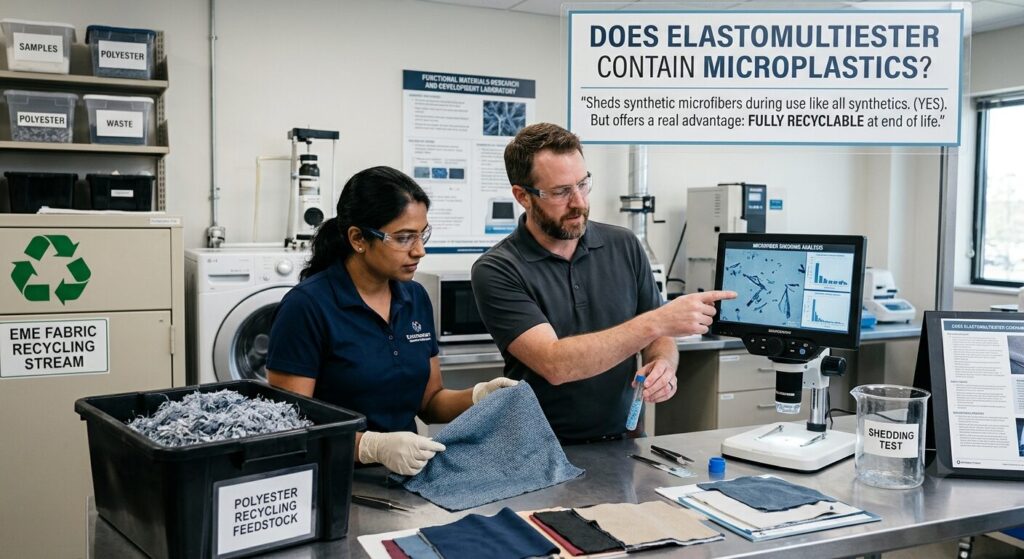
Where elastomultiester genuinely differentiates itself from an elastane-blended fabric is not in how much it sheds during use there’s no strong evidence it sheds meaningfully more or less than other synthetic fibers of similar construction but in what happens at end of life. Because it’s a single-polymer, fully polyester construction, elastomultiester-enhanced fabric can be diverted into standard polyester mechanical recycling streams rather than landfill, which is a real and provable difference worth stating plainly, without overselling elastomultiester as somehow “microplastic-free” it isn’t, and no synthetic fiber currently is. For the complete breakdown of microfiber shedding data, regulatory scope, and how elastomultiester’s recyclability offsets (without eliminating) its microplastic footprint, see our full explainer here.
How to Spot Elastomultiester on a Garment Label
Because the term isn’t yet a household name the way “spandex” or “Lycra” is, elastomultiester often hides in plain sight on care labels and hangtags. A few practical signals can help:
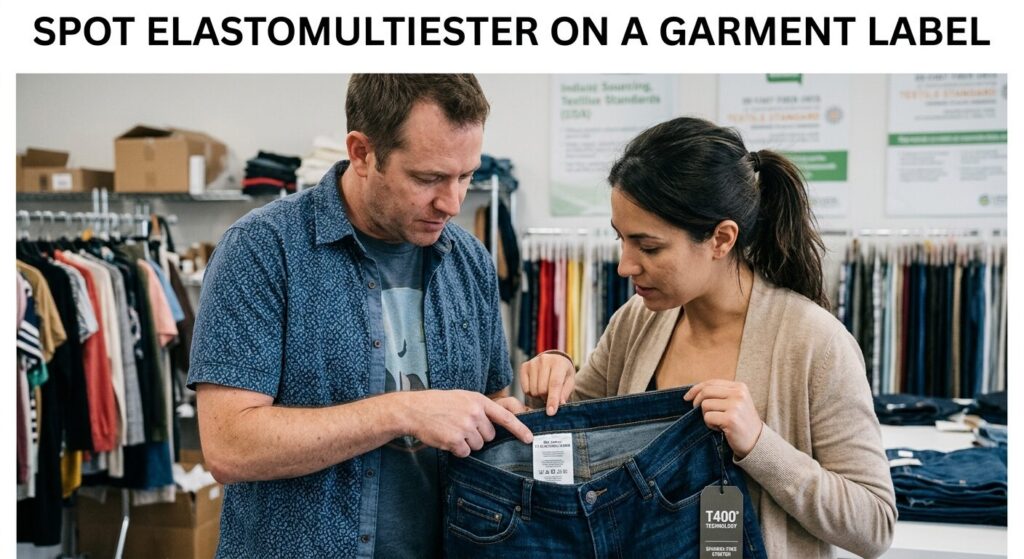
- Look for the word itself. Regulators require it to appear by its generic name in the fiber content listing wherever it’s present above the labeling threshold, so “elastomultiester” printed alongside cotton or polyester is the most direct signal.
- Recognize common trade names. Sorona, T400, T800, and Elasterell-P are among the most widely used branded or mill-specific names for fiber that falls under the generic elastomultiester category. If you see one of these on a tag, you’re looking at a form of elastomultiester even though the generic term may not appear anywhere on the label itself.
- Watch the marketing language. Hangtags sometimes describe the technology in plain English rather than by fiber name phrases like “mechanical stretch,” “bi-stretch technology,” or “spandex-free stretch” are common ways brands describe elastomultiester-based fabric to consumers who might not recognize the technical term.
- Notice what’s absent. If a garment is marketed as having genuine stretch and recovery, but the fiber content label doesn’t list elastane, spandex, or Lycra anywhere, elastomultiester (or another mechanical-stretch fiber) is very often the explanation.
For sourcing and export teams, this matters beyond casual label-reading: mislabeling elastomultiester as generic “polyester” is a compliance issue under both EU and US textile labeling law, not just a naming preference, since the fiber’s specific elastic-recovery performance is part of what legally distinguishes it from ordinary polyester in the first place.
Quick-Reference Summary Table
| Question | Short Answer |
| Is it stretchy? | Yes, by regulatory definition roughly 20–40% elongation with strong recovery |
| Is it comfortable? | Generally yes soft, non-compressive “comfort stretch” hand-feel |
| Is it breathable? | Can be engineered for good breathability; depends on fabric construction |
| Is it durable? | Yes, more wash- and wear-durable than elastane over time |
| Wrinkle resistant? | Yes, inherits standard polyester’s crease resistance |
| Moisture wicking? | Low absorbency like polyester; can be engineered for active wicking |
| Is it safe? | Yes chemically testable and OEKO-TEX certifiable like any polyester; lot-specific documentation matters |
| Good for sensitive skin? | Generally well tolerated; no elastane/latex content, but check finished-fabric certification |
| Eco-friendly? | Not biodegradable, but offers real recyclability and longevity advantages over elastane |
| Recyclable? | Yes single-polymer construction allows standard polyester recycling streams |
| Microplastics? | Sheds like any synthetic fiber, but fully recyclable at end of life unlike elastane blends |
Where to Go Deeper
This guide is intentionally broad, covering the twenty questions people ask most often about elastomultiester in one place. If a specific area caught your attention, these dedicated resources go significantly deeper:
- What Is Elastomultiester? The Complete Guide for Indian Textile Buyers full regulatory definition, conjugate spinning process, and commercial sourcing guidance
- Is Elastomultiester Safe? Breathability & Microplastics Guide safety testing, OEKO-TEX certification, and microplastic regulation in detail
- Elastomultiester: The Eco-Friendly Stretch Yarn Replacing Elastane how the fiber is made and where it’s used across industries
- Sustainable Textiles: How Elastomultiester Is Leading the Eco-Revolution circular economy frameworks and recyclability in depth
- Elastomultiester Yarn: The Science Behind Sustainable Stretch Fabrics applications across sportswear, hosiery, swimwear, and intimate apparel
- DuPont and the Science Behind Elastomultiester Stretch Yarn the history of PTT polymer and Sorona development
- Elasterell-P Explained: DuPont Sorona vs Elastomultiester how branded fiber names relate to the generic category
- Mestre® India’s Leading Elastomultiester Stretch Yarn Brand a domestically manufactured elastomultiester yarn option for Indian and global buyers
Frequently Asked Questions
Is elastomultiester the same as spandex or elastane?
No. They’re both stretch fibers, but they get there through completely different chemistry. Elastane (spandex, Lycra) is a polyurethane elastomer that stretches chemically. Elastomultiester is a bicomponent polyester fiber that stretches mechanically, through a permanently coiled fiber structure. Garments can use one, the other, or occasionally both together.
Is elastomultiester a natural fiber?
No, it’s synthetic almost always petroleum-derived polyester chemistry, though some branded variants (like DuPont’s Sorona-based Elasterell-P) incorporate a partially plant-based component.
How much elastomultiester is typically in a garment?
It varies widely by category: often as little as 1–3% in stretch denim, up to 10–25% in activewear tops, and as much as 20–40% in compression-style garments, always blended with cotton, nylon, or standard polyester.
Does elastomultiester show up on every garment label?
It should, under EU and US labeling regulations, but it sometimes appears instead under a brand or trade name like Sorona, T400, or Elasterell-P, which fall under the same generic elastomultiester category.
Mestre® is an elastomultiester stretch yarn brand manufactured by Madhusudan Group, based in Surat, Gujarat. For technical specifications, certification documentation, or sourcing inquiries, visit mestre.co.in.