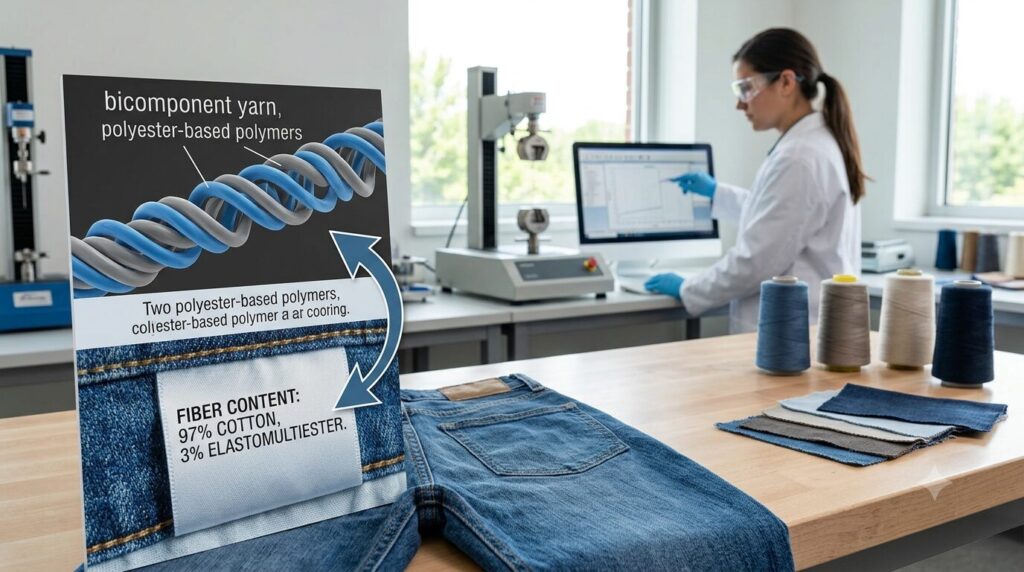
If you’ve checked the care label on a pair of stretch jeans or an athletic top and seen the word “elastomultiester” listed next to cotton or polyester, you’re not alone in wondering what it actually is. It sounds like a chemistry term, and in a sense, it is one but it’s also one of the more clever pieces of fiber engineering used in modern clothing. This guide breaks down what elastomultiester means, how it’s made, why manufacturers choose it over traditional elastane, and what to expect from garments that contain it.
Elastomultiester Meaning: The Basic Definition
Elastomultiester is a generic fiber name recognized by international textile labeling standards for a category of synthetic fibers made from two different polyester-based polymers combined into a single filament. Unlike elastane (commonly known by the brand names Spandex or Lycra), which stretches because of its rubber-like polyurethane chemistry, elastomultiester stretches because of how its two polymer components are physically joined together. This is why you’ll often see it described using the terms bicomponent yarn or biconstituent fiber both refer to the same underlying idea of two materials working as one within a single strand.
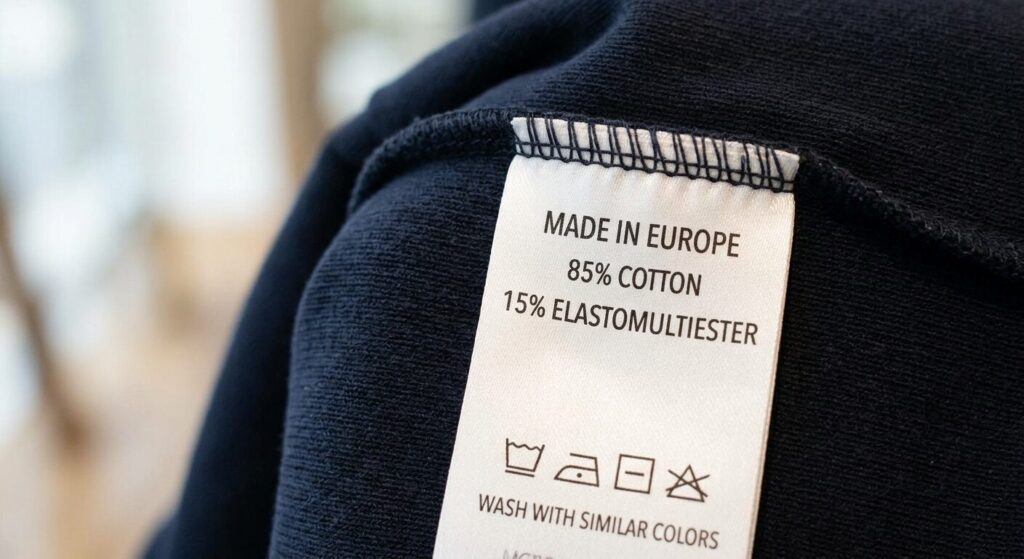
The name itself is a combination of “elasto,” referring to its elastic behavior, and “multiester,” referring to the fact that it’s built from multiple polyester-type components rather than a single uniform polymer. Regulatory bodies in the EU and other regions use this exact term on textile labels, which is why shoppers frequently encounter it without much explanation on the garment tag itself.
Understanding the fiber also helps when comparing similar-sounding products across brands, since marketing terms for stretch fabrics vary widely even when the underlying fiber technology is nearly identical. By the end of this guide, you’ll be able to recognize elastomultiester by name, by common trade names, and by the practical performance traits that set it apart from other stretch fibers on the market.
A Brief History of Bicomponent Stretch Fibers
Bicomponent fiber technology dates back several decades, originally developed as textile manufacturers searched for ways to introduce stretch into fabrics without relying entirely on rubber-based fibers, which had durability and heat-sensitivity limitations. Early biconstituent fibers such as Elasterell-P laid the groundwork for what eventually became a broader category of mechanical-stretch yarns. As manufacturing techniques improved, companies developed more refined versions with better recovery, softer hand-feel, and greater compatibility with natural-fiber blends, leading to the modern elastomultiester fibers used widely in denim, workwear, and athleisure today.
How Bicomponent Yarn Creates Stretch
The core idea behind elastomultiester is deceptively simple. Two polyester polymers with different shrinkage and elasticity properties are extruded together, side by side, within the same fiber, in what’s known as a side-by-side or sheath-core configuration. Because one component wants to contract more than the other when heat-treated during finishing, the fiber naturally coils or crimps, similar to how a bimetallic strip bends when heated. This coiled, spring-like structure is what gives the yarn its stretch and recovery, often referred to in the industry as mechanical stretch, as opposed to the chemical stretch elastane relies on.
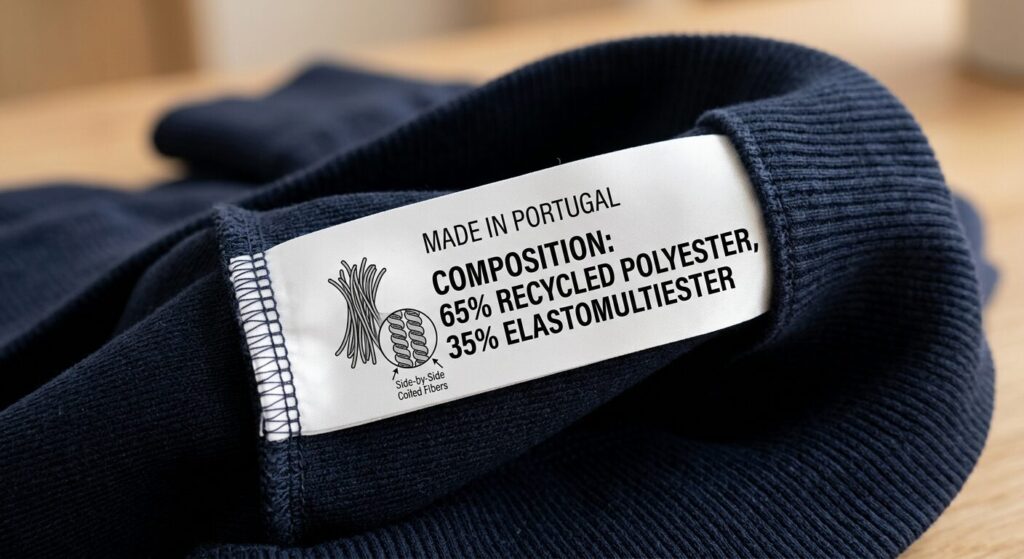
Because the stretch comes from fiber geometry rather than a separate rubber-based component, elastomultiester fabric tends to hold its shape well over repeated washing and stretching cycles, without the sagging or “bagging out” that elastane-blended fabrics can develop over time, particularly around knees and seat areas in denim.
The Manufacturing Process Step-by-Step
Understanding how elastomultiester is produced helps explain why it performs the way it does in finished garments. The process generally follows several key stages:
- Polymer selection: Two polyester variants with different intrinsic viscosity or shrinkage behavior are chosen as the two components.
- Bicomponent extrusion: The two polymers are melted and extruded simultaneously through a single spinneret, forming a single filament with two distinct zones running along its length.
- Drawing: The extruded filament is stretched to align the polymer molecules and build tensile strength.
- Heat-setting: Controlled heat causes the differential shrinkage between the two polymer zones, triggering the coiling or crimping effect that produces elasticity.
- Texturizing and spinning: The coiled filament is processed into yarn, sometimes blended with cotton, modal, or other fibers before being woven or knitted into fabric.
This process is what allows manufacturers to fine-tune stretch percentage, recovery speed, and softness by adjusting the ratio of the two polymer components and the heat-setting conditions.
Common Brand Names You’ll See on Labels
Elastomultiester rarely appears under its generic name alone on a retail tag. Several textile companies have developed proprietary versions with their own branding, which is part of why the terminology can feel confusing to shoppers:
- Sorona a partially bio-based stretch fiber developed using renewable plant-derived ingredients in place of some petroleum-based content
- T400 a widely used bicomponent stretch yarn found in denim, chinos, and workwear
- Elasterell-P an earlier bicomponent fiber technology from which many modern variants descended
- Various mill-specific trade names used by denim and technical fabric producers
If you see any of these names on a garment tag, you’re looking at a form of elastomultiester, even though the generic word itself may not appear anywhere on the label.
Where Elastomultiester Is Commonly Used
Because it combines stretch with durability, elastomultiester shows up across a wide range of clothing categories:
- Stretch denim and jeans, where shape retention through the knees and waistband matters
- Activewear and performance leggings that need to resist stretching out during workouts
- Workwear and uniforms that must hold shape through long shifts and repeated laundering
- Casual knitwear blended with cotton or modal for everyday comfort
- Outerwear and technical garments where stretch needs to survive exposure to heat or friction
It’s especially popular in garments where consistent recovery the fabric’s ability to snap back to its original shape after stretching matters more than achieving the maximum possible stretch percentage.
Elastomultiester vs Regular Polyester
Standard polyester is a single-component fiber with little to no built-in stretch; any flexibility in a 100% polyester garment usually comes from the weave or knit structure, not the fiber itself. Elastomultiester, by contrast, is engineered at the fiber level to stretch and recover, which is why a small percentage often between 5% and 40% blended into a fabric can noticeably change how it moves and fits. In short, all elastomultiester is a form of polyester chemistry, but not all polyester behaves like elastomultiester.
Reading Garment Labels: Typical Blend Percentages
| Garment Type | Typical Elastomultiester % | Common Blend Partner |
| Stretch denim | 1% – 3% | Cotton |
| Workwear trousers | 3% – 8% | Cotton or polyester |
| Activewear tops | 10% – 25% | Polyester or nylon |
| Compression garments | 20% – 40% | Polyester |
Advantages of Elastomultiester in Clothing
- Excellent shape recovery even after hundreds of wash cycles
- Higher heat tolerance than elastane, reducing damage from dryers or ironing
- Softer, more consistent stretch that avoids the overly tight feel of high-elastane fabrics
- Longer garment lifespan due to resistance to sagging and bagging
- Compatible with a wide range of natural and synthetic blend partners
Potential Downsides to Be Aware Of
- Lower maximum stretch percentage compared to elastane, making it unsuitable for extreme-stretch garments like swimwear
- Still a synthetic, petroleum-derived fiber in most conventional versions
- Less universally recognized by name, which can make label-reading confusing for shoppers
Elastomultiester in the Denim Industry: A Closer Look
Denim is arguably where elastomultiester has made its biggest commercial impact. Traditional 100% cotton denim has almost no stretch, which is part of why raw denim can feel stiff when new. Adding a small amount of elastane solved the stretch problem but introduced a new one: elastane-heavy stretch jeans tend to bag out at the knees and lose their fit within months of regular wear, especially with frequent washing. Elastomultiester-blended denim, often using yarns like T400, addresses this by providing a gentler, more durable stretch that holds the garment’s original silhouette far longer, which is why many premium denim brands quietly shifted toward small elastomultiester percentages, sometimes combined with a touch of elastane, to get the best of both worlds comfort on day one and shape retention a year later.
Elastomultiester in Activewear and Performance Apparel
Beyond denim, elastomultiester has carved out a meaningful niche in activewear, particularly in garments where moderate, durable stretch matters more than the extreme range of motion needed for compression leggings or swimwear. Golf and tennis apparel, for example, often uses elastomultiester blends to provide enough give for a full swing while maintaining a crisper, more tailored look than heavily elastane-blended fabrics typically allow. Similarly, technical outerwear and softshell jackets increasingly use elastomultiester in their stretch-woven fabrics because it holds up better to the repeated flexing, UV exposure, and temperature swings these garments experience outdoors compared to elastane, which tends to break down faster under those same conditions.
How to Identify Elastomultiester on a Care Label
Because elastomultiester isn’t always spelled out clearly, shoppers can look for a few label clues. The most direct signal is the word “elastomultiester” itself listed in the fiber content alongside cotton, polyester, or elastane. Alternatively, look for known trade names like Sorona, T400, or Elasterell-P, or general phrases such as “mechanical stretch” or “bi-stretch technology” used in marketing copy on hangtags. If a garment advertises stretch and recovery but the label doesn’t list elastane or spandex at all, elastomultiester is often the fiber responsible.
Future Trends: Where Elastomultiester Technology Is Headed
The bicomponent fiber category continues to evolve as textile manufacturers respond to two competing demands: consumers who want more stretch and comfort, and a growing push for lower-impact materials. Expect to see continued growth in bio-based elastomultiester variants that reduce reliance on virgin petroleum feedstocks, alongside improved recycling processes designed specifically for polyester-based bicomponent fibers. Some manufacturers are also experimenting with finer-denier elastomultiester yarns aimed at softer, more lightweight applications beyond denim and workwear, such as dress shirts and lightweight knitwear, expanding the fiber’s reach into categories it hasn’t traditionally competed in.
Frequently Asked Questions
Is elastomultiester plastic?
Yes. Like conventional polyester, elastomultiester is a synthetic fiber derived from petrochemical or, in some newer versions, partially bio-based feedstocks. It is a form of plastic in fiber form, though some manufacturers now offer recycled or renewably sourced variants.
Is elastomultiester the same as elastane?
No. They’re different fiber types that both provide stretch. Elastane relies on stretchy polyurethane chemistry, while elastomultiester relies on the mechanical coiling of two joined polyester polymers. Garments can use one, the other, or both together.
Is elastomultiester breathable?
Breathability depends on the overall fabric construction and blend ratio, but because it’s a polyester-based fiber, elastomultiester generally offers moderate breathability similar to standard polyester, and is often blended with natural fibers like cotton to improve airflow and comfort.
Does elastomultiester lose its stretch over time?
Elastomultiester is known for strong long-term recovery compared to elastane, largely because its stretch comes from a physically stable coiled structure rather than a chemically elastic polymer that can degrade with heat and UV exposure.