Stretch yarn is a broad term used in the textile industry to describe any yarn that possesses inherent elasticity the ability to extend under tension and return to its original length upon release. Stretch yarns are the building blocks of all elastic and form-fitting fabrics, from everyday innerwear to high-performance sportswear and technical compression garments.
In India, stretch yarn is a critical input for the hosiery, knit garment, and active apparel industries. Textile clusters in Ludhiana, Surat, Tirupur, and Coimbatore process thousands of tonnes of stretch yarn annually to produce the vast range of elastic garments consumed domestically and exported globally.
Types of Stretch Yarn
There are several categories of stretch yarn, each with distinct properties and suitable applications. The most widely used is spandex (elastane), sold under brand names such as Lycra, Invista, and Roica. Spandex provides exceptional elongation up to 500–800% of its original length and excellent recovery, making it the go-to fibre for high-stretch applications like swimwear, hosiery, and sportswear.
Bi-component polyester fibres, such as DuPont’s T-400 and T-800, represent another important category of stretch yarn. These fibres deliver stretch through their polymer architecture rather than a separate elastomeric component. They offer the advantage of processing like standard polyester while still delivering meaningful stretch and recovery.
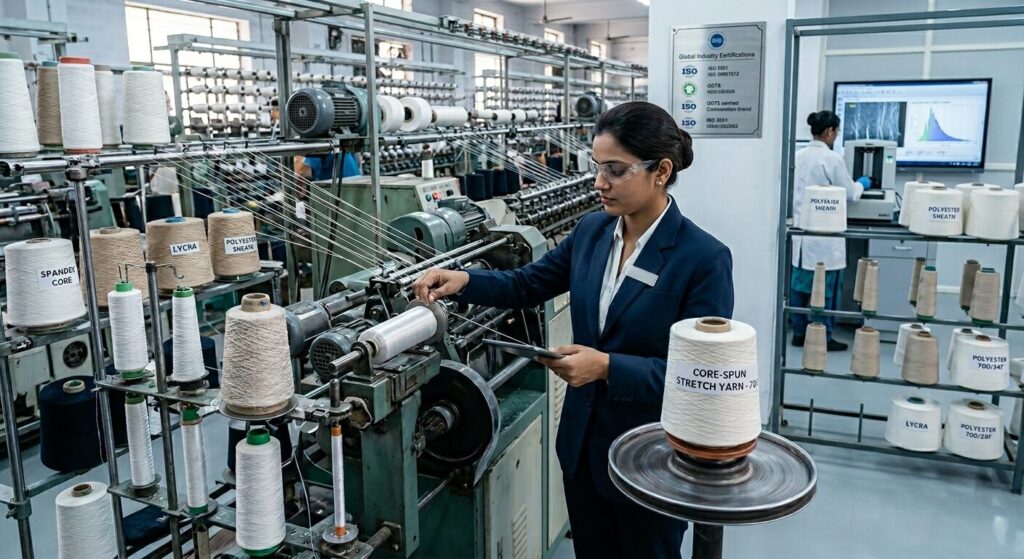
Air-covered and core-spun stretch yarns are composite constructions where an elastomeric core (usually spandex) is wrapped or covered with one or more sheath yarns such as cotton, polyester, or nylon. This construction combines the elastic properties of spandex with the tactile qualities and processing characteristics of the sheath fibre.
Textured polyester yarn, while not as elastic as spandex, also provides some degree of stretch through its crimped or textured structure. It is widely used in hosiery, socks, and casual wear where moderate stretch is needed without the cost or processing complexity of spandex.
How Stretch Yarns Are Manufactured
Spandex yarn is produced through a dry-spinning process in which a polymer solution is extruded through a spinneret and then solidified by evaporation of the solvent in a heated chamber. The resulting filaments are then drawn to achieve the desired denier and wound onto packages.
Bi-component polyester yarns like T-400 and T-800 are produced through a conjugate spinning process, in which two different polymers are simultaneously extruded through the same spinneret openings. The side-by-side arrangement of the two polymers within each fibre creates the coil-spring effect that gives these yarns their stretch capability.
Air-covered yarns are manufactured on specialised covering machines that wrap or interlace the spandex core with the sheath yarn under precisely controlled tension. The covering density and pattern determine the surface texture and stretch behaviour of the finished yarn.
Key Properties of Stretch Yarns
The most important performance parameters for stretch yarns are elongation at break, elastic recovery, set (permanent deformation after repeated stretching), and resistance to environmental factors such as chlorine, UV radiation, and heat. Spandex typically offers the highest elongation and recovery among all stretch fibre types, while bi-component polyester fibres offer lower elongation but superior chemical resistance.
For innerwear and hosiery applications, good recovery and low set are critical to ensure garments retain their shape through repeated wear and washing. Poor set results in garments that become baggy and lose their fit over time, leading to consumer dissatisfaction.
Choosing the Right Stretch Yarn for Your Application
Selecting the appropriate stretch yarn depends on the specific performance requirements of the end garment. For high-stretch applications like swimwear, leggings, and compression garments, high-denier spandex provides the necessary elongation and recovery. For moderate stretch applications like casual wear, denim, and innerwear, lower-denier spandex or bi-component polyester fibres may be more appropriate.
Processing considerations also play a role in yarn selection. Spandex requires careful temperature management during dyeing, while bi-component polyester can be processed under standard polyester conditions. Brands that want to simplify their production process may benefit from specifying bi-component yarns despite their lower elongation compared to spandex.
Sustainability in Stretch Yarn Production
Environmental concerns are shaping the stretch yarn market. The Lycra Company, Invista, and other major producers are developing recycled and bio-based alternatives to conventional spandex. DuPont’s Sorona is the most prominent example of a bio-based stretch fibre with meaningful market adoption. Indian manufacturers can align with global sustainability trends by specifying these innovative yarns.
Sourcing Stretch Yarn in India
India’s stretch yarn market is supplied by a combination of domestic producers and importers. Major domestic manufacturers include companies in Gujarat and Tamil Nadu that produce polyester-spandex core-spun yarns. High-performance spandex yarn from brands like Lycra and Roica is imported through authorised distributors.
Buyers should evaluate stretch yarn suppliers based on consistency of yarn count and denier, quality of covering uniformity (for covered yarns), certifications (OEKO-TEX, GRS), and the supplier’s technical support capability. Working with certified suppliers ensures a consistent input quality that reduces defects in the final fabric and garment.