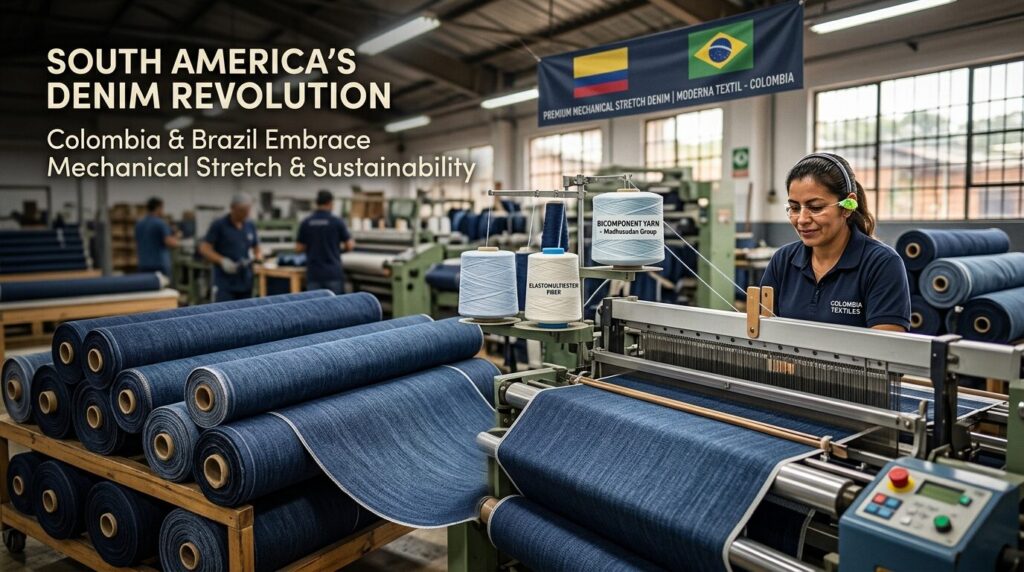
South America, and Colombia and Brazil in particular, has built a strong reputation in global denim manufacturing, and the region’s mills are increasingly exploring bicomponent yarn and elastomultiester fiber as a way to modernize stretch fabric production while meeting rising sustainability expectations from international buyers.
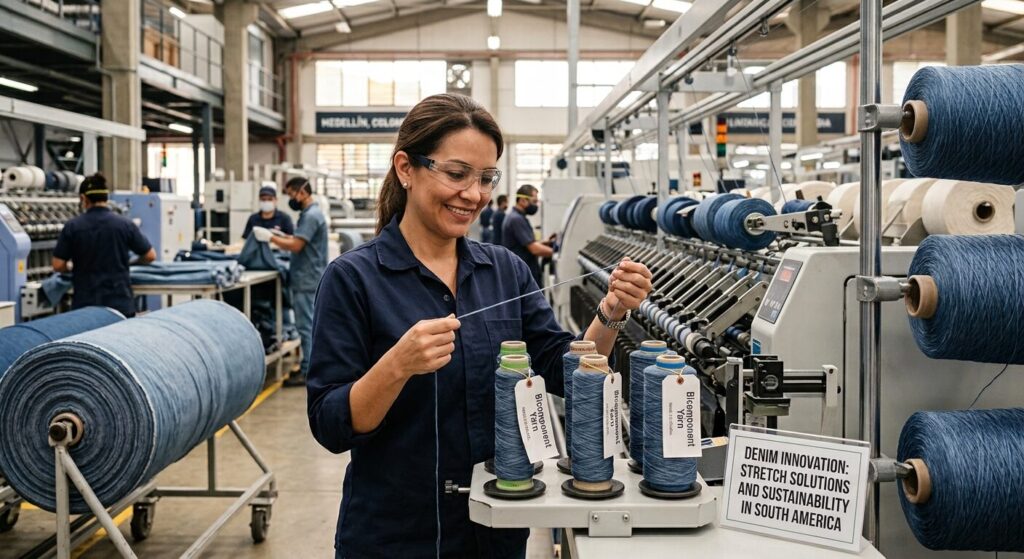
South America’s Position in Global Textile Manufacturing
Colombia is recognized as one of Latin America’s premier denim manufacturing centers, home to integrated mills producing everything from raw denim to finished stretch fabric for domestic and export brands. Brazil brings scale advantages through its large cotton production base and vertically integrated textile groups, while Peru and Ecuador contribute specialty cotton and knitwear capacity. Regional trade agreements and proximity to the US market give South American manufacturers a logistical advantage for supplying North American denim and apparel brands.
Textile Industry Trends
- Growing regional demand for stretch comfort denim across both domestic and export markets.
- Increasing buyer interest in sustainable and traceable fiber sourcing, partly driven by European and North American brand requirements.
- Ongoing investment in modernizing spinning capacity across Colombian and Brazilian mills.
- Rising interest in reducing reliance on imported elastane through mechanical stretch alternatives.
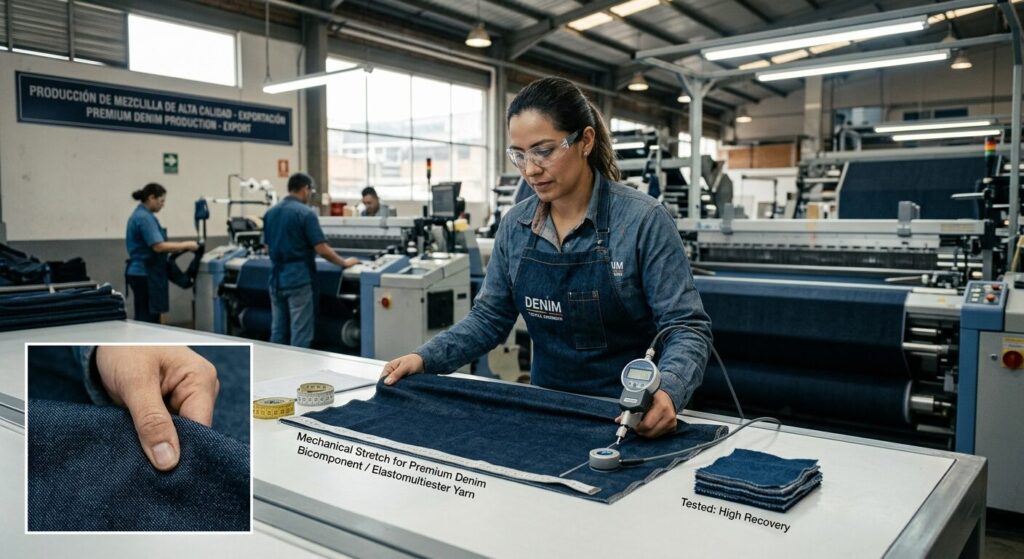
Key Fabric Emphasis: Mechanical Stretch for Premium Denim
Bicomponent and elastomultiester yarn provide Colombian and Brazilian denim mills a path to mechanical stretch fabric that holds recovery over more wash cycles than conventional elastane blends, an important quality advantage for the premium stretch denim segments these mills increasingly target for export.
Applications Across Industries
- Denim: the dominant application for mechanical stretch yarn across the region.
- Workwear: durable stretch fabric for industrial and institutional buyers.
- Activewear: a growing segment, particularly in Brazil’s domestic apparel market.
- Home textiles: shape-retentive fabric for furnishing applications.
Why Global Buyers Source from India
South American mills and international buyers alike often source bicomponent and elastomultiester yarn from Indian manufacturers because of the technical spinning expertise, consistent quality, and scale India offers, allowing regional denim producers to access advanced stretch yarn technology without developing it in-house.
How Madhusudan Group Supports the Market
Madhusudan Group supplies bicomponent and elastomultiester yarn to denim and technical fabric mills across Colombia, Brazil, and neighboring markets, supporting the region’s shift toward mechanical stretch fabric that meets both the durability and sustainability expectations of global denim buyers.
Future Opportunities in South America’s Stretch Fabric Market
Expanding sustainable denim certification programs, growth of nearshoring for US-bound denim exports, and increased investment in vertically integrated stretch yarn spinning within the region all point to continued growth for mechanical stretch fabric across South America.
Conclusion
Bicomponent yarn and elastomultiester technology are helping South America’s denim and apparel manufacturers modernize their fabric offerings while meeting the sustainability standards demanded by global buyers. With strong regional expertise and support from established partners like Madhusudan Group, South America’s stretch fabric industry is positioned for continued growth.
FAQ Section
1. Why is Colombia known for denim manufacturing?
Colombia has developed integrated denim mills with strong finishing and design capability, making it a recognized hub for premium stretch denim in Latin America.
2. What is bicomponent yarn used for in denim?
Bicomponent yarn provides mechanical stretch and recovery in denim fabric without requiring a separate elastane filament.
3. Is elastomultiester more durable than spandex in denim?
Elastomultiester fabrics generally retain their stretch recovery over more wash cycles compared to conventional elastane-blended denim.
4. Which South American countries lead in textile exports?
Colombia and Brazil are the leading textile and denim exporters in South America, with Peru and Ecuador contributing specialty cotton and knitwear.
5. Why do Colombian and Brazilian mills import yarn from India?
Indian yarn producers offer technical expertise, consistent quality, and competitive pricing that supports South American denim manufacturing.
6. Is mechanical stretch denim more sustainable?
Mechanical stretch denim using mono-material yarn construction is generally easier to recycle than fabrics blended with elastane.
7. What role does Brazil play in South America’s textile industry?
Brazil contributes large-scale cotton production and vertically integrated textile manufacturing that supports the broader regional supply chain.
8. How can I source stretch yarn for denim manufacturing in South America?
Manufacturers and brands can source bicomponent and elastomultiester yarn through established suppliers such as Madhusudan Group.