When a pair of trousers stretches comfortably at the knee, the automatic assumption is that there is spandex woven in somewhere. Increasingly, that assumption is wrong. A growing share of stretch fabric on the market today gets its flexibility from the physical structure of the yarn itself, not from an added elastic fibre. That property has a name in the textile industry: mechanical stretch.
Understanding mechanical stretch matters for anyone sourcing or designing fabric, because it changes how a garment performs, ages, and gets recycled. This guide walks through what mechanical stretch actually is, how it is engineered into yarn, and where it fits compared with elastane-based stretch.
What Is Mechanical Stretch?
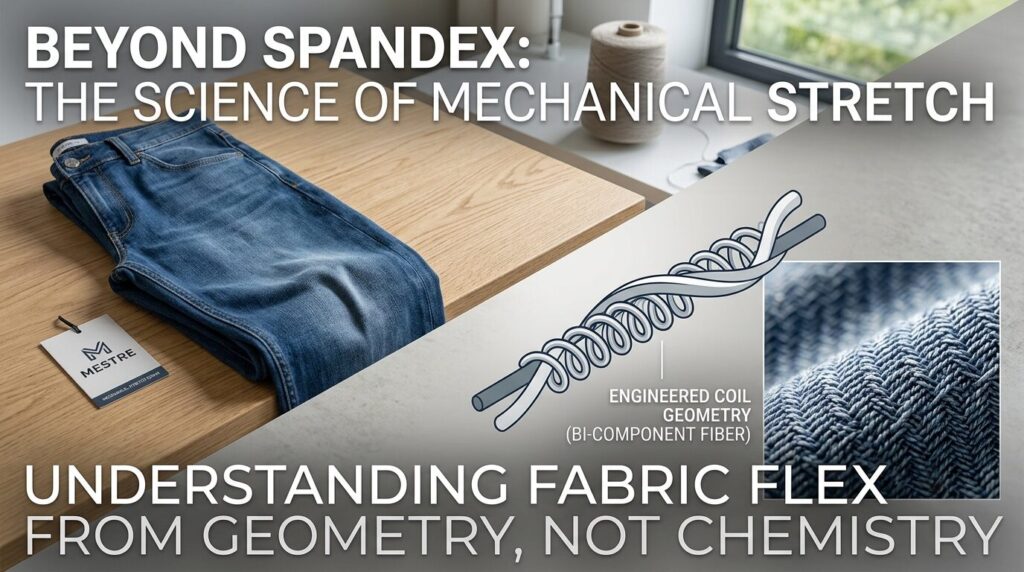
Mechanical stretch refers to a fabric’s ability to extend and recover based purely on its physical construction the way the yarn is spun, crimped, twisted, woven, or knitted rather than from the chemical elasticity of a fibre like spandex, Lycra, or elastane. In short, the stretch is built into the geometry, not the chemistry.
This is what people mean when they describe a fabric as stretch without elastane. The flexibility comes from how tightly a yarn is coiled, how a weave is constructed, or how a knit loop is formed, and all of these can be engineered to allow a fabric to elongate and spring back without a single rubber-like fibre present.
How Yarn Crimp Stretch Is Created
The core mechanism behind most mechanical stretch yarn is crimp a controlled, repeating wave or coil built into the filament. There are a few distinct ways manufacturers achieve it.
- False-twist texturising takes a flat synthetic filament, typically polyester or nylon, and twists, heat-sets, and untwists it in a continuous process. This locks a fine, spiral crimp into the yarn, which behaves like a tiny spring when the fabric is stretched and released.
- Air-jet or air-entanglement texturising uses compressed air to interlace filaments into a bulkier, looped structure, adding stretch and volume without relying on twist alone.
- Bicomponent self-crimping extrudes two polymers with different shrinkage rates together in a side-by-side structure. When heat-set, the mismatch forces the filament to coil permanently the same principle used in elastomultiester yarn. This route tends to produce a more durable crimp than texturising alone.
Whichever method is used, the resulting yarn crimp stretch acts like a microscopic spring at the fibre level, which is what allows the finished fabric to elongate under tension and return to shape once that tension is released.
Understanding Fabric Stretch Types
Not all stretch fabric behaves the same way, and it helps to separate mechanical stretch into a few recognised categories.
| Stretch Type | How It’s Created | Typical Elongation |
| Comfort / moderate stretch | Crimped yarn in warp or weft of a woven fabric | Roughly 10-20% |
| Two-way mechanical stretch | Crimped or coiled yarn running in one direction | Roughly 15-30% |
| Four-way mechanical stretch | Crimped yarn combined with knit construction in both directions | Higher than two-way; structure-dependent |
| Power / compression stretch | Usually requires added elastane content | 30%+, often higher |
| Construction-based stretch | Specific weaves (twill, dobby) or crepe structures create natural fabric give | Varies by weave geometry |
As a general guide, mechanical stretch fabrics fall into the comfort-to-moderate stretch range, roughly 15-30% elongation with good to excellent recovery, which covers the vast majority of everyday wear, workwear, and smart-casual fashion. Genuinely high-compression sportswear typically still relies on some elastane content to reach higher elongation percentages.
It is worth noting that construction-based stretch does not always need a specially crimped yarn at all. A crepe weave, for instance, relies on alternating high-twist yarns that pull against each other to create a pebbled surface with natural give, while a dobby or twill weave can introduce diagonal give simply through how the threads interlace. In these cases, two fabrics made from the exact same straight, uncrimped yarn can stretch very differently depending purely on how that yarn is woven.
Why Inherent Stretch Fabric Outperforms Elastane Blends in Key Areas
Durability over time: Elastane is a rubber-like polymer that gradually loses elasticity with repeated exposure to heat, washing, body oils, and UV light. A mechanically crimped yarn does not rely on a degrading polymer chain, so its stretch performance tends to hold up better over the garment’s working life.
Heat and chemical resistance: Mechanical stretch fabrics built on polyester crimp structures generally tolerate higher-temperature industrial laundering and dyeing without the processing complications elastane can introduce.
Recyclability: When a fabric’s stretch comes from a single polymer family rather than a blended elastane fibre, it is significantly easier to recycle. Elastane must be chemically separated before recycling a step many facilities cannot perform at scale.
Dyeing consistency: Elastane can absorb dye differently from the surrounding fibres, leading to shade variation. Yarn built purely from crimped polyester tends to dye more uniformly, reducing rejection rates in production.
The trade-off is ceiling elongation: for applications that demand very high, rubber-band-level stretch, mechanical construction alone usually cannot match dedicated elastane fibre. The two approaches tend to serve different segments of the stretch fabric market rather than fully replacing one another.
Industries Relying on Mechanical Stretch Yarn
- Denim and Casualwear: Mechanical stretch delivers comfort stretch and shape retention where compression is not the goal.
- Corporate Wear and Workwear: Repeated industrial laundering at high temperatures favours a fabric that will not degrade as quickly as elastane.
- Formalwear and Smart-Casual Fashion: Blazers and trousers benefit from natural movement without a compression feel.
- Knitwear and Hosiery: Crimped yarn structure provides the bulk of the stretch needed for everyday comfort.
Mestre’s Approach to Mechanical Stretch Technology
Mestre, manufactured by the Surat-based Madhusudan Group, builds its mechanical stretch directly into a bicomponent polyester fibre. Two polyester components with different shrinkage rates are co-extruded and heat-set into a permanent coil structure, giving the yarn permanent elastic recovery alongside strong colour fastness, moisture management, and resistance to heat and light all without any elastane in the construction.
As an example of advanced yarn technology developed within India’s domestic textile ecosystem, Mestre reflects the broader shift toward inherent stretch fabric: brands get comfort-stretch performance with the durability and dyeing simplicity of a mechanically engineered yarn, manufactured locally rather than imported.
Frequently Asked Questions
Is mechanical stretch as strong as elastane-based stretch?
For comfort and moderate stretch, roughly 15-30% elongation, mechanical stretch performs very well. For ultra-high-compression applications like performance sportswear, elastane still typically delivers higher maximum elongation.
Can mechanical stretch fabric lose its stretch over time?
It is generally more durable than elastane, but extreme or improper heat exposure can still relax the coil structure over time. Properly engineered crimp yarns are designed to maintain recovery across a garment’s normal wear life.
What is the difference between mechanical stretch and power stretch?
Mechanical stretch comes from the yarn or fabric’s physical structure: crimp, weave, or knit geometry. Power stretch typically refers to higher-elongation fabrics that rely on added elastane content to reach compression-level stretch.
Does a mechanical stretch fabric need any spandex finishing?
No. That is the defining feature of mechanical stretch: the elasticity is self-contained in the yarn or fabric construction, so no separate elastic fibre or finishing step is required.
Can mechanical stretch and elastane be combined in the same fabric?
Yes. Some fabrics blend a small amount of elastane with a mechanically crimped base yarn to push elongation higher while still benefiting from the crimp structure’s durability. This hybrid approach is common where moderate-to-high stretch is needed.
Final Thoughts
Mechanical stretch proves that elasticity does not have to come from a chemically elastic fibre. By engineering crimp directly into yarn whether through texturising or bicomponent self-crimping manufacturers can deliver comfort stretch that holds up to heat, repeated washing, and recycling better than many elastane blends. As more producers, including Indian manufacturers like Mestre, scale up this kind of yarn crimp stretch technology, mechanical stretch is positioned to become the default choice for everyday stretch fabric, while elastane remains reserved for the highest-compression applications.