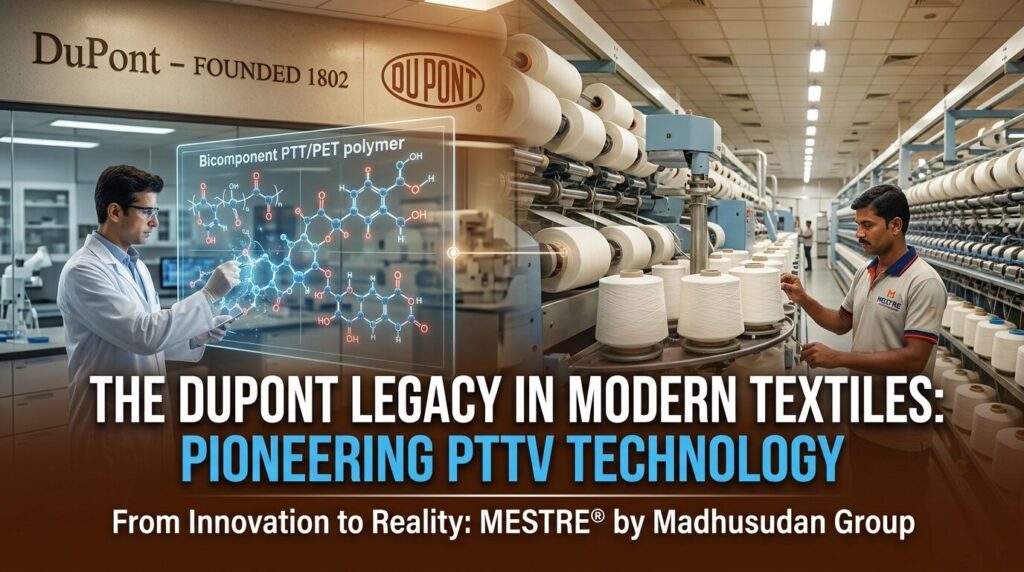
DuPont formally E. I. du Pont de Nemours and Company is one of the most consequential companies in the history of textile science. Founded in 1802 as a gunpowder manufacturer, DuPont transformed into a global chemical and materials giant through the 20th century. Its contributions to the textile industry include the invention of Nylon (1935), Lycra® spandex (1958), and the later development of PTT polymer-based fibers under the Sorona® brand.
Understanding DuPont’s role in textile innovation is essential to understanding the scientific foundations of modern Elastomultiester stretch yarn including products like Mestre® by Madhusudan Group, which draw on the same bicomponent PTT/PET fiber principles that DuPont pioneered.
DuPont and the Development of PTT Polymer
Polytrimethylene terephthalate (PTT) was first synthesised in the 1940s, but it remained a laboratory curiosity for decades due to the high cost and limited availability of 1,3-propanediol (PDO), the key monomer required for its production. It was DuPont’s development of a bio-based fermentation route to produce PDO from corn glucose that made PTT commercially viable at scale in the 1990s.
This breakthrough allowed DuPont to commercialise PTT as Sorona® fiber, combining bio-based content, superior softness, and exceptional elastic recovery in a single polyester-family material. The development of Sorona® opened the door to an entirely new category of textile fiber Elastomultiester bicomponent yarn which now powers stretch performance in millions of garments worldwide.
DuPont’s PTT development work directly enabled the emergence of bicomponent stretch yarn technologies that brands like Mestre® have brought to Indian textile manufacturing.
How DuPont’s Bicomponent Technology Works
DuPont’s contributions to bicomponent fiber technology involve the side-by-side or sheath-core extrusion of two distinct polymers through a single spinneret hole. In the case of Elastomultiester yarn, this means PTT and PET are extruded together in a side-by-side format. The differential thermal shrinkage between the two polymers upon cooling causes the filament to develop a natural helical crimp the three-dimensional spring-like structure that gives the final yarn its stretch and recovery performance.
This technology is the scientific backbone of every high-performance Elastomultiester yarn on the market today, including Mestre® from Madhusudan Group. The innovation DuPont initiated has been refined and commercialised by manufacturers around the world, bringing the benefits of bicomponent stretch to a global textile industry.
DuPont’s Influence on Modern Stretch Textile Standards
DuPont did not merely develop new fibers it shaped the standards and expectations of the entire global stretch textile market. By commercialising both spandex (under the Lycra® brand, originally developed by DuPont and later owned by others) and PTT bicomponent fiber (Sorona®), DuPont defined what textile brands, consumers, and manufacturers expect from performance stretch fabrics.
These expectations consistent stretch percentage, reliable recovery after multiple wash cycles, uniform dyeability, and body-conforming comfort have become baseline requirements for any stretch yarn sold in competitive markets. Indian-made Mestre® Elastomultiester yarn is built to meet precisely these DuPont-influenced standards, giving Indian fabric manufacturers access to world-class stretch performance from a domestic source.
The technical parameters used to evaluate Mestre® stretch force, recovery force, growth after cycling, dye levelness, and chlorine resistance are all grounded in the performance benchmarks that DuPont’s textile innovations helped establish.
From DuPont’s Lab to Indian Textile Mills: The Mestre® Connection
The journey from DuPont’s polymer laboratories to the looms and knitting machines of Indian fabric mills is a story of global technology transfer and domestic manufacturing excellence. Madhusudan Group, through its Mestre® brand, has taken the bicomponent PTT/PET fiber science that DuPont pioneered and adapted it for the specific needs of Indian textile manufacturers.
This means Indian manufacturers can now access the same fundamental stretch technology inspired by DuPont’s innovations without the cost and supply chain complexity of importing from international sources. Mestre® stretch yarn, available at mestre.co.in, brings DuPont-lineage stretch performance to the doorstep of every fabric mill in India.
For manufacturers looking to upgrade their stretch fabric range with yarn built on globally proven technology, Mestre® represents the most accessible and cost-effective path forward.
Why DuPont-Inspired Technology Matters for Your Fabric Business
When you choose a stretch yarn built on DuPont-developed PTT bicomponent technology, you are choosing decades of scientific validation. The performance characteristics of PTT bicomponent fiber have been proven in millions of garments across sportswear, innerwear, swimwear, and fashion categories globally.
For fabric manufacturers and garment exporters in India, aligning with this proven technology through domestically produced Mestre® yarn means lower risk in product development, higher confidence in end-product performance, and stronger credibility when pitching to global brands that demand verified quality. To explore how Mestre® Elastomultiester stretch yarn can transform your fabric range, visit mestre.co.in and speak with the Madhusudan Group technical team.