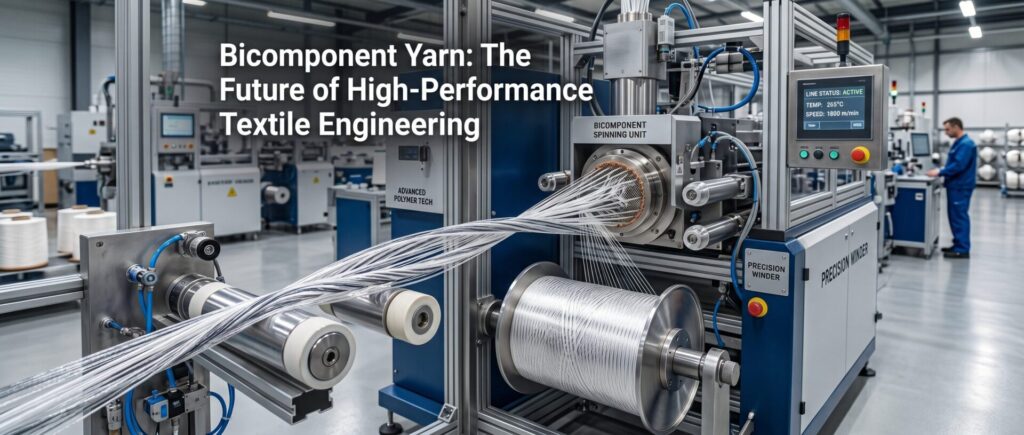
Modern textiles are no longer defined by a single material. The rise of bicomponent yarn a revolutionary two-in-one fibre technology has fundamentally changed what fabrics can do, feel like, and perform. From athletic apparel to automotive interiors, bicomponent yarn is quietly powering a textile renaissance.
At Mestre, we have spent decades mastering the science and art of advanced yarn technologies, and bicomponent yarn sits at the very heart of our innovation portfolio.
What Is Bicomponent Yarn?
Bicomponent yarn is a manufactured fibre made from two distinct polymer components that are extruded simultaneously through the same spinneret. The two components are joined together in a specific cross-sectional arrangement, giving the resulting yarn unique characteristics that neither polymer could achieve alone.
Unlike blended yarns where fibres of different types are twisted together bicomponent yarn integrates both components at the molecular fibre level. This creates a single, cohesive yarn with complex, engineered properties.
Primary Structural Types of Bicomponent Yarn
- Sheath-Core: One polymer forms the outer sheath while the other forms the inner core. This is commonly used when one component provides surface characteristics (softness, colour absorption) and the other provides structural strength.
- Side-by-Side: Two polymers are placed adjacent to each other along the fibre’s length. When these polymers have different thermal shrinkage rates, the fibre naturally crimps, producing inherent stretch and bulk.
- Islands-in-the-Sea: A matrix of one polymer contains tiny ‘islands’ of another. This structure is often used in ultra-fine fibre production and technical filtration.
- Segmented Pie: The fibre cross-section is divided into alternating wedge-shaped segments of two polymers — used in microfibre splitting applications.
Key Properties That Make Bicomponent Yarn Exceptional
The genius of bicomponent yarn lies in property combination. Here is what sets it apart:
- Mechanical Stretch Without Elastane: Side-by-side configurations naturally produce self-crimping fibres, delivering stretch without the need for spandex or rubber.
- Enhanced Thermal Bonding: The lower-melting-point sheath in sheath-core constructions allows the yarn to bond under heat, making it ideal for non-woven fabrics and geotextiles.
- Moisture Management: By pairing hydrophilic and hydrophobic polymers, bicomponent yarns can be engineered for precise moisture wicking.
- Dimensional Stability: The dual-polymer structure often provides greater resistance to elongation, deformation, and fatigue than mono-component counterparts.
Applications of Bicomponent Yarn Across Industries
Sportswear and Performance Apparel
Performance athletic wear demands fabrics that stretch, recover, breathe, and resist fatigue. Bicomponent yarns particularly side-by-side configurations deliver inherent mechanical stretch, making them a preferred choice for running tights, yoga wear, and cycling jerseys. The absence of elastane also means better durability through repeated washing.
Home Textiles and Upholstery
In carpets, upholstery, and home furnishing fabrics, bicomponent yarns provide enhanced bulk, resilience, and soil resistance. Sheath-core variants with thermally bondable sheaths are widely used in carpet backing production.
Automotive Textiles
Vehicle seat covers, headliners, and floor mats benefit from the mechanical durability, acoustic damping, and thermal stability that bicomponent yarn constructions offer. The automotive sector is one of the fastest-growing end markets for these fibres.
Medical and Hygienic Nonwovens
In medical-grade nonwovens, the thermal bondability of sheath-core bicomponent fibres is exploited to create fabrics without chemical adhesives. This is critical for skin-safe applications such as wound dressings, surgical drapes, and hygiene products.
Technical Filtration
Islands-in-the-sea bicomponent fibres, when the sea component is dissolved, yield ultra-fine nanofibres ideal for HEPA-level filtration in air purifiers and industrial filtration systems.
The Manufacturing Process of Bicomponent Yarn
Producing bicomponent yarn requires specialised co-extrusion spinnerets that deliver two distinct polymer melts simultaneously. The key steps include:
- Polymer Preparation: Both polymer types are separately melted and filtered.
- Co-Extrusion: The two melts are fed through a bicomponent spinneret designed for the target cross-sectional arrangement.
- Quenching: The extruded filaments are rapidly cooled to lock in the structural arrangement.
- Drawing: Filaments are stretched to orientate the polymer chains and develop strength.
- Texturising or Crimping: Additional mechanical or thermal treatments may be applied to enhance bulk or stretch.
At Mestre, our state-of-the-art manufacturing infrastructure ensures consistent polymer distribution, precise temperature control, and repeatable quality across every production run.
Bicomponent Yarn vs. Conventional Yarn: A Comparison
When compared to standard mono-component yarns or simple fibre blends, bicomponent yarns offer a compelling advantage matrix. They deliver properties that single-material yarns cannot such as inherent crimp, differential shrinkage-induced stretch, or dual-surface characteristics within a single, unified fibre. This reduces the need for chemical finishes or multiple fabric layers, simplifying production while improving performance.
Sustainability Considerations
Bicomponent yarns present exciting sustainability opportunities. Combining a biodegradable polymer with a functional one, or using recycled PET as the core, reduces virgin material use. Side-by-side configurations that enable mechanical stretch also reduce reliance on petroleum-derived elastane, supporting cleaner supply chains. Mestre is actively researching eco-forward bicomponent formulations to align with global sustainability mandates.
Why Mestre Is Your Ideal Bicomponent Yarn Partner
With deep technical expertise, flexible customization capabilities, and a commitment to quality that spans every step of the production process, Mestre is positioned as a leading supplier of bicomponent yarn solutions for global textile manufacturers. Our team works closely with customers to develop yarn constructions tailored to specific application requirements.
Explore Mestre’s bicomponent yarn range at mestre.co.in and request a sample or technical consultation today.
Frequently Asked Questions
Q1: What is the primary advantage of bicomponent yarn over blended yarn?
- Bicomponent yarn integrates two polymers at the fibre level, creating uniform, consistent properties throughout. Blended yarns mix different fibres but each fibre retains its own properties, resulting in less precise performance control.
Q2: Can bicomponent yarn be used in natural fibre blends?
- Yes. Bicomponent synthetic yarns can be twisted or woven alongside natural fibres like cotton or wool, combining the functional benefits of the bicomponent structure with the comfort attributes of natural fibres.
Q3: Is bicomponent yarn more expensive than conventional yarn?
- The manufacturing process is more complex, which may increase cost per unit. However, the enhanced performance often reduces downstream processing costs such as the need for chemical finishing agents or elastic insertions.
Q4: What polymers are most commonly used in bicomponent yarn?
- PET (polyethylene terephthalate) and PE (polyethylene) are the most common pairing for sheath-core constructions. PET and PTT (polytrimethylene terephthalate) pairings are popular for side-by-side stretch variants.
Q5: Does Mestre offer custom bicomponent yarn specifications?
Yes. Mestre provides customised bicomponent yarn development, including polymer selection, denier range, cross-sectional structure, and surface finish. Contact our technical team through mestre.co.in for a consultation.