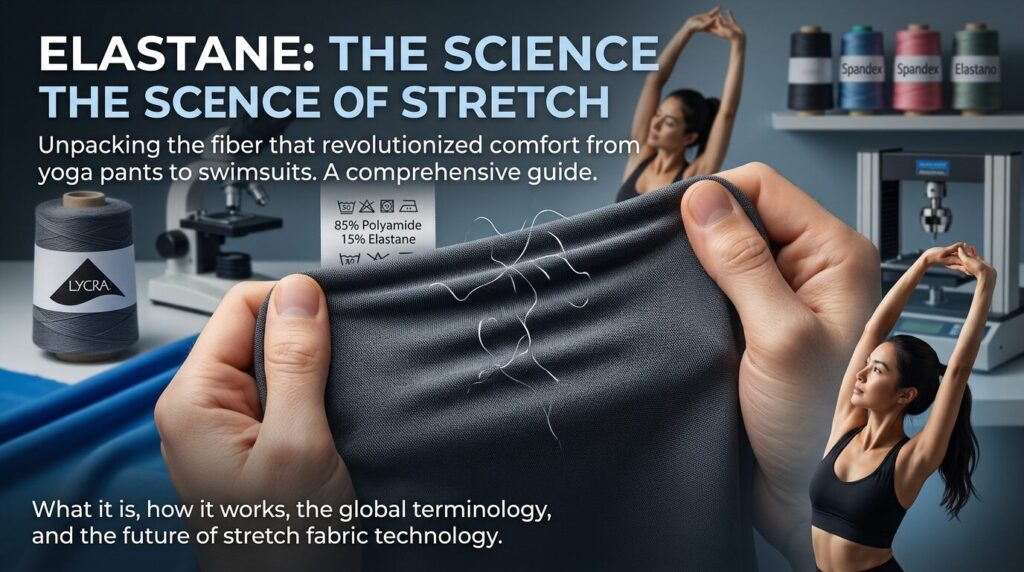
Picture slipping on a pair of yoga pants that feel like a second skin, or pulling on a swimsuit that perfectly hugs every curve while you move through the water without restriction. Behind that seamless, liberating sensation lies one of the most transformative fibers in modern textile history: elastane.
Known by several names across the globe spandex in North America, lycra as a famous brand name, elastano in Spanish and Portuguese-speaking countries, elastan in French and German markets, and élasthanne in formal French textile terminology this synthetic elastic fiber has quietly revolutionized the way we dress, move, work out, and even sleep. Yet despite its near-ubiquitous presence in our wardrobes, surprisingly few people understand what it actually is, how it works, or why it matters so deeply to the textile and apparel manufacturing industries.
This comprehensive guide unpacks everything you need to know about elastane and its global equivalents: its chemistry and construction, its performance properties, the differences between key terms and brand names, its applications across industries, sustainability considerations, and the future trajectory of stretch fabric technology. Whether you are a fashion designer sourcing performance fabrics, an apparel manufacturer optimizing blend ratios, a buyer evaluating textile specifications, or simply a curious consumer who wants to understand what makes activewear so comfortable this is your definitive resource.
1. What Is Elastane? A Scientific Overview
Elastane is a lightweight, synthetic polymer fiber engineered to provide exceptional elasticity to textile products. Chemically, it is composed of at least 85% polyurethane a long-chain polymer derived from petrochemical sources which gives the fiber its signature ability to stretch dramatically and recover its original dimensions without permanent deformation.
The fiber was first developed in 1958 by chemist Joseph Shivers at DuPont’s laboratories in Waynesboro, Virginia. Originally marketed under the brand name Lycra, the material was developed as a replacement for rubber in garments, offering greater durability, lighter weight, and far superior comfort against the skin. Within a decade, its adoption in swimwear, hosiery, and activewear had begun transforming the apparel industry worldwide.
Unlike rubber or other elastic materials, elastane can be produced as very fine, lightweight filaments some as thin as a single denier making it suitable for sheer fabrics, form-fitting garments, and performance textiles where bulk is undesirable. It is almost never used alone; instead, it is blended with natural or other synthetic fibers in proportions typically ranging from just 2% to upward of 40%, depending on the performance requirements of the final fabric.
| Key Fact: Just 2–5% elastane content in a fabric blend is enough to deliver measurable stretch and recovery properties making it one of the most performance-efficient fibers in modern textile science. |
2. Global Terminology: Elastane, Spandex, Lycra, Elastano, Elastan & Élasthanne
One of the greatest sources of confusion in the global textile trade is the multitude of names used to refer to what is essentially the same synthetic elastic fiber. The terminology varies by region, language, and whether the term refers to a proprietary brand or a generic fiber category. Understanding these distinctions is essential for buyers, manufacturers, compliance teams, and international supply chain professionals.
The Six Key Terms Explained
Here is a comprehensive comparison of the most commonly used terms across global textile markets:
| Term | Language/Region | Pronunciation | Brand/Generic | ISO Standard |
| Elastane | English (UK/EU) | ih-LAS-tayn | Generic | Yes (ISO) |
| Spandex | English (US/CA) | SPAN-deks | Generic | Yes (ISO) |
| Lycra® | Global | LY-kruh | Brand (Invista) | N/A (trademark) |
| Elastano | Spanish/Portuguese | eh-las-TAH-no | Generic | Regional |
| Elastan | French/German/Turkish | eh-las-TAHN | Generic | Regional |
| Élasthanne | French (formal) | eh-las-TAN | Generic | French standard |
Why So Many Names for One Fiber?
The proliferation of terminology stems from a combination of linguistic adaptation, trade regulation, and brand history. In North America, the fiber was registered under the generic name “spandex” a loose anagram of the word “expands” by the American Society for Testing and Materials (ASTM) and the U.S. Federal Trade Commission. This term became standard in the United States and Canada.
In Europe and much of the rest of the world, the ISO standard designation “elastane” took precedence. The French textile industry adopted “élasthanne” as its official technical term, while everyday usage across France, Belgium, and Switzerland often simply uses “élastane” or the shorter “elastan.” In Spanish-speaking markets spanning Spain, Latin America, and parts of the Caribbean, the term “elastano” is widely used on garment care labels, fabric specifications, and retail descriptions. Similarly, German-language markets and Turkey use the term “elastan” as the primary technical descriptor.
Lycra, by contrast, is not a generic term at all it is the registered trademark of Invista (formerly a DuPont subsidiary), now owned by Koch Industries. Because Lycra became so synonymous with high-quality elastic fiber in the consumer consciousness, the brand name is frequently used colloquially as a synonym for elastane or spandex, even when the actual fiber in question is not Invista’s Lycra product.
| Trade Tip: When reviewing international garment labels or fabric specifications, always check whether the term used (elastane, spandex, elastano, elastan, or élasthanne) appears alongside a fiber content percentage. All these terms refer to the same underlying fiber chemistry the name simply reflects regional labeling convention. |
3. How Textile Elasticity Works: The Science of Stretch
The extraordinary elasticity of spandex and elastane fibers arises from their unique molecular architecture. At the polymer level, elastane consists of two types of molecular segments that alternate along the polymer chain: rigid, crystalline “hard” segments and flexible, amorphous “soft” segments. This combination produces what materials scientists call a block copolymer structure.
When the fiber is stretched, the soft segments uncoil and extend allowing the fiber to reach up to five to eight times its resting length. Critically, the hard segments remain crystalline and anchored, storing elastic energy like a compressed spring. When the stretching force is removed, this stored energy drives the soft segments back into their original coiled state, and the fiber recovers its original dimensions almost instantaneously. This combination of high extensibility and near-perfect elastic recovery distinguishes polyurethane-based elastane from all other textile fibers.
In fabric terms, textile elasticity is quantified through metrics including extension at break, elastic recovery percentage, and residual elongation after repeated stretch cycles. High-quality elastane blends used in professional sportswear and compression garments typically achieve over 95% elastic recovery even after hundreds of wash and wear cycles a performance benchmark that cheaper alternatives often struggle to match.
Two-Way vs. Four-Way Stretch
Not all stretch fabrics offer the same directional flexibility. Understanding stretch direction is critical for pattern cutting, garment construction, and fit optimization:
- Two-way stretch: The fabric extends in one direction only typically along the width (weft). Common in standard jersey knits and some woven stretch fabrics. Suitable for garments where only horizontal flexibility is needed.
- Four-way stretch: The fabric stretches both horizontally and vertically, offering full omnidirectional movement. Essential for activewear, swimwear, compression garments, and any application requiring unrestricted body movement. Achieved through specific knit constructions or lycra blends woven in both warp and weft directions.
Performance fabrics used in high-end sportswear, dance costumes, and compression wear almost universally feature four-way stretch construction, made possible by carefully calibrated elastane content and specialized knitting or weaving techniques.
4. Lycra vs. Spandex vs. Elastane: Understanding the Differences
This is one of the most frequently searched questions in the textile industry and the honest answer is more nuanced than a simple comparison chart suggests. Here is how to think about the distinctions clearly:
Elastane vs. Spandex: Regional Names, Same Fiber
Elastane and spandex are functionally identical. They describe the same category of synthetic polyurethane elastic fiber, and any fabric labeled with either term will behave in essentially the same way. The choice of terminology is purely a matter of geography and regulatory convention. Elastane is the ISO-standard term used in Europe, Australia, and much of Asia; spandex is the standard term in North America.
When sourcing fabrics internationally, be aware that a fabric specification sheet from a UK mill listing “5% elastane” and one from a U.S. mill listing “5% spandex” are referring to the exact same type of fiber in the exact same proportion. There is no performance difference attributable solely to the terminology used.
Lycra: The Premium Brand Within the Category
Lycra is a different matter. As a registered trademark, it refers specifically to elastane/spandex manufactured to Invista’s proprietary quality and performance standards. Think of it as the difference between “adhesive bandage” (generic) and “Band-Aid” (brand name): all Lycra is elastane, but not all elastane is Lycra.
In practice, Invista’s Lycra fiber does command a reputation for superior quality attributes, including higher elastic recovery rates, better resistance to chlorine and UV degradation in swimwear applications, and enhanced compatibility with dyeing processes. Garments certified with the Lycra® brand label are subject to quality testing and standards set by Invista, which is why many premium sportswear and swimwear manufacturers specifically source Lycra fiber for their performance product lines.
However, there are many high-quality generic elastane manufacturers globally particularly in China, South Korea, Taiwan, and India whose products perform comparably to Lycra for most apparel applications, particularly in the mid-market segment.
5. Benefits of Elastane Fabric in Modern Apparel
The widespread adoption of elastane across virtually every apparel category is no accident. The fiber delivers a unique combination of performance attributes that no other material can replicate. Here is a detailed breakdown of the key benefits:
| Property | Benefit | Application Example |
| High Elasticity | Stretches 4–7x its length; returns to original shape | Swimwear, hosiery, underwear |
| Lightweight | Adds stretch without bulk or extra weight | Compression sportswear, sheer hosiery |
| Moisture-wicking | Moves sweat away from skin when blended correctly | Gym wear, cycling shorts, yoga pants |
| Durability | Resists abrasion and maintains shape after washing | Athletic wear, medical garments |
| Colorfastness | Accepts and holds dye well in blended fabrics | Printed activewear, fashion knitwear |
| Comfort & Fit | Conforms to body shape without restricting movement | Dance costumes, performance outerwear |
How Elasticity Improves Clothing Comfort
The comfort contribution of even small percentages of elastane is profound and multidimensional. From a biomechanical perspective, stretch fabrics reduce the resistance fabric places against natural body movement. When you walk, bend, reach, or sit, your clothing must accommodate the dimensional changes of your body and rigid fabrics resist these changes, creating pressure points, bunching, and restricted movement.
Elastane-containing fabrics move in synchrony with the body, eliminating the friction and restriction associated with woven non-stretch materials. This is why denim with 2% elastane feels dramatically more comfortable in the seat and knees than 100% cotton rigid denim, despite the minimal fiber content difference. The principle scales predictably: higher elastane content delivers greater freedom of movement, which is why performance-oriented garments for yoga, swimming, cycling, and running typically contain 15–25% elastane.
Beyond movement comfort, elastane also contributes to fit comfort. Form-fitting garments made with stretch fabrics accommodate a broader range of body shapes and sizes than rigid constructions, reducing the need for extensive sizing architecture and delivering a more consistently flattering, body-contouring silhouette across diverse body types.
6. Best Uses of Stretch Fabrics Across Industries
The range of industries and applications that rely on elastane and stretch fabrics is broader than most consumers realize. Here is a comprehensive overview by sector:
| Sector | Typical Elastane % | Key Performance Need |
| Activewear / Sportswear | 15–25% | Full range of motion, compression, moisture management |
| Swimwear | 15–20% | Chlorine resistance, body-contouring fit, quick-dry |
| Underwear & Hosiery | 2–10% | Smooth fit, shape retention, breathability |
| Denim | 1–3% | Comfort stretch, recovery after sitting or bending |
| Medical / Compression | 20–40% | Graduated compression, therapeutic fit, durability |
| Fashion Knitwear | 5–15% | Drape, body-contouring silhouette, wrinkle resistance |
Activewear and Sportswear
The sportswear fabric technology market is perhaps the most dynamic and demanding application for stretch textiles. Modern athletic performance wear integrates elastane with polyester, nylon, or polyamide to create compression fabrics that provide targeted muscle support, improve blood circulation, reduce vibration fatigue during high-impact activity, and accelerate recovery post-exercise. Leading sportswear brands invest heavily in proprietary fabric engineering including zoned compression architectures, bonded construction, and seamless knitting all built on the foundation of high-performance elastane blends.
Breathable stretch fabric technology has also advanced significantly, with innovations like open-mesh knit structures, hydrophilic fiber treatments, and moisture-management systems allowing activewear materials to manage perspiration effectively even during intense exercise.
Swimwear and Water Sports
Swimwear represents one of the most technically demanding applications for elastane. Fabrics must withstand chlorine exposure (which degrades standard elastane), UV radiation, saltwater, and repeated stretching while maintaining their shape, color, and elasticity across an entire season of use. Lycra Xtra Life, a specialist chlorine-resistant variant of the Lycra product line, was developed specifically to address these challenges in competitive and recreational swimwear.
Medical and Compression Garments
The medical textile sector relies heavily on high-elastane compression fabrics for a range of therapeutic applications, including graduated compression stockings for varicose veins and deep vein thrombosis prevention, post-surgical compression garments for lymphedema management, and orthopedic supports for joint stabilization. These applications demand precise, calibrated compression levels measured in millimeters of mercury (mmHg) requiring exact elastane content and knit tension engineering that goes far beyond fashion application requirements.
Fashion and Casual Wear
In everyday fashion, elastane works quietly behind the scenes. Stretch denim with 1–3% elastane content has become the dominant denim category globally precisely because it delivers the aesthetics of traditional denim with dramatically improved wearability. Knit tops, fitted blazers, ponte trousers, and bodycon dresses all rely on elastane blends to achieve the combination of tailored fit and body comfort that contemporary consumers expect from fashion garments.
7. Drawbacks and Limitations of Elastane
Despite its remarkable performance profile, elastane is not without limitations. Understanding these constraints is important for textile professionals making informed sourcing and product development decisions.
- Heat sensitivity: Elastane degrades when exposed to high temperatures. Garments containing spandex or elastane should be washed in cool or warm water and avoided from tumble drying on high heat settings, which can permanently damage the fiber’s elastic properties.
- Chemical vulnerability: Standard elastane is susceptible to degradation from chlorine bleach, some dry cleaning solvents, and prolonged exposure to pool chemicals. Specialist chlorine-resistant variants are available but command a price premium.
- Petroleum-derived origin: Conventional elastane is synthesized from petrochemical feedstocks, raising sustainability concerns in an era of growing pressure on the fashion industry to reduce its environmental footprint. Biodegradability is minimal with standard polyurethane elastane.
- Pilling and microfiber shedding: Elastane blends, particularly with polyester, can pill on the fabric surface over time and may release synthetic microfibers during washing a growing concern for aquatic ecosystems.
- Cost premium: High-quality elastane, particularly Lycra-branded fiber, adds cost to fabric production. This cost is typically justified by performance and longevity gains in premium garment segments but may be a constraint in price-sensitive market tiers.
- Dyeing complexity: Elastane accepts dye differently from the base fibers it is blended with, requiring careful dyeing process management to ensure consistent coloration across the full fabric construction.
8. Manufacturing and Blending: How Stretch Fabrics Are Made
Understanding how elastane is incorporated into fabrics helps textile professionals optimize blend specifications for their target applications. There are two primary methods through which elastane enters fabric construction:
Bare Yarn Incorporation
Bare elastane yarns thin filaments of pure elastane are fed directly into knitting or weaving machinery alongside other fibers. In circular knitting for jersey and interlock fabrics, the bare elastane yarn is plated alongside the primary fiber (typically cotton, polyamide, or polyester) so that it appears on the reverse face of the fabric, providing elasticity while keeping the primary fiber facing outward for aesthetic and comfort-against-skin reasons.
Core-Spun and Covered Yarns
In woven applications and more complex knit structures, elastane is often encased within a sheath of other fibers to create core-spun or covered yarns. A core-spun yarn has the elastane at its center, surrounded by cotton, wool, or polyester fibers spun around it. Covered yarns wrap one or two outer fibers helically around a central elastane core. Both constructions protect the elastane from abrasion and chemicals while allowing the outer fiber properties softness, natural appearance, moisture absorption to dominate the fabric handle.
Fabric construction method significantly influences the stretch direction, recovery rate, and overall hand feel of the finished textile. Knitted constructions inherently offer greater stretch than woven constructions due to their loop-based architecture, and the addition of elastane amplifies this natural extensibility further.
9. Sustainability and the Future of Elastic Fibers
The sustainability profile of conventional elastane poses real challenges for an industry under increasing pressure to decarbonize and reduce synthetic fiber dependence. Several developments are reshaping the landscape of elastic textile materials:
Bio-Based and Recycled Alternatives
Research and commercial development programs are actively investigating bio-based polyurethane elastomers derived from plant-based feedstocks rather than petroleum. While no bio-based elastane has yet achieved the full performance parity or commercial scale of conventional synthetic fiber, progress in this space is accelerating. Similarly, mechanical and chemical recycling processes for polyurethane are improving, creating pathways for end-of-life elastane recovery though the complexity of separating blended fabric components remains a significant practical challenge.
Extended Fiber Durability
One sustainability argument often made in favor of high-quality elastane particularly Lycra and equivalent premium fibers is that superior elastic recovery and durability translate directly into longer garment lifespan. A compression garment or athletic wear item that maintains its fit and performance after three years of regular use displaces the need for earlier replacement, reducing total fiber consumption and garment disposal over time.
Emerging Smart Stretch Textiles
At the innovation frontier, researchers are combining elastane and elastic fiber technology with conductive materials, shape-memory polymers, and sensor integration to develop next-generation smart textiles. Applications include biometric monitoring garments that measure heart rate, breathing, and movement through the fabric itself; adaptive compression garments that modulate their pressure level in response to body temperature or activity intensity; and wearable technology platforms embedded seamlessly within athletic and medical clothing.
These developments point toward a future in which textile elasticity is not merely a passive comfort property but an active, programmable performance dimension further cementing the centrality of elastane-derived fibers in the next era of apparel innovation.
10. FAQ: Your Stretch Fabric Questions Answered
Q: Is elastane the same as spandex?
Yes. Elastane and spandex are two names for the same synthetic elastic fiber, composed of at least 85% polyurethane. “Elastane” is the ISO-standard term used in Europe, Australia, and most international markets. “Spandex” is the generic term used in North America. Both refer to identical fiber chemistry and performance properties.
Q: What is the difference between Lycra and elastane?
Lycra is a brand name specifically, the registered trademark of Invista for a premium quality elastane fiber. All Lycra is elastane, but not all elastane is Lycra. Lycra is manufactured to higher quality standards and undergoes specific performance certification, which is why it commands a premium price and carries a brand reputation associated with high-performance swimwear, sportswear, and fashion apparel.
Q: What does elastano mean in Spanish?
Elastano is the Spanish and Portuguese-language term for the synthetic elastic fiber known as elastane or spandex in English. You will find this term on garment care labels, fabric composition declarations, and textile specifications throughout Spain, Latin America, Brazil, and Portugal. It refers to the same polyurethane-based elastic fiber.
Q: What is élasthanne?
Élasthanne is the French technical term for elastane, used in official textile standards and garment labeling across France, Belgium, and French-speaking regions of Switzerland and Canada. The simpler form “élastane” is also widely used colloquially. Both terms refer to the same synthetic elastic fiber.
Q: How much elastane should activewear contain?
Most performance activewear contains between 15% and 25% elastane. Lower percentages (8–15%) are common in fashion activewear and yoga wear. Competitive swimwear typically contains 15–20%. Medical compression garments may use 20–40% elastane for therapeutic pressure levels. The optimal percentage depends on the specific performance requirements stretch range, compression level, recovery speed of the garment.
Q: Can elastane be washed in hot water?
No. Elastane is heat-sensitive and should always be washed in cool or warm water (below 40°C / 104°F). High temperatures including hot washing and tumble drying can permanently damage the polymer structure of elastane fibers, causing loss of elasticity and shape retention. Air drying is always recommended for garments with significant elastane content.
Q: Is stretch fabric breathable?
Breathability in stretch fabrics depends primarily on the construction and the base fibers used in the blend, rather than the elastane itself. Fabrics blending elastane with natural fibers like cotton have good inherent breathability. High-performance breathable stretch fabrics used in sportswear typically combine elastane with engineered synthetic fibers featuring moisture-wicking treatments, open-knit structures, or hydrophilic surface finishes that enhance air and moisture vapor transmission.
Conclusion: Why Elastane Matters in the Modern Textile World
From its origins as a laboratory curiosity in the late 1950s to its current status as an indispensable component of the global apparel supply chain, elastane known equally as spandex, lycra, elastano, elastan, and élasthanne depending on where in the world you stand has fundamentally redefined what clothing can do for the human body.
Its unique ability to provide exceptional textile elasticity from minimal fiber content, combined with durability, lightweight performance, and compatibility with virtually any base fiber, makes it irreplaceable across an extraordinary range of applications: from the compression socks helping post-surgical patients recover, to the performance swimwear propelling competitive athletes through the water, to the stretch denim making everyday life more comfortable for millions of people worldwide.
Understanding the global terminology, the performance science, the blend engineering, and the sustainability trajectory of elastic fibers is not merely academic knowledge. For textile professionals, manufacturers, and brands operating in an increasingly competitive and sustainability-conscious market, this knowledge translates directly into better product decisions, more accurate sourcing, and more compelling value propositions for customers who are increasingly sophisticated about what goes into their clothing.
The stretch fabric story is far from over. As bio-based alternatives mature, as smart textile technology advances, and as circular economy models for synthetic fiber reclaim ground in the apparel industry, elastane and its global family of equivalents will remain at the center of the most exciting innovations in textile science continuing to make the clothes of the future move as naturally as the bodies inside them.
| Ready to Elevate Your Textile Business? Explore high-performance elastane, spandex, and stretch fabric solutions for modern apparel manufacturing. Whether you’re sourcing premium lycra blends for activewear, developing compression fabrics for medical garments, or designing the next generation of sustainable stretch textiles we have the expertise and materials to bring your vision to life. Contact us today for custom elastic fabric manufacturing and wholesale textile solutions. |