Stretch denim is one of the fastest-growing categories in Indian apparel manufacturing. Comfortable, flattering, and versatile, it dominates the mid-market and premium denim segments. Nearly every major Indian denim brand and garment exporter now offers stretch denim in their range.
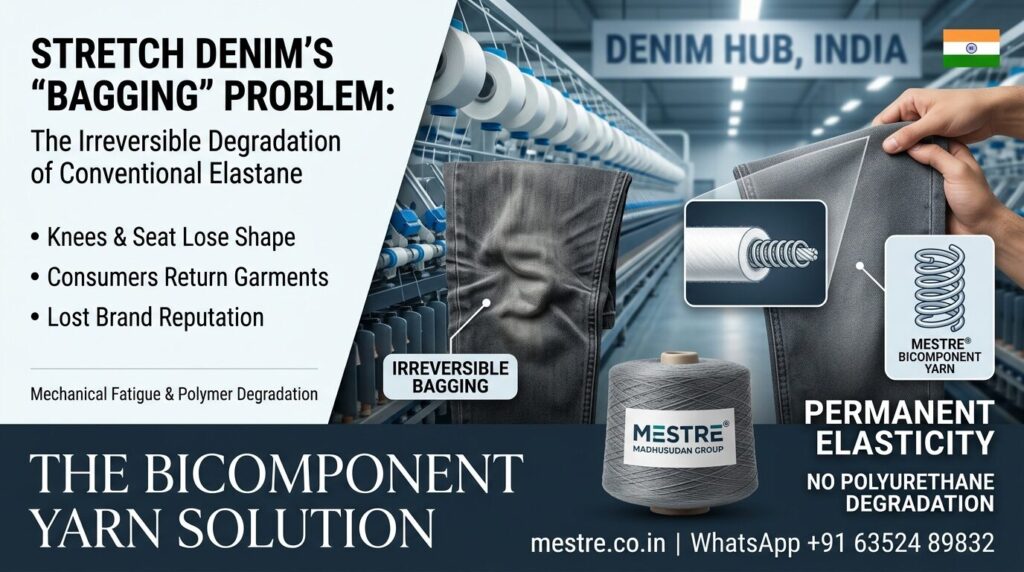
But there is a persistent quality problem that plagues stretch denim made with conventional elastane: the fabric bags.
Within months of regular wear, the knees stretch out. The seat loses its shape. The fabric looks tired long before the denim itself shows any sign of wear. Consumers return garments. Brands lose reputation. Manufacturers receive chargebacks.
The root cause is the elastane content and bicomponent yarn is the solution.
The Rise of Stretch Denim in India
India is one of the world’s largest denim producers. With major manufacturing clusters in Ahmedabad, Surat, and Bengaluru, India produces hundreds of millions of metres of denim fabric annually for domestic consumption and export markets including Europe, the US, and the Middle East.
The shift toward stretch denim began in the early 2010s and has accelerated sharply. Today, the majority of denim sold in the premium and mid-premium Indian market contains stretch. Consumer expectations have changed “comfort stretch” is now table stakes for any denim brand that wants to remain relevant.
The challenge for manufacturers is delivering stretch that actually holds up over the garment’s lifetime.
Why Traditional Elastane Causes Denim Bagging
Conventional stretch denim is made by weaving a small percentage of elastane (Lycra, spandex) into the warp or weft alongside cotton. The elastane provides stretch and recovery when it is new.
The problem is that elastane is polyurethane, and polyurethane is inherently degradable. Several forces attack it over the garment’s lifetime:
Washing: Detergents particularly those with optical brighteners or oxidising agents degrade polyurethane chains with each wash cycle. Recovery ability weakens progressively.
Heat: Tumble drying and high-temperature pressing accelerate elastane degradation. Many Indian consumers use high-heat washing, which is especially damaging.
Sweat and body oils: Perspiration (acidic) and body oils attack the polyurethane at points of highest mechanical stress exactly where bagging is most visible: knees, seat, thighs.
Mechanical fatigue: Every time the fabric stretches, polyurethane chains must extend and retract. Over thousands of repetitions, chains fatigue, and recovery becomes permanently incomplete.
The result: the fabric stretches out and stays out. This is the bagging problem and it is irreversible in elastane-based denim.
How Bicomponent Yarn Solves the Problem
Mestre® bicomponent yarn does not use polyurethane. There is no elastane in the stretch mechanism. Instead, Mestre® creates stretch through a mechanical coil crimp a three-dimensional spring structure inherent to the fibre itself.
A spring does not degrade. It does not react with detergents or body chemistry. It does not fatigue under normal mechanical loads. The coil crimp in Mestre® is as functional after 100 wash cycles as it was in the first metre of fabric produced.
This is what “permanent elasticity” means in practice for denim manufacturers. Denim woven with Mestre® does not bag because the mechanism that creates the stretch is not subject to the degradation that causes bagging in elastane-denim.
Mestre® in Denim: Wash Fastness, Colour Retention, and Recovery
Wash Fastness
Mestre® is a polyester-based fibre with excellent chemical stability. Standard denim washing processes stone washing, enzyme washing, bleaching can be applied without compromising Mestre®’s stretch performance. This is a critical practical advantage: denim finishing is aggressive, and a stretch yarn that cannot survive it is commercially useless.
Colour Retention
In denim constructions where Mestre® is used in the weft alongside indigo-dyed cotton warp, colour balance and appearance are consistent and predictable across production runs. Manufacturers avoid the colour irregularities that sometimes occur when elastane reacts unexpectedly with denim finishing chemistry.
Recovery Performance
After standard denim finishing and wash treatments, Mestre®-based stretch denim retains full recovery performance. The finished fabric springs back immediately when stretched providing the fit and shape retention consumers expect from premium stretch denim.
Core Spinning with Mestre® for Denim Manufacturers
The most common way to incorporate Mestre® into denim is through core spinning. In a core-spun construction, Mestre® forms the elastic core of the yarn, while cotton (or a cotton-polyester blend) wraps around it as the outer sheath.
This construction delivers:
- The familiar feel and appearance of cotton denim on the fabric surface
- The permanent elasticity of Mestre® in the yarn core
- Full compatibility with standard denim weaving and finishing processes
Core-spun Mestre® yarns can be used in the weft (two-way stretch), warp (cross-stretch), or both (four-way stretch denim) depending on the desired stretch direction and degree.
Mestre® Yarn Specifications for Denim Applications
Key considerations when specifying Mestre® for denim:
- Denier selection: Heavier deniers for denim weights above 9 oz; lighter deniers for lightweight denim and chambray constructions
- Stretch level: Mestre® delivers controlled stretch appropriate for woven denim (typically 15–35%) rather than the high stretch levels suited to knit fabrics
- Spinning compatibility: Mestre® is compatible with ring spinning, open-end spinning, and air-jet spinning processes used by Indian denim yarn manufacturers
The Madhusudan Group’s technical team advises on yarn selection, spinning parameters, and fabric construction optimisation for specific denim applications.
Conclusion
The Indian denim industry has a bagging problem and conventional elastane is the cause. Bicomponent yarn like Mestre® is the solution. With permanent mechanical elasticity that does not degrade, full compatibility with standard denim finishing processes, and the backing of India’s own Madhusudan Group, Mestre® gives Indian denim manufacturers the tool they need to produce stretch denim that actually holds its shape.
In a market where quality differentiation is increasingly important, permanent stretch is a compelling story to tell your buyers and brand partners.
Talk to Mestre® about your denim application. Request a technical consultation or yarn sample at mestre.co.in or WhatsApp +91 63524 89832.