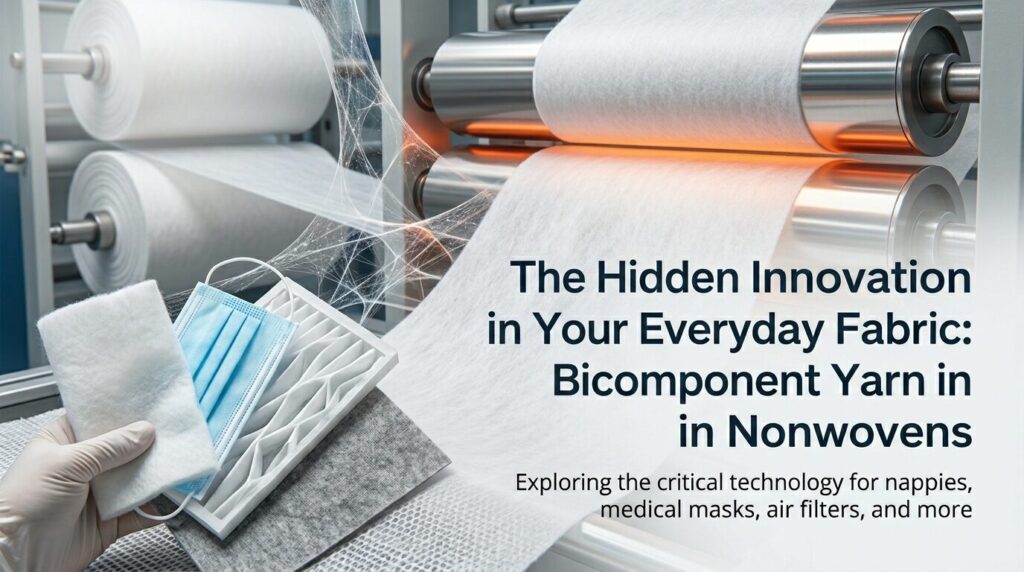
Every day, billions of people interact with nonwoven fabrics in nappies, wipes, medical masks, surgical gowns, air filters, and geotextiles without ever knowing the name of the technology at the heart of those materials. That technology, very often, is bicomponent yarn.
In the nonwoven industry, bicomponent fibres particularly staple fibres in sheath-core configuration are indispensable. They enable thermal bonding without chemical adhesives, control fibre crimp for web structure, and engineer specific surface properties for speciality applications. Mestre is a key supplier of bicomponent fibres to the nonwoven sector.
What Is a Nonwoven Fabric?
A nonwoven is a fabric-like material made from fibres bonded together through mechanical, thermal, or chemical processes rather than by weaving or knitting. Nonwovens are defined by their simplicity of manufacture, versatility of performance, and the enormous range of applications they serve.
The global nonwoven fabric market exceeds $50 billion annually and is growing across hygiene, medical, filtration, construction, and automotive sectors. At the centre of most high-performance nonwoven production is the bicomponent fibre.
The Role of Bicomponent Fibre in Nonwoven Manufacturing
Thermal Bonding: The Primary Application
Thermal bonding is the process by which a nonwoven web is consolidated by passing it through an oven or between heated calendar rolls, causing selected fibres to melt and bond. Sheath-core bicomponent fibres are the key enabler of this process.
In a typical thermal bonding system:
- The web is laid from a blend of structural fibres (e.g., high-tenacity PET) and bicomponent bonding fibres (sheath-core with polyethylene or co-polyester sheath).
- During thermal bonding, the lower-melting-point sheath softens and flows, creating bonds at fibre crossover points.
- The higher-melting-point core remains solid throughout, maintaining the fibre’s structural contribution.
- On cooling, the bonds solidify into a strong, flexible network of fibre crosslinks.
This process produces a nonwoven fabric with controlled strength, softness, and porosity without the need for chemical binders an important advantage for skin-contact and medical applications.
Self-Crimping for Web Loft and Porosity Control
Side-by-side bicomponent staple fibres, when heat-treated after laying, develop a spontaneous 3D helical crimp due to differential polymer shrinkage. This crimp:
- Creates a lofty, open web structure with controlled pore geometry.
- Improves fibre entanglement during web formation, enhancing web cohesion before bonding.
- Allows filtration nonwovens to be engineered with specific particle capture efficiency and airflow resistance.
Binder-Free Medical Nonwovens
In medical and hygiene applications, chemical binders in nonwovens raise concerns about skin compatibility and migration. Bicomponent thermal bonding allows medical-grade nonwovens surgical drapes, wound care materials, hygiene product coverstock to be produced without chemical adhesives, meeting the strictest requirements for skin safety.
Key Nonwoven Applications of Bicomponent Yarn
Hygiene Products
Baby nappies, adult incontinence products, and feminine care items use multiple nonwoven layers, many of which are thermally bonded bicomponent constructions. Mestre supplies bicomponent staple fibres specifically engineered for the softness, loft, and thermal bondability required in these applications.
Medical Textiles
Surgical gowns, drapes, masks, and sterilisation wraps rely on nonwovens that combine barrier performance with binder-free construction. Bicomponent fibres allow these critical medical materials to meet demanding microbial barrier standards without chemical contamination risks.
Air Filtration
HEPA-class and sub-HEPA air filtration media often incorporate bicomponent fibres to engineer the pore geometry, loft, and particle capture efficiency required for their performance class. The self-crimping property of side-by-side bicomponent fibres is particularly valuable in this application.
Geotextiles
In geotextile engineering, bicomponent fibres contribute to the mechanical strength, filtration efficiency, and long-term durability of nonwoven geotextile layers used in road construction, drainage, erosion control, and landfill lining.
Mestre’s Bicomponent Staple Fibre Range for Nonwovens
Mestre offers a comprehensive range of bicomponent staple fibres for the nonwoven industry, including:
- Sheath-core configurations with PE, co-PET, and bi-elastomer sheath options
- Side-by-side configurations for self-crimping web applications
- Multiple denier and cut-length options for web formation compatibility
- Speciality surface treatments for enhanced fibre-to-fibre bonding and web cohesion
Our technical team provides comprehensive application engineering support, including fibre blend recommendations, bonding parameter guidance, and end-product performance testing.
Contact Mestre’s nonwoven specialist team at mestre.co.in to discuss your bicomponent fibre requirements.
Frequently Asked Questions
Q1: What denier is most commonly used for bicomponent bonding fibre in nonwovens?
- For most hygiene and medical nonwovens, 1.5–3.0 denier bicomponent staple fibres are commonly used. Coarser deniers (4–6 denier) are used in geotextile and industrial filtration applications.
Q2: What is the typical sheath melting point for thermal bond nonwoven bicomponent fibre?
- PE sheath fibres typically bond at 130–140°C. Co-polyester sheath fibres bond at 110–180°C depending on formulation. Mestre supplies fibres across this range to suit different bonding systems.
Q3: Can Mestre supply bicomponent fibres with antimicrobial or hydrophilic finishes?
- Yes. Mestre offers speciality-treated bicomponent fibres with hydrophilic, hydrophobic, antistatic, and antimicrobial finishes for applications that require specific surface performance. Contact mestre.co.in for options.
Q4: What is the difference between using bicomponent fibre and chemical binder in nonwoven bonding?
- Chemical binder bonding deposits an adhesive latex or resin onto the fibre web and cures it. This can affect hand feel, porosity, and skin safety. Bicomponent thermal bonding achieves the same consolidation through fibre-to-fibre polymer fusion, without chemical additions.
Q5: Does Mestre supply bicomponent fibre for sustainable nonwoven applications?
- Yes. Mestre offers bicomponent fibres produced from recycled PET and bio-based polymer inputs for nonwoven manufacturers targeting sustainability certification and reduced virgin material content.