Not all stretch is created equal. When most consumers think of stretchy fabric, they think of elastane the rubber-like synthetic fibre that revolutionised activewear and shapewear. But there is another, more elegant form of stretch that requires no rubber polymer whatsoever: mechanical stretch.
Mechanical stretch is an inherent property arising from the physical architecture of a yarn or fabric from crimp, coil, texture, and structure rather than from elastic polymers. It is more durable, more sustainable, and increasingly more versatile than chemical-elastic stretch.
Defining Mechanical Stretch
Mechanical stretch refers to the ability of a textile to elongate under applied force and return to its original dimensions when that force is removed achieved through the geometric structure of the yarn rather than the chemical elasticity of a rubber-like polymer.
In practice, mechanical stretch is generated by:
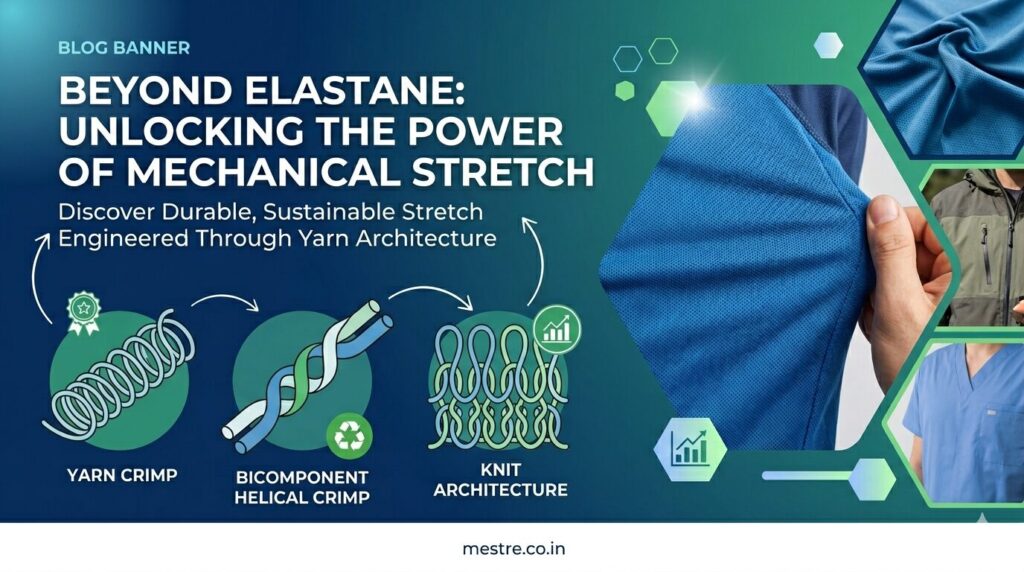
- Yarn Crimp: Textured or crimped yarns can straighten out under tension and recoil when released.
- Fabric Construction: Knitted fabrics inherently have mechanical stretch due to the looped interlocking of yarns. Even woven fabrics can exhibit moderate stretch through specific weave geometries.
- 3D Fibre Architecture: Bicomponent fibres with side-by-side configurations develop spontaneous helical crimps after heat treatment a primary source of mechanical stretch in advanced yarns.
Mechanical Stretch vs. Chemical (Elastane) Stretch
Understanding the differences between these two stretch mechanisms is critical for textile designers and procurement teams:
Stretch Range
Elastane-based stretch can extend fabric by 150% to 600% of its original length ideal for extreme-fit applications. Mechanical stretch typically delivers 15% to 50% elongation, which is sufficient for comfort-fit sportswear, casual wear, and many performance applications.
Durability
Mechanical stretch fabrics generally maintain their stretch properties longer than elastane blends. Elastane is vulnerable to heat, chlorine, body oils, and UV radiation all of which degrade its elastic performance over time. Mechanical stretch yarn, particularly polyester-based bicomponent constructions, is resistant to these environmental stressors.
Recyclability
This is where mechanical stretch delivers a decisive environmental advantage. Fabrics achieving stretch purely through fibre architecture (particularly those made from bicomponent polyester yarns) can be recycled as mono-material streams. Elastane-blended fabrics, by contrast, are virtually impossible to recycle cost-effectively.
Processing Complexity
Fabrics with chemical stretch (bare elastane) require careful handling during fabric production, dyeing, and finishing to avoid over-stretching or damaging the elastic core. Mechanical stretch fabrics generally process more like conventional fabrics, simplifying production workflows.
How Mechanical Stretch Is Engineered into Yarn
Texturising
One of the oldest methods of imparting mechanical stretch is false-twist texturising of polyester or nylon filaments. This creates a crimped, coiled structure in the filament. When the yarn is under tension it straightens; when tension is released, the coil recoils, providing stretch recovery.
Air-Jet Texturising
Air-jet texturing creates a looped, knotted surface on filament yarn, generating bulk and a degree of mechanical stretch. This technique is widely used for producing textured yarns for upholstery, technical textiles, and carpets.
Bicomponent Co-Extrusion
The most sophisticated source of mechanical stretch is the bicomponent side-by-side architecture. As detailed in Mestre’s bicomponent yarn technology, co-extruding PET with PTT creates a differential shrinkage-driven 3D helical crimp after heat relaxation. This architecture delivers exceptional, durable mechanical stretch that mimics the feel of elastane without relying on rubber polymers.
Fabric Construction (Knit Architecture)
Beyond yarn-level engineering, knit fabric construction plays a major role in mechanical stretch. Circular-knit structures, double-jersey constructions, and interlock fabrics inherently have significant stretch in multiple directions. Combining mechanically-stretched yarn with engineered knit structures multiplies the stretch performance.
Mechanical Stretch in Action: Industry Applications
Casual and Lifestyle Apparel
Denim-look stretch fabrics using mechanical stretch yarn blends deliver comfort and freedom of movement without the clinginess associated with high-elastane content. Consumers appreciate the natural feel of well-designed mechanical stretch fabrics.
Workwear and PPE
Personal protective equipment (PPE) and occupational workwear increasingly incorporate mechanical stretch for ease of movement. Elastane-free stretch is particularly valuable in workwear that must be laundered frequently at high temperatures, where elastane would degrade rapidly.
Outdoor and Adventure Textiles
Hiking trousers, climbing gear, and camping apparel benefit from the durable, UV-stable stretch performance that bicomponent mechanical stretch yarns provide. These garments need to maintain performance across years of demanding outdoor use.
Healthcare and Hygiene
Medical compression garments and hygiene products that require gentle stretch without rubber content utilise mechanical stretch structures. This also avoids latex sensitisation concerns associated with some elastic polymers.
The Role of Mestre in Mechanical Stretch Innovation
Mestre has been at the forefront of developing bicomponent yarn solutions that deliver superior mechanical stretch performance. Our elastomultiester yarns engineered from PET-PTT bicomponent side-by-side configurations represent the pinnacle of mechanical stretch technology available in the market today.
Our R&D team continually refines crimp geometry, polymer ratios, and heat-setting parameters to expand the performance envelope of mechanical stretch yarn. We work hand-in-hand with fabric manufacturers and brand development teams to engineer solutions that meet demanding performance specifications.
Contact Mestre at mestre.co.in to learn how our mechanical stretch yarns can elevate your next textile development project.
Frequently Asked Questions
Q1: Can mechanical stretch match the performance of elastane?
- For moderate-stretch applications (up to 40%), mechanical stretch yarns can fully replace elastane. For extreme-stretch applications (swimwear liners, medical compression), a hybrid approach may be preferred.
Q2: Does mechanical stretch fabric feel different from elastane fabric?
- Yes, subtly. Mechanical stretch fabrics tend to feel more ‘fabric-like’ and less ‘rubbery’. Many consumers prefer the hand feel of mechanically stretched fabrics, particularly in casual and lifestyle applications.
Q3: How is mechanical stretch measured and tested?
- Standard textile tests such as ASTM D2594 (knitted fabrics stretch) or ISO 13934-1 assess stretch and recovery. Mestre provides full test data with our yarn offerings.
Q4: Is mechanical stretch yarn more sustainable than elastane?
- In most cases, yes. When mechanical stretch is achieved through bicomponent polyester yarns, the fabric retains mono-material recyclability, unlike elastane-blended fabrics.
Q5: What is the lead time for Mestre mechanical stretch yarn orders?
- Lead times vary by specification and volume. Contact our sales team at mestre.co.in for a tailored quotation and delivery schedule.